-
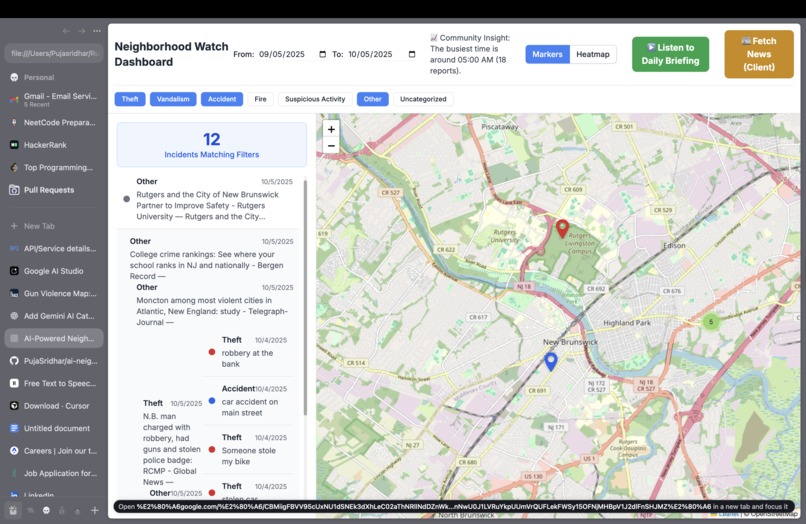
the website

Inspiration
In every neighborhood, important local events from lost pets to safety alerts often get lost in long message threads or social media noise. I wanted to make community awareness effortless, accessible, and AI-driven. Inspired by the idea of a “Neighborhood Watch 2.0,” I built a system that can automatically turn text-based reports into visual maps and audio briefings, ensuring everyone, including busy commuters and visually impaired residents, can stay informed in seconds.
What it does
AI-Neighborhood-Watch collects reports from community members, categorizes them using generative AI, plots them on an interactive map, and produces a daily “Neighborhood Briefing” podcast that summarizes all activity in a conversational, human-like voice.
In short: Visualize community reports on an interactive map. Categorize incidents using Google Gemini for structured insights. Summarize & Speak daily events through a multi-voice AI-generated audio briefing.
But it doesn’t stop there. I used Snowflake to analyze these reports at scale, surfacing patterns and community insights such as trending issue types, hotspot locations, and sentiment over time. In short, AI-Neighborhood-Watch helps neighborhoods move from isolated incidents to shared awareness.
How we built it
Our system combines data, design, and storytelling:
Frontend: A clean, interactive map built with HTML, TailwindCSS, and Leaflet.js for intuitive exploration.
Backend: Flask powers the RESTful API, handling submissions, categorization, and podcast generation.
Database: PostgreSQL stores user reports and geospatial data efficiently.
AI Stack:
Gemini for categorizing and summarizing incident reports.
ElevenLabs for generating natural, multi-voice daily podcasts.
Data Insights: All reports are securely synced to Snowflake, where I analyze trends, frequencies, and geographic clusters, turning raw community data into actionable insights.
Behind the scenes, it’s an end-to-end pipeline: User Report → Gemini Categorization → Database + Snowflake Analysis → Podcast Summary
Challenges we ran into
Integrating multiple APIs (Gemini + ElevenLabs) while handling rate limits and audio fallback gracefully. Efficient data management syncing real-time report submissions with the live map without race conditions. Making real-time map updates synchronize smoothly with backend analytics in Snowflake.
Accomplishments that we're proud of
I turned raw neighborhood reports into audio stories people actually want to listen to. I combined AI, mapping, and cloud data to build something practical yet inspiring. I implemented Snowflake analytics to reveal real community patterns and make the data meaningful. And I built the entire system from scratch in just day.
What we learned
This project taught me that AI isn’t just about automation, it’s about amplifying human connection. I learned how to: Orchestrate multimodal AI pipelines that turn text into speech, and data into stories. Design data-driven insights pipelines using Snowflake for real-time community analytics. Handle edge cases, API failures, and privacy considerations gracefully. Communicate ideas not just through dashboards but through human-centered narratives.
What's next for AI-Neighborhood-Watch
Integrate live open data feeds from local authorities. Add pattern recognition to detect emerging issues or anomalies in reports. Use Snowflake dashboards to visualize long-term community trends. Enable push notifications for nearby incidents and daily summaries via SMS or email. Partner with local organizations to deploy AI-Neighborhood-Watch in real neighborhoods.
My vision is to make AI-powered civic awareness accessible to everyone, where data becomes dialogue, and neighborhoods become communities again.
Built With
- api
- css
- elevenlabs
- gemini
- html
- postgresql
- python
- snowflake


Log in or sign up for Devpost to join the conversation.