Inspiration
Design systems are intended to create consistency, but in practice, their rules are often scattered across design files, documentation, component libraries, and team knowledge. Designers repeatedly review the same details, developers interpret specifications differently, and AI coding tools often generate interfaces that look acceptable but do not follow the product’s actual standards.
We created AI-Native Design System to turn static design guidelines into an intelligent, executable system that can understand product requirements, recommend the correct components, generate consistent interfaces, and validate implementation quality.
What it does
AI-Native Design System helps product teams move from an idea to a production-ready interface.
Users can enter product requirements, describe a page, or provide an existing interface. The system then:
Analyzes the product goal and user task Generates an information architecture Recommends suitable components and interaction patterns Applies approved design tokens and layout rules Produces implementation-ready interface specifications Generates frontend code Reviews interfaces for consistency, usability, and accessibility Identifies violations and provides actionable recommendations
The system acts as a shared design intelligence layer for product managers, designers, developers, and AI coding agents.
How we built it
We structured the project around three main layers.
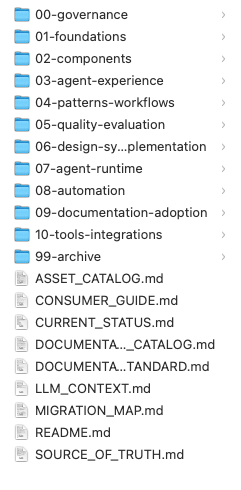
The first layer is a machine-readable design knowledge base containing typography, colors, spacing, layout rules, component anatomy, interaction states, responsive behavior, accessibility requirements, and prohibited patterns.
The second layer uses OpenAI models to interpret product requirements, understand business context, select relevant design rules, and produce structured UI decisions.
The third layer converts these decisions into interface specifications, component structures, validation results, and production-ready frontend code.
We also designed the workflow so that generation and review happen together. The system does not only create an interface; it also checks whether the result follows the approved design system.
Challenges we ran into
The main challenge was converting subjective design language into explicit rules. Terms such as “clean,” “premium,” or “consistent” are difficult for an AI system to apply reliably, so we translated them into measurable decisions involving spacing, hierarchy, contrast, density, component states, and interaction behavior.
Another challenge was preventing generic output. The generated interface needed to reflect the actual business scenario and user task rather than simply assembling visually attractive components.
We also had to balance creativity with strict design-system compliance. The system needed enough flexibility to solve different product problems while still maintaining consistency.
Accomplishments that we're proud of
We created a working foundation that can:
Convert unstructured requirements into structured UI specifications Generate information architecture and component recommendations Apply design tokens automatically Produce implementation-ready frontend structures Review interfaces against design and accessibility rules Generate clear correction recommendations Support collaboration between human teams and AI coding agents
What we learned
We learned that an AI design system cannot be built as a simple prompt library. It requires structured knowledge, explicit constraints, reusable validation rules, and consistent output formats.
We also learned that interface generation is only half of the problem. Evaluation, correction, and traceability are equally important.
Most importantly, we discovered that a design system can become active product infrastructure rather than static documentation.
What's next for AI-Native Design System
Next, we plan to add:
Screenshot-based interface analysis Automatic design-token extraction Figma integration GitHub and pull-request review Multi-brand design-system support Visual regression testing Team-specific design knowledge Version control and approval workflows Direct synchronization between design specifications and production components
Our long-term goal is to make design systems executable, adaptive, and available throughout the entire product-development lifecycle.
Built With
- api
- codex
- gpt-5.6
- openai
- responses
- structured

Log in or sign up for Devpost to join the conversation.