-
-
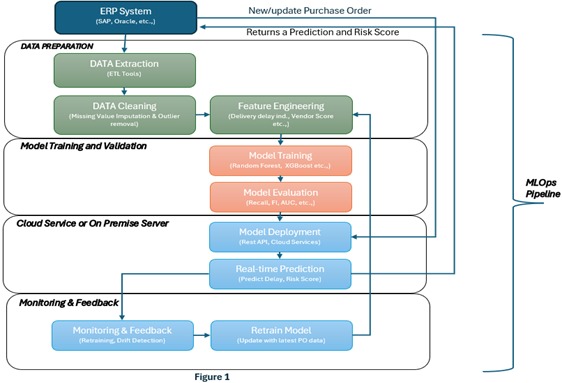
The System Architecture
-
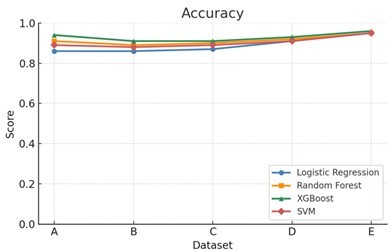
Accuracy Comparison Chart_Fig2
Inspiration
ERP platforms are excellent at recording history, but they often struggle to predict the future. With nearly 90% of organizations facing supply chain delays that directly impact their bottom line, I felt it was time to move past "reactive firefighting." I was inspired to build a solution that turns passive historical data into an active early-warning system, allowing supply chain leaders to see disruptions before they actually hit the warehouse dock.
What it does
This project is an AI-driven intelligence layer designed to integrate with standard ERP sourcing and procurement modules. It analyzes historical purchase order (PO) patterns and vendor lead times to assign a risk score to every open order. By identifying anomalies and high-risk shipments early, the system provides procurement teams with the foresight needed to find alternative suppliers or adjust production schedules, effectively protecting the company's revenue and service levels.
How I built it
The architecture was designed in four distinct stages to ensure it could scale within a corporate environment:
Data Engineering: I extracted and cleaned historical data, focusing on features like vendor reliability, seasonal trends, and material categories.
Model Development: I experimented with ensemble methods, specifically XGBoost and Random Forest, which are robust enough to handle the complexities of supply chain data.
The MLOps Pipeline: I designed a pipeline using REST APIs to ensure that the AI engine could communicate seamlessly with the ERP framework.
Challenges I ran into
The biggest hurdle was the inherent data imbalance. In any functional supply chain, most orders arrive on time, meaning "delays" are relatively rare. This makes it difficult to train a model that doesn't just guess "on time" every time. I had to focus heavily on feature engineering and fine-tuning the model’s recall to ensure we were catching the actual disruptions without creating a flood of false alarms.
Accomplishments that I'm proud of
I am incredibly proud that this research and the predictive architecture were accepted for presentation at the 2025 IEEE International Conference on Computation, Big-Data and Engineering (IEEE ICCBE 2025).
From a technical standpoint, achieving a 96% accuracy rate and a 94% recall rate using ensemble methods like XGBoost was a major milestone. These results prove that machine learning can navigate the high-imbalance nature of enterprise supply chain data far more effectively than traditional rule-based ERP systems.
Beyond the metrics, I am proud of designing a modular MLOps pipeline that bridges the gap between complex data science and established ERP frameworks. Seeing this transition from a theoretical concept into a working model that can reduce "reactive firefighting" in global logistics is highly rewarding. The recognition from the IEEE ICCBE committee validates the importance of proactive AI in building the next generation of resilient business processes.
What I learned
This project reinforced that successful AI in the enterprise isn't just about the best algorithm; it’s about the "last mile" of integration and user trust. I learned that procurement teams are far more likely to intervene when the system can explain the logic behind a risk score. It's about bridging the gap between data science and daily business operations.
What's next for AI/ML-Driven Predictive Model for ERP Supply Chain Resilience
The initial success of this model in predicting disruptions has laid the groundwork for several critical next steps. I am currently focused on evolving this system from a simple forecasting tool into a transparent, high-integrity decision platform.
1. Moving from "Black Box" to Transparent Predictions One of the most important lessons from this research was that accuracy alone isn't enough to drive business adoption. If a procurement manager doesn't understand why the model is flagging an order as high-risk, they are less likely to act on it. My immediate priority is integrating the Explainable AI (XAI) frameworks I’ve been developing. By adding a layer that explains the logic, citing factors like specific vendor volatility or seasonal lead-time shifts, I want to bridge the trust gap between the algorithm and the end-user.
2. Integrating Real-Time Global Data While the current model is highly effective at finding patterns in historical ERP data, it is still largely "internally focused." The next phase involves pulling in external signals. I am looking into incorporating real-time data such as port congestion indices, geopolitical risk alerts, and major weather disruptions. Combining these external "macro" signals with internal "micro" purchase history will allow the model to offer a much more comprehensive view of the global supply chain.
3. Developing Prescriptive Actions Eventually, I want this system to do more than just predict a problem; I want it to suggest a solution. I am exploring "Prescriptive Analytics," where the AI can automatically identify the best alternative supplier or a more efficient shipping route directly within the ERP interface. This would transform the system from an early warning tool into a proactive, semi-autonomous partner in supply chain management.

Log in or sign up for Devpost to join the conversation.