-
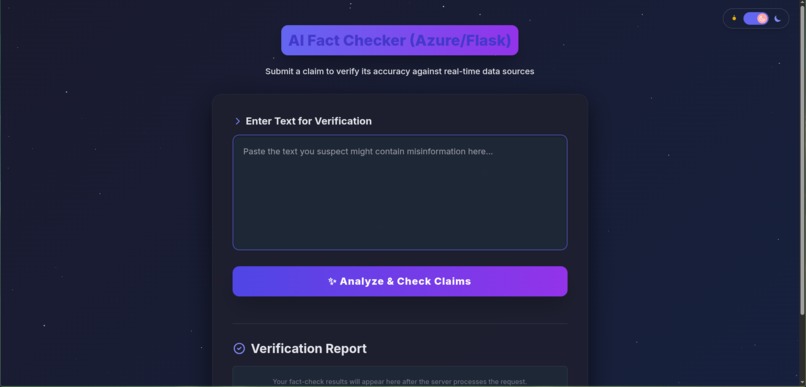
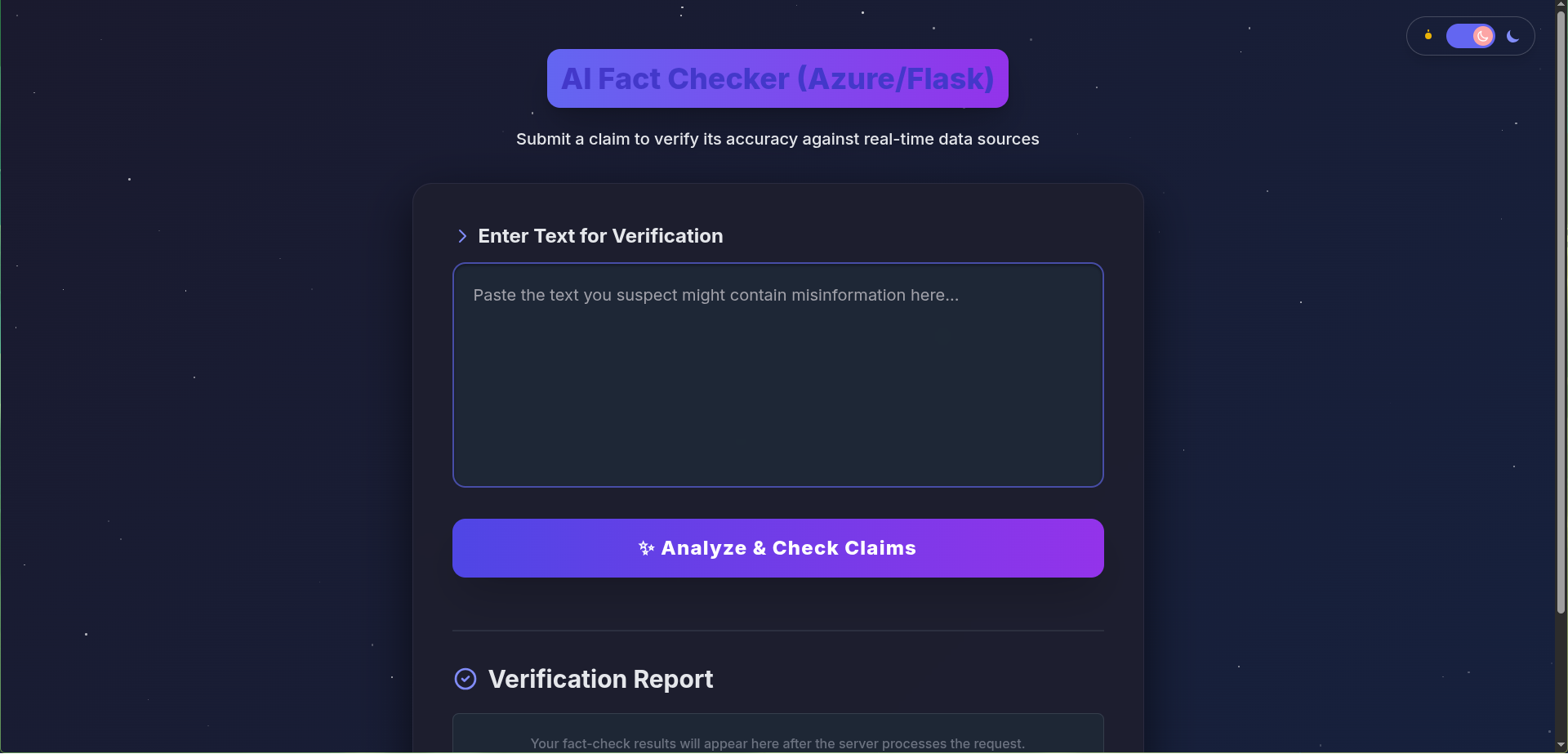
Main Menu
Inspiration
Every day, we’re flooded with online content, including news, social posts, and articles. It’s hard to tell what’s true. I wanted a tool that could instantly fact-check anything I read, without having to open ten tabs or verify sources myself. That frustration inspired DecetAI, an AI-powered misinformation checker that helps people separate fact from fiction in real time.
What it does
DecetAI is a web application, and soon to be Chrome Extension, that allows you to analyze its truthfulness. It...
- Extracts keywords and context from the highlighted text
- Cross-verifies claims using credible sources like Wikipedia, The Guardian, arXiv, and real-time news APIs.
- Uses Azure OpenAI to evaluate the accuracy of the statement based on evidence from these sources.
- Returns a clear, summarized explanation right inside the popup — no need to leave the page.
How we built it
- Frontend: Modern and lightweight UI built with HTML, CSS, Tailwind CSS, and JavaScript
- Backend: Python Flask API running locally, handling text analysis and AI processing.
- AI & NLP: Used KeyBERT for keyword extraction. spaCy for text processing and sentence relevance detection. Azure OpenAI GPT model for misinformation reasoning.
- APIs integrated: Google Custom Search (for credible web sources) NewsAPI (for recent news) The Guardian API, arXiv API and Wikipedia API (for factual context)
Challenges we ran into
- Integration of CORS and browser extension permissions with a local Flask server.
- Some sites either rejected requests or necessitated sophisticated parsing, thus making the extraction of trustworthy data from news and research APIs a tedious process.
- Maintenance of rate limits and latency when joining together different APIs and an LLM.
Accomplishments that we're proud of
- A system that can actually fetch and assess real proof — not only viewpoints — was established.
- Achieved end-to-end integration between Flask, OpenAI, and browser APIs in the little time that was allotted for the hackathon!
What we learned
- An effective way to integrate frontend browser extensions with AI-powered backend systems.
- A better understanding of natural language processing for the purpose of misinformation detection.
- A lot of knowledge in API orchestration and how to make noisy search results structured and analyzable data.
- When combating misinformation, designing for trust and clarity is equally important as designing for accuracy.
What's next for AI-Misinformation-Checker
- Complete and design a modern interface for the Chrome Extension that would allow you get instant feedback on truthiness while reading articles, news, blogs, and more.
Built With
- arxivapi
- azureopenai
- chromeextensions
- css
- flask
- googlecustomsearchapi
- html
- javascript
- keybert
- mediawikiapi
- newsapi
- python
- spacy
- tailwindcss
- theguardianapi


Log in or sign up for Devpost to join the conversation.