-
-
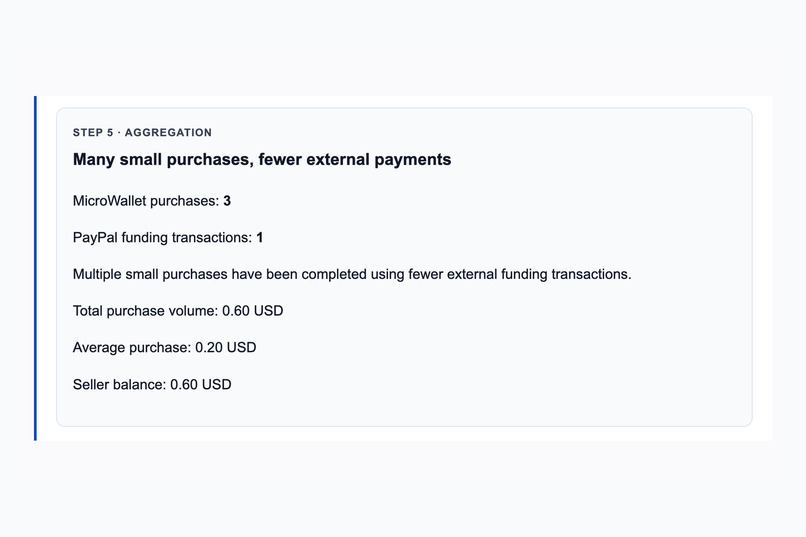
Aggregation view: three MicroWallet purchases supported by one external funding transaction.
-
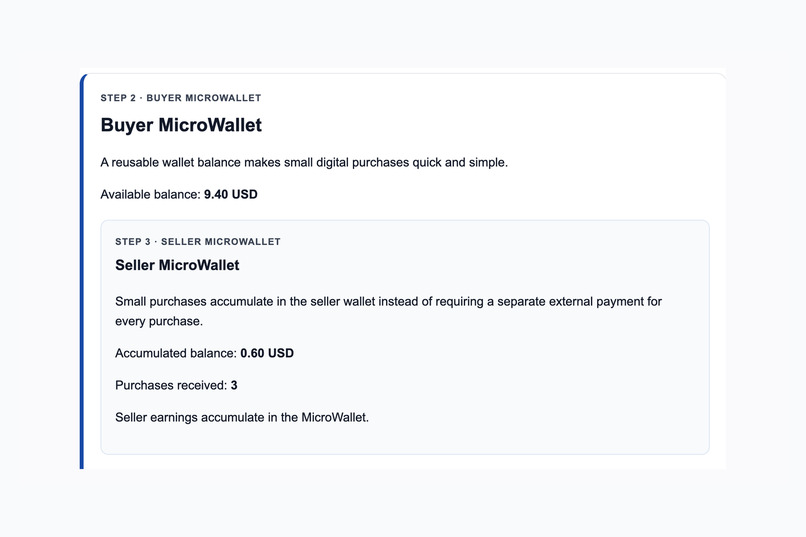
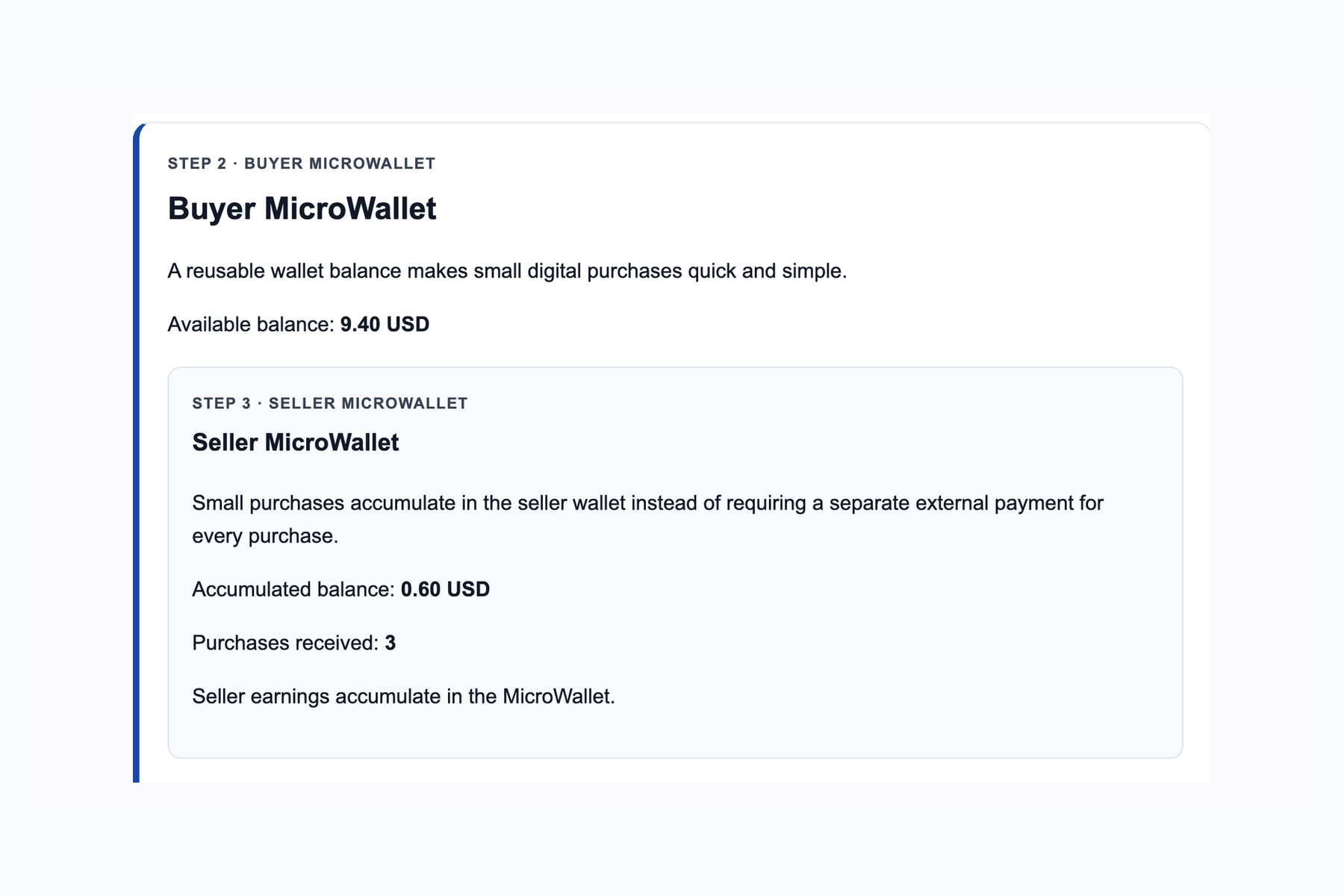
Buyer and seller MicroWallet balances after three small purchases.
-
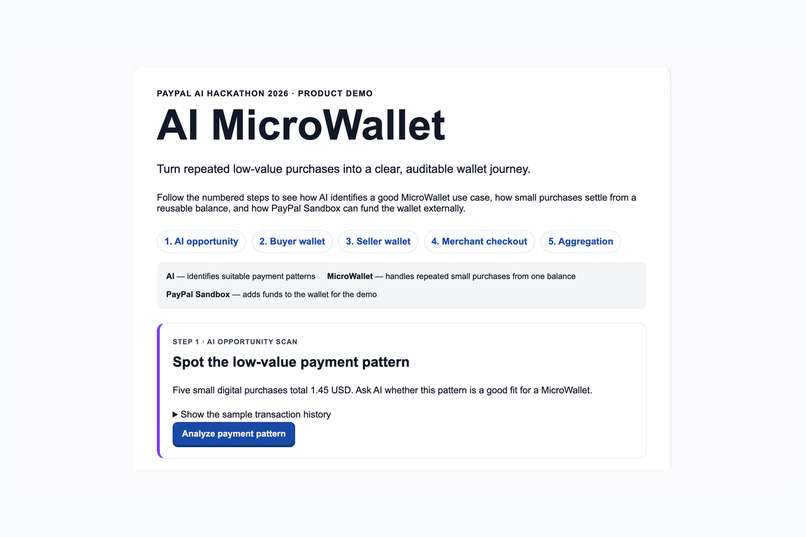
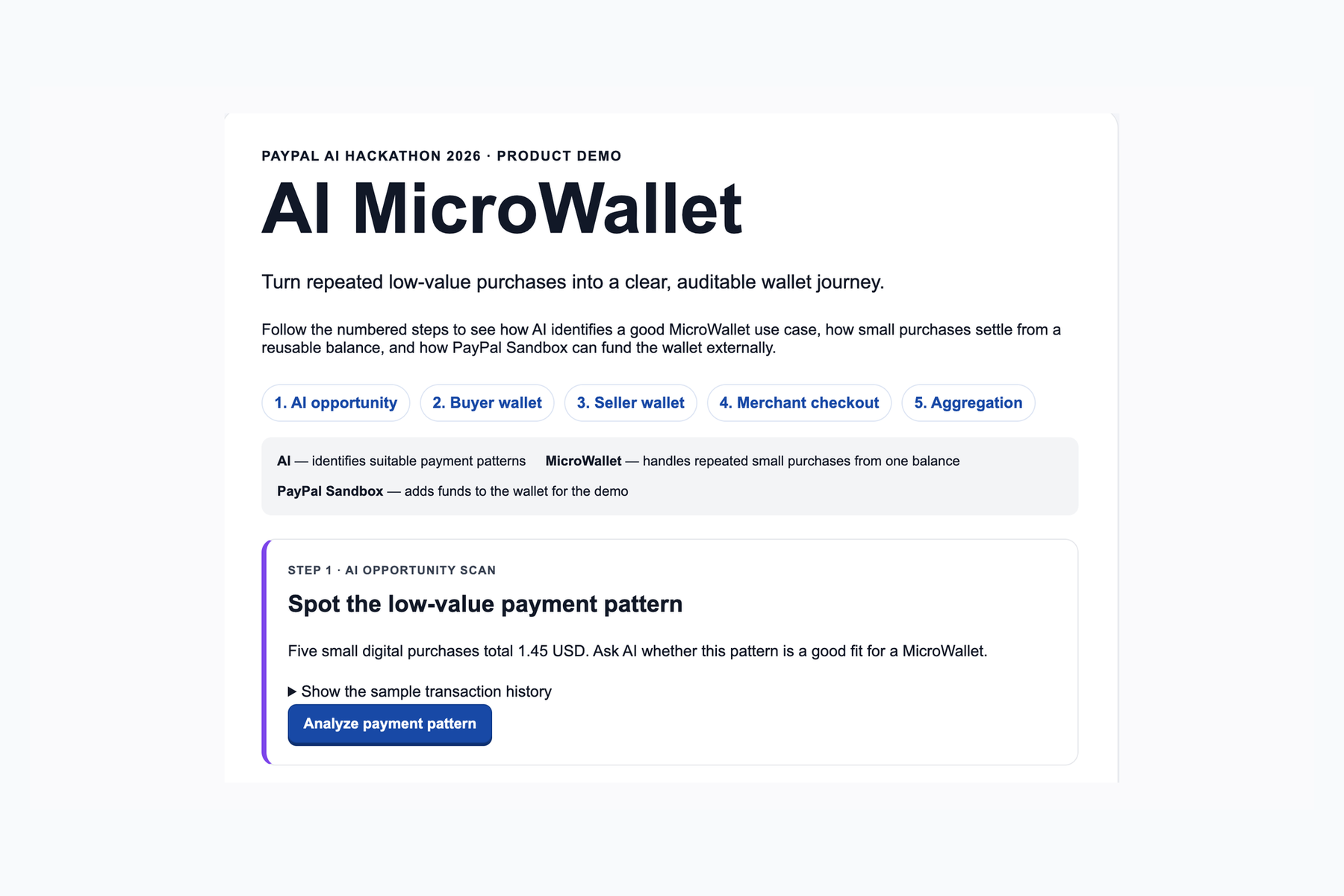
AI MicroWallet overview and AI opportunity scan for repeated low-value digital purchases.
-
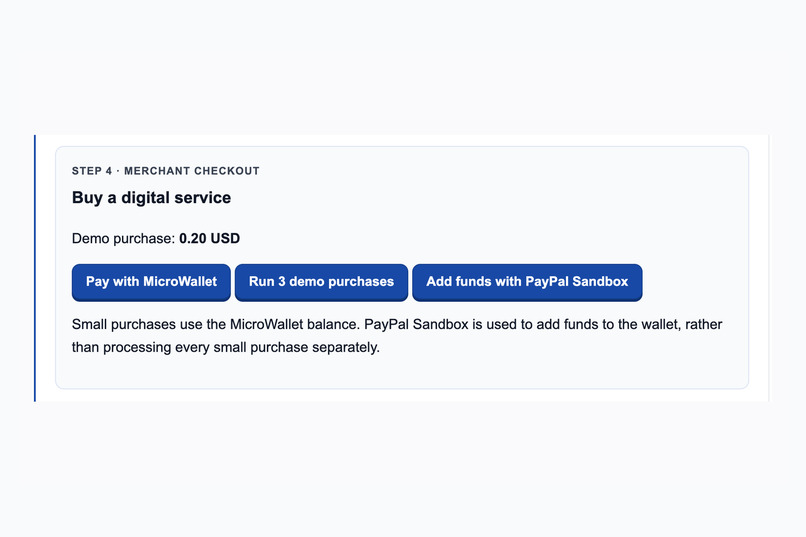
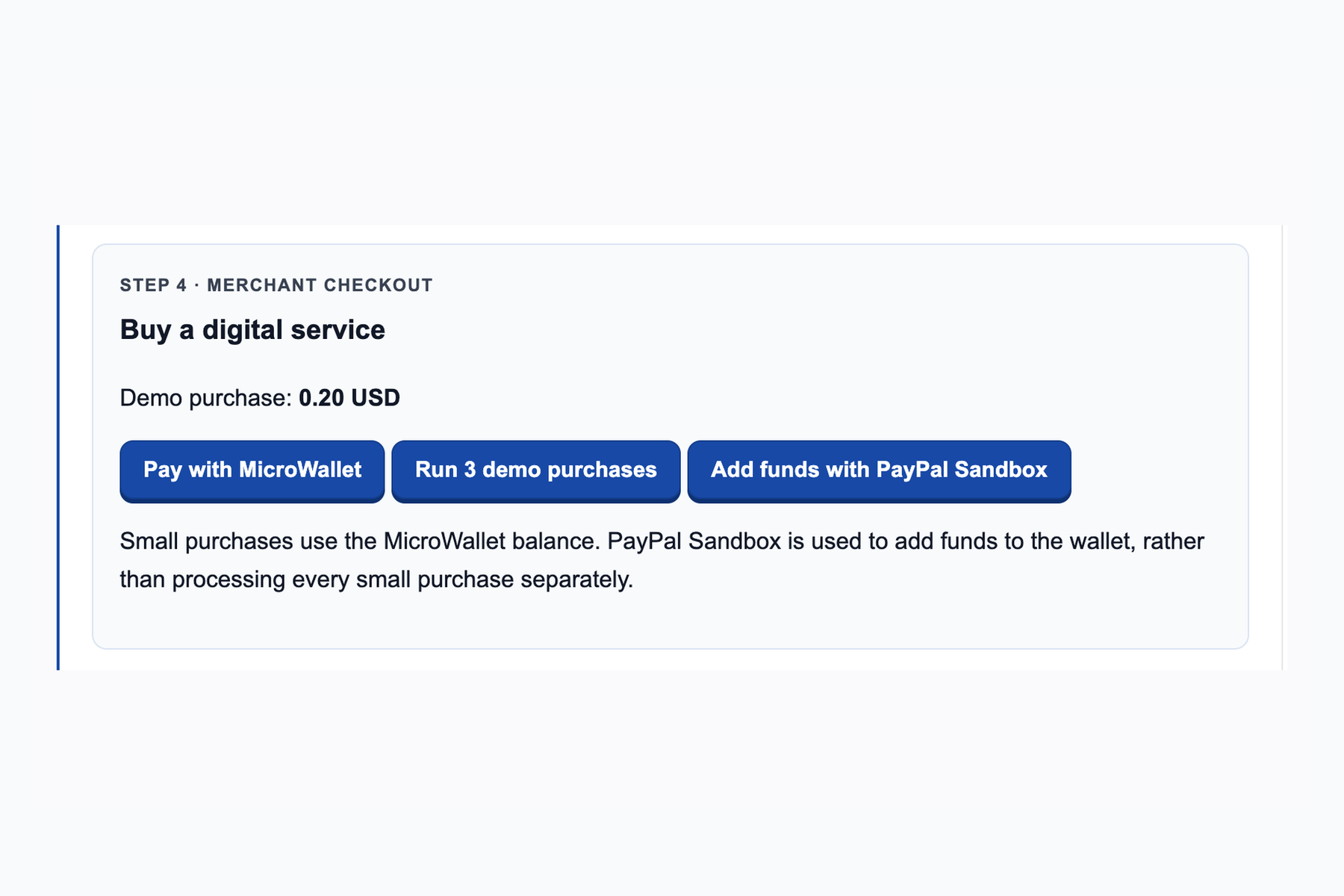
Merchant checkout showing direct MicroWallet payment and PayPal Sandbox funding.
-
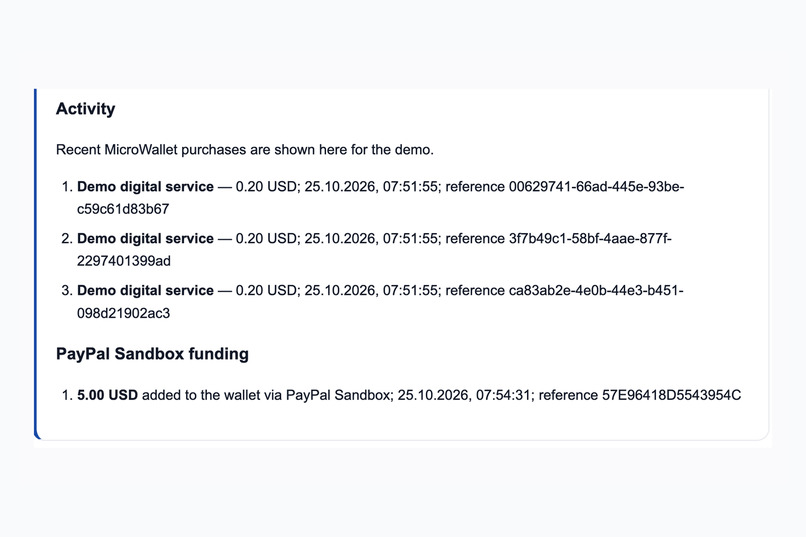
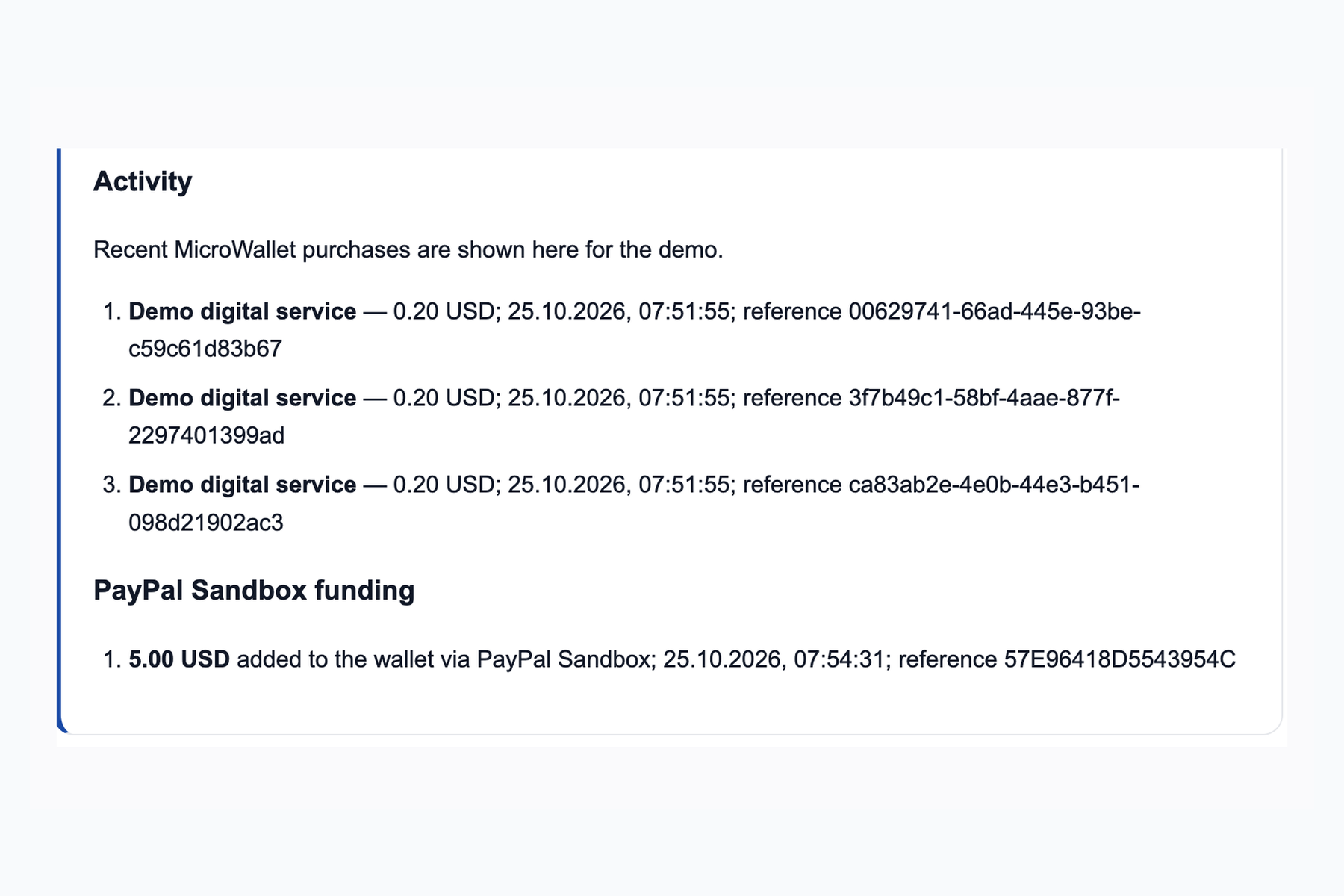
Purchase activity and verified PayPal Sandbox funding reference.

Inspiration
Small digital purchases still have a big problem.
Sometimes a user needs only one AI task, one PDF check, one article, one e-book, one song, or another digital service worth only a few cents or a euro.
But instead of making a tiny purchase, the user often faces disproportionate payment fees, repeated checkout steps, or an unnecessary subscription.
For very small purchases, the payment process can become more complicated than the product itself.
AI MicroWallet starts from a simple idea:
A commercial purchase does not always need to create a separate external payment transaction.
Instead, the buyer can fund a reusable balance once and use that balance for multiple low-value purchases.
The seller receives the value of each purchase inside a separate MicroWallet balance, while external payment infrastructure is used less frequently.
This can make pay-per-use digital products practical where subscriptions or conventional checkout are too expensive or inconvenient.
It can also create a better legal alternative to piracy: if one article, one song, one chapter, or one digital action costs only a few cents and takes almost no effort to purchase, paying may become easier than searching for a workaround or torrent.
What it does
AI MicroWallet demonstrates three separate responsibilities:
AI identifies suitable micropayment patterns. Application code controls wallet balances and purchases. PayPal Sandbox demonstrates external wallet funding.
The public demo follows five steps.
First, an AI opportunity scan analyzes a sample pattern of small digital purchases and determines whether a MicroWallet could be useful.
The AI recommendation is advisory only. AI never moves money and cannot directly change a wallet balance.
The buyer has a reusable MicroWallet balance.
The seller has a separate MicroWallet where proceeds from small purchases accumulate.
A digital service can then be purchased directly from the buyer's existing balance.
For example, if a service costs twenty cents:
- the buyer balance decreases by twenty cents;
- the seller balance increases by twenty cents;
- the purchase is recorded individually;
- no separate PayPal transaction is required for that individual purchase.
In the current demo, three MicroWallet purchases can be completed while only one PayPal Sandbox funding transaction is recorded.
This demonstrates the central idea:
Many small purchases can be supported by fewer external payment events.
The system keeps an activity history and funding references so individual purchases remain visible and auditable.
Production model
The PayPal Sandbox approval step is intentionally visible in the hackathon demo so judges can verify the external funding flow.
A production product should have a much smoother everyday experience.
The intended model is:
- the user authorizes a trusted device once;
- the user chooses configurable spending limits;
- purchases inside those limits can be completed without repeated login or payment approval;
- step-up authentication is required only when limits are exceeded, the device changes, or a risk control is triggered.
For example, a user could allow purchases of up to one dollar each and up to twenty dollars per day.
This preserves user control while removing unnecessary friction from very small purchases.
How we built it
The prototype is a web application built with:
- Next.js and TypeScript for the application;
- OpenAI API for the opportunity analysis and recommendation layer;
- PayPal Developer Sandbox for external wallet funding;
- Vercel for deployment;
- server-side wallet state and ledger logic for the hackathon demo, with Supabase/PostgreSQL support in the project architecture.
The payment logic is intentionally separated from the AI layer.
AI can analyze a purchase pattern and recommend whether MicroWallet aggregation makes sense.
It cannot authorize a purchase or modify a balance.
Wallet debits, seller credits, purchase references, and aggregation statistics are handled by deterministic application logic.
For PayPal funding, the prototype performs the external flow on the server:
- create a Sandbox order;
- allow buyer approval;
- return to AI MicroWallet;
- verify the PayPal capture;
- record the funding reference;
- update the demo buyer balance only after successful verification.
The public demo has been tested end to end with both OpenAI and PayPal Sandbox.
How AI is used
AI is not used as a fictional payment engine.
Its role is to answer a different question:
When is a sequence of small purchases a good candidate for a MicroWallet instead of repeated conventional checkout?
The demo gives the model a sample purchase pattern containing repeated low-value digital transactions.
The AI layer evaluates the pattern and returns a recommendation.
This keeps AI connected directly to the payment architecture without giving the model authority over financial state.
In a future product, the same recommendation layer could help identify customers, merchants, or product categories where pay-per-use micropayments are economically more practical than subscriptions or repeated external checkout.
How PayPal is used
PayPal Sandbox represents the trusted external payment layer.
The prototype does not attempt to replace PayPal.
Instead, PayPal is used when the wallet needs external funding.
Once the reusable balance exists, individual low-value purchases can be handled inside the MicroWallet rather than creating a new external transaction every time.
The hackathon demo intentionally uses PayPal Sandbox only and does not claim production payment processing, banking, EMI status, or an implemented external seller payout service.
Challenges we ran into
The main challenge was defining a clear boundary between three different things:
the commercial purchase, the internal wallet state, and the external movement of money.
Those events are related, but they do not have to happen through the same transaction.
A second challenge was making the concept understandable.
It is easy to describe a MicroWallet in technical terms such as ledgers, aggregation, and settlement.
It is harder to show why a normal user should care.
The practical value is much simpler:
Fund once, then buy tiny things without repeating a full payment flow every time.
Another challenge was finding an honest role for AI.
AI should not be presented as controlling money simply because this is an AI hackathon.
We therefore kept the model advisory and gave deterministic application logic full control over balances and purchases.
Accomplishments that we're proud of
We built and publicly deployed a working end-to-end prototype.
The demo includes:
- a real OpenAI-powered opportunity analysis;
- separate buyer and seller MicroWallet balances;
- single and repeated low-value purchases;
- individual purchase activity records;
- PayPal Sandbox funding;
- server-side capture verification;
- recorded funding references;
- an aggregation view comparing MicroWallet purchases with external funding transactions;
- public Privacy Policy and Terms & Demo Disclaimer pages.
We also verified a complete scenario in production:
Three MicroWallet purchases and one PayPal Sandbox funding transaction.
The result clearly demonstrates the product idea without pretending that every part of a future regulated financial product has already been implemented.
What we learned
The economics of buying something and the economics of moving money are not the same.
A digital service can genuinely be worth twenty cents even when running a complete external payment flow for twenty cents is inefficient.
Separating these events creates new possibilities for pay-per-use digital services.
We also learned that many users may not need another subscription.
They may simply want:
- one AI action;
- one document check;
- one article;
- one chapter;
- one song;
- one small professional service.
A practical micropayment layer can make those business models easier to offer.
Finally, AI is most useful here when it helps decide where this architecture makes sense, rather than pretending to be the payment system itself.
What's next for AI MicroWallet
The next stage is to evolve the hackathon prototype into a production-oriented architecture.
That includes:
- secure one-time device authorization;
- device-bound credentials;
- configurable per-purchase and daily spending limits;
- step-up authentication for exceptions;
- merchant APIs and SDKs;
- richer buyer and seller reporting;
- configurable funding policies;
- merchant settlement design;
- anomaly and fraud detection;
- multi-currency support;
- production-grade persistence and reconciliation.
We also want to test the concept with real digital use cases where conventional pricing is often too coarse:
- AI tools;
- document processing;
- digital publishing;
- research databases;
- music and media;
- education;
- professional micro-services.
The long-term hypothesis is simple:
Small digital purchases become more practical when we stop treating every purchase as a separate external payment transaction.
AI identifies where the model makes sense.
Code controls balances and purchases.
PayPal provides the trusted external funding layer.
Built With
- github
- gpt
- next.js
- node.js
- paypal
- postgresql
- supabase
- typescript
- vercel

Log in or sign up for Devpost to join the conversation.