-
-
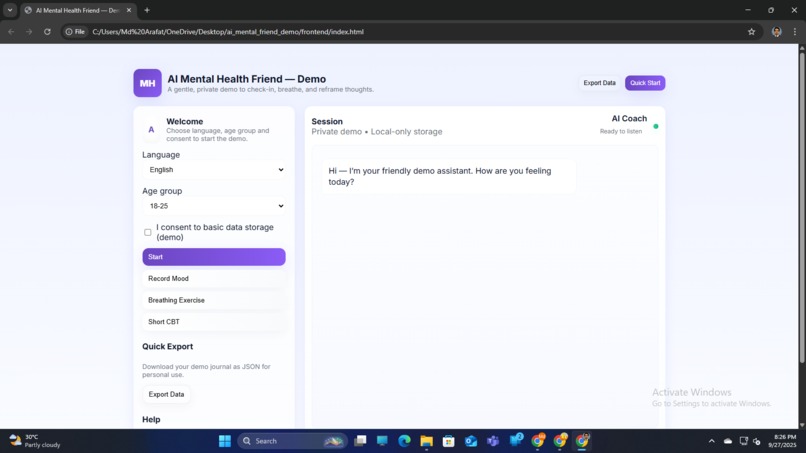
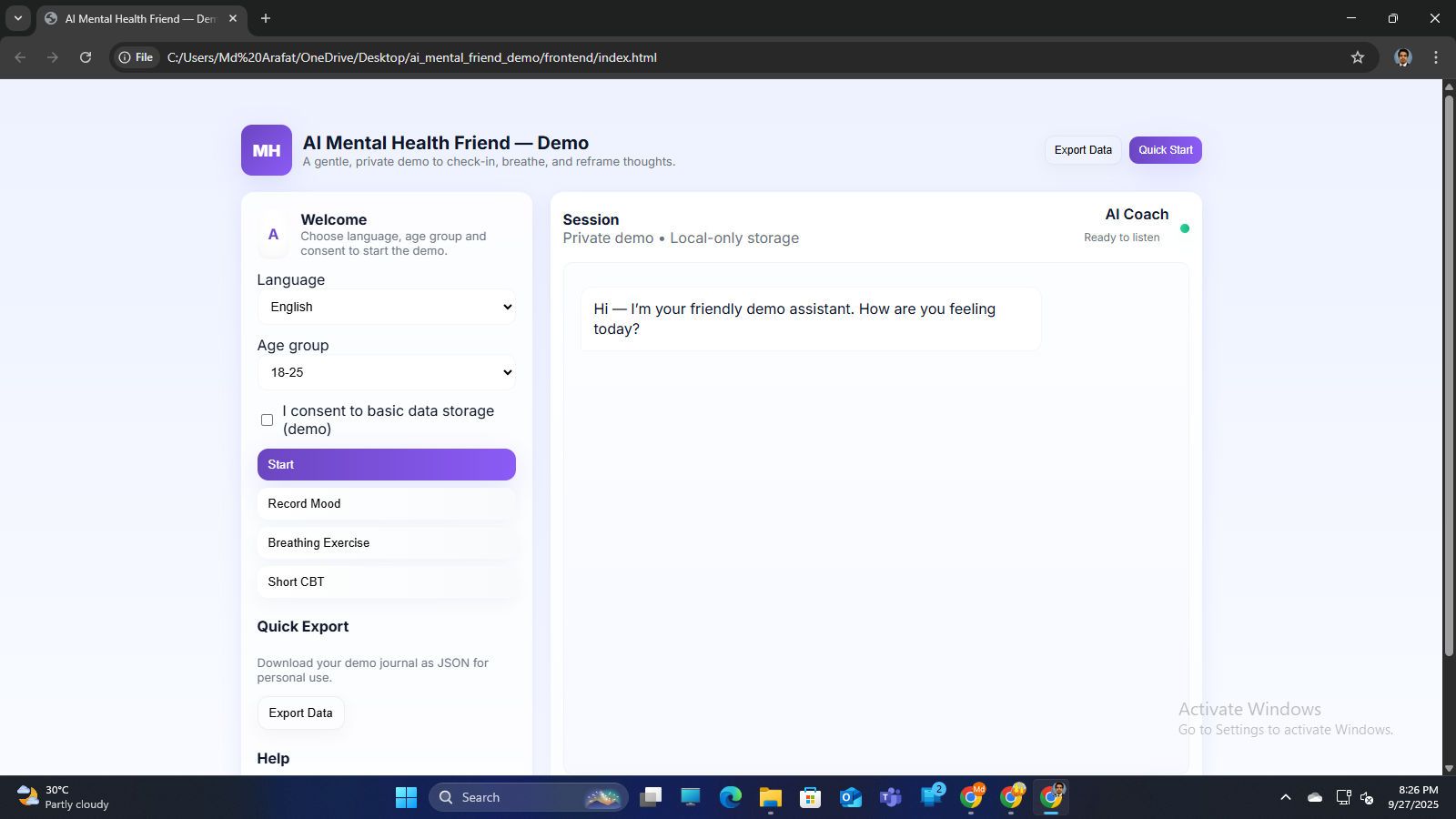
Screenshot
Inspiration
Mental health is a silent struggle for millions of people around the world. Yet, access to professional help is often limited due to stigma, cost, or language barriers.
What it does
AI Mental Health Friend Demo is a web-based journaling and support tool that helps users think about their mental health.
- It provides a simple chat-like journaling interface where users can write about their day.
- The app stores journal entries locally in a database. 3.It conducts crisis detection using journal input to identify potentially harmful or urgent mental health concerns.
- If a crisis is detected, it provides helpful, clinician-informed responses and directs the user to appropriate resources.
- The project is designed as a safe, ethical demo of how AI can act as a supportive companion – not a substitute for professional help.
How we built it
Backend: Built with Flask (Python) to handle API requests, store journals in SQLite database, and run crisis detection. Frontend: A lightweight HTML, CSS, and JavaScript interface that simulates a chat/journaling experience Content: Helpful feedback and guidance are stored in JSON (clinician_content.json) to make the app customizable. Safety Level: A safety_policy.md document and built-in filters enforce ethical boundaries and prevent unsafe AI behavior.
Challenges we ran into
- Crisis detection: balancing between false positives (identifying safe content as harmful) and false negatives (missing real crisis signs).
- Ethical design: ensuring that the system supports but does not mislead users that it is a substitute for therapy.
- Frontend-backend communication: Managing API routes and avoiding "method not allowed/not found" errors during testing.
- Data Management: Figuring out how to securely store journals while keeping the demo light and easy to run.
Accomplishments that we're proud of
- A functional AI friend prototype has been created that is helpful and empathetic.
- Integrated real-time crisis detection instead of just simple journaling.
- The project is designed to be transparent and principled, with clear security guidelines.
- A clean and simple UI has been created that anyone can use without technical knowledge.
What we learned
- How to integrate AI-style assistive dialogue into a minimal web app.
- The importance of safety-first design when dealing with mental health.
- How to set up Flask APIs and seamlessly connect them to a frontend.
- Practical lessons on balancing user experience vs. responsible constraints.
What's next for AI Mental Health Friend Demo
1.Adding a real AI model (LLM integration) for more natural, context-aware responses. 2.Expanding multilingual support using existing translations.json. 3.Improving crisis detection with more advanced NLP models. 4.Creating a mobile-friendly version for easy daily journaling. 5.Exploring integration with telehealth services (e.g., connecting users to hotlines or physicians if needed).

Log in or sign up for Devpost to join the conversation.