-
-
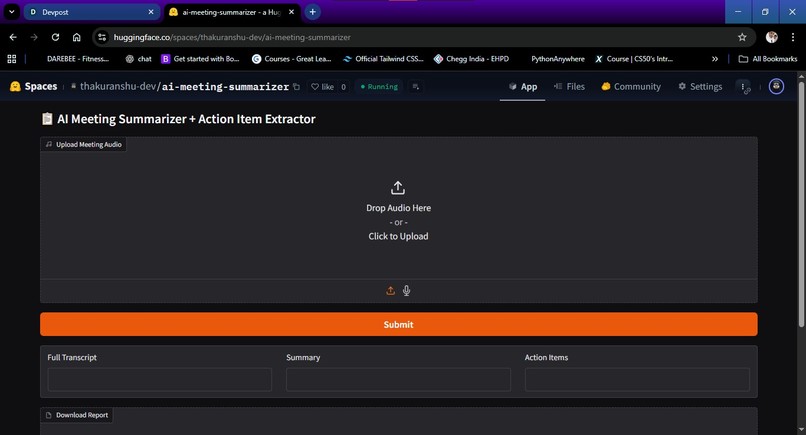
Ai meeting Summarizer | Action Item Extractor

Inspiration
In today’s world of remote work and endless meetings, it’s easy to lose track of key points, decisions, and follow-ups. Teams spend hours re-watching recordings or manually writing notes. We wanted to create a tool that eliminates this friction by automating transcription, summarization, and action item extraction — so teams can stay productive and focused.
What it does
AI Meeting Summarizer takes a meeting recording and:
- Transcribes the audio into text using speech-to-text models.
- Summarizes the discussion into clear, concise notes.
- Extracts action items so teams know exactly what needs to be done.
The output is structured into three sections:
- Transcript – full conversation record.
- Summary – concise highlights of the discussion.
- Action Items – key tasks and decisions.
How we built it
- Frontend: Built with Gradio for a simple and interactive interface.
- Backend: Python-based pipeline integrating OpenAI Whisper for transcription.
- Summarization & Action Item Extraction: Transformer-based NLP models fine-tuned for text summarization and key-point detection.
- Lightweight Deployment: Focused on smaller model variants to ensure performance on local machines without heavy GPU requirements.
Challenges we ran into
- Handling large audio files efficiently without crashing.
- Optimizing inference speed for transcription and summarization.
- Installing and configuring dependencies like
ffmpegandsentencepiece. - Balancing accuracy vs. performance — larger models are more accurate but slower.
- Optimizing inference speed for transcription and summarization.
Accomplishments that we're proud of
- Successfully built an end-to-end pipeline from audio input → transcript → summary → action items.
- Made the solution lightweight enough to run locally on CPU.
- Designed a clean, user-friendly interface for non-technical users.
- Delivered a working prototype within the hackathon timeframe.
What we learned
- How to integrate speech-to-text models with NLP pipelines.
- Trade-offs between different model sizes and performance.
- The importance of chunking audio and text for scalability.
- Streamlining Python environments and dependency management.
What's next for AI Meeting Summarizer
- Real-time live summarization while the meeting is happening.
- Support for multi-speaker diarization (who said what).
- Integration with platforms like Zoom, Google Meet, or MS Teams.
- Adding support for multi-language transcription and translation.
- Export options to tools like Slack, Notion, or Trello for seamless workflows.
Built With
- gradio
- python
- whisper
