-
-
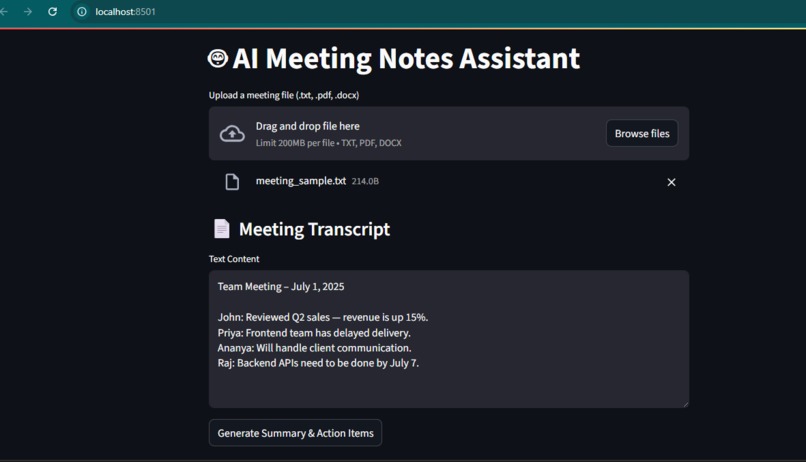
ui
-
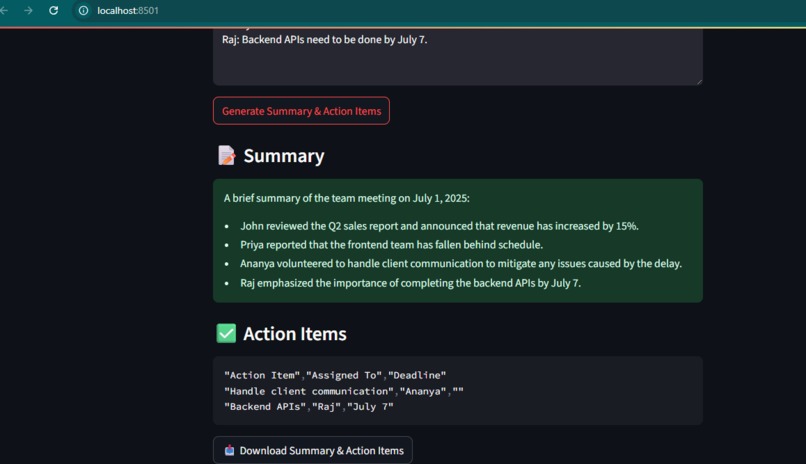
summary output
-
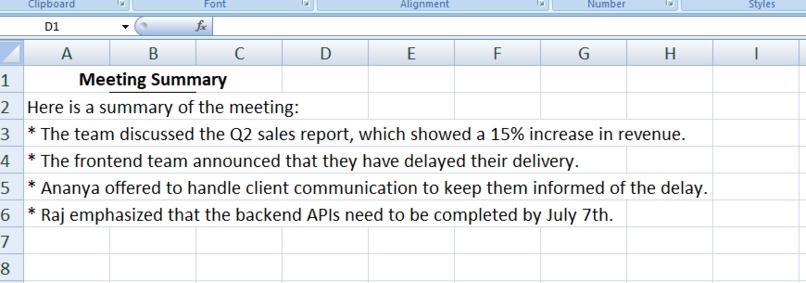
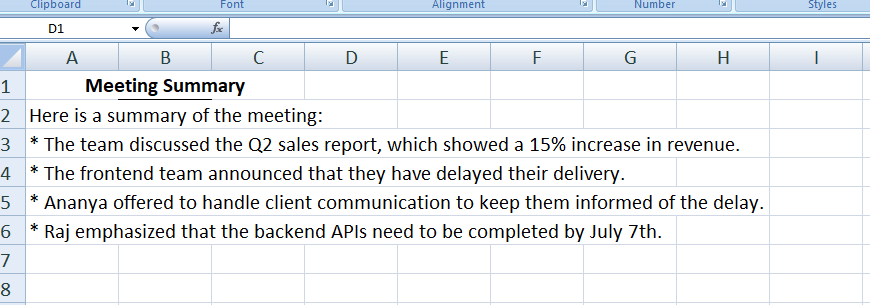
excel downloads
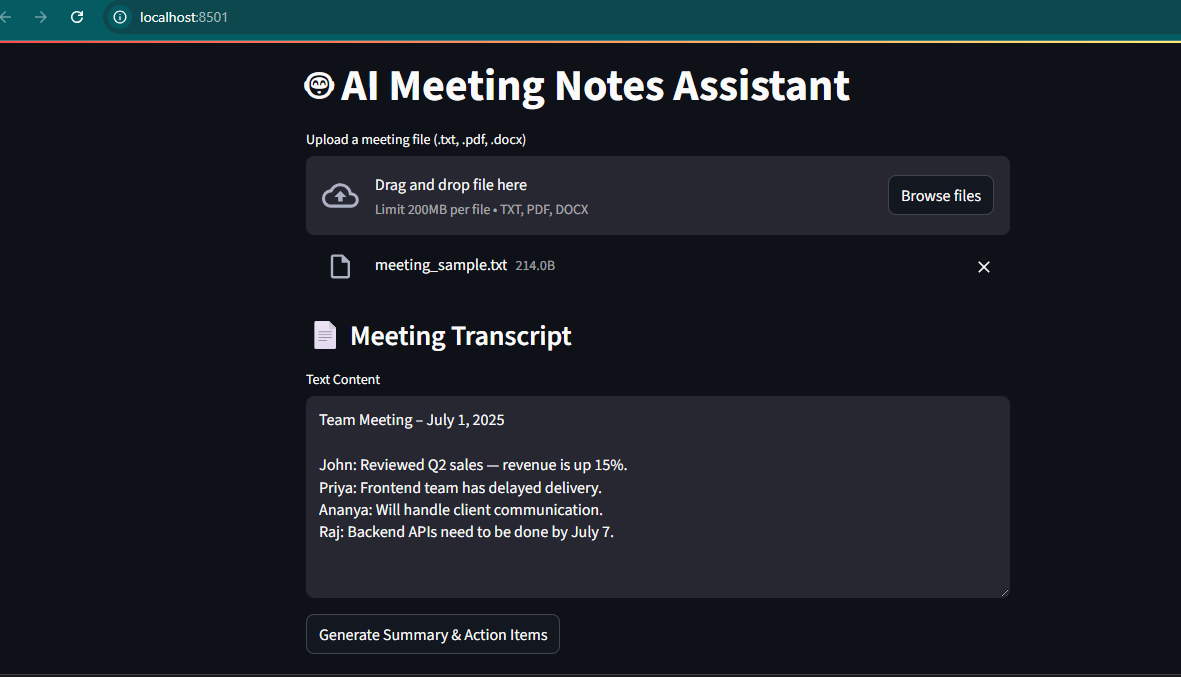
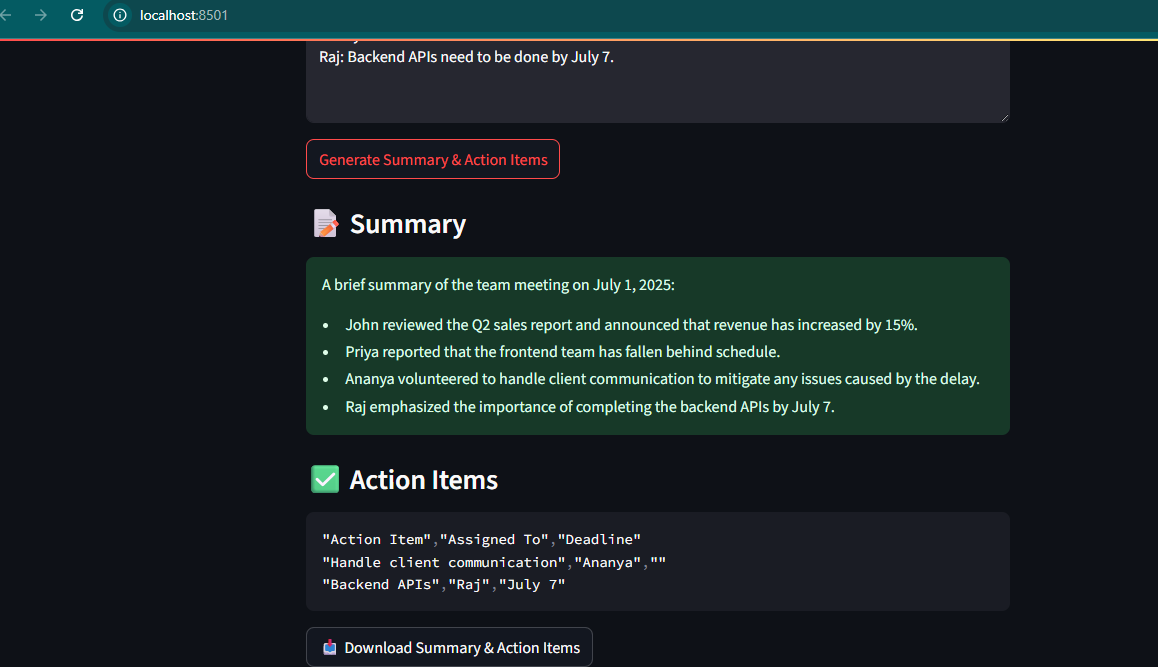
In today's fast-paced remote and hybrid work environments, meeting overload has become a real challenge. I often found myself struggling to recall key discussion points, assign tasks, or follow up effectively after meetings. This inspired me to build an AI Meeting Assistant that could automate note-taking, summarize conversations, and highlight action items — all without disrupting the natural flow of discussion.
🛠️ How I Built It I used a layered architecture consisting of the following components:
Speech-to-Text Layer Leveraged Whisper API to convert real-time audio into accurate text transcripts.
NLP & Summarization Layer Applied large language models (LLMs) via OpenAI’s GPT-4 API to generate concise summaries and extract:
Key points
Action items
Decisions made
Front-End Interface Developed using React.js and Tailwind CSS to ensure a clean, responsive UI for users to view, export, and interact with notes.
Export & Sharing Enabled CSV/XLSX export of meeting summaries for integration with task managers or documentation workflows.
I also considered token limitations and prompt design techniques to optimize LLM responses and keep outputs structured.
💡 What I Learned How to fine-tune LLM prompts to improve output consistency
Techniques for efficient real-time transcription using Whisper
Importance of user-friendly UI in adoption of productivity tools
Trade-offs between latency, accuracy, and summarization granularity
I also explored how memory and context length affect multi-speaker summarization.
⚙️ Challenges I Faced Real-time Processing: Ensuring Whisper and LLM responses could keep up with live conversations without lag
Speaker Attribution: Differentiating between multiple speakers in transcripts
Token Management: Managing context size and input length for long meetings while retaining coherence
Data Privacy: Handling sensitive meeting data responsibly and securely
🧠 Bonus — A Peek into My Thought Process I aimed to minimize information loss by using summarization functions that approximate:
Summary
argmax = [Relevance(S,T)−λ⋅Length(S)] where 𝑇 T is the transcript, and 𝜆 λ is the trade-off parameter for verbosity.
Built With
- github
- groq
- javascript
- openai
- promptengineering
- react
- tailwind


Log in or sign up for Devpost to join the conversation.