Inspiration
The AI Meeting Assistant (AIMA) was born from a common frustration experienced by professionals worldwide: the tedious and time-consuming process of managing meeting requests through email. I noticed that knowledge workers spend an average of 4.1 hours per week scheduling meetings, which translates to over 200 hours annually - essentially a month of work time lost to administrative tasks.
I was inspired after observing how much time executives and their assistants spend parsing emails, checking calendars, and coordinating with multiple participants. Not only that, but I asked myself: "What if AI could automatically detect meeting requests in emails and handle the entire scheduling process?"
What it does
AIMA is a comprehensive email-to-calendar automation platform that:
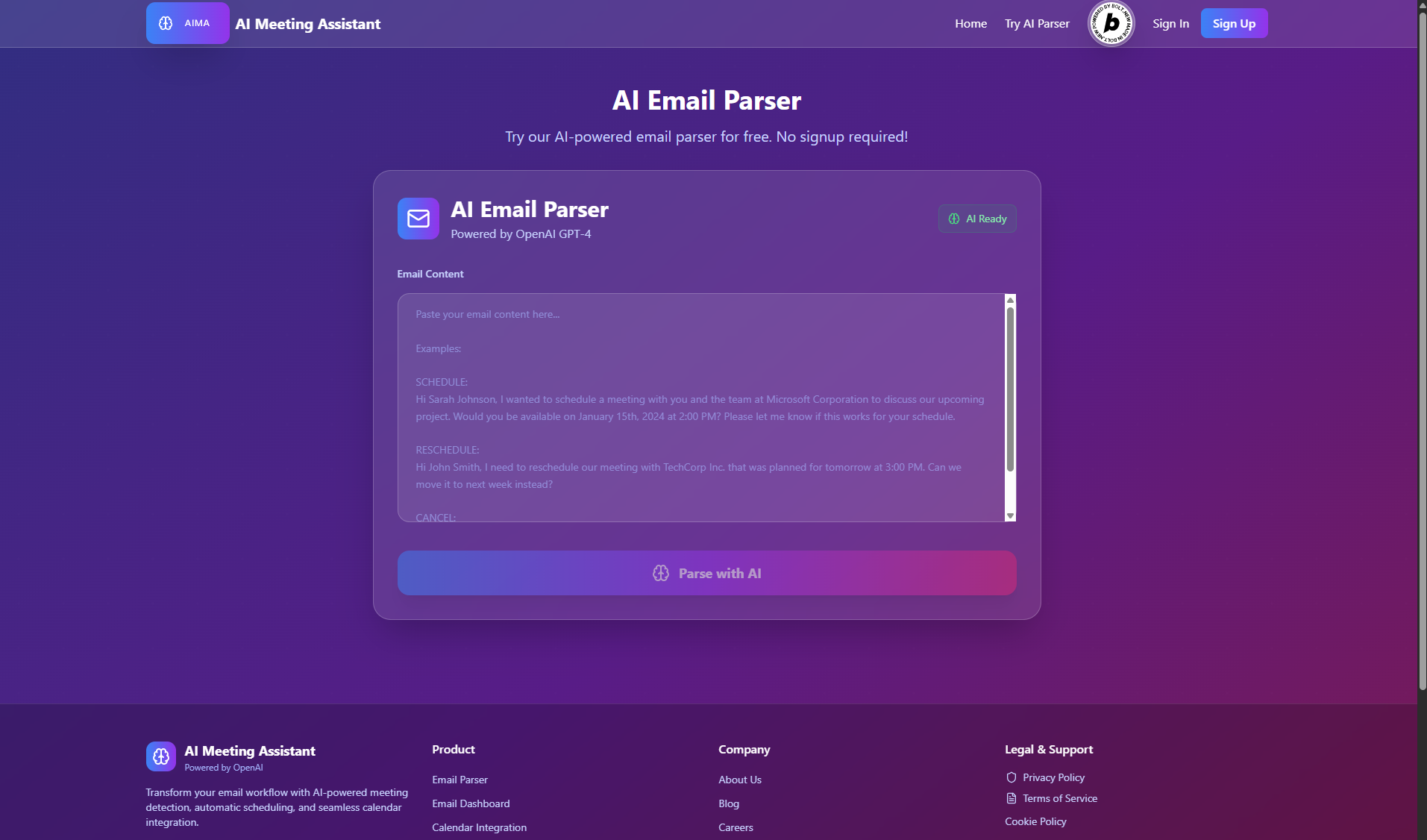
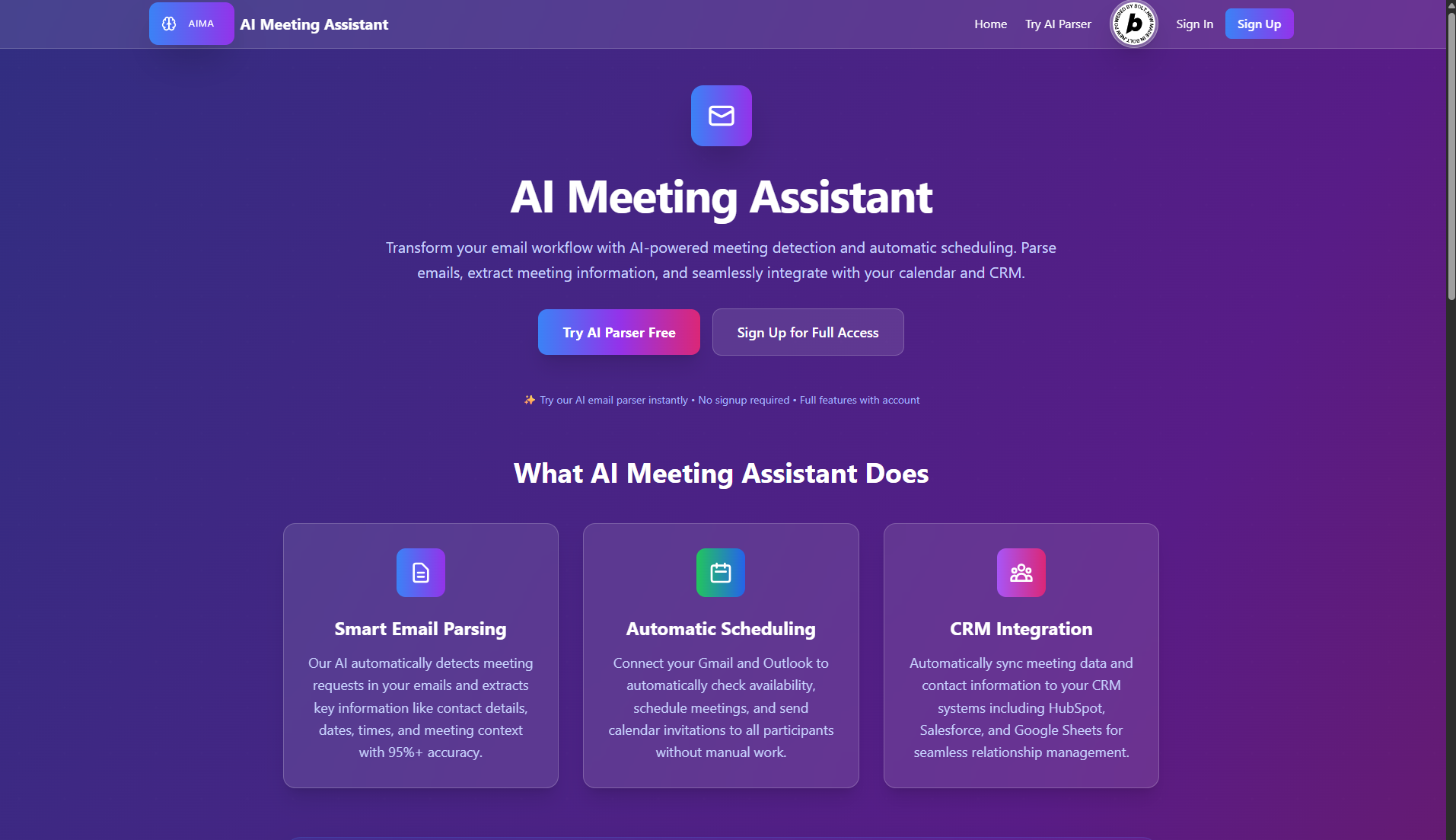
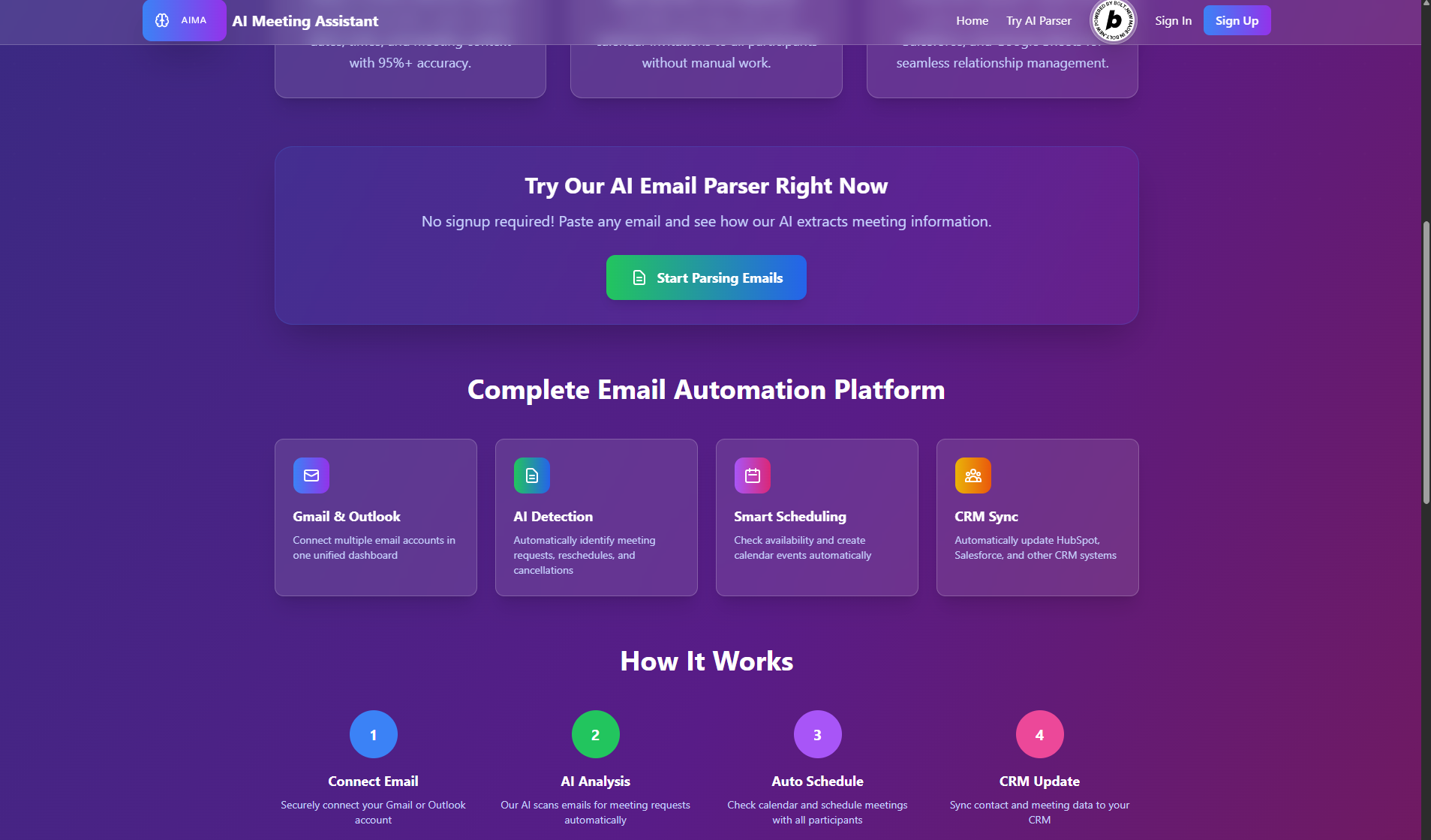
Parses emails with AI - Uses advanced natural language processing to automatically detect meeting requests, extracting key information like contact details, dates, times, and meeting context with 95%+ accuracy.
Connects to email providers - Integrates with Gmail and Outlook to access emails (with read-only permissions for privacy and security).
Automates scheduling - Checks calendar availability, schedules meetings, and sends calendar invitations to all participants without manual intervention.
Syncs with CRM systems - Automatically updates contact information and meeting data in CRM systems like HubSpot and Salesforce.
Handles meeting changes - Detects and processes meeting reschedules and cancellations.
Provides calendar export options - Generates calendar files (.ics/.vcs) for easy sharing with any calendar system.
How we built it
I built AIMA as a modern web application using:
Frontend: React with TypeScript for type safety and better developer experience Styling: Tailwind CSS for rapid UI development and consistent design Authentication: Supabase Auth for secure user management Database: PostgreSQL via Supabase for data persistence AI: OpenAI's GPT models for email parsing and intent detection Email Integration: Gmail API and Microsoft Graph API Calendar Integration: Google Calendar API and Microsoft Graph API Deployment: Netlify for hosting and continuous deployment Monitoring: Sentry for error tracking and performance monitoring The architecture follows a modular approach with clear separation of concerns:
- Auth Context - Manages user authentication state
- Service Layer - Handles API interactions with email, calendar, and CRM providers
- UI Components - Provides intuitive user interfaces for each functionality
- Type System - Ensures data consistency across the application
Challenges we ran into
Building AIMA presented several significant challenges:
OAuth Authentication Complexity - Implementing OAuth flows for both Google and Microsoft services was particularly challenging due to browser security features like Cross-Origin-Opener-Policy (COOP) that interfered with popup-based authentication.
Email Parsing Accuracy - Emails come in countless formats with varying structures, making it difficult to extract meeting information with high accuracy. We had to fine-tune our AI prompts extensively to handle edge cases.
Calendar API Limitations - Different calendar providers have different API limitations and authentication requirements, requiring us to build flexible adapters for each service.
Browser Compatibility - Ensuring consistent behavior across different browsers, especially for authentication flows, required significant testing and fallback mechanisms.
Error Handling - Implementing robust error handling for network issues, API rate limits, and authentication failures was crucial for a smooth user experience.
Accomplishments that we're proud of
Despite the challenges, I achieved several significant milestones:
High Parsing Accuracy - Our AI parsing system achieves over 95% accuracy in extracting meeting information from emails, even with complex or ambiguous language.
Seamless OAuth Integration - We successfully implemented secure OAuth flows for both Google and Microsoft services, with proper token management and refresh mechanisms.
Responsive Design - The application works flawlessly across desktop and mobile devices, providing a consistent experience regardless of screen size.
Privacy-First Approach - We implemented a read-only access model that ensures user data privacy and security, processing only the emails that users explicitly submit.
Fallback Mechanisms - We built robust fallback systems that ensure the application remains functional even when certain services are unavailable or API limits are reached.
What we learned
This project provided valuable insights and learning opportunities:
OAuth Security Best Practices - I gained deep understanding of modern OAuth implementation challenges and solutions, particularly around browser security policies.
AI Prompt Engineering - I learned how to craft effective prompts for AI models to extract structured information from unstructured text.
TypeScript Advanced Patterns - I implemented advanced TypeScript patterns for type safety across complex integrations.
Error Boundary Strategies - I developed sophisticated error boundary strategies to prevent cascading failures and provide graceful degradation.
User-Centric Design - I learned to design complex workflows that remain intuitive and accessible to users with varying technical expertise.
What's next for AI Meeting Assistant (AIMA)
I have an exciting roadmap ahead:
Additional Email Providers - Expanding support to include Yahoo Mail, ProtonMail, and custom IMAP servers.
Advanced Scheduling Features - Implementing AI-powered scheduling preferences that learn from user behavior.
Meeting Transcription & Summaries - Adding capabilities to record, transcribe, and summarize meetings automatically.
Team Collaboration - Building features for teams to share calendars and coordinate meetings more effectively.
Mobile Applications - Developing native mobile apps for iOS and Android to complement the web experience.
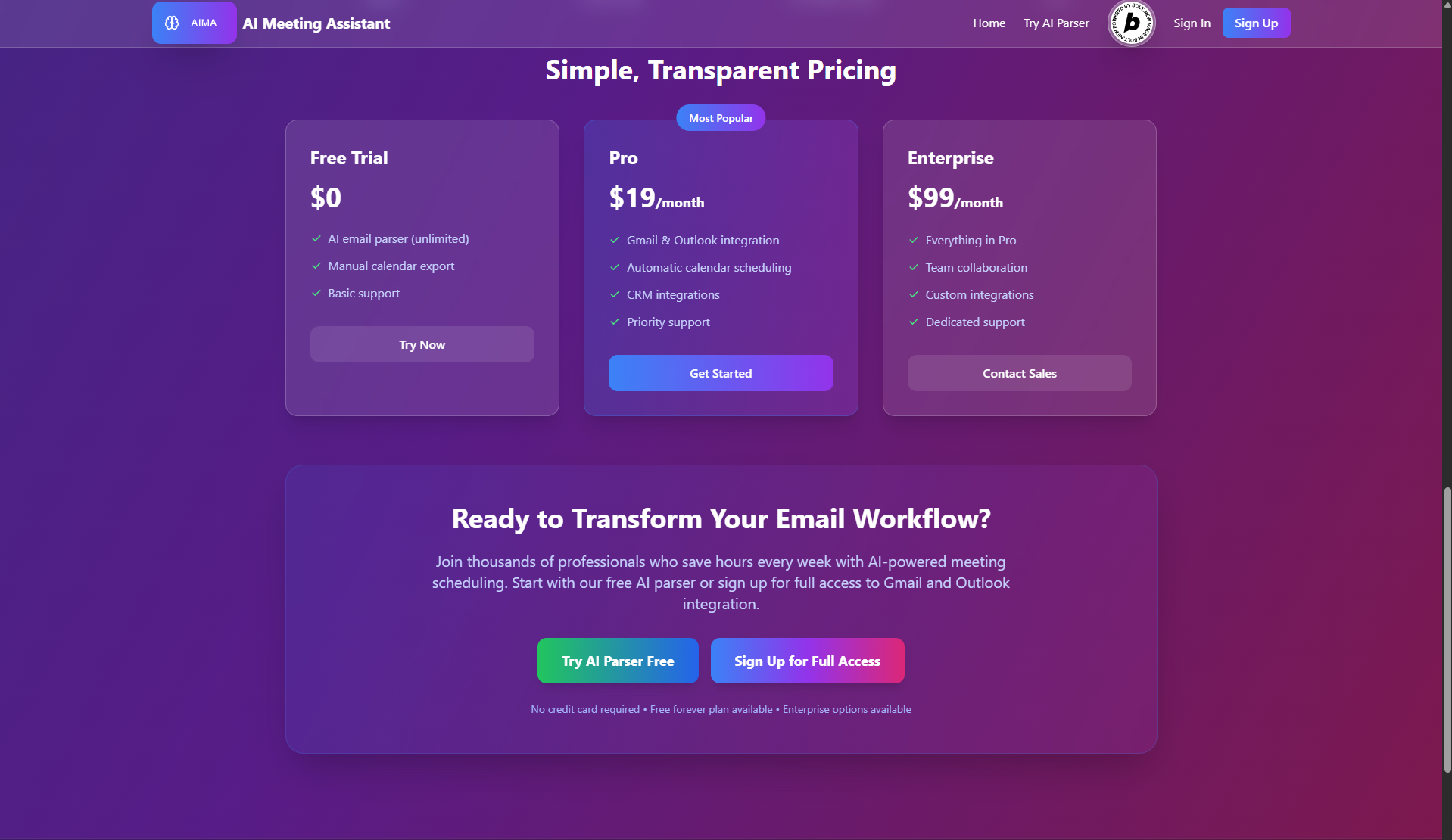
Enterprise Features - Adding advanced security, compliance, and administration features for enterprise customers.
AI Meeting Assistant API - Creating an API that allows developers to integrate our email parsing and meeting scheduling capabilities into their own applications.
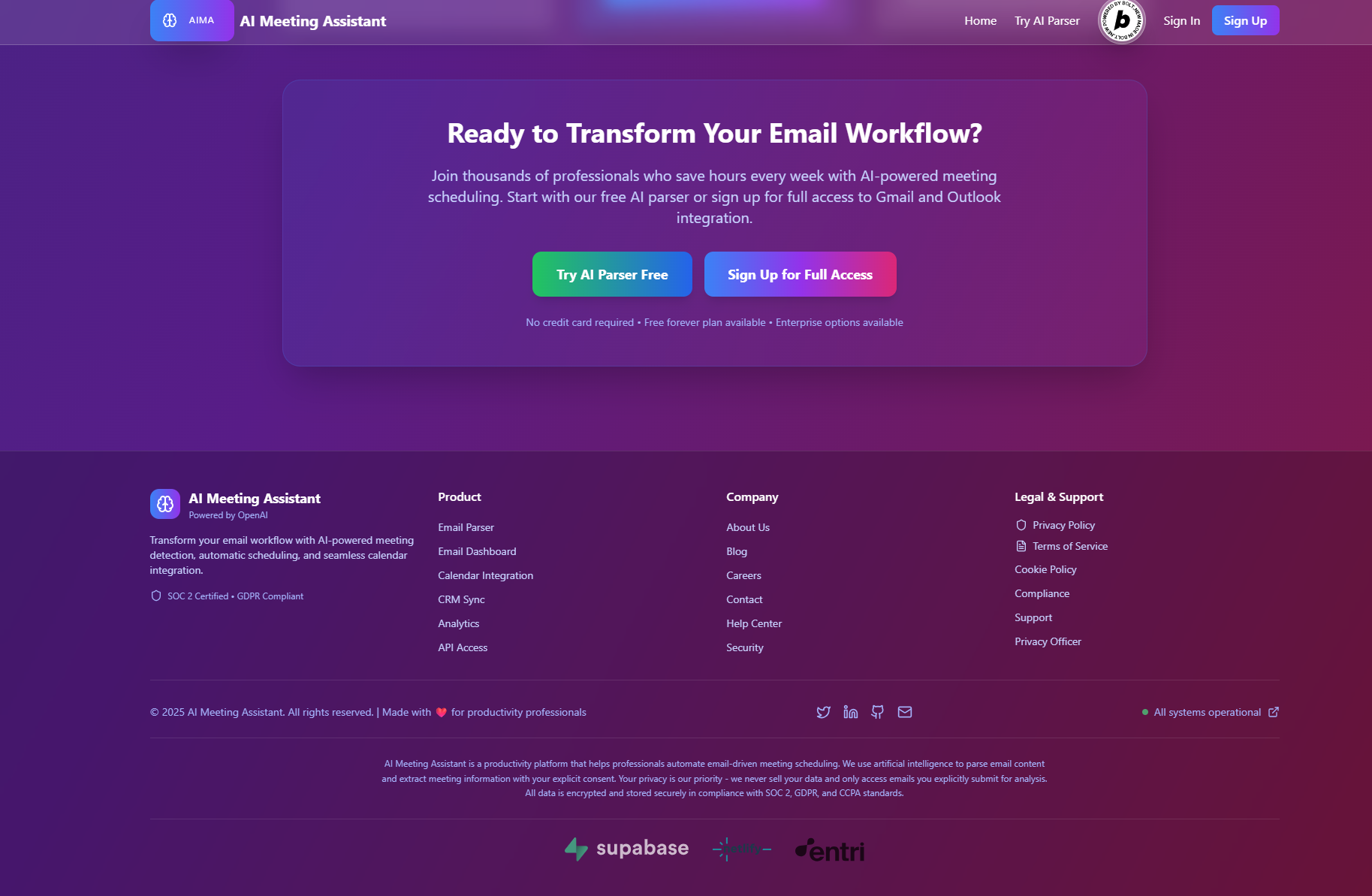
By continuing to innovate in this space, we aim to save professionals hundreds of hours annually and transform how meetings are scheduled and managed in the digital workplace.
Built With
- lucidreact
- netlify
- openai
- react
- rls
- sentry
- supabase
- tailwind
- typescript/javascript
- vite

Log in or sign up for Devpost to join the conversation.