Inspiration
Healthcare providers are overwhelmed by administrative tasks, spending hours on documentation instead of focusing on patient care. We wanted to build something that brings them back to what matters most—human connection. Inspired by the transformative potential of large language models and real-time transcription tools, we envisioned an AI assistant that acts like an invisible scribe, streamlining medical documentation while boosting accuracy and reducing burnout
What it does
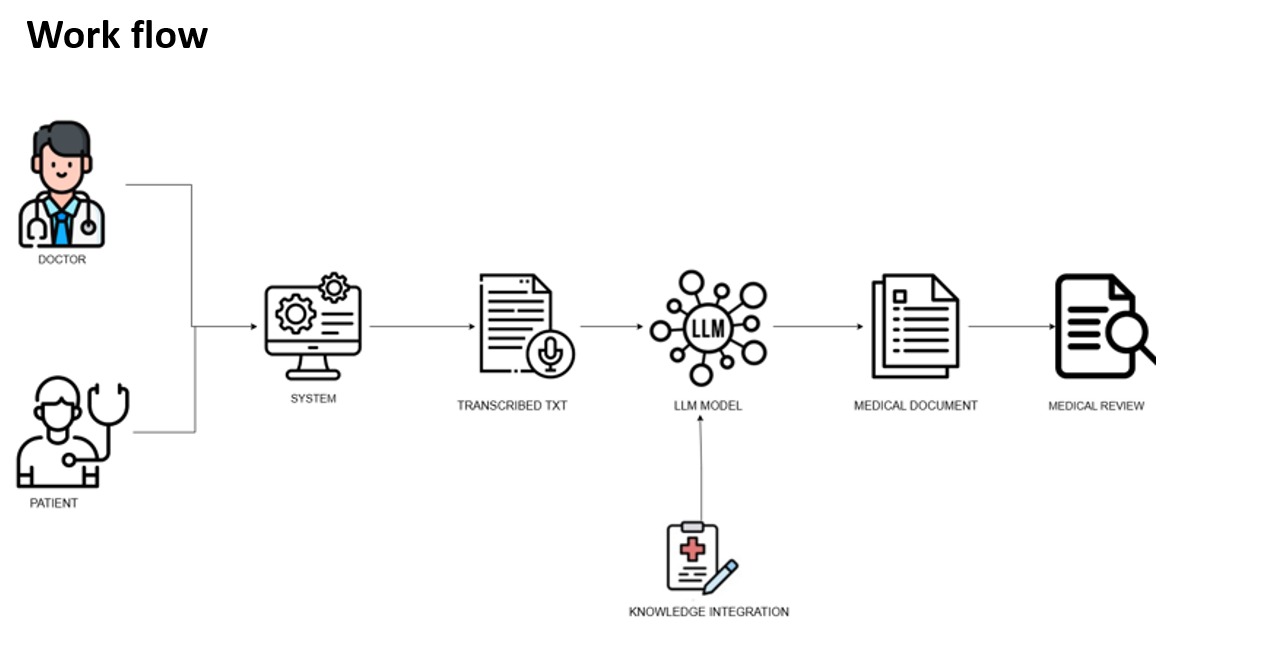
The AI Medical Documentation Assistant listens to doctor-patient conversations, transcribes them in real time, and intelligently generates structured medical notes, diagnoses, and treatment recommendations. It integrates seamlessly with Electronic Health Records (EHR) systems and ensures compliance with medical data privacy standards. Available across platforms, it supports hands-free, voice-activated interaction for ultimate flexibility
How we built it
Whisper by OpenAI – Used for real-time, accurate speech-to-text transcription, especially tuned for medical conversations.
MedPaLM 2, BioGPT, and Mistral – Leveraged for natural language understanding and generation of structured medical content such as SOAP notes, discharge summaries, and treatment suggestions.
Built the UI using a cross-platform framework, ensuring access via web, mobile, and voice assistants
Challenges we ran into
Ensuring medical terminology accuracy in real-time transcription.
Aligning generated notes with standard SOAP formats and EHR schemas.
Balancing AI autonomy with physician control and verification.
Ensuring HIPAA compliance during data processing and storage.
Accomplishments that we're proud of
Achieved high-accuracy, real-time medical transcription.
Successfully generated SOAP-formatted notes and treatment suggestions.
Built a functional prototype that integrates with sample EHR data.
Created a seamless, voice-activated experience for doctors on the go.
What we learned
Fine-tuning LLMs for domain-specific tasks (like healthcare) can drastically improve output quality.
Interoperability with legacy healthcare systems requires deep understanding of healthcare standards like HL7 and FHIR.
User experience is crucial in medical tech—trust, explainability, and ease of use are non-negotiable.
What's next for AI MEDICAL DOCUMENTATION ASSISTANT
Expanding language support and regional dialect handling in transcription.
Adding voice biometrics for secure and personalized usage.
Partnering with hospitals and clinics for real-world testing and feedback.
Incorporating more medical LLMs for deeper diagnostic assistance.
Building a feedback loop to continuously learn from physician edits and improve suggestions over time.
Built With
- biogpt
- clinicalbert
- face
- hugging
- langchain
- medpalm-2
- prompt-engineering
- python
- whisper

Log in or sign up for Devpost to join the conversation.