AI Medical Assistant — Streamlining Clinical Workflows with Generative AI 🚀 Inspiration
Healthcare professionals spend a significant portion of their time collecting patient details, summarizing symptoms, and preparing medical reports. This repetitive process delays diagnosis and reduces face-to-face time with patients. We were inspired to create an AI Medical Assistant that automates early-stage symptom analysis, retrieves relevant medical knowledge, and generates structured reports — helping doctors focus on clinical decisions rather than documentation.
🧠 What We Built!
We built a Streamlit-based conversational medical assistant powered by AWS Bedrock, OpenSearch, and LangChain, which can:
Conduct interactive conversations with users to understand symptoms.
Summarize medical history using a Chat Summary Agent.
Retrieve relevant clinical information using OpenSearch for RAG-based retrieval.
Generate structured, doctor-friendly reports through a Report Generator Agent.
Incorporate doctor feedback loops to continually improve AI responses.
🏗️ Architecture Overview
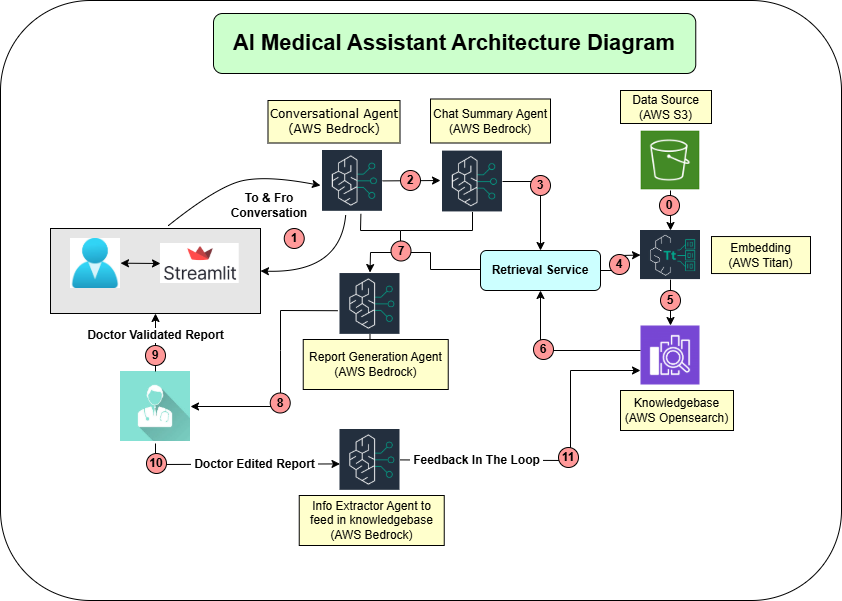
Our architecture includes multiple specialized agents:
Conversation Agent – Handles patient dialogue via natural language.
Chat Summary Agent – Extracts and summarizes user responses for clarity.
Retrieval Agent – Connects to an OpenSearch Knowledge Base for context-aware retrieval.
Report Generator Agent – Produces a structured clinical summary and recommendation draft.
Feedback Loop – Updates and fine-tunes responses based on doctor edits.
All these components are orchestrated through Streamlit UI, backed by AWS Bedrock models for LLM and embeddings.
⚙️ How We Built It
Frontend: Streamlit for an intuitive conversational interface.
LLM Backbone: AWS Bedrock (Claude by Anthropic) for reasoning and summarization.
Retrieval: OpenSearch used directly for efficient semantic search.
Deployment: Dockerized application pushed to Amazon ECR, deployed on ECS (Fargate) for scalability.
💡 What We Learned
How to integrate AWS Bedrock seamlessly with LangChain for both embeddings and LLM inference.
Efficient retrieval-augmented generation (RAG) implementation using OpenSearch.
Best practices for containerization, versioning, and deployment in ECS/ECR.
Building modular AI agents that work collaboratively in a single workflow.
🧩 Challenges Faced
Handling validation errors during Bedrock model invocation (e.g., ensuring valid message structures).
Managing environment files (.env) and dependencies during Docker builds.
Designing a multi-agent pipeline that remains stateless yet contextually coherent.
Fine-tuning prompt engineering for accurate symptom-to-report conversion.
🌟 Future Enhancements
Integrate voice-based symptom collection using AWS Transcribe.
Add multilingual support for diverse patient populations.
Implement doctor dashboard analytics for insights into case patterns.
Fine-tune a domain-specific medical LLM using de-identified datasets.
❤️ Impact
By combining the power of AWS AI services and open-source retrieval, the AI Medical Assistant demonstrates how AI can reduce clinical workload, improve patient interaction quality, and enable faster, data-driven medical insights.
Built With
- amazon-web-services
- bedrock
- ecr
- ecs
- langchain
- opensearch
- python
- s3-bucket
- streamlit

Log in or sign up for Devpost to join the conversation.