-
-
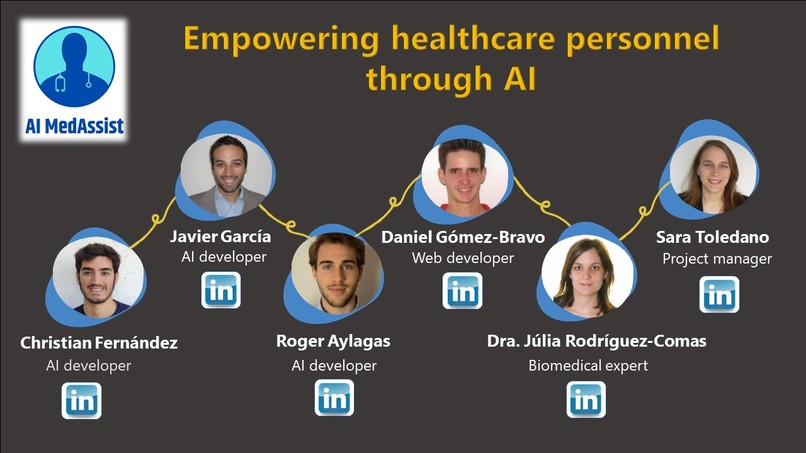
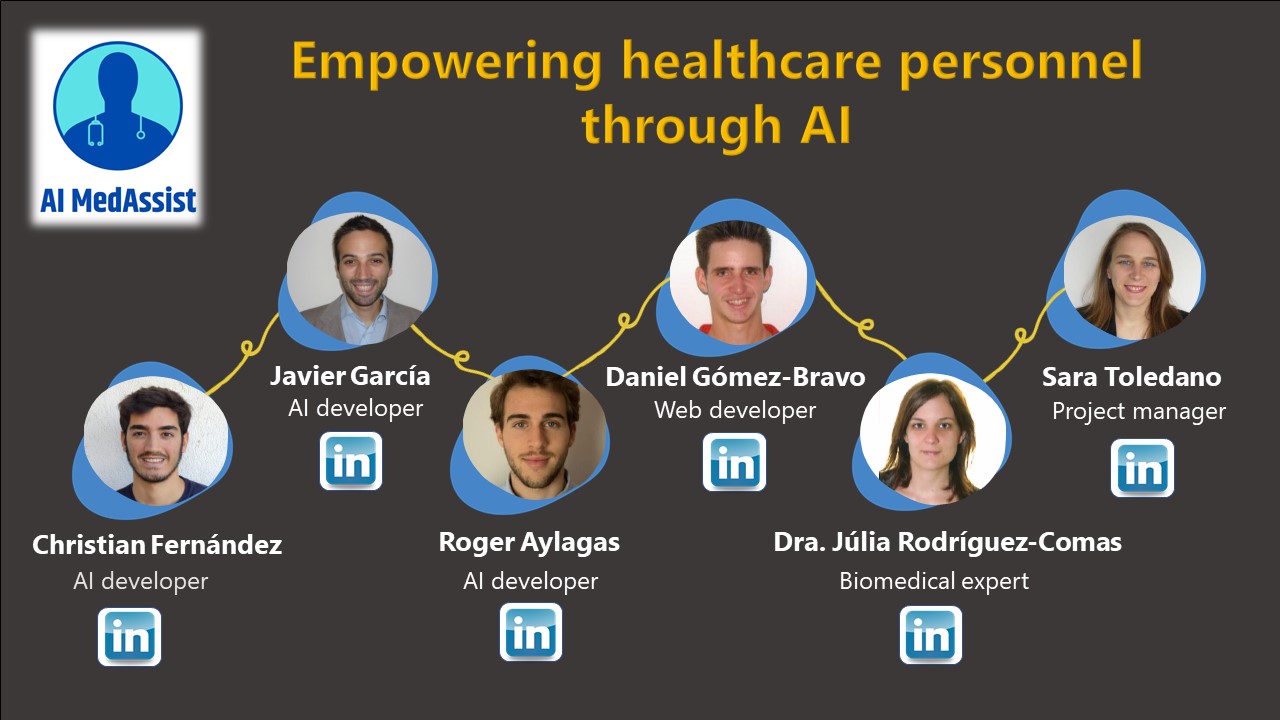
Team
-
AI MedAssist
-
App
Inspiration.
The fast spread of the virus and their unknown effects are increasing the number of admissions in the hospitals. Face to face examination of patients during the COVID-19 pandemic may not be always possible and, if possible, patients often must wait hours for a specialist to evaluate their cases and give them a diagnosis. This complex situation has shortened the time that doctors can dedicate to each patient, making their jobs even more difficult. What if we could help the doctors by conducting an automated analysis to diagnose patients with COVID-19 and to predict their evolution? This can be possible with AI MedAssist. With this medical assistant created to make the medical staff’s daily routine easier, we can shrink the waiting time avoiding the health system to collapse.
What it does
AIMedAssist is an AI-based tool, which helps doctors to have a previous evaluation of each patient before they examine them and helps other medical healthcare personnel to have a preliminary diagnosis and a prediction of the evolution of a patient when they cannot contact a specialist. It analyses chest x-ray images in order to diagnose COVID-19 and predict its evolution with an accuracy higher than 90%. The tool works through an app, that can be installed in every primary care desktop for an off-line use. Their function is particularly interesting for helping healthcare staff from areas with lack of specialists and resources, who cannot access more equipped hospitals. A preliminary screening of the patients suspicious of COVID-19 and the prediction of the probable evolution of the confirmed ones with an automate tool will avoid unnecessary admissions, preventing saturation of hospitals and reducing waiting-times. This will provide critical information for the coordination and planification of the further needs of the healthcare resources.
How we built it
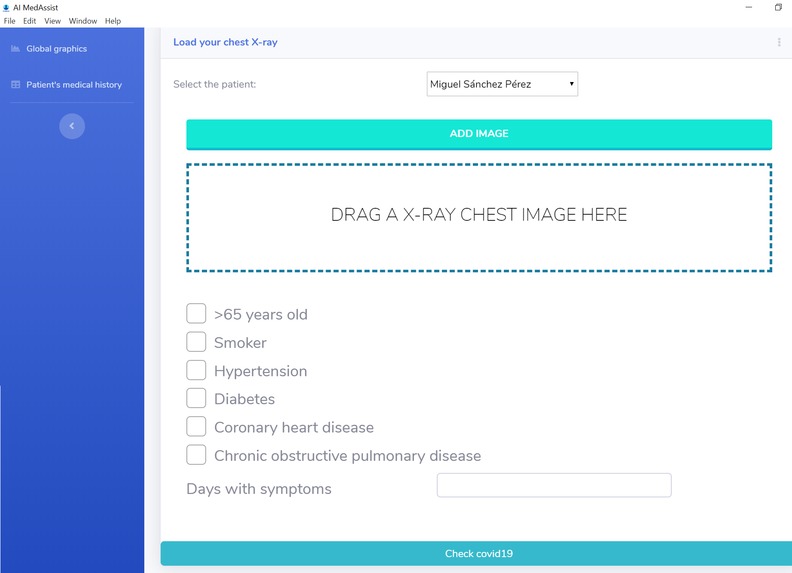
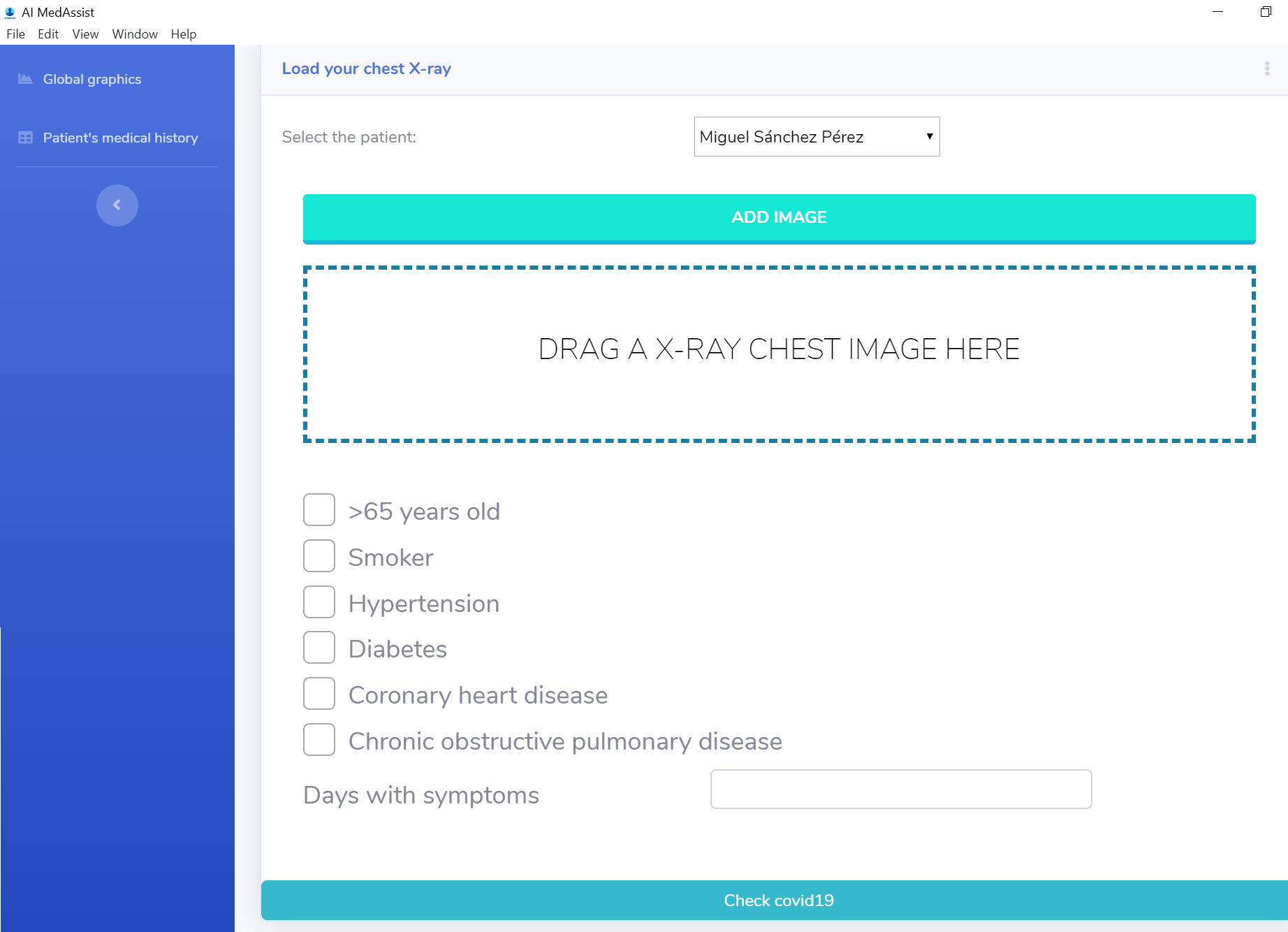
AIMedAssist uses a deep neural network trained with hundreds of publicly available chest X-Rays and 6 relevant characteristics extracted from each clinical history from patients with COVID-19 and other lung-related pathologies all over the world. The AI-based software analyses the images looking for abnormalities and focuses on them in order to identify each disease. For patients with COVID-19 uses 6 more key data to predict the probable evolution. A proof of concept of the software can be downloaded from our web to be used in any computer. Any healthcare personnel can use it: open the application, upload the X-ray file and introduce 6 key factors from the medical history of the patient, then the user receives the diagnosis and a prediction of the probable evolution, in less than 15 seconds.
Accomplishments that we're proud of
The project idea was proposed by a Spanish Start-up, in which half of the team is working, which is developing AI-software for different applications. We built the team and started the project a couple of weeks ago in other Hackathon, in which we contacted several doctors in order to validate the idea. During the weekend we have improved the network using more data to train it. One of the biggest achievements is that our software was trained not only with images but also with data from the medical histories of the patients and their evolutions. That has led our software to be more reliable and more complete, because it is able not only to diagnose the virus, but also to predict how it will evolve in time. We also integrated the network in an installable software to make the experience better and easier for the doctors.
What's next for AI MedAssist
The next step would be to get more images and medical histories to improve the accuracy of the model and to validate the training and integrate the network in the website (right now it works properly just through the desktop application). It would be also critical to have feedback from Doctors who use it in their daily works in order to adapt the UX to their needs. When the product is working with an acceptable accuracy we want to licence it for a monthly fee, which will allow us to work on the correct maintenance of the software and their continuous training. Due to the high scalability of the model, as a medium-term goal, we would like to complete the tool in order to recognize other diseases and include the pronostic of their evolutions too. We based our model in other medical imaging companies offering this kind of solutions for other applications and we really think our tool can make a difference in the diagnosis and prediction of evolution of many diseases now and in the future.


Log in or sign up for Devpost to join the conversation.