-
-
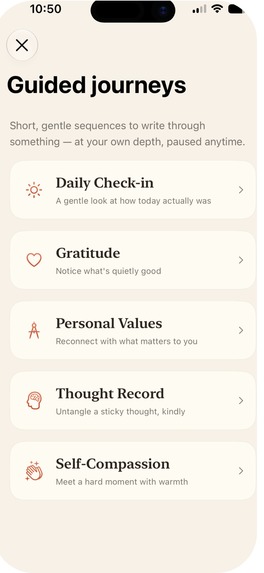
Guided journeys
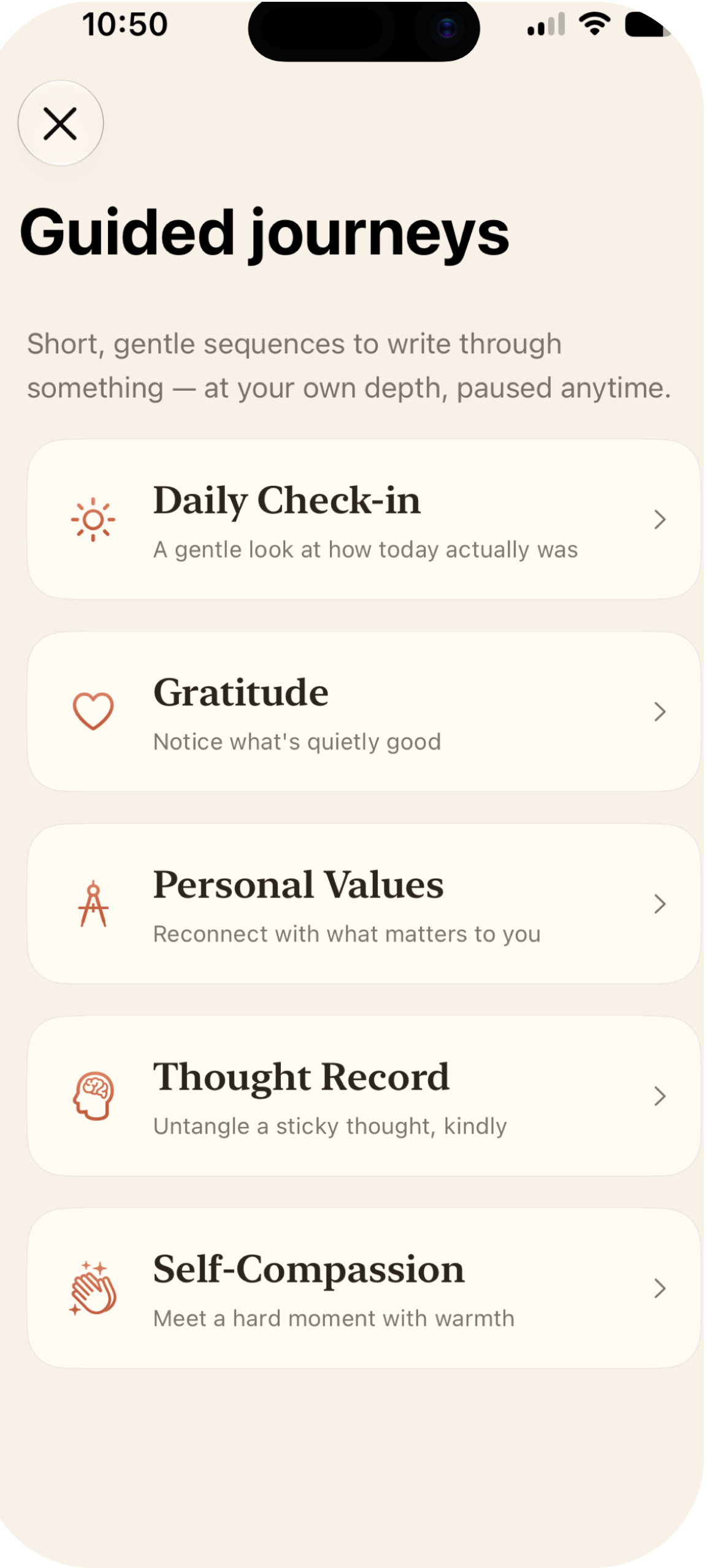
Inspiration
Unfold started from a simple question: what would a journal look like if it respected the most private parts of someone’s life as carefully as Apple respects the device they carry? Most AI journals either feel like chatbots, wellness dashboards, or cloud notebooks with a privacy paragraph added later. I wanted to build the opposite: a calm, Apple-native journal where the user’s own words stay at the center, and AI supports reflection without taking over the diary.
The launch version was built during the RevenueCat Shipaton window and released publicly on the App Store in September 2026. The goal was not just to finish an app, but to ship a real subscription product with a generous free tier, careful privacy promises, and a monetization model that fits the emotional trust required by journaling.
What it does
Unfold is a private AI journal for iPhone. People can write text entries, save voice thoughts, add photos, scan paper notes, log their mood, search their history, and use gentle prompts when they need a starting point. The core principle is that AI never writes the journal entry for the user. It can suggest a starter, ask a reflective question, organize memory, or help surface patterns, but the substance stays human.
Unfold+ unlocks the deeper layer: Ask Unfold over the user’s journal history, weekly and yearly reflections, photo understanding, scan/OCR cleanup, guided journeys, multiple journals, and less friction for richer visual entries. The free tier keeps unlimited writing, mood logging, export, and basic reflection available, because trust comes before conversion.
How we built it
The app is built with SwiftUI and SwiftData, with an Apple-native design system called Warm Paper. The interface uses soft paper surfaces, readable editorial typography, and tactile controls rather than a generic productivity-app shell. AI features route through Apple Foundation Models and on-device retrieval patterns, with clear availability gates so the app remains useful when AI is unavailable.
RevenueCat powers the subscription layer for Unfold+. The app uses RevenueCat offerings, purchases, restores, customer info, and entitlement checks around the premium feature gates. StoreKit remains the Apple billing truth on device, while RevenueCat gives the product a real, manageable subscription foundation: yearly-first pricing, monthly fallback, trial-aware paywall copy, restore handling, and clean premium unlock behavior.
Challenges
The hardest part was keeping the product honest. Journaling is sensitive, so it would have been easy to overclaim: mood detection, AI therapy, or a chatbot that understands the user. Instead, Unfold uses self-reported mood, labels AI output clearly, avoids third-party LLMs, and treats privacy as a product behavior rather than a marketing line.
Another challenge was designing monetization that did not punish the habit. Export is free. Daily journaling is free. The subscription is attached to meaningful depth: private memory, reflections, scans, photo understanding, guided journeys, and multi-journal organization. RevenueCat made that split practical to ship without scattering billing logic through the app.
Accomplishments
I’m proud that Unfold shipped as a real App Store product, not just a demo. It combines private journaling, mood reflection, photo and scan capture, Apple-native AI, and a working RevenueCat subscription in one polished iPhone experience. The app is built to feel calm and trustworthy: no ads, no social pressure, no guilt mechanics, and no AI-generated diary entries pretending to be the user’s thoughts.
What’s next
The next phase is launch learning: improve the onboarding and paywall from real user behavior, add clearer growth loops around reminders and reflection moments, and keep expanding private memory as the premium core. I also want to use early RevenueCat data to tune pricing, trials, and feature gates without compromising the generous free journal that makes Unfold worth trusting in the first place.
Built With
- foundationmodels
- revenuecat
- swiftdata
- swiftui
- xcode


Log in or sign up for Devpost to join the conversation.