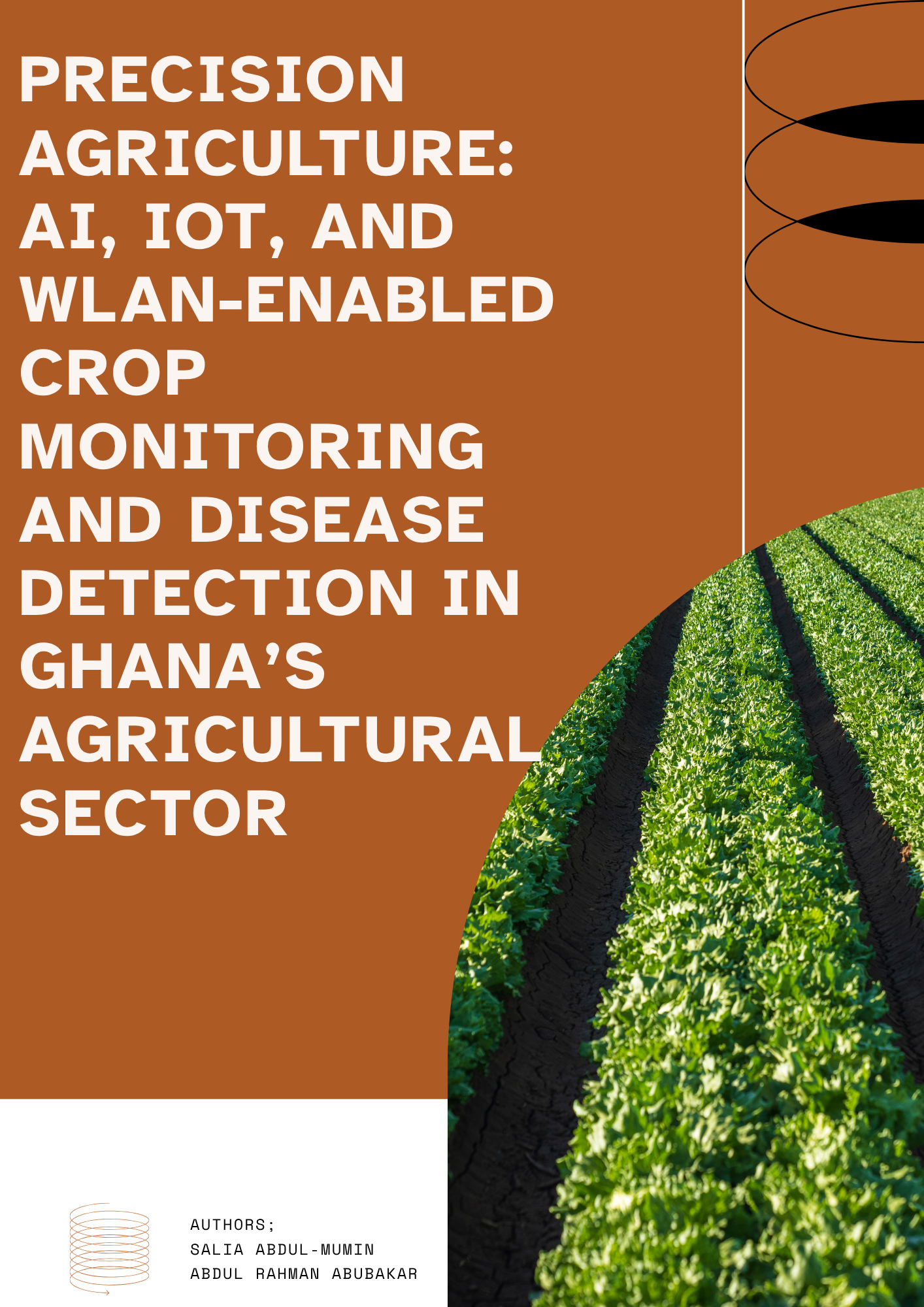
Inspiration
Ghana's agriculture sector faces persistent challenges that threaten food security and farmer livelihoods. With the world population projected to reach 9.8 billion by 2050, and agriculture contributing significantly to Ghana's GDP, the need for innovative solutions has never been more urgent. We were inspired by the stark reality that many Ghanaian farmers lose substantial yields due to late disease detection, inefficient resource usage, and limited access to modern agricultural tools. Traditional farming methods lack timely, data-driven detection capabilities, leading to late interventions, improper treatments, and reduced productivity. Many smallholder farmers have limited access to modern technology and training, making it difficult to respond effectively to emerging threats. We saw an opportunity to bridge this gap by creating an affordable, accessible solution that works even in Ghana's most remote, off-grid farming regions.
What it does
Our AI-powered solution, Nnɔbae Boafo (meaning "Famer's Assistant" in Twi), is a comprehensive crop monitoring and disease detection system that operates completely offline. The system integrates multiple technologies to provide farmers with real-time insights: Core Capabilities:
Disease Detection: AI models detect diseases in five key crops (Cashew, Cassava, Maize, Lettuce, and Tomato) with up to 96% accuracy and <50ms inference time Soil Monitoring: Continuous tracking of soil temperature, moisture, pH, salinity, and electrical conductivity using IoT sensors Aerial Surveillance: DJI Mini Pro 3 drone captures high-resolution crop images for large-scale disease analysis Smart Recommendations: Provides crop-specific treatment suggestions and resource optimization advice CropAI Assistant: Domain-specific conversational AI trained to answer farmer queries Accessibility Features: Text-to-speech functionality for visually impaired users Offline Operation: Full functionality across 10,000 acres without internet connectivity
The mobile app serves as the farmer's command center, displaying all sensor data, AI predictions, soil health status, and providing actionable insights with active alerts for critical events.
How we built it
We adopted a multi-layered design approach, integrating hardware, AI, and network infrastructure into a unified system: IoT Hardware Integration:
Deployed HALISENSE soil sensors (IP68 rated, ±0.01 accuracy) connected to ESP8266 WiFi modules for low-cost, low-power data collection Implemented RS485 communication for long-range (up to 1.2km), noise-resistant data transmission supporting up to 32 sensors Custom PCB design to integrate all components into a single communication loop Optimized power consumption to 0.75mAh/hour using deep sleep modes, enabling solar-powered deployment
AI & Machine Learning:
Fine-tuned lightweight EfficientNet B0 and V2-S models for edge deployment on Raspberry Pi Implemented automated deep learning pipeline with smart dataset preparation, dynamic model selection, and advanced data augmentation including Mixup Built robust preprocessing with fallback strategies for handling corrupt or noisy images Integrated cloud support for Google Colab training while maintaining edge inference capabilities
Mobile Application (Nnɔbae Boafo):
Developed cross-platform offline-capable app using modern mobile development frameworks Implemented real-time data visualization for sensor readings and AI predictions Built custom CropAI conversational assistant for contextual agricultural guidance Added accessibility features including text-to-speech for inclusive design
Network Infrastructure:
Designed custom WLAN infrastructure covering 10,000 acres (tested at 0.5 acres) Raspberry Pi serves as local edge server processing all data without internet dependency RESTful API architecture with HTTP POST for seamless device communication
Drone Integration:
Integrated DJI Mini Pro 3 for 4K aerial imaging with 34-minute flight time Implemented image tiling and local processing pipeline for large-area analysis Developed automated workflow: capture → upload → preprocess → detection → recommendations
Challenges we ran into
Power Constraints: Initial prototypes consumed excessive power, making field deployment impractical. We overcame this by implementing sophisticated power management with deep sleep modes, reducing sensor hub consumption to under 0.75mAh/hour and making solar-powered deployment viable. Connectivity in Remote Areas: Ghana's rural areas often lack reliable internet connectivity. We solved this by designing the entire system around offline WLAN connectivity and local edge processing on Raspberry Pi, ensuring full functionality without internet dependency.
Image Quality & Noise Handling: Poor lighting conditions and motion blur during drone and smartphone image capture initially degraded AI model performance. We addressed this through Mixup data augmentation, robust model selection strategies, and advanced preprocessing techniques.
Hardware Integration Complexity: Integrating diverse components (HALISENSE sensors, ESP8266 modules, RS485 communication, and Raspberry Pi) into a single cohesive system required extensive custom PCB design and firmware optimization to ensure reliable communication across all devices. Model Optimization for Edge Deployment: Balancing AI model accuracy with the computational constraints of Raspberry Pi required careful model selection, compression, and optimization techniques to achieve real-time inference without cloud dependency.
Dataset Evolution and Scalability: Ensuring our models remain accurate as new diseases emerge and crop variants change required building extensible training pipelines and considering continuous learning approaches.
Accomplishments that we're proud of
High-Performance AI Models: Achieved up to 96% accuracy in disease detection across all five crops with inference times under 50 milliseconds, proving that edge AI can compete with cloud-based solutions.
True Offline Functionality: Successfully created a system that operates completely without internet across 10,000 acres, making it accessible to Ghana's most underserved farming regions.
Affordable and Scalable Design: Prioritized low-cost components throughout the system, ensuring accessibility for smallholder farmers without sacrificing performance or reliability.
Comprehensive Integration: Built a complete end-to-end solution integrating IoT sensors, drone technology, AI models, mobile applications, and network infrastructure into a single cohesive platform. Local Impact Focus: Designed specifically for Ghana's agricultural realities, including local language support, crop-specific models, and infrastructure constraints.
Energy Efficiency Achievement: Reduced system power consumption to enable solar-powered operation, critical for off-grid deployment in rural areas.
Innovative Network Design: Created a WLAN infrastructure capable of supporting agricultural operations across vast areas without external connectivity.
Accessibility and Inclusion: Implemented text-to-speech and intuitive interfaces to ensure the technology is usable by farmers with varying levels of digital literacy and physical abilities.
What we learned
Technical Insights; Edge AI deployment requires careful balance between model complexity and hardware constraints Power optimization is crucial for IoT systems in agricultural environments Robust communication protocols are essential for reliable data transmission in challenging field conditions Automated machine learning pipelines significantly improve model development and maintenance
Agricultural Domain Knowledge; Understanding local farming practices and constraints is essential for technology adoption Farmers need actionable insights, not just data - the "so what" matters more than the "what" Accessibility features are not optional extras but essential for inclusive agricultural technology Offline capability is not a nice-to-have but a fundamental requirement for rural deployment
System Design Principles; Integrated solutions are more valuable than point solutions in agriculture User experience design must account for varying levels of technical literacy Hardware reliability and durability are critical in harsh agricultural environments Local processing capabilities enable greater system autonomy and reliability
Project Management; Interdisciplinary collaboration between engineering, agriculture, and UX design is essential Iterative testing with real users leads to better solutions Documentation and reproducibility are crucial for scalable technology development
What's next for AI-IoT Crop Monitoring & Disease Detection in Ghana Farms
Immediate Enhancements (Next 6 Months); Drone Automation: Integrate GPS-based autonomous navigation for scheduled flight paths, enabling fully automated aerial surveys without manual piloting Solar Power Integration: Implement solar-powered modules to ensure continuous operation in areas without conventional electricity access Extended Crop Support: Expand disease detection models to include additional Ghanaian crops like cocoa, plantain, and yam
Medium-term Development (6-18 Months); Large-Scale Pilot Testing: Deploy the system on commercial farms to test network reliability, sensor distribution, and scalability under real operational conditions Advanced Analytics: Implement predictive analytics for crop yield forecasting and optimal harvest timing Integration with Agricultural Supply Chain: Connect farmers with markets, suppliers, and agricultural extension services through the platform
Long-term Vision (2-5 Years); Regional Expansion: Adapt the system for other West African countries with similar agricultural challenges Machine Learning Evolution: Implement continuous learning capabilities to automatically adapt models as new diseases emerge and farming conditions change Ecosystem Development: Create a comprehensive agricultural technology ecosystem including financial services, insurance integration, and cooperative farming tools Policy Integration: Work with government agencies to integrate the system with national agricultural monitoring and food security initiatives
Sustainability and Impact Goals; Farmer Training Programs: Develop comprehensive training modules and support systems for widespread adoption Local Manufacturing: Establish local assembly and maintenance capabilities to reduce costs and create jobs Research Partnerships: Collaborate with agricultural research institutions to continuously improve crop disease detection and treatment recommendations Open Source Components: Release key components as open source to encourage broader innovation in African agricultural technology Our ultimate goal is to transform Ghana's agricultural sector by making advanced farming technology accessible, affordable, and effective for every farmer, regardless of their location or resources. We envision a future where data-driven decision making becomes standard practice in Ghanaian agriculture, contributing to food security, economic growth, and sustainable farming practices across the region.
Built With
- bash
- dart
- flutter
- kicad
- ltspice
- python
- raspberry-pi


Log in or sign up for Devpost to join the conversation.