-
-
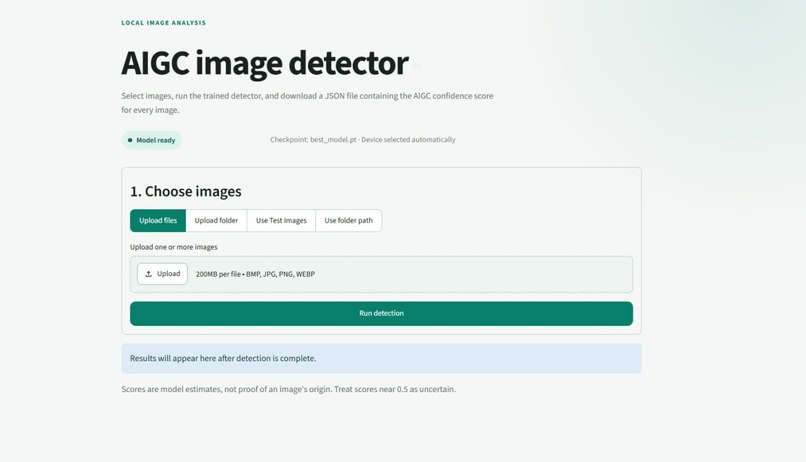
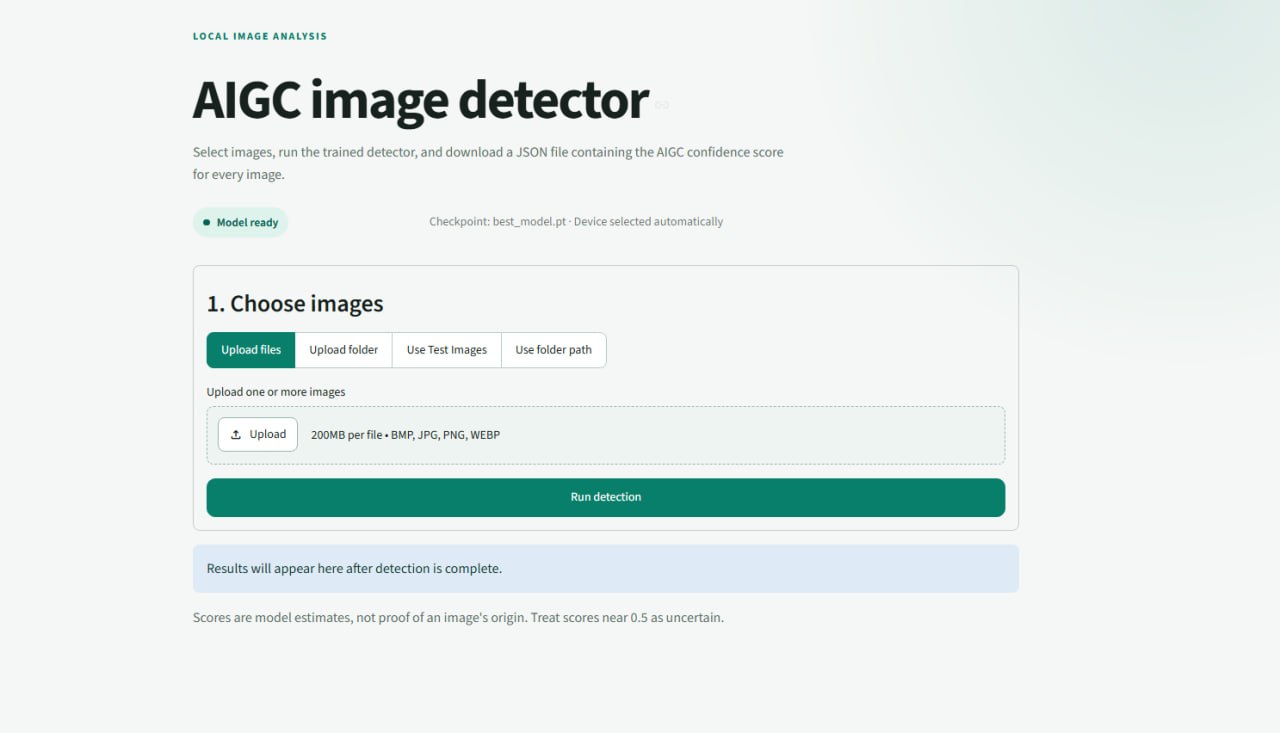
Model Input (UI)
-
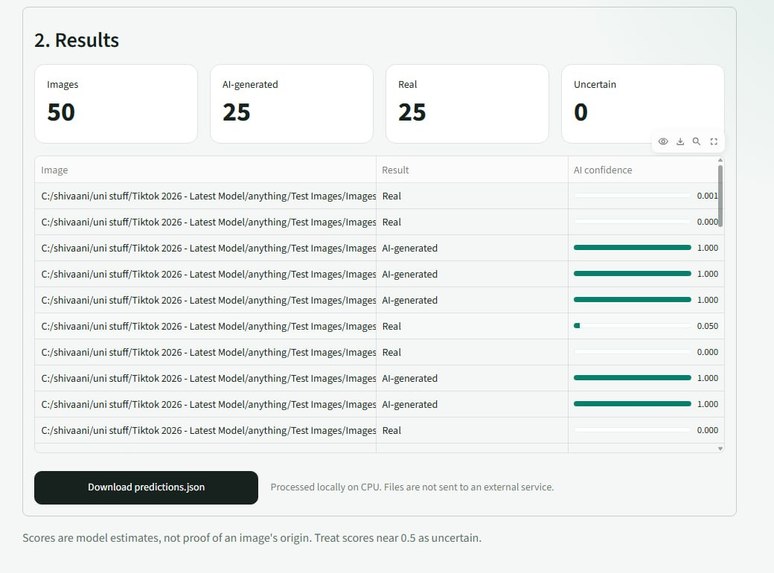
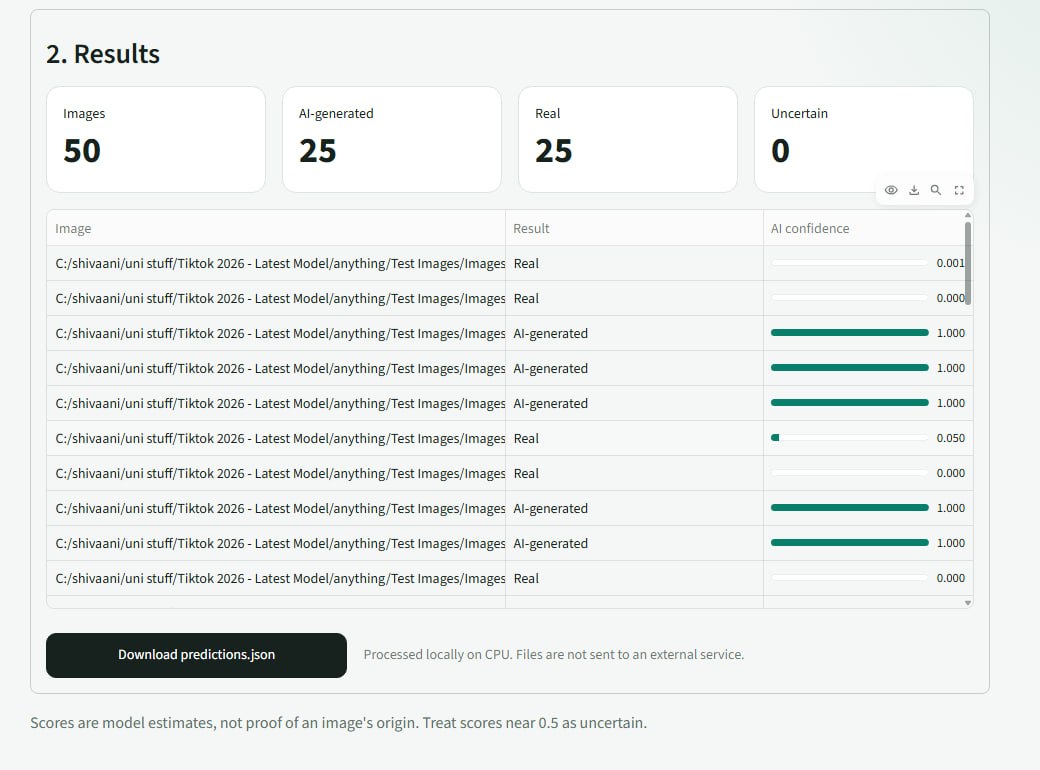
Model Output (UI)
-
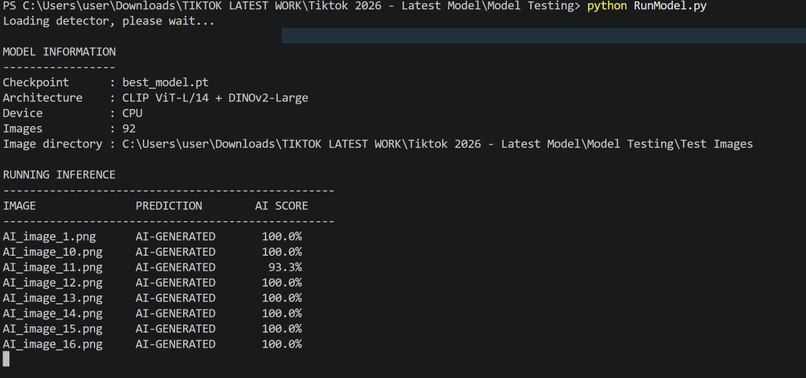
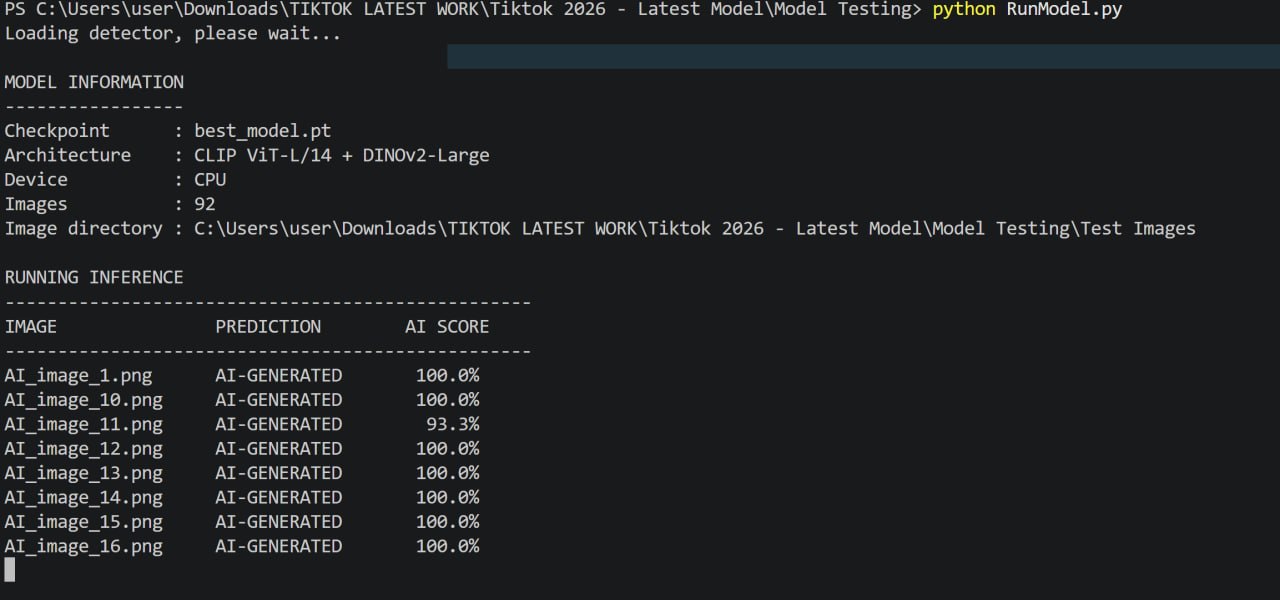
Output (CLI)
-
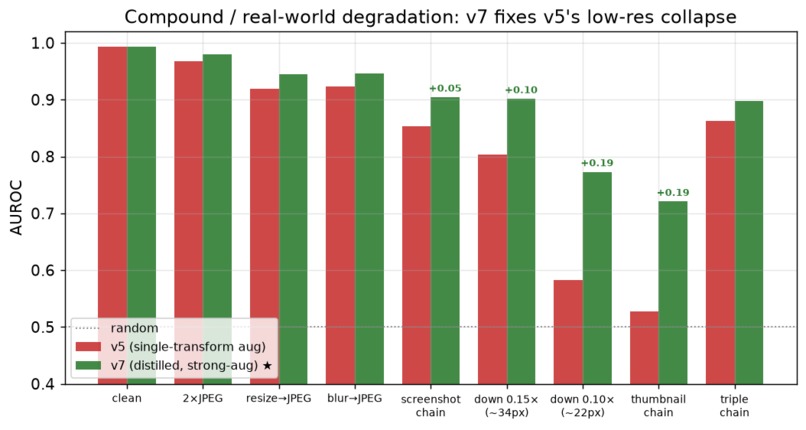
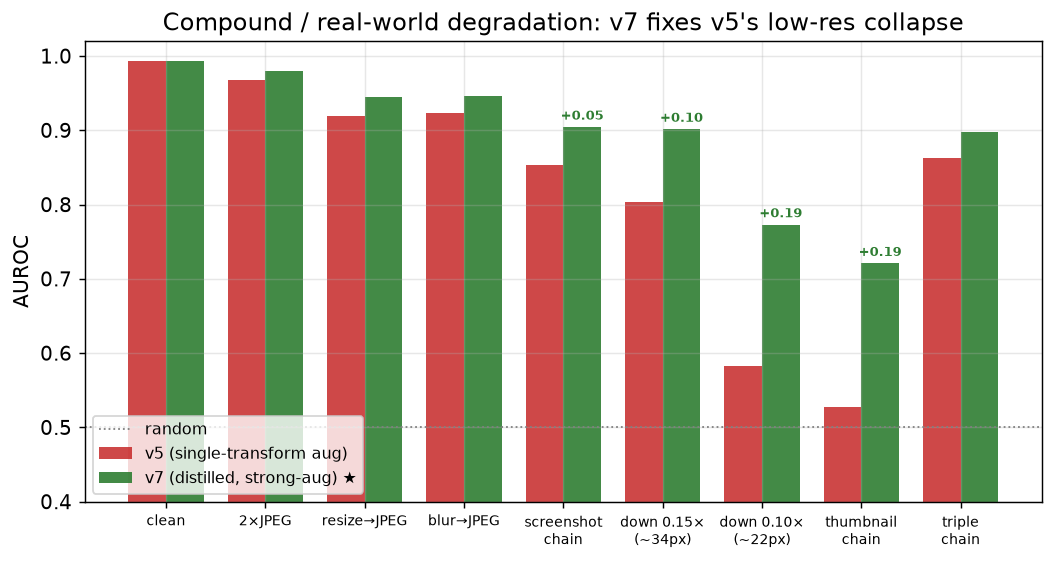
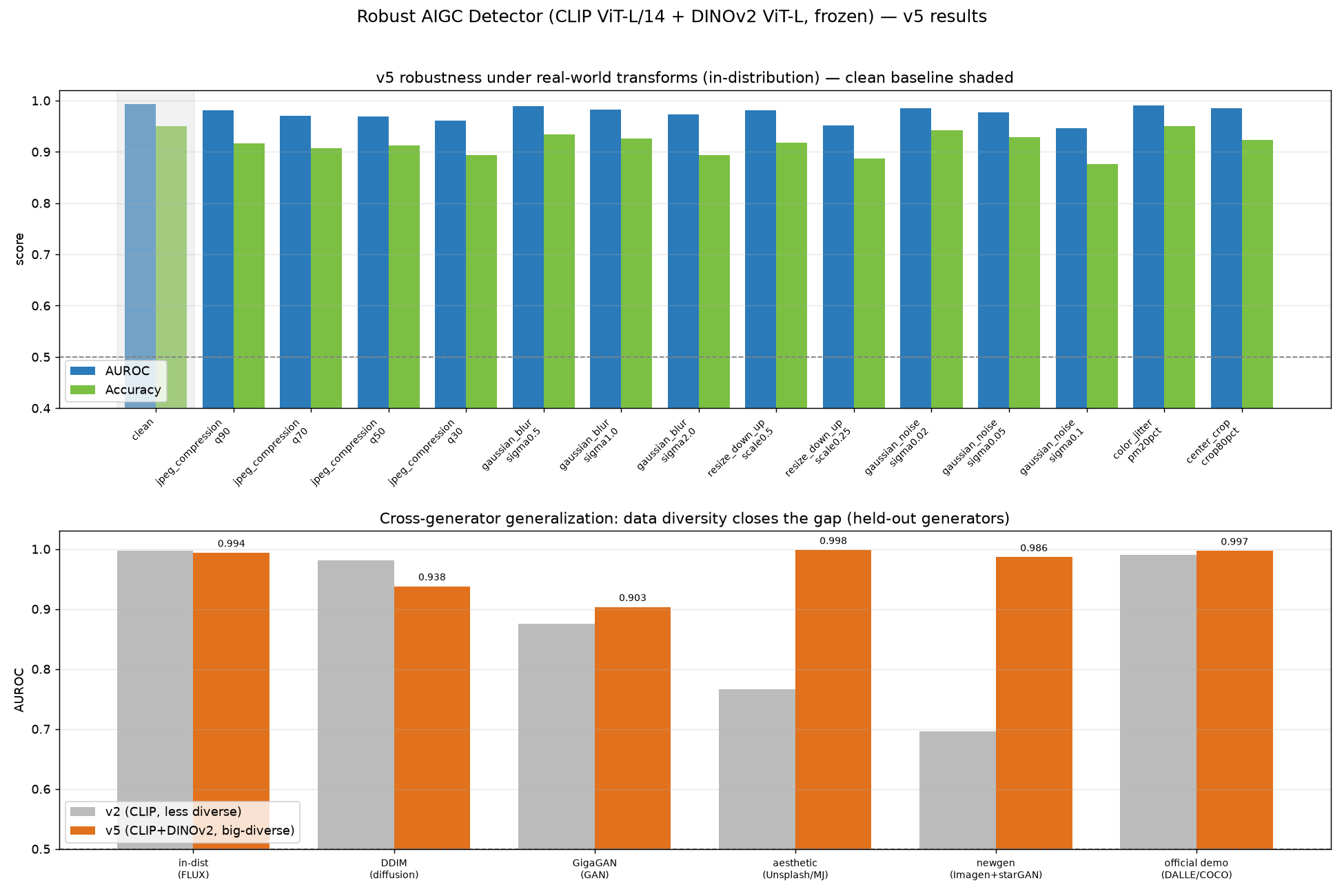
Real World Degradation
-
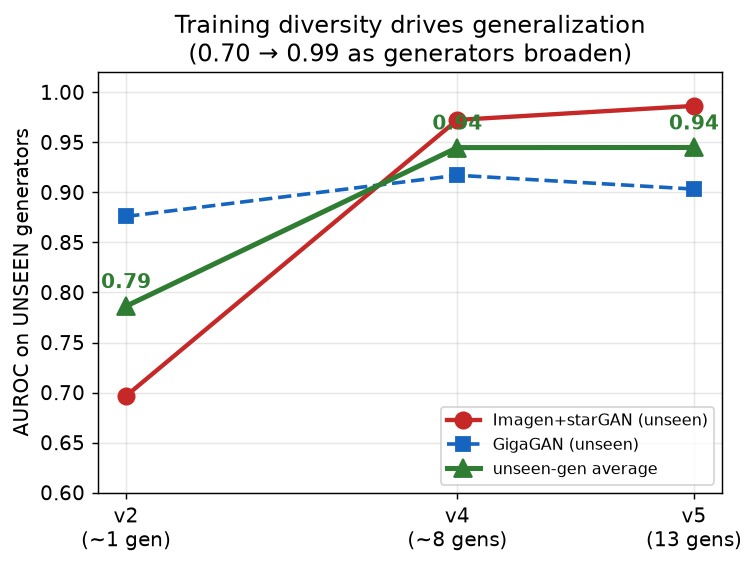
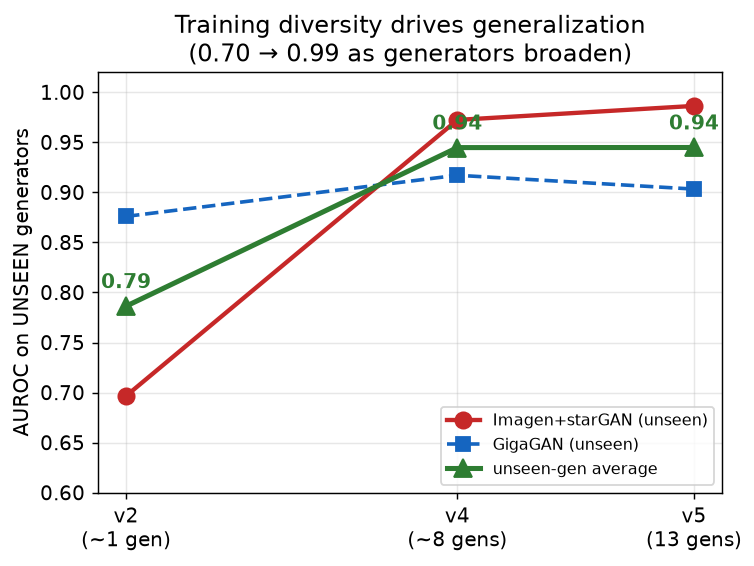
Training Diversity
-
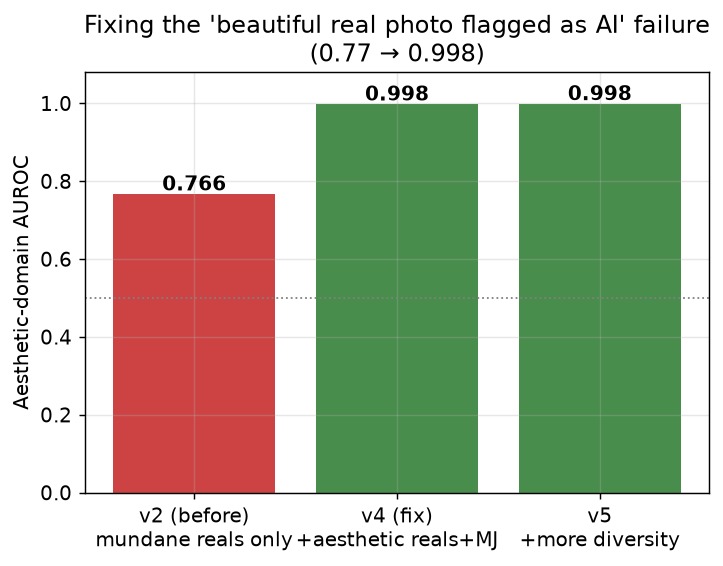
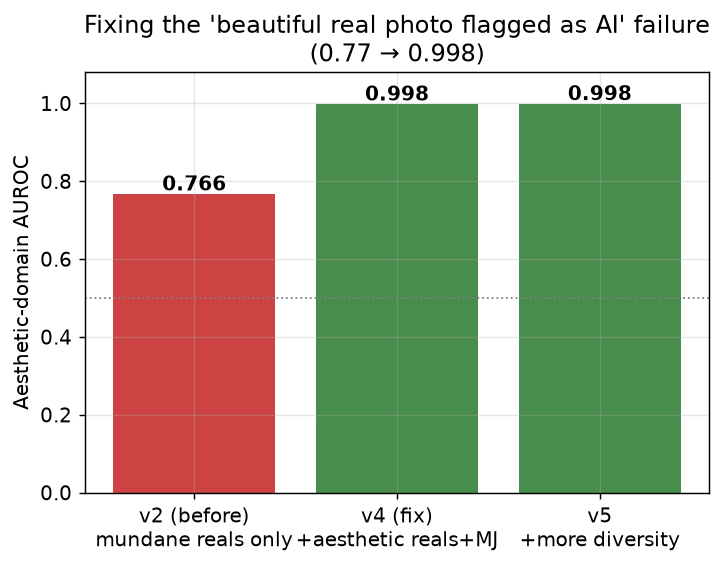
Performance of model per version
-
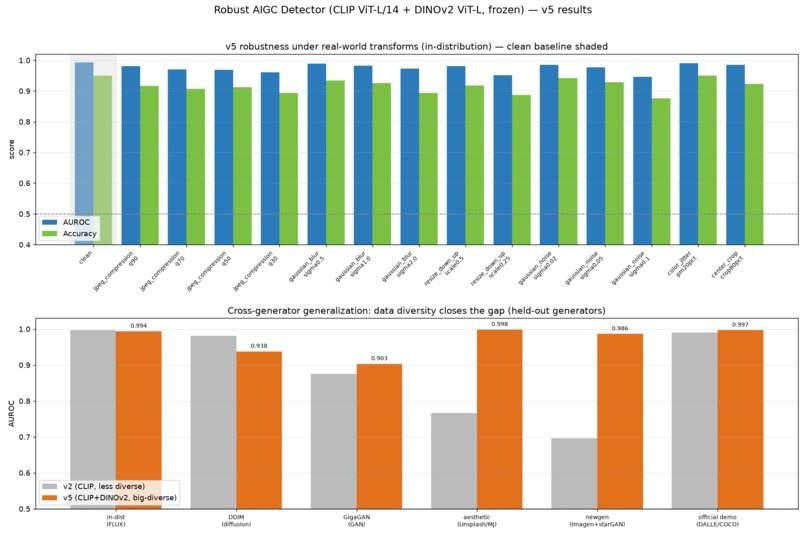
Robustness Visual
-
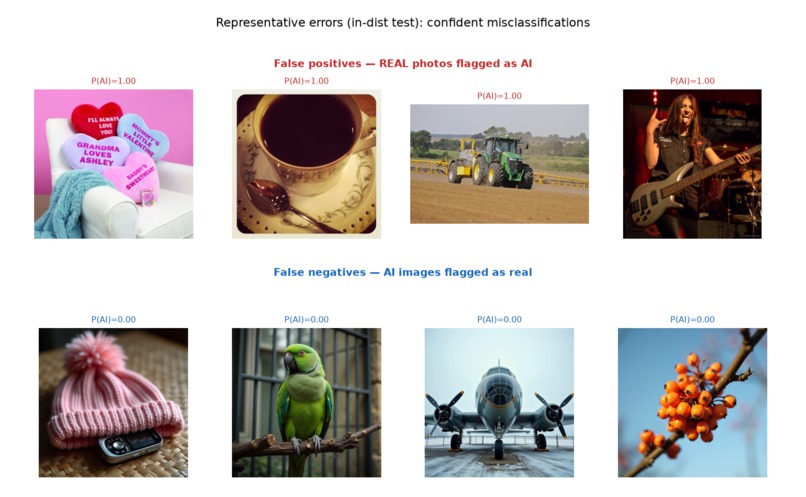
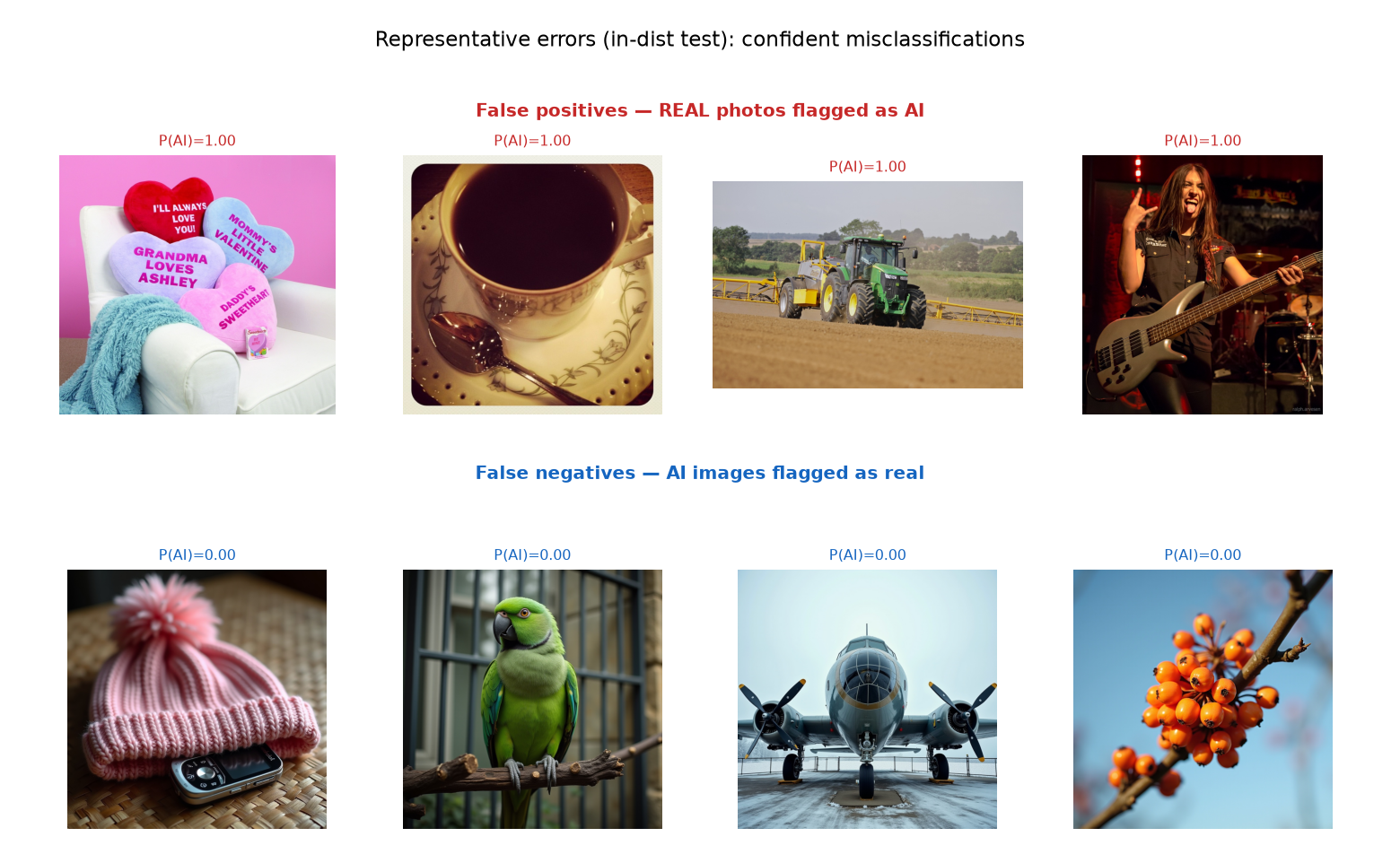
Error Handing for False Positives and Negatives
Project Description — Robust AI-Generated Image Detector
A detector that tells whether photos are real or AI-generated and stays accurate after any tranformations images undergo when re-shared in the real world context — JPEG, resize, blur, noise, color shifts, crops, screenshots, and thumbnails.
How our solution addresses the problem statement
The challenge is not accuracy on clean generator output — it's robustness (accuracy survives real-world post-processing) and generalization (works on generators never seen in training). We address both directly:
A two-branch detector using frozen backbones, purposefully shifting away from frequency and artifact-based approaches. Most fake-image detectors key on high-frequency generation fingerprints (spectral peaks, PRNU residuals, DCT artifacts) — exactly what JPEG, blur, resize, and noise destroy. We reject that. Instead we fuse two complementary, robust frozen backbones — CLIP ViT-L/14 (semantics) + DINOv2 ViT-L (self-supervised structure/texture) — and train only a small calibrated MLP head on the concatenated features. Both degrade gracefully under compression. It is one model, one forward pass (the two "branches" are backbones fused internally).
Train on the exact transforms we're evaluated on — plus compound chains and extreme low-res. The highest-ROI robustness lever is showing the model degraded images in training. We go further than single transforms: we train on chained real-world degradations (double-JPEG, resize→re-JPEG, screenshot→downscale) and extreme low-resolution (down to ~11–48px thumbnails).
Diversity for generalization. We train across 13 generator families and hold generators out to measure cross-generator generalization. Broadening the training set from one generator to thirteen took unseen-generator AUROC from 0.70 → 0.99.
Ensemble distillation into one fast model (our key innovation). Our two best models were complementary; we distilled their ensemble into a single hybrid via online distillation on augmented images — and the student beat both teachers while staying a single, fast checkpoint.
Calibrated confidence, not a raw sigmoid. Temperature scaling + Expected Calibration Error (ECE 0.0005) make
preda trustworthy probability that drives a 3-band human-in-the-loop triage pipeline.
Result (shipped model, v7): scored metric 0.9867 (0.5·AUROC_clean +
0.5·AUROC_robust); on a completely independent third-party test set (AI-vs-Real,
never used in training) it scores clean AUROC 0.9986 and 0.99–0.998 under every
transform — proof it generalizes, not memorizes. 733M params (< 2B limit), 55 img/s
on one RTX 3060. Full numbers in ROBUSTNESS_SUMMARY.md.
Development tools used
- Git — version control.
- NVIDIA RTX 3060 (12 GB) — all training/eval on a single consumer GPU (CUDA 12.8), mixed precision.
- Command-line Python scripts (no notebook dependency); an optional Gradio
dashboard (
app.py) for the live demo.
Models / APIs used
- OpenAI CLIP ViT-L/14 (frozen) — semantic features, via Hugging Face Transformers.
- Meta DINOv2 ViT-L (frozen) — self-supervised structure/texture features, via HF.
- Custom trained MLP head (~0.9M params) on the fused 1792-d features.
- No external/paid inference APIs — the detector runs fully locally.
Libraries & frameworks used
- PyTorch 2.9 (CUDA 12.8) + torch.amp (mixed precision) — model & training.
- Hugging Face
transformers— CLIP/DINOv2 backbones;datasets— streaming. - albumentations + OpenCV — the transform/augmentation pipelines.
- scikit-learn — AUROC / AP / F1 / accuracy / ECE metrics.
- pandas, numpy, pyarrow — data handling; matplotlib — figures.
- Pillow — image I/O; gradio — the optional demo dashboard.
Datasets & assets used
- SID_Set (
saberzl/SID_Set, HF, CC-BY-4.0) — FLUX fakes + OpenImages reals. - WildFake (ModelScope) — 13 generator families (DDPM, DDIM, styleGAN, BigGAN, DF-GAN, GigaGAN, ADM, VQDM, SD, GALIP, Midjourney, DALL·E-2, …) + COCO/FFHQ reals; streamed / partially extracted so we never downloaded the ~2 TB.
- Unsplash Lite — aesthetic real photography (fixes the "pretty real = fake" bug).
- CIFAKE (Kaggle) — smoke-test + low-resolution OOD benchmark.
- AI-vs-Real (
Parveshiiii/AI-vs-Real, HF) — test-only independent validation (deduplicated against train). - Held-out generators (DDIM, GigaGAN, Imagen, starGAN, Midjourney-Typical) measure true cross-generator generalization.
- Compliance: all backbones public; all datasets public/licensed; we never train on COCO val2017 or the DALL·E-Advanced demo set (report-only). Trained head + hyperparameters + eval code are open-sourced in the repo.


Log in or sign up for Devpost to join the conversation.