-
-
-
-
-
-
-
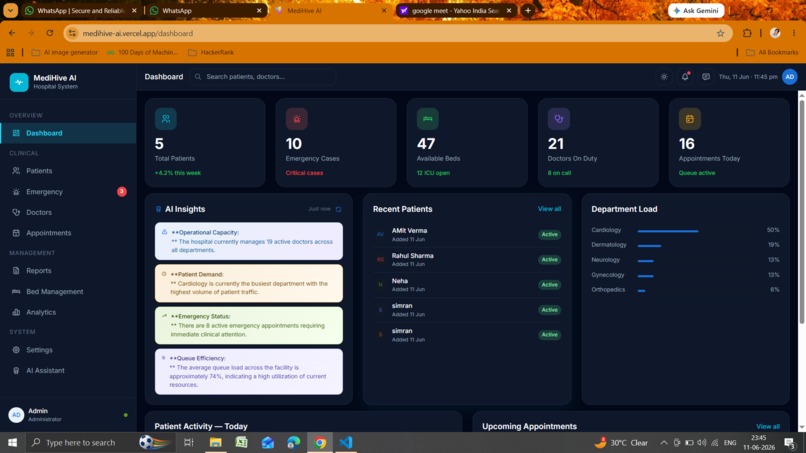
MediHive-AI Dashboard
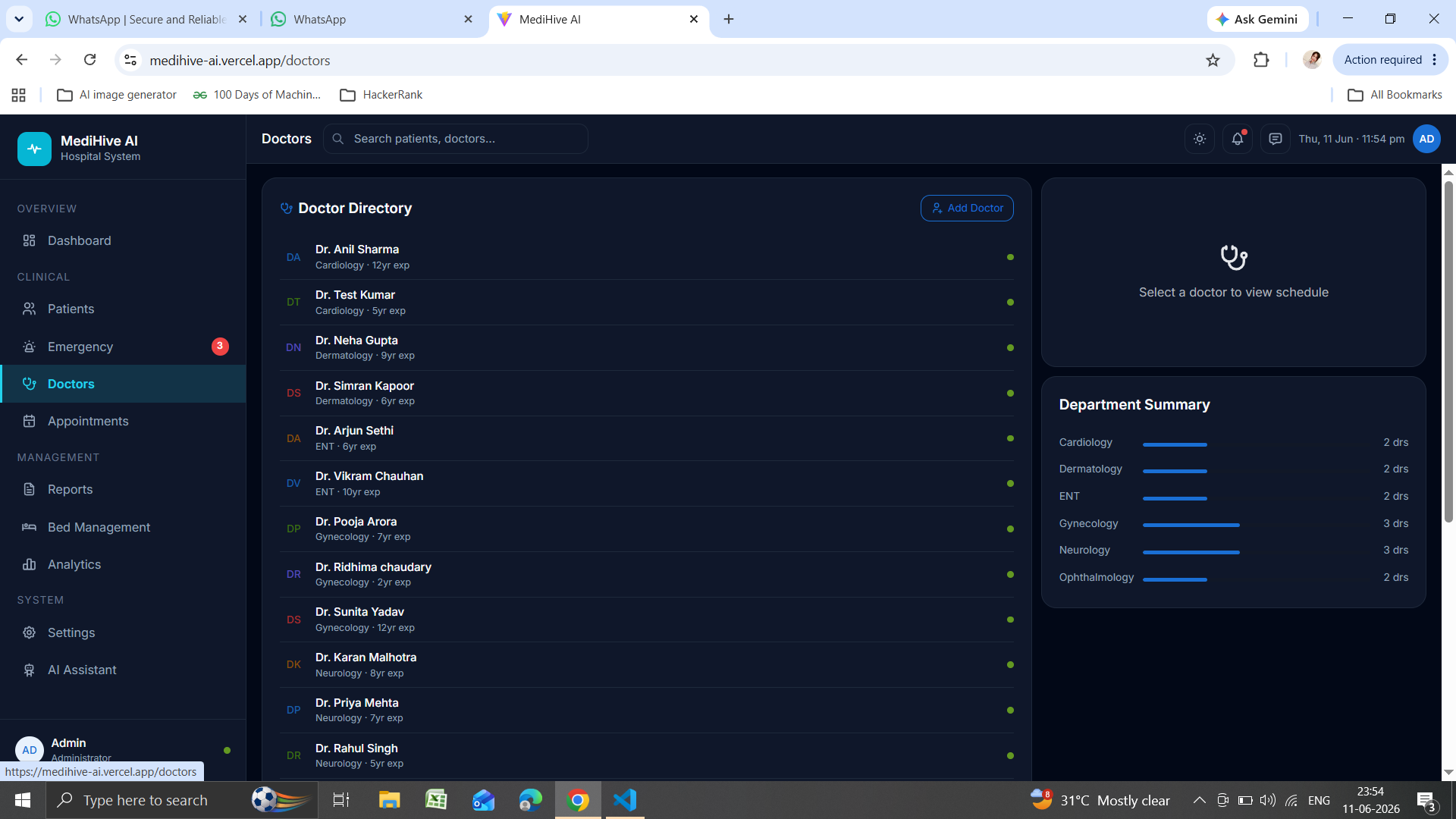
MediHive AI
Inspiration
Healthcare is one of the most critical sectors in our society, yet many hospitals still struggle with overloaded staff, long patient waiting times, inefficient appointment scheduling, and delayed identification of emergency cases.
During our research, we observed that hospital staff often spend a significant amount of time performing repetitive administrative tasks instead of focusing on patient care. Patients frequently face confusion about which department they should visit, while doctors must manage growing queues with limited information about patient urgency.
We asked ourselves a simple question:
What if hospitals could have an intelligent AI workforce that works alongside doctors and administrators to automate routine tasks, prioritize critical patients, and streamline hospital operations?
This idea became the foundation of MediHive AI — an Agentic AI-powered Hospital Management System designed to improve healthcare accessibility, efficiency, and decision-making, Predictive disease risk analysis
What It Does
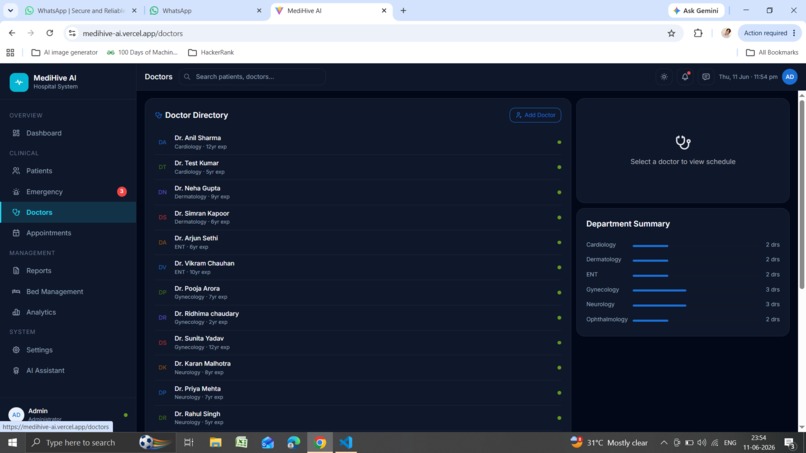
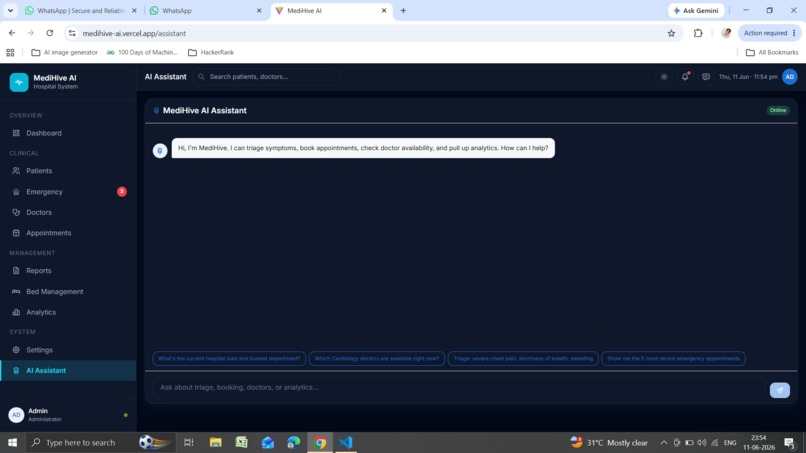
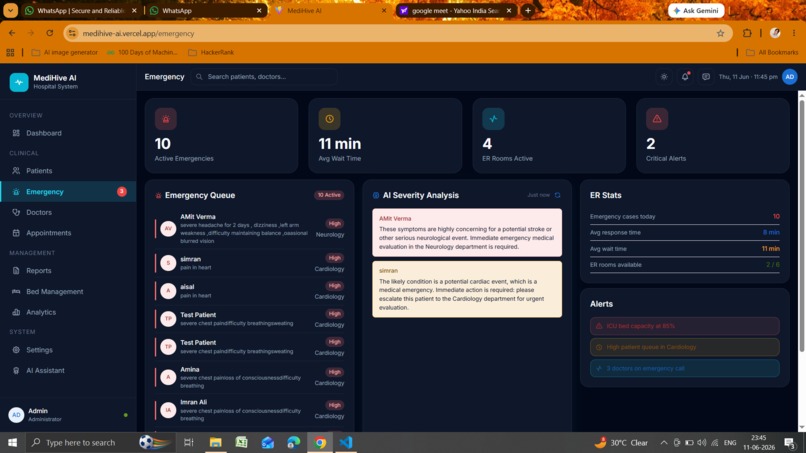
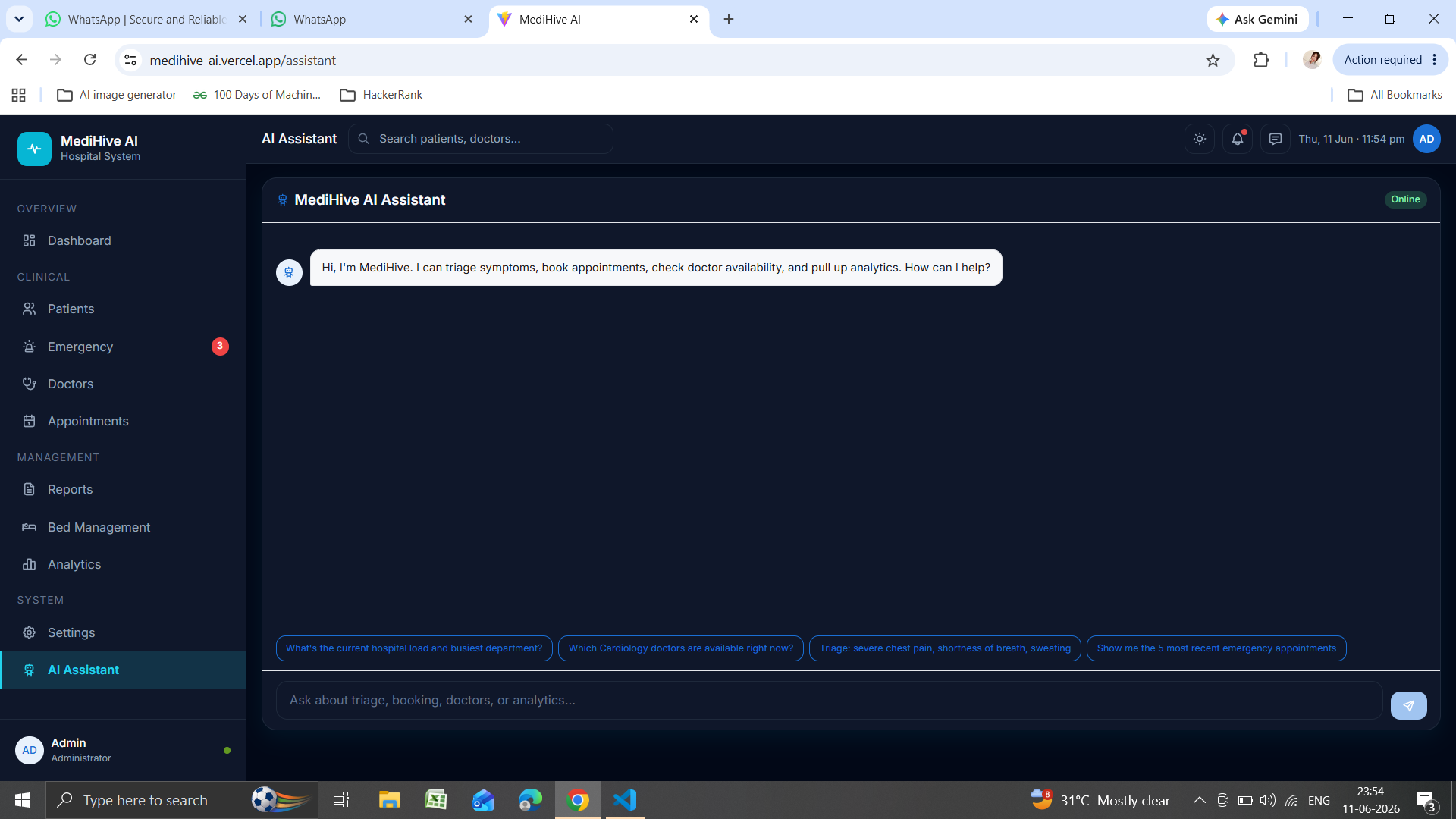
MediHive AI is an intelligent hospital management platform powered by multiple specialized AI agents working together to automate healthcare workflows.
The platform assists hospitals in:
- Patient symptom analysis
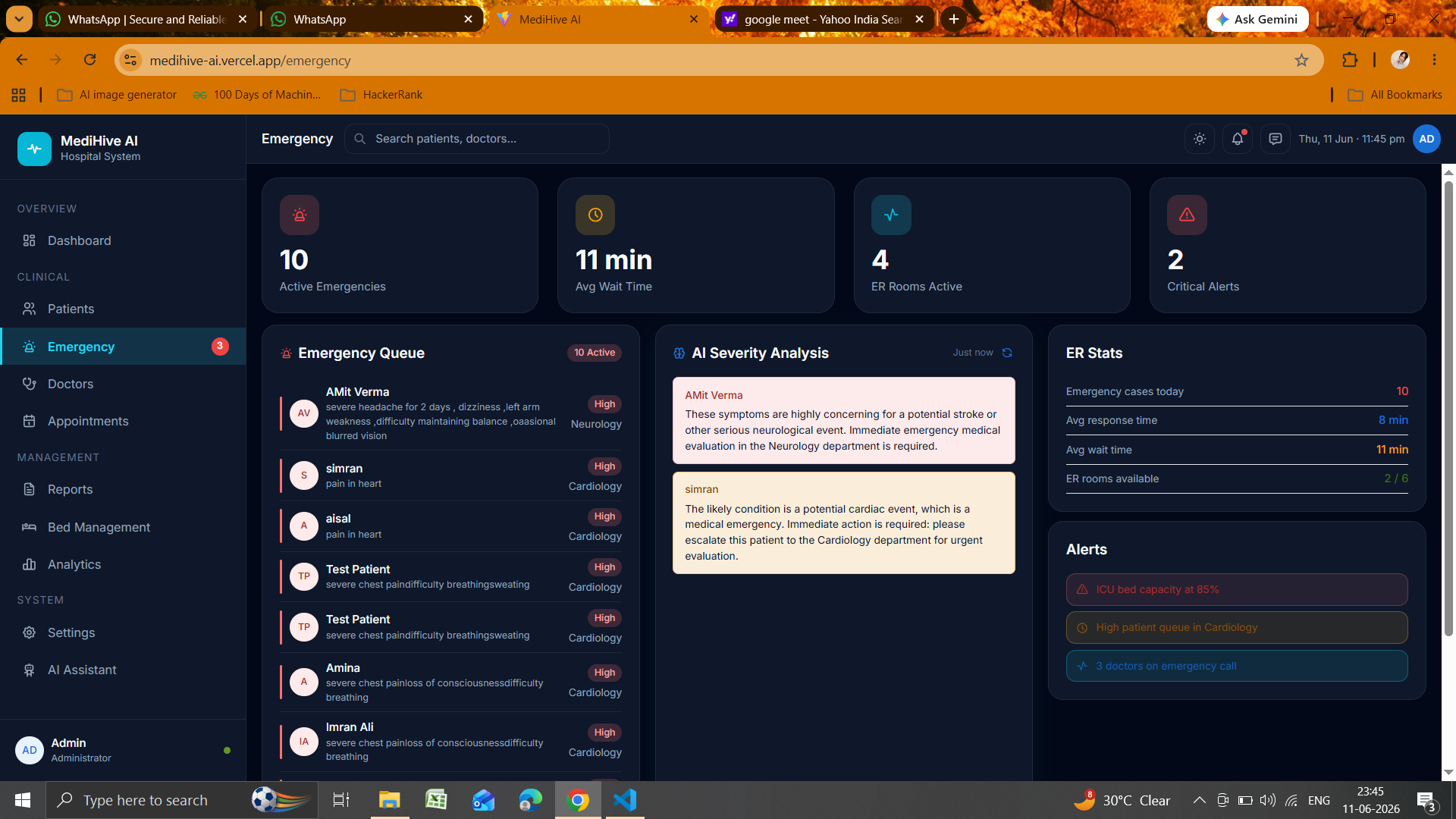
- Severity assessment and triage
- Emergency detection
- Department recommendation
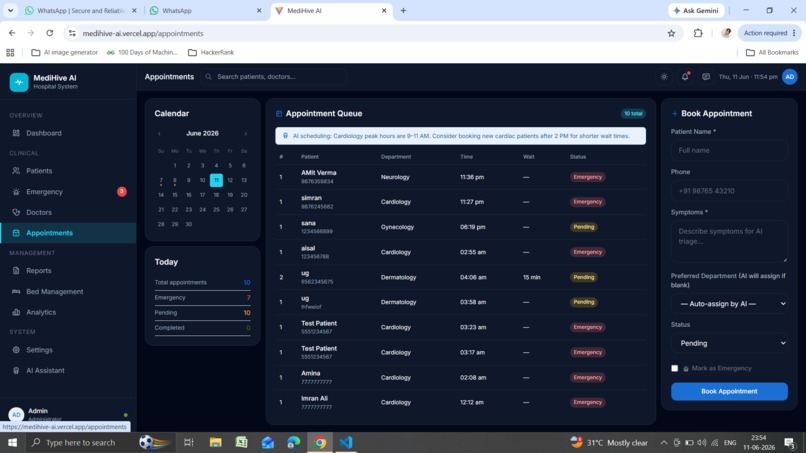
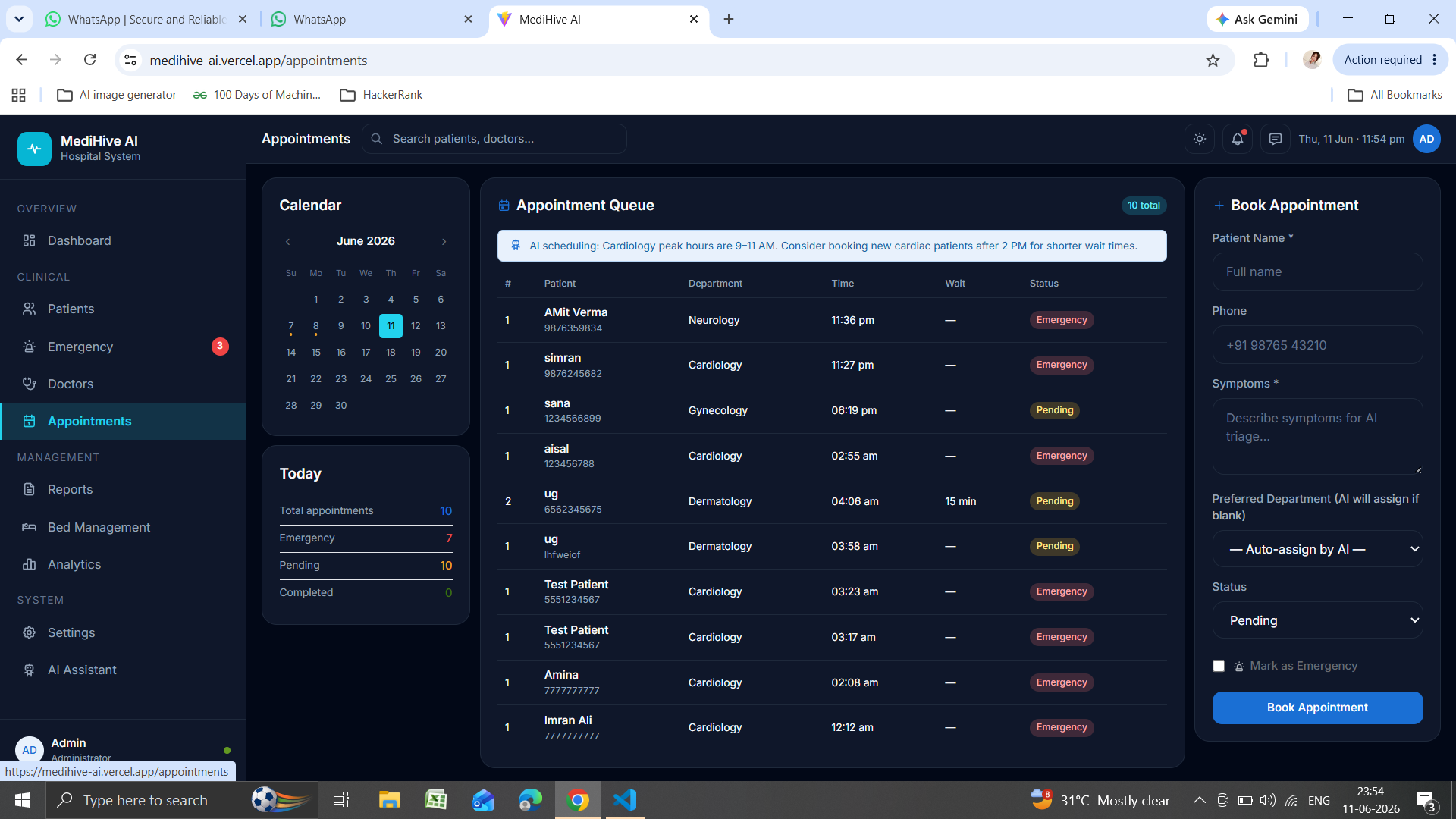
- Smart appointment scheduling
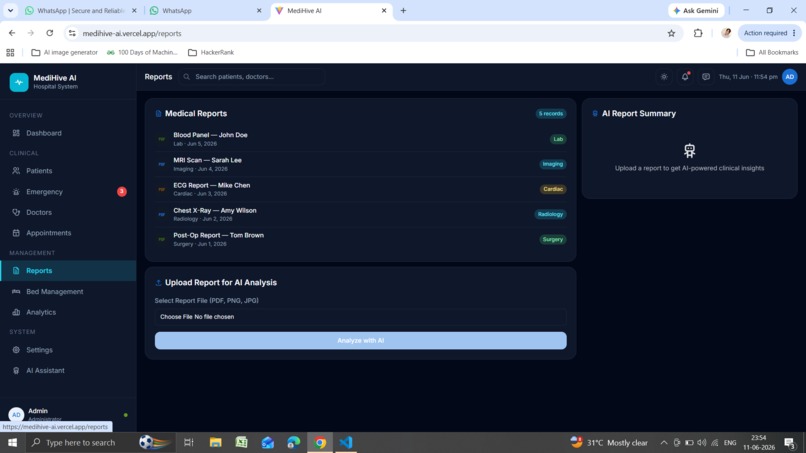
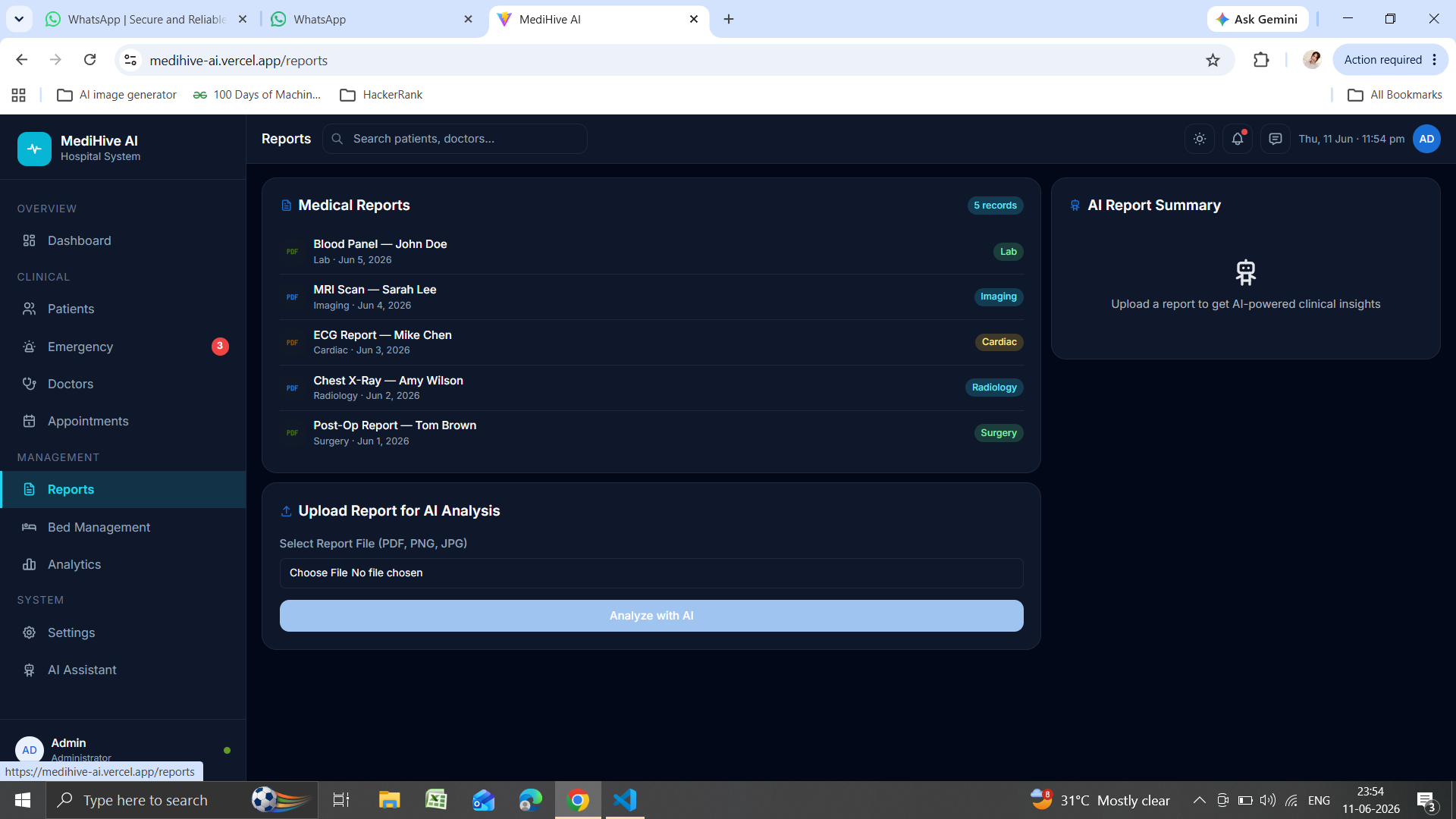
- Medical report analysis
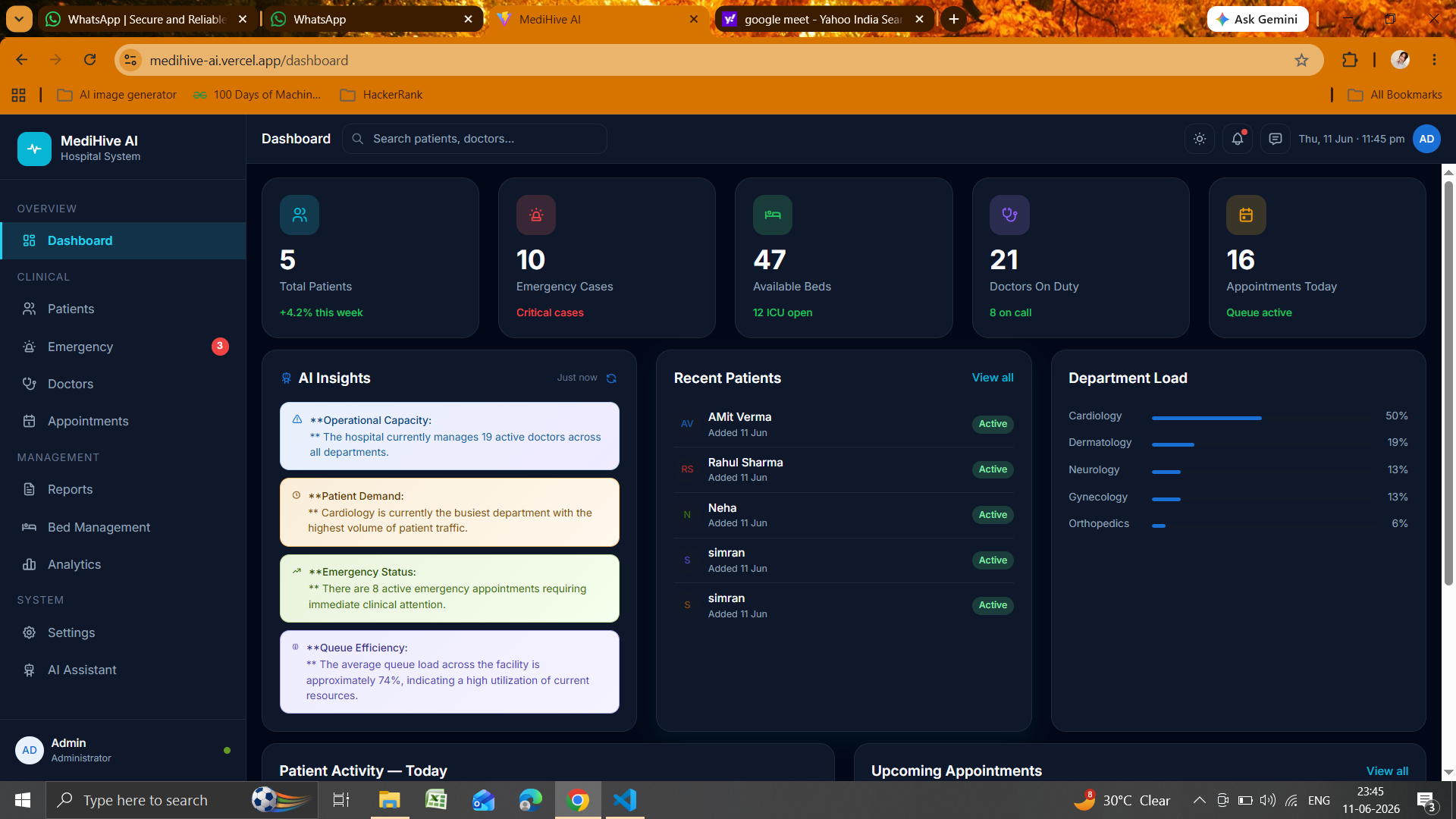
- Queue management
- Financial and billing management
Instead of relying on a single AI model, MediHive AI uses an Agentic Architecture, where each AI agent is responsible for a specific task and collaborates with other agents to provide accurate and efficient healthcare support.
The Problem We Are Solving
Modern hospitals face several operational challenges:
Long Waiting Times
Patients often spend hours waiting before being assigned to the correct department or doctor.
Manual Triage
Severity assessment is usually performed manually, creating bottlenecks during high patient volume periods.
Delayed Emergency Identification
Critical patients may not always receive immediate attention due to overloaded hospital workflows.
Administrative Burden
Appointment scheduling, report handling, and billing consume significant staff resources.
Fragmented Patient Journey
Patients often navigate multiple systems and departments before receiving proper treatment.
These inefficiencies impact both healthcare providers and patients.
How MediHive AI Works
Step 1: Patient Registration
The patient enters symptoms and personal information through the MediHive AI platform.
Example:
- Chest pain
- Fever
- Dizziness
- Shortness of breath
Step 2: Symptom Analysis Agent
The Symptom Analysis Agent processes the patient's input and converts unstructured symptom descriptions into structured medical data.
This creates a standardized medical profile that can be used by downstream agents.
Step 3: Triage & Severity Agent
The Triage Agent evaluates symptom severity and classifies cases into:
- Low Priority
- Medium Priority
- High Priority
This enables hospitals to prioritize resources effectively.
Step 4: Department Routing Agent
Based on symptom patterns and severity, the Department Routing Agent recommends the most appropriate department.
Examples:
- Cardiology
- Neurology
- Orthopedics
- General Medicine
- Emergency Care
This reduces patient confusion and improves hospital efficiency.
Step 5: Emergency Detection Agent
For high-risk cases, the Emergency Detection Agent continuously evaluates warning indicators.
If critical symptoms are detected, the system:
- Flags the patient immediately
- Escalates priority level
- Notifies emergency workflows
This helps reduce response time for urgent medical situations.
Step 6: Appointment Scheduling Agent
The Appointment Agent checks:
- Doctor availability
- Department schedules
- Existing queue status
It automatically assigns the most suitable appointment slot while minimizing waiting times.
Step 7: Report Analysis Agent
Medical reports can often be difficult to interpret.
The Report Analysis Agent extracts key findings and presents concise summaries, enabling quicker review by healthcare professionals.
Step 8: Finance & Billing Agent
The Finance Agent manages:
- Billing records
- Payment tracking
- Revenue monitoring
- Financial reporting
This reduces administrative workload and improves operational transparency.
How We Built It
MediHive AI was built using Google Agent Development Kit (ADK), Google Gemini, MongoDB, Node.js, and React.js.
Using Google ADK, we created multiple specialized AI agents for symptom analysis, triage, department routing, emergency detection, appointment scheduling, and report analysis. These agents collaborate to automate the entire patient journey and hospital workflow.
MongoDB was used to store patient records, appointments, AI-generated assessments, medical reports, and billing data in a flexible and scalable document-based database, making it ideal for handling diverse healthcare information.
The result is an intelligent multi-agent healthcare platform that improves efficiency, reduces manual workload, and enhances patient care. 🚀🏥
Frontend
- React.js
- Tailwind CSS
- ShadCN UI
Backend
- Node.js
- Express.js
Database
- MongoDB
AI & Agent Framework
Google Gemini Google Agent Development Kit (ADK) Multi-Agent Orchestration
Deployment
- Vercel
- Render
The system follows a modular multi-agent architecture, allowing each AI agent to independently perform its task while collaborating with others to deliver end-to-end healthcare automation.
Challenges We Ran Into
Designing Agent Collaboration
One of the biggest challenges was creating smooth communication between multiple AI agents while maintaining consistency across decisions.
Accurate Department Routing
Different symptoms can belong to multiple departments. Designing reliable routing logic required careful prompt engineering and workflow design.
Emergency Detection
Balancing sensitivity and accuracy was critical. The system needed to identify urgent cases without generating excessive false alarms.
Real-Time Hospital Workflows
Integrating appointments, queues, patient management, and AI reasoning into a unified experience required extensive architecture planning.
Accomplishments That We Are Proud Of
- Built a complete Agentic AI healthcare platform.
- Implemented multiple specialized AI agents working together.
- Automated symptom analysis and patient triage.
- Developed emergency detection workflows.
- Created intelligent department routing.
- Integrated appointment and queue management.
- Designed a scalable architecture for future hospital deployments.
Most importantly, we demonstrated how AI can support healthcare professionals instead of replacing them.
What We Learned
Through this project, we gained valuable experience in:
- Agentic AI system design
- Multi-agent collaboration workflows
- Healthcare workflow automation
- Prompt engineering
- Full-stack application development
- Real-world healthcare problem solving
We also learned that successful healthcare AI requires more than accurate predictions—it requires seamless integration into existing hospital operations.
What's Next for MediHive AI
Our vision is to evolve MediHive AI into a comprehensive healthcare ecosystem.
Future plans include:
- Voice-based patient interaction
- AI-powered doctor assistant
- Electronic Health Record (EHR) integration
- Real-time hospital analytics dashboards
- Multi-hospital deployment support
- Mobile application support
- Wearable device integration
- AI-powered patient follow-up system
Our ultimate goal is to create a smarter, faster, and more accessible healthcare experience powered by intelligent AI agents.
Built With
- React.js
- Node.js
- Express.js
- MongoDB
- Google Gemini
- Tailwind CSS
- ShadCN UI
- Vercel
- Render *Google Agent development kit
MediHive AI — Empowering Healthcare Through Intelligent Agents.
Built With
- agentic
- ai
- api
- cssnode.js
- express.js
- gemini
- google-agent-development-kit
- javascript
- jsonwebtoken
- mongodb
- multer
- react.js
- shadcn
- tailwind
- vercel


Log in or sign up for Devpost to join the conversation.