-
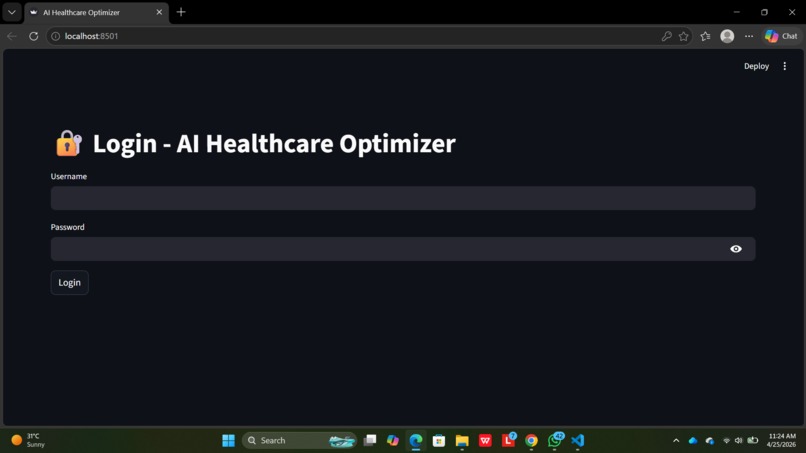
Login Page
-
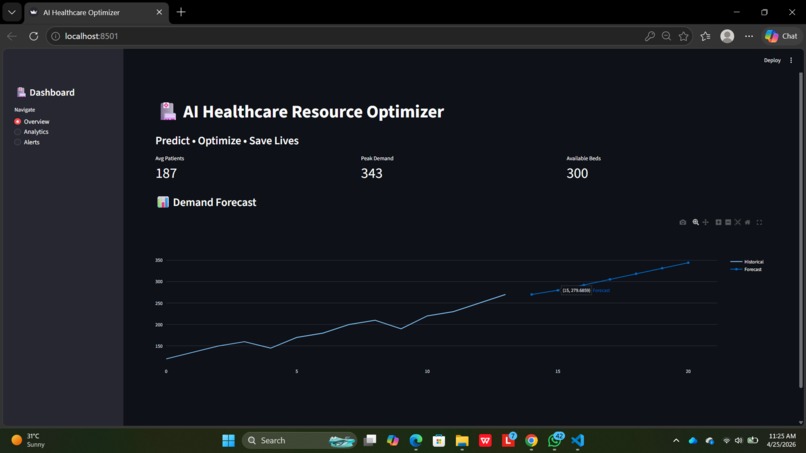
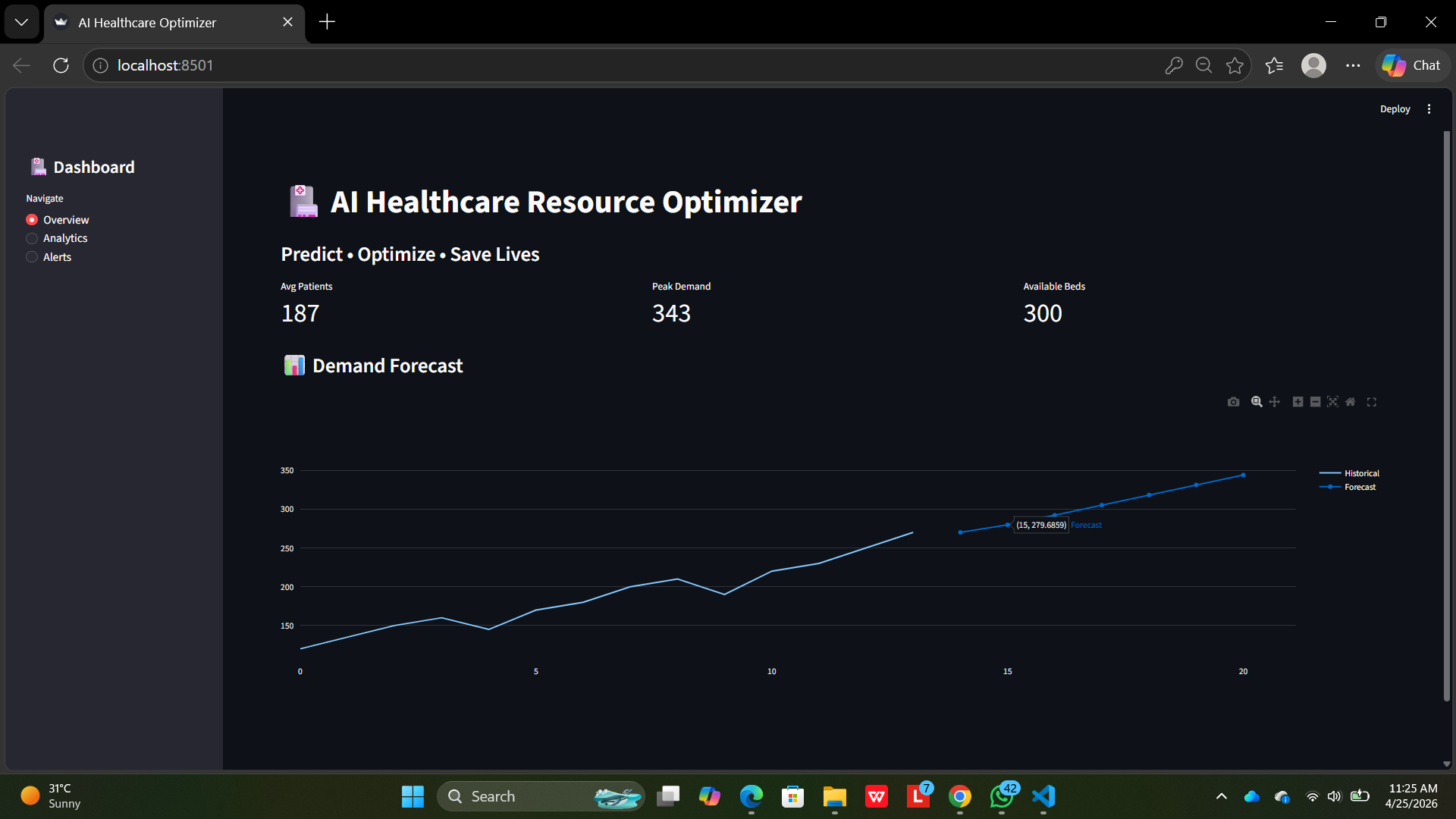
Dashboard
🧠 Inspiration
Hospitals often struggle with unpredictable patient demand, leading to overcrowding, long waiting times, and inefficient use of resources like beds and staff.
Seeing this gap inspired us to build a system that can predict demand and optimize resource allocation using AI, helping hospitals make smarter decisions.
💡 What it does
AI Healthcare Resource Optimizer is an intelligent system that:
- 📊 Predicts patient inflow using time-series forecasting
- 🛏 Optimizes allocation of hospital beds and staff
- ⚠️ Provides alerts for resource shortages
- 📈 Improves operational efficiency and reduces waiting time
⚙️ How we built it
We designed the system in three main stages:
Data Processing
- Cleaned and structured historical healthcare data
- Cleaned and structured historical healthcare data
Prediction Model
- Used ARIMA to forecast future patient demand
- Used ARIMA to forecast future patient demand
Optimization Engine
- Applied mathematical optimization to allocate resources efficiently
- Applied mathematical optimization to allocate resources efficiently
Dashboard (UI)
- Built using Streamlit for real-time visualization
- Built using Streamlit for real-time visualization
The prediction model is based on time-series forecasting:
$$ y_t = c + \phi_1 y_{t-1} + \phi_2 y_{t-2} + \dots + \epsilon_t $$
🚧 Challenges we ran into
- Handling inconsistent and limited healthcare datasets
- Balancing prediction accuracy with simplicity
- Designing a clean and understandable dashboard
- Integrating prediction with optimization logic
🏆 What we learned
- Practical use of AI in real-world healthcare problems
- Importance of combining ML with optimization techniques
- Building end-to-end systems from data to UI
- Presenting complex ideas in a simple and clear way
🚀 Future scope
- Real-time hospital integration
- Advanced ML models for higher accuracy
- Mobile app for hospital staff
- Integration with IoT healthcare devices
🌍 Impact
This system can help hospitals:
- Reduce overcrowding
- Improve patient care
- Optimize resource usage
- Make data-driven decisions
Ultimately, it contributes to smarter, more efficient healthcare systems.
Built With
- arima
- decision
- linear
- numpy
- pandas
- programming
- python
- scikit-learn
- streamlit
- tree
- xgboost


Log in or sign up for Devpost to join the conversation.