-
-
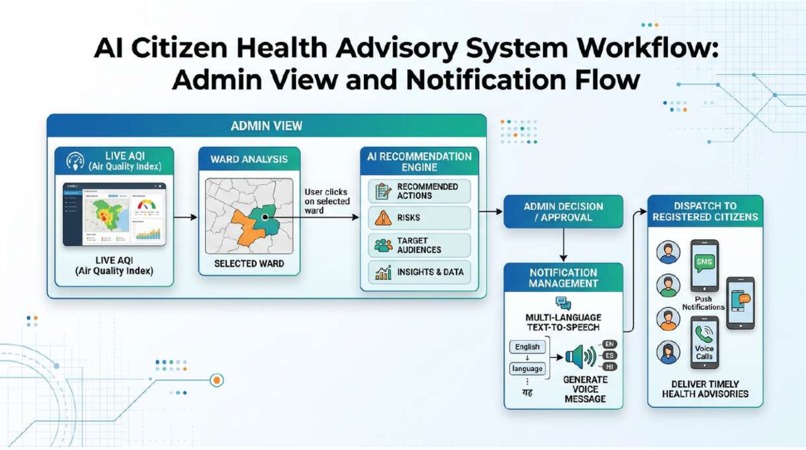
Workflow
-
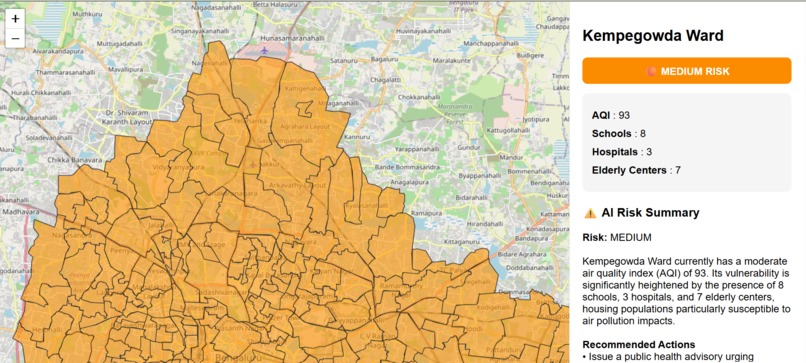
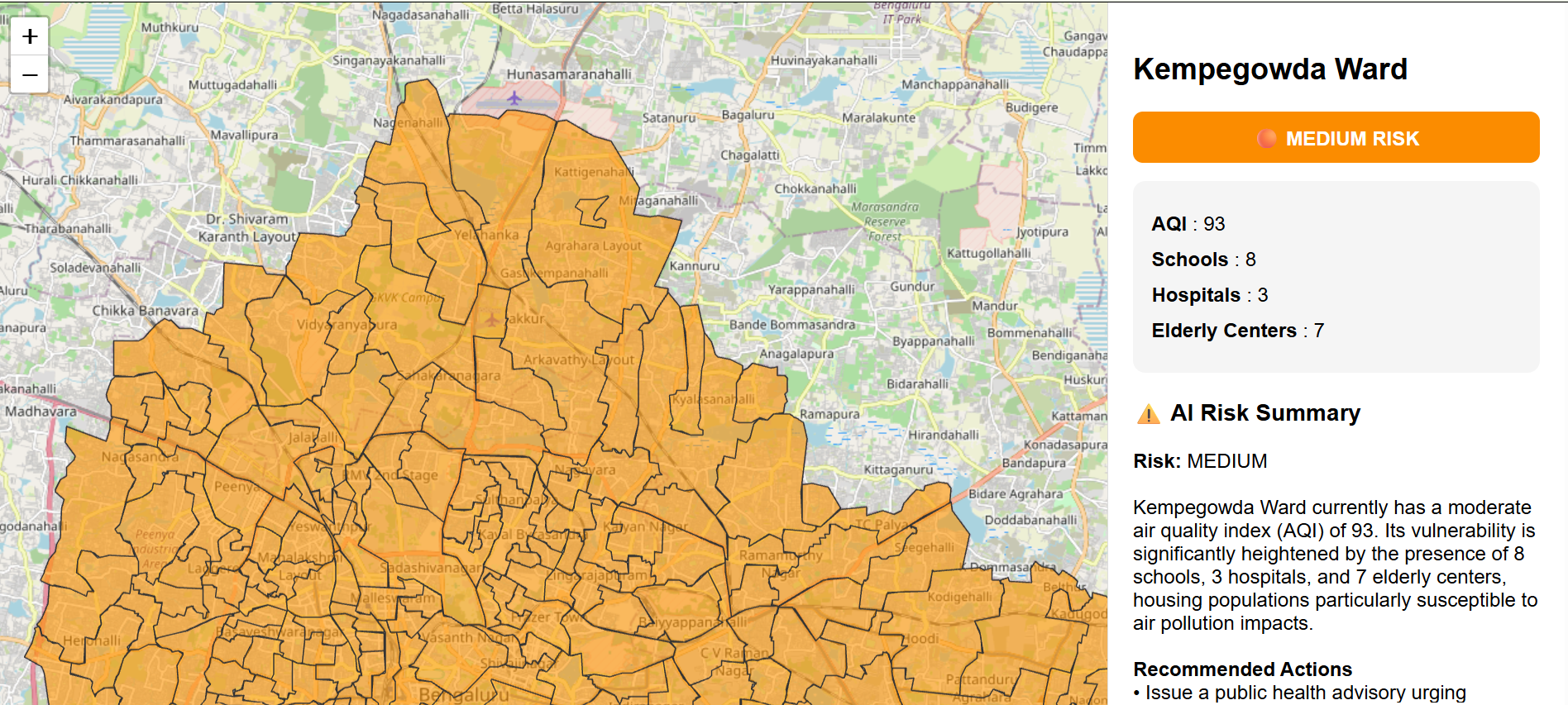
Admin Dashboard
-
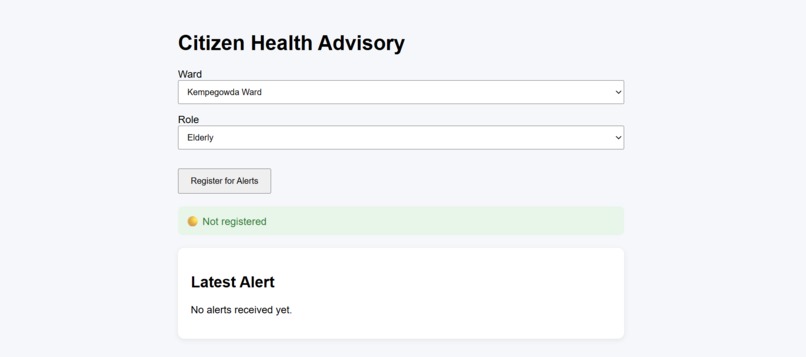
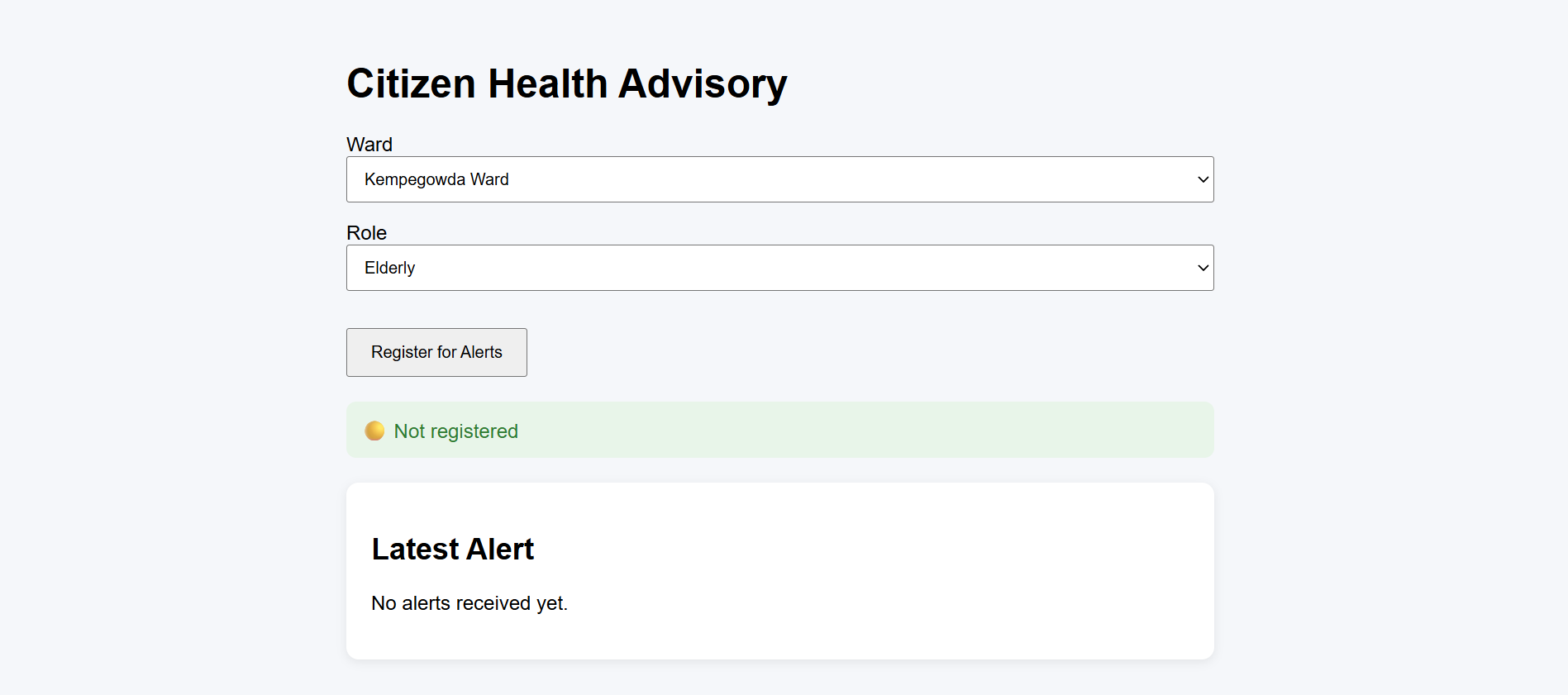
User Screen
Inspiration
Urban air spikes trigger acute respiratory emergencies every year. While high-precision monitoring stations capture toxic particulate spikes in real time, official public warnings arrive hours late, remain generic, and are published as text-heavy bulletins in English.
To an asthmatic child or a non-literate laborer, dangerous particulate thresholds:
$$\text{PM}_{2.5} \ge 250\ \mu\text{g/m}^3$$
are completely meaningless. We were inspired to turn raw atmospheric telemetry into instant, actionable, mother-tongue guidance for vulnerable citizens.
What it does
AeroHealth AI connects live air monitoring directly with automated civic protection:
- Ward-Level Mapping: Visualizes real-time AQI overlays on an interactive municipal ward map, pinpointing schools, hospitals, and eldercare facilities.
- Contextual Health Guidance: Gemini AI translates raw pollutant data into clinical, demographic-tailored precautions for students, seniors, and outdoor laborers.
- 1-Click Multilingual Voice Dispatch: City authorities can review AI recommendations on a dashboard and push localized voice advisories and notifications directly to citizens' phones in under 30 seconds.
How we built it
- Frontend & GIS: Built with React and Leaflet.js using OpenStreetMap layers to render ward polygons and critical infrastructure markers.
- Sensor Stream: Ingests live ambient pollutant metrics (PM₂.₅, PM₁₀, NO₂, O₃) via the WAQI API.
- Risk Engine: Computes a ward-level vulnerability index accounting for infrastructure density:
$$R_w = \left(\frac{\text{AQI}w}{\text{AQI}{\text{threshold}}}\right) \times \left(1 + \sum_{k} \omega_k \frac{N_{k, w}}{A_w}\right)$$
- Intelligence & Voice: The Gemini API generates structured, localized advisory scripts, which Google Cloud Text-to-Speech converts into natural regional audio broadcasts.
- Distribution: Managed through Firebase Cloud Messaging (FCM) topic-based pub/sub channels for instant delivery.
Challenges we ran into
- Spatial Interpolation: Sensor stations rarely align with administrative ward polygons; we implemented inverse-distance-weighted spatial interpolation to calculate representative ward averages in real time.
- Zero-Hallucination Guardrails: Health advisories cannot afford clinical ambiguity; we engineered strict JSON schemas and system prompts in Gemini to ensure deterministic medical recommendations.
- Low-Latency Audio Streaming: Delivering synchronous multilingual audio on the fly risked pipeline delays; we introduced asynchronous voice synthesis batching to keep the full dispatch cycle under 30 seconds:
$$T_{\text{dispatch}} = T_{\text{infer}} + T_{\text{TTS}} + T_{\text{FCM}} < 30\text{ s}$$
Accomplishments that we're proud of
- 30-Second Emergency Pipeline: Reduced the civic delay between toxic spike detection and public broadcast from hours to under 30 seconds.
- Universal Accessibility: Completely eliminated the literacy and language barrier by prioritizing native-language voice broadcasts.
- Civic-Grade Human-in-the-Loop UX: Designed an intuitive dashboard giving city officers one-click authorization over AI suggestions, preventing accidental public panic.
What we learned
- Civic Tech is an Equity Challenge: Complex AI is useless if advice cannot be understood by a daily-wage earner who speaks only a local dialect—voice-first design is essential.
- Grounded Prompts Win: Feeding Gemini infrastructure context (such as the number of schools nearby) transforms generic warnings into tactical, life-saving municipal playbooks.
What's next for AeroHealth AI
- Predictive Forecasting: Incorporating wind vector and microclimate models to predict ward pollution spikes 6 to 12 hours before they occur.
- Interactive IVR & WhatsApp Dispatch: Automated outbound voice calls (IVR) and WhatsApp Business bot integration to reach basic feature phones without app installs.
- Hospital Surge Prediction: Linking ward vulnerability scores directly to municipal hospital ER systems to forecast asthma and cardiac admission surges.

Log in or sign up for Devpost to join the conversation.