-
-
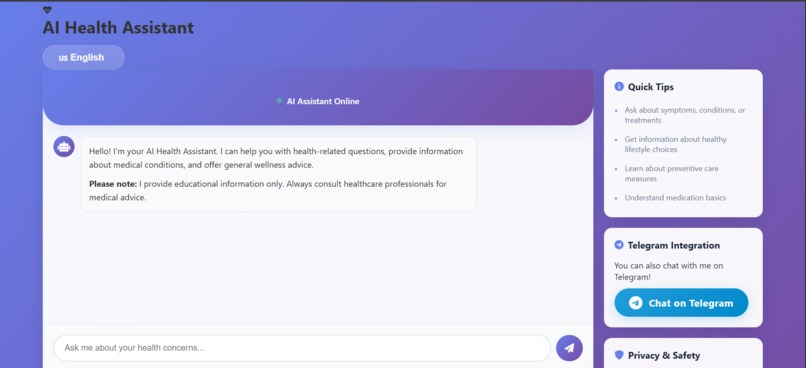
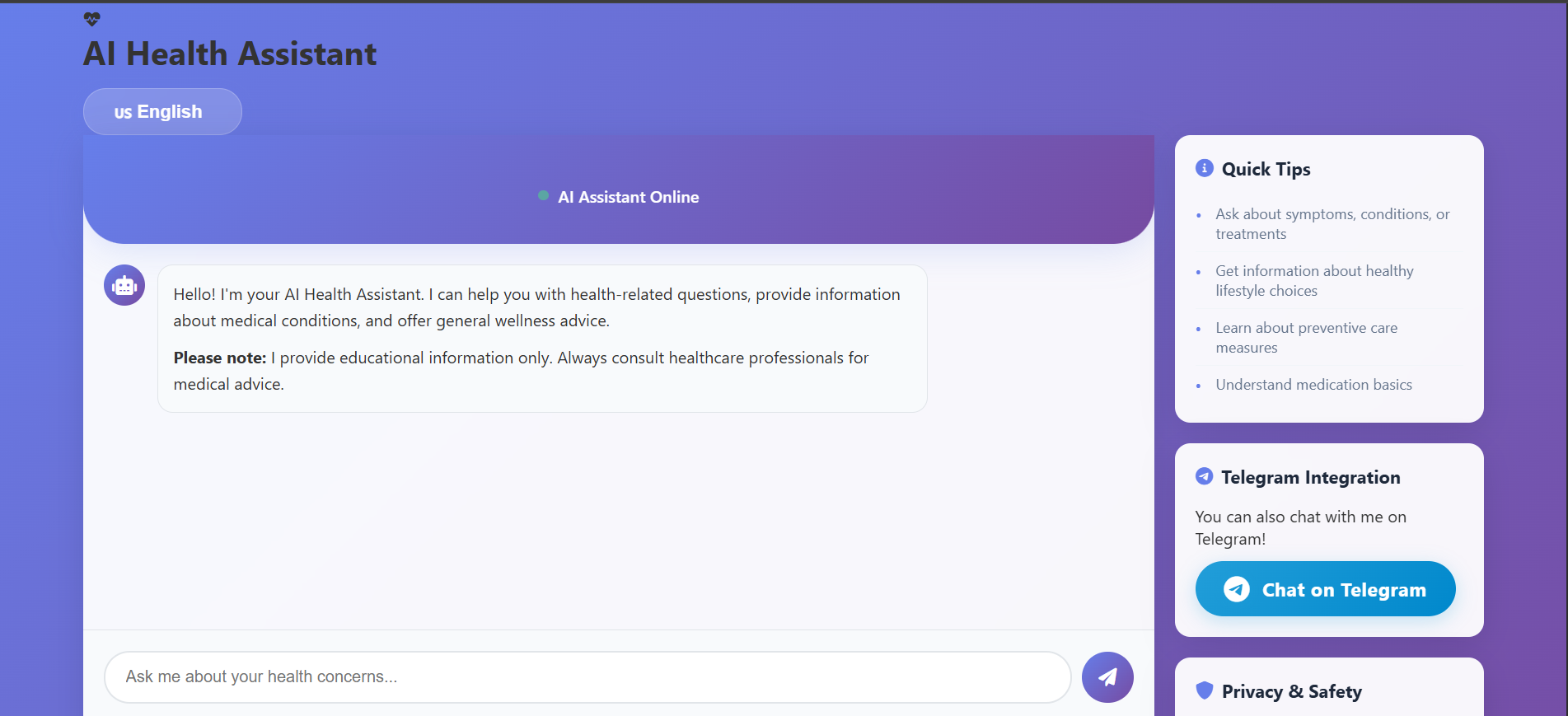
This is the main page of our chatbot
-
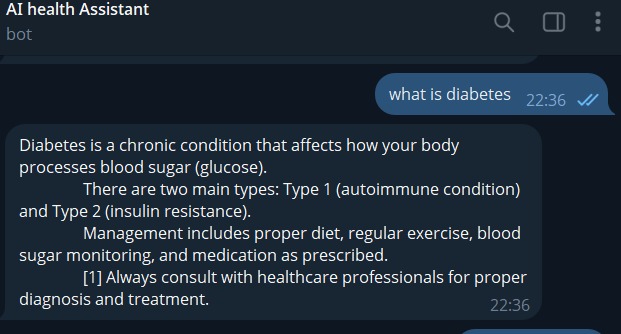
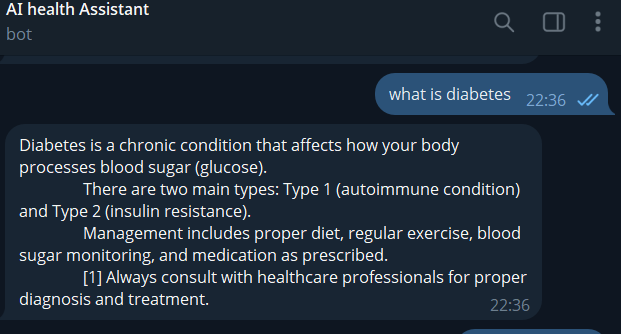
this is our telegram bot
About the Project: AI Health Assistant
Inspiration
The inspiration for this project stemmed from observing how many individuals struggle to access basic health information and timely medical advice, especially in remote or underserved areas. The rapid advancement in artificial intelligence and natural language processing made me wonder: could an AI-powered assistant bridge this gap, providing reliable health guidance and personalized recommendations to users at any time, from anywhere?
What I Learned
During the development of the AI Health Assistant, I delved deep into several domains:
- Natural Language Processing (NLP): I gained hands-on experience with NLP libraries and models, learning how to fine-tune them to understand user queries, medical terminology, and contextual nuances.
- Healthcare Data Management: I learned how to responsibly handle sensitive health data, implementing privacy safeguards and ensuring compliance with data protection standards.
- User Experience Design: I explored how conversational interfaces can guide users, and how to design flows that feel natural while being informative and empathetic.
- Machine Learning Fundamentals: Building and evaluating models for symptom checking and health advice reinforced concepts like supervised learning, model evaluation metrics, and feature engineering.
- Math Behind the Models: For instance, understanding loss functions, optimization algorithms, and the concept of gradient descent:
$$ \theta := \theta - \alpha \nabla_\theta J(\theta) $$ where ( \theta ) are model parameters, ( \alpha ) is the learning rate, and ( J(\theta) ) is the cost function.
How I Built the Project
Tech Stack Chosen:
- Python for backend logic and model deployment.
- Streamlit for interactive UI.
- OpenAI's GPT models for conversational AI.
- Integration with public health APIs for up-to-date medical information.
Development Workflow:
- Outlined user stories and key functionalities: symptom checker, health tips, personalized recommendations.
- Implemented the conversational engine, starting with basic intent recognition, then layering on more advanced NLP.
- Connected the assistant to external APIs to fetch real-time health data and advice.
- Iteratively tested the assistant with sample health queries, refining the dialogue and model responses.
- Added user feedback mechanisms and accessibility features.
Mathematical Modeling:
- Used logistic regression for binary classification tasks (e.g., risk assessment): $$ P(y=1|x) = \frac{1}{1 + e^{-(w^Tx + b)}} $$
- Applied decision trees for symptom triage.
Deployment:
- Containerized the application using Docker.
- Deployed on cloud platforms for scalability and availability.
Challenges Faced
- Data Quality: Ensuring the accuracy and reliability of health data was paramount. I had to rigorously vet sources and validate model outputs.
- Privacy and Security: Designing the system to handle sensitive health information required careful architectural choices and encryption practices.
- Conversational Robustness: Users express symptoms in myriad ways. Training the system to recognize intent and context, including ambiguous or incomplete inputs, was a continual challenge.
- Maintaining Empathy: Striking the right balance between clinical accuracy and supportive, empathetic interaction was an iterative process.
Conclusion
Building the AI Health Assistant was a rewarding journey, merging technology and empathy to create a tool that could make a real difference in people's lives. The combination of machine learning, conversational AI, and healthcare domain knowledge proved both challenging and fascinating. I hope this project inspires others to explore the intersection of AI and health for the greater good!
Built With
- css
- deep-translator
- fastapi
- html
- javascript
- python
- python-telegram-bot
- rag


Log in or sign up for Devpost to join the conversation.