-
-
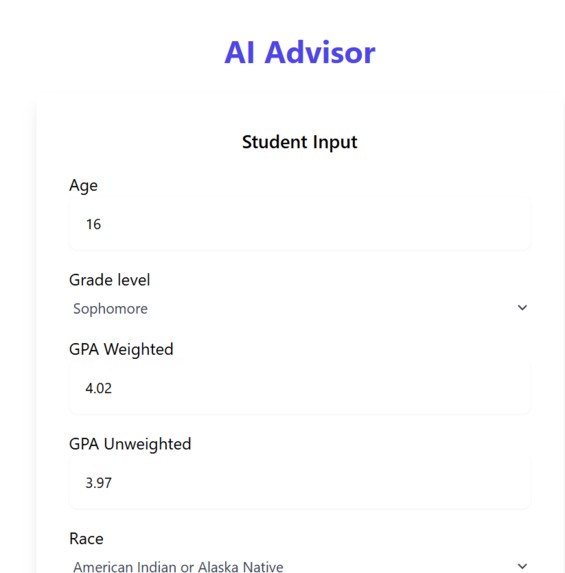
Main menu
-
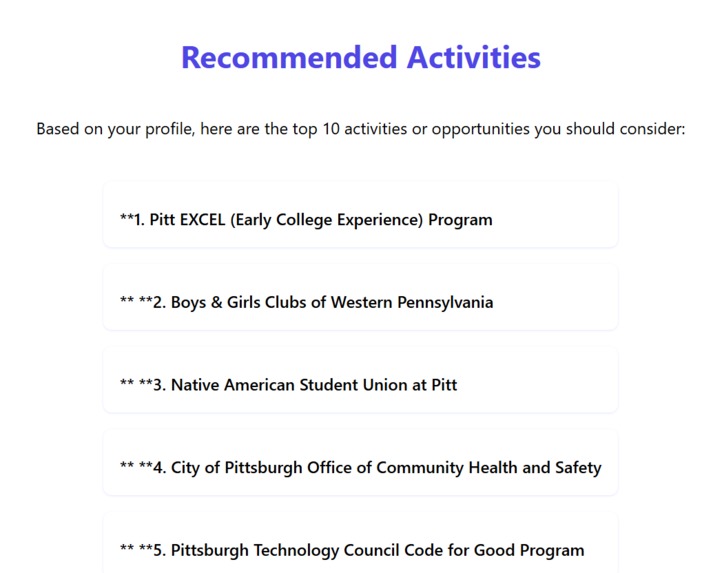
Activites Rec
-
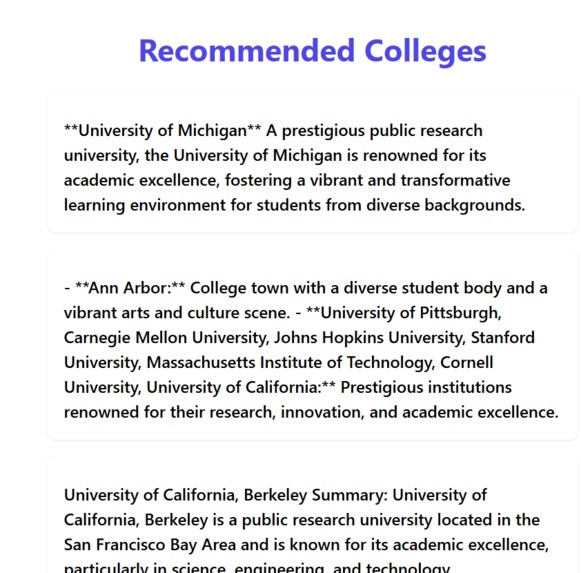
College rec
Inspiration
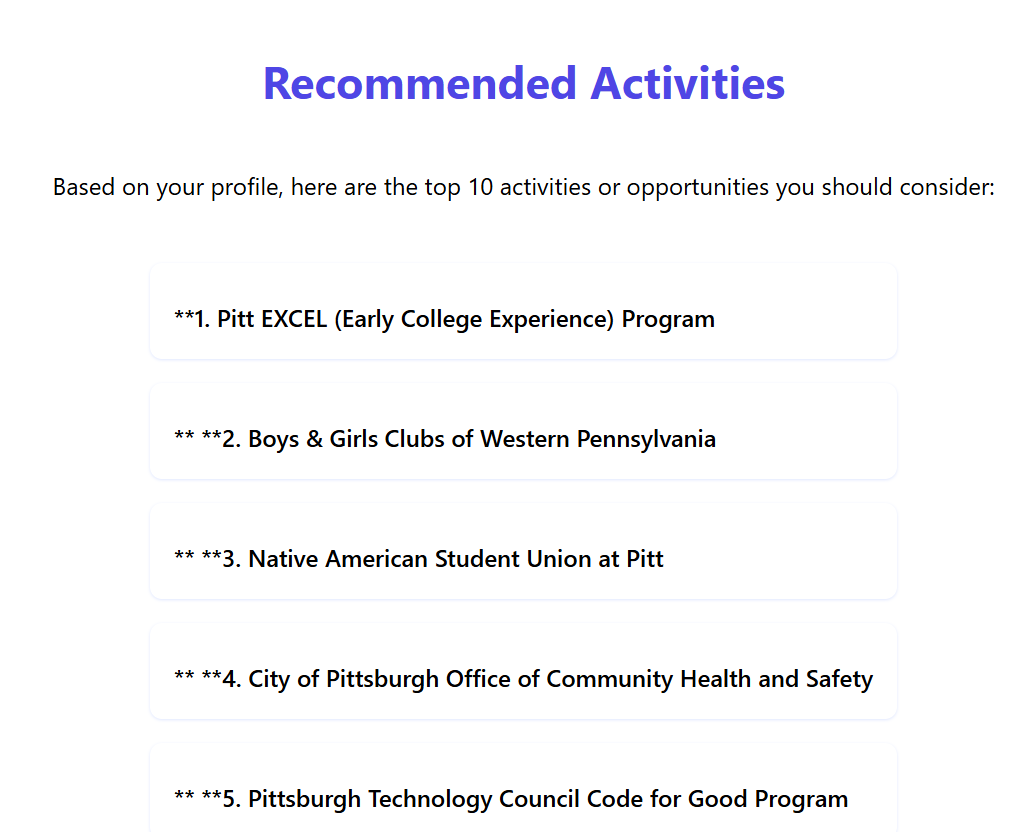
Our inspiration stemmed from a desire to democratize access to educational resources and opportunities for low-income students. Recognizing that these students often face barriers in navigating the complex landscape of academic and extracurricular opportunities, we aimed to create a tool that provides tailored guidance and support. The vision was to empower these students by leveraging cutting-edge AI technologies to deliver personalized, actionable recommendations that can significantly impact their educational and career trajectories.
What it does
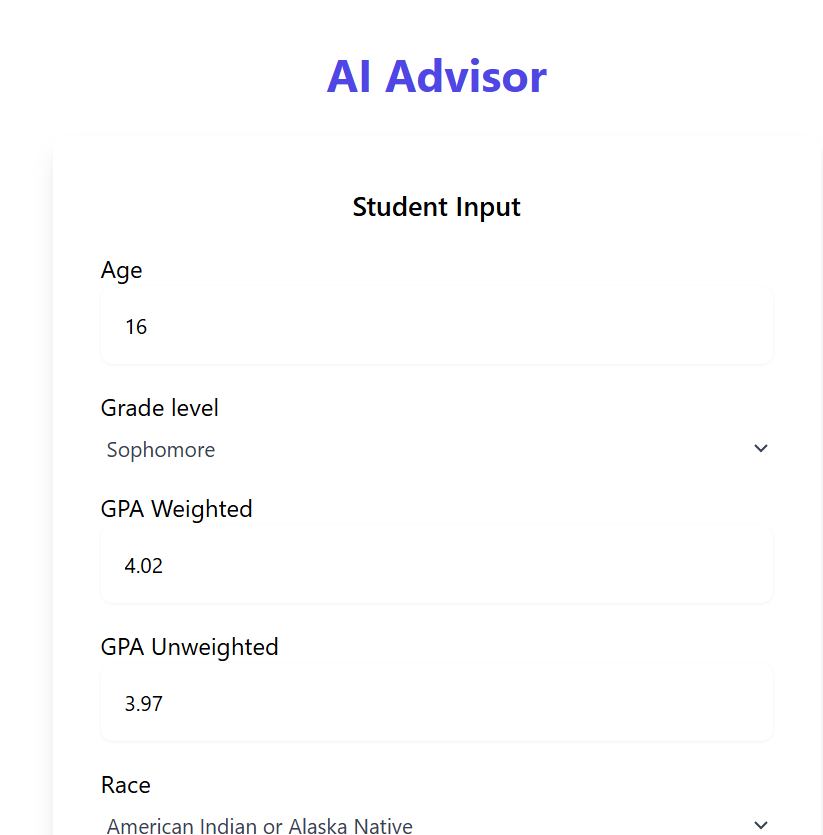
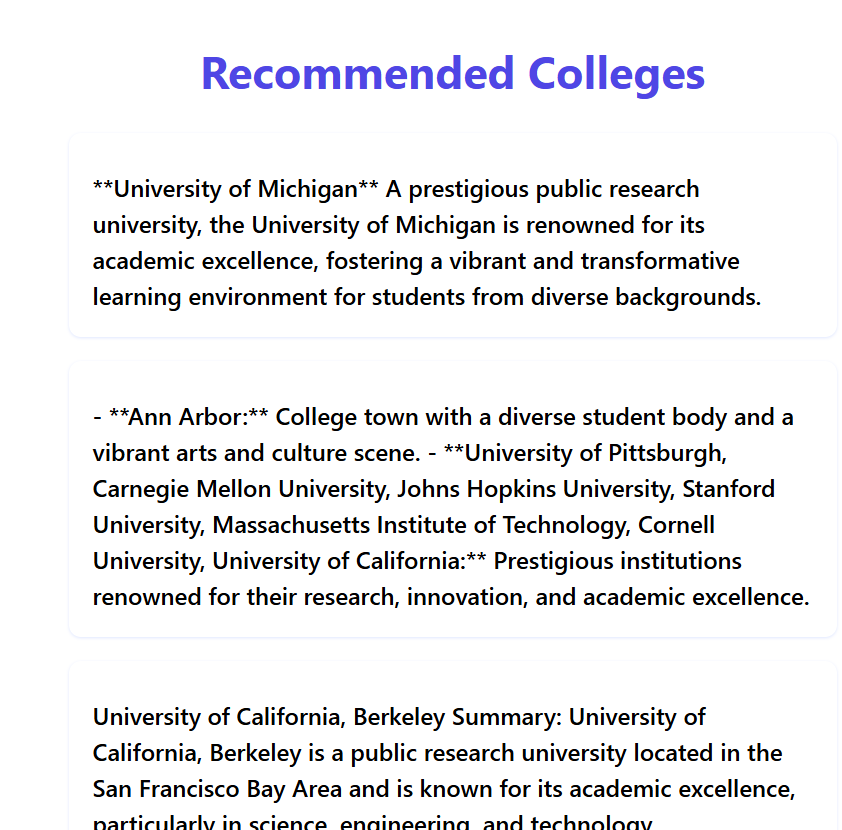
The AI Guidance for Low-Income Students tool is an innovative web application designed to assist high school students from low-income backgrounds in identifying and applying for suitable academic and extracurricular opportunities. By analyzing user profiles, which include academic performance, personal interests, and financial status, the tool generates customized recommendations for activities, programs, and colleges. It also processes and summarizes uploaded transcripts and resumes to provide actionable insights and guidance. Wolfram Technologies are integrated to enhance the application's ability to provide detailed information and analysis on colleges and other educational resources.
How we built it
We built the application using Flask for the backend, which handles user interactions and data processing. The AI components are powered by Google’s Generative AI models, which analyze user input and generate recommendations. Integration of these models was facilitated through the Google API, requiring secure API access setup. For data analysis and processing, we implemented direct interactions with user inputs, removing the need for static CSV files and allowing dynamic, real-time responses. Wolfram Technologies were incorporated through their API to provide in-depth information and analysis on educational institutions, enriching the recommendations and guidance offered. The frontend was crafted using Tailwind CSS to ensure a responsive and visually appealing user experience.
Challenges we ran into
One of the primary challenges was integrating the AI models effectively to handle diverse and complex user inputs. Ensuring that the system could process and analyze uploaded documents, such as transcripts and resumes, required significant refinement. Additionally, generating meaningful recommendations that are both realistic and tailored to low-income students posed a challenge, requiring us to fine-tune the AI prompts and outputs to align with our goals. Integrating Wolfram Technologies to provide accurate and detailed educational information added another layer of complexity, necessitating seamless API integration and effective data handling.
Accomplishments that we're proud of
We are proud of the tool's ability to deliver personalized and actionable recommendations based on a comprehensive analysis of user profiles. The seamless integration of AI technologies into a user-friendly web application exemplifies our commitment to leveraging advanced technology for social good. The incorporation of Wolfram Technologies to provide detailed information on colleges and educational resources significantly enhances the tool’s capability, offering users rich and relevant insights. The tool’s ability to process and summarize documents dynamically without relying on static datasets is a significant accomplishment, ensuring real-time and relevant guidance for users.
What we learned
Through this project, we gained valuable insights into the practical applications of generative AI and data analysis in educational technology. We learned how to effectively integrate AI models and external technologies, such as Wolfram, into a web application, manage and process user-generated data, and address the specific needs of low-income students. Additionally, we developed a deeper understanding of the challenges involved in generating customized recommendations and the importance of tailoring solutions to user contexts.
What's next for AI Guidance for Low-Income Students
Looking ahead, we plan to enhance the tool by incorporating additional AI capabilities and expanding the use of Wolfram Technologies to provide even more comprehensive educational insights. Future updates will focus on improving user experience, increasing accessibility, and expanding the range of opportunities and resources available through the platform. We also aim to establish partnerships with educational institutions and community organizations to further support and empower low-income students.


Log in or sign up for Devpost to join the conversation.