-
-
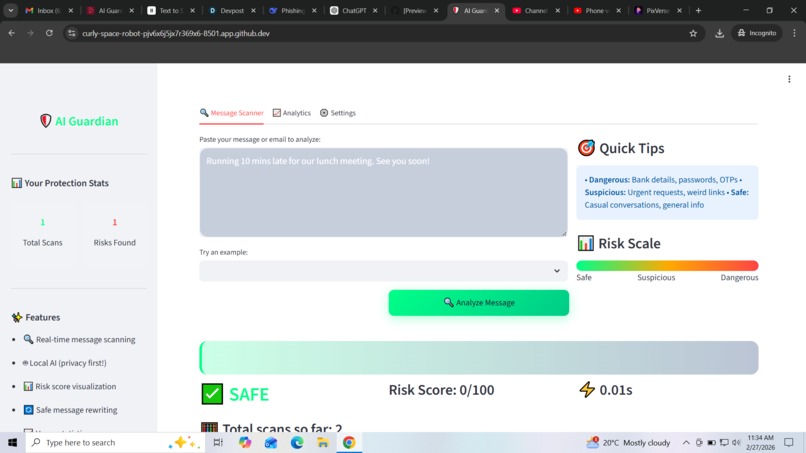
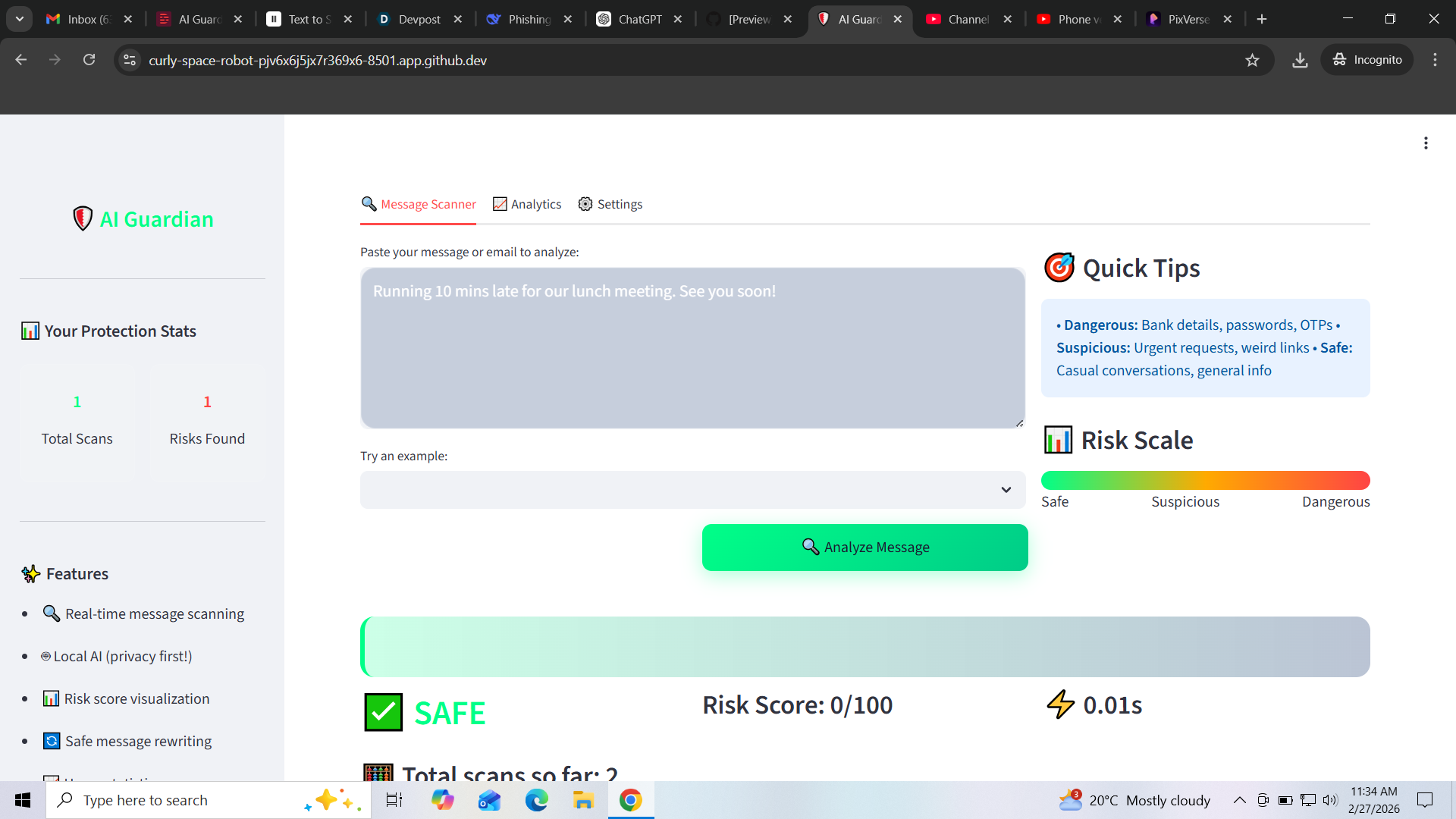
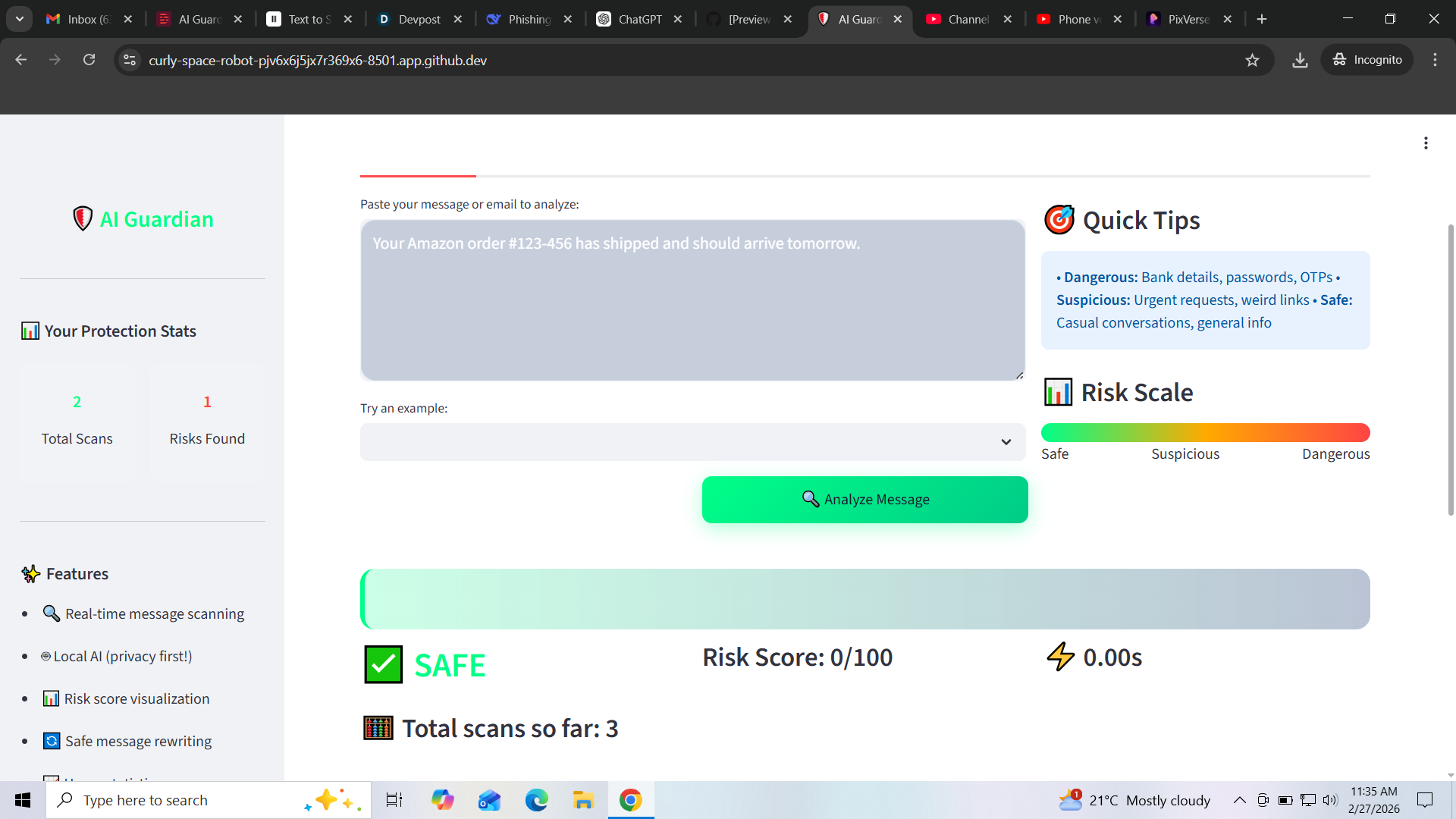
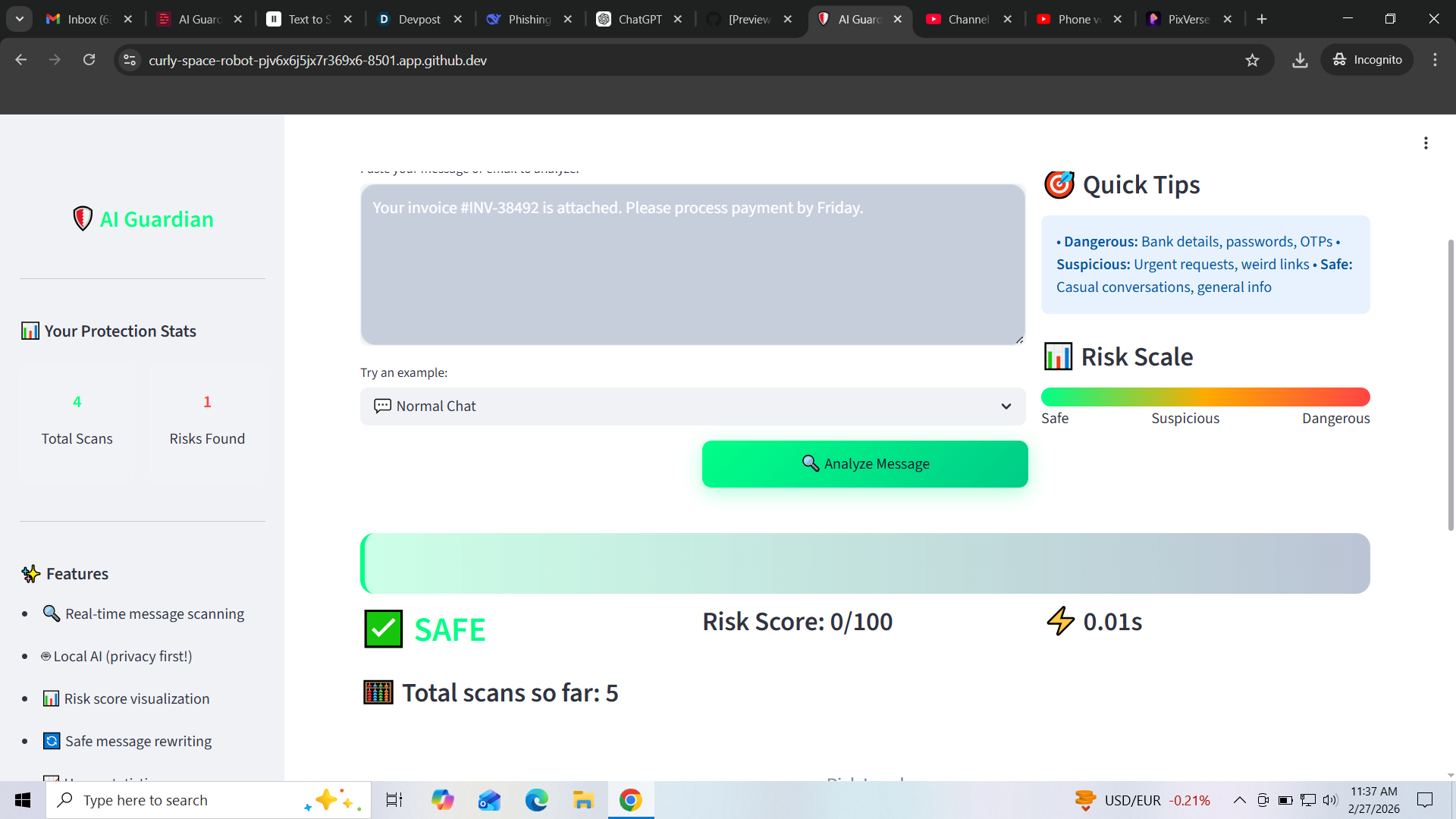
Safe message Detection
-
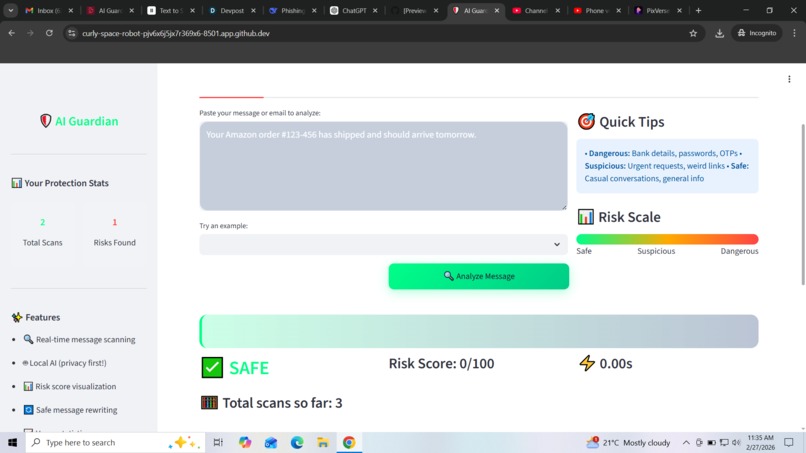
This is safe message Detection
-
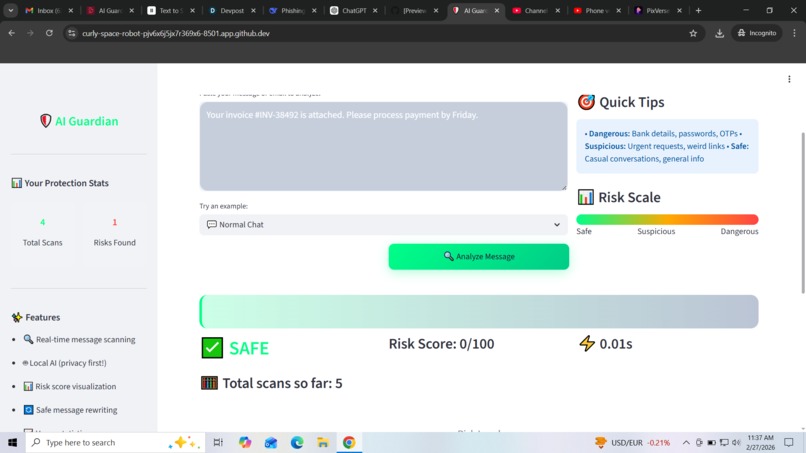
Edge-case ambiguous samples
-
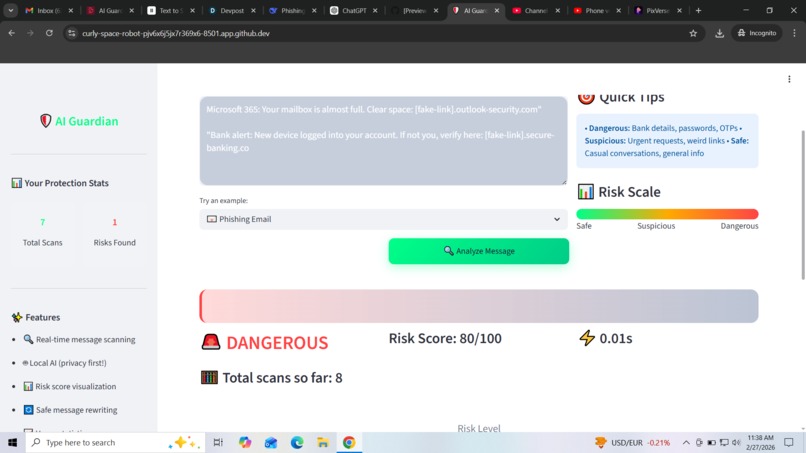
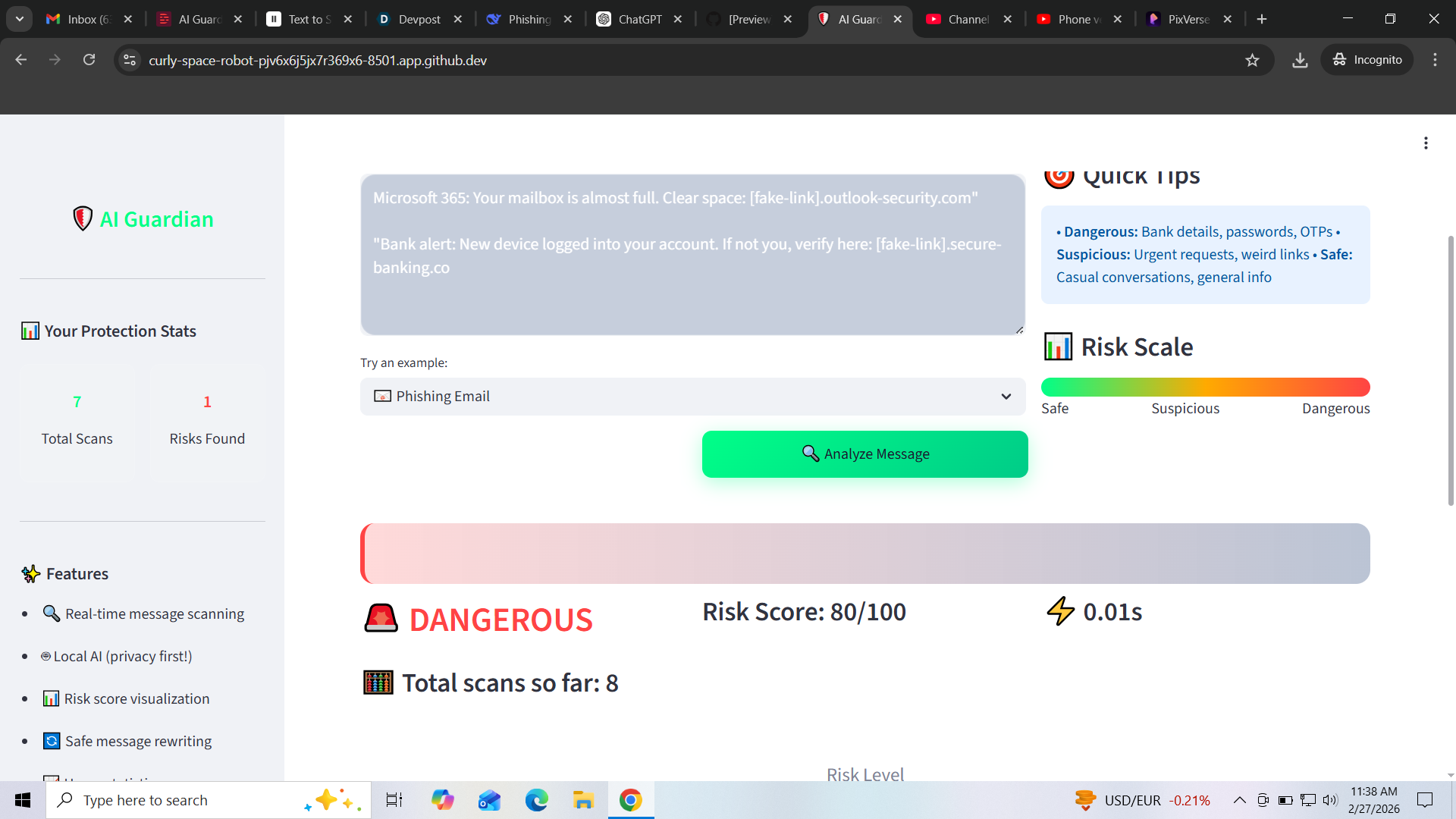
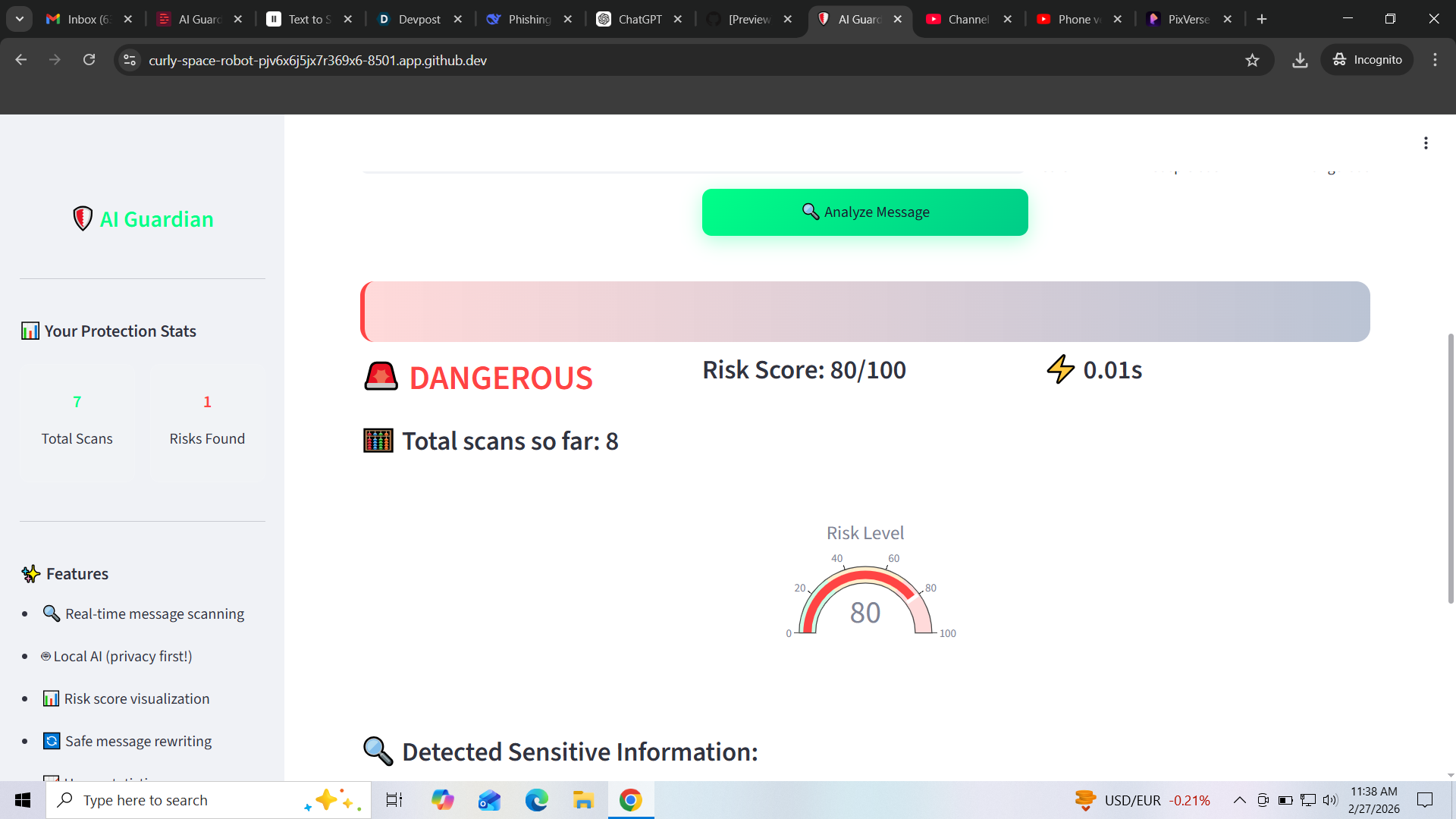
realistic phishing messages that attempt to trick users into sharing passwords, OTPs, or bank details.
-
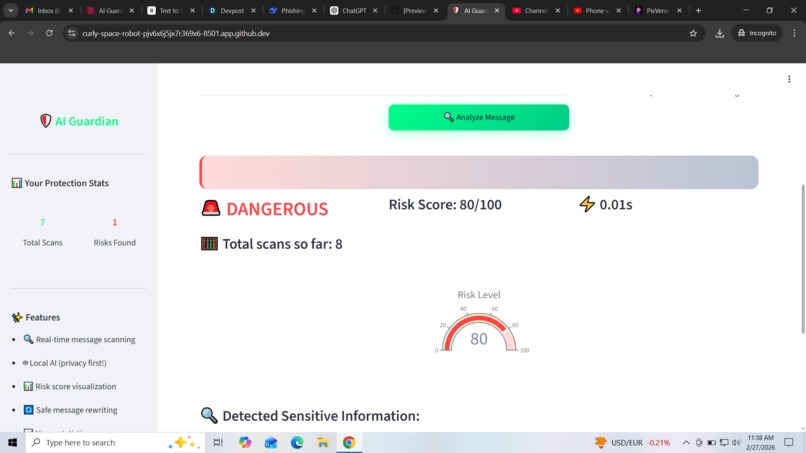
realistic phishing messages that attempt to trick users into sharing passwords, OTPs.
-
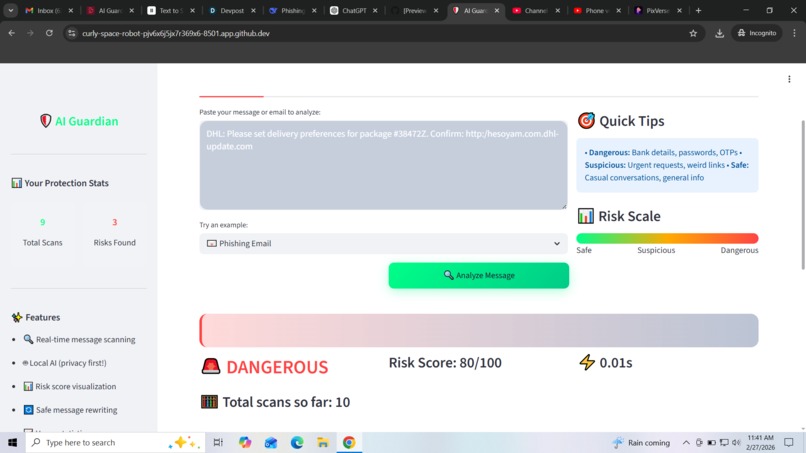
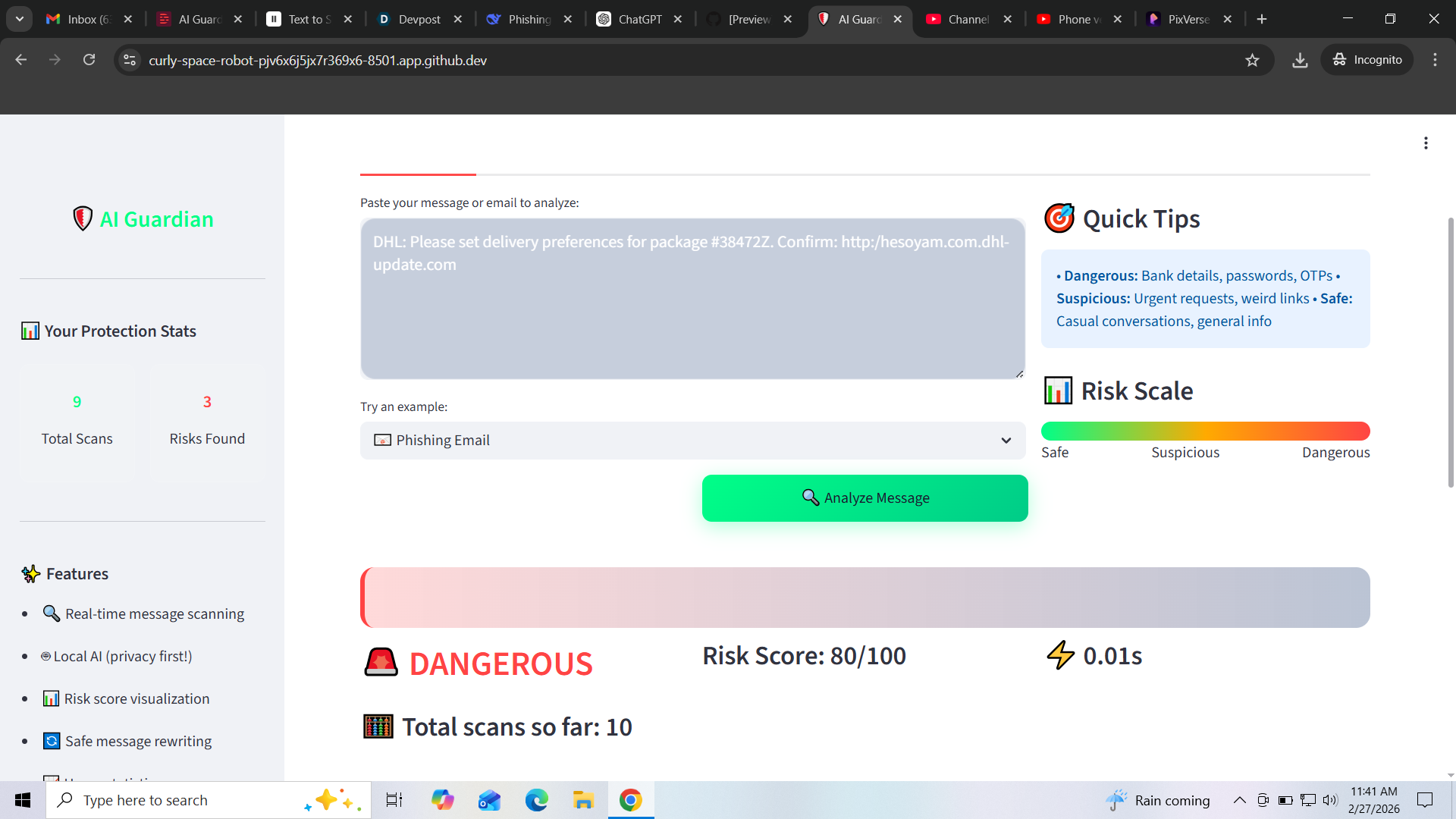
Real scam
Inspiration
Every day, millions of people accidentally share sensitive information online – bank details, OTPs, passwords, and personal data. Grandparents fall for phishing emails, small businesses leak customer data, and teenagers share too much on social media. I wanted to build something that protects everyone, especially those who aren't tech-savvy.
What it does
I built AI Guardian as a privacy-first solution using 100% local AI – no cloud, no data leaks, no API costs.
How we built it
- Backend: Python + FastAPI for lightning-fast API endpoints
- Frontend: Streamlit for beautiful, interactive dashboard
- AI: Ollama + Llama 3.2 (runs completely locally!)
- Visualization: Plotly for stunning risk gauges and analytics
- Deployment: GitHub Codespaces (fully reproducible)
The architecture is simple but powerful:
- User pastes text in the dashboard
- FastAPI sends it to local Llama 3.2 model
- AI analyzes for risks (phishing, leaks, PII)
- Returns risk score + safe rewrite + security tips
- Dashboard visualizes everything beautifully
Challenges we ran into
The biggest challenge was making the local LLM fast enough for real-time use. I solved this by:
- Implementing model caching (loads once, stays in memory)
- Using smaller, optimized models (Llama 3.2 3B)
- Adding smart timeout handling
- Creating fallback keyword detection when AI is warming up
Another challenge was making the dashboard beautiful AND functional. I spent hours on CSS gradients, animations, and the perfect color scheme (green = safe, orange = suspicious, red = dangerous).
Accomplishments that we're proud of
Every day, millions of people accidentally share sensitive information online – bank details, OTPs, passwords, and personal data. Grandparents fall for phishing emails, small businesses leak customer data, and teenagers share too much on social media. I wanted to build something that protects everyone, especially those who aren't tech-savvy.
I was inspired by stories of people losing their life savings to phishing scams and friends accidentally sharing passwords in Discord chats. The problem isn't that people are careless – it's that we don't have simple tools to check messages BEFORE sending them. AI Guardian solves this with a beautiful, easy-to-use dashboard that runs completely offline.
What we learned
This project was an incredible learning journey across multiple domains:
Technical Skills
- FastAPI : Building production-ready REST APIs with automatic documentation
- Streamlit : Creating beautiful, interactive dashboards with custom CSS
- Ollama Integration : Running local LLMs without cloud dependencies
- Plotly: Designing custom gauges, charts, and data visualizations
- Error Handling : Managing timeouts, connection issues, and fallback systems
Session State : Tracking user history and analytics in Streamlit
AI/ML SkillsPrompt Engineering : Crafting prompts that get structured JSON responses
Model Caching : Loading models once to avoid repeated startup delays
Local LLMs : Understanding the trade-offs between cloud and local AI
JSON Parsing : Extracting structured data from free-text AI responses
Fallback Systems : Using regex when AI is warming up or slow
Cybersecurity Knowledge
Phishing Patterns : Recognizing common scam templates and urgent language
PII Detection : Identifying emails, phones, bank details, and SSNs
OTP Risks : Understanding why one-time passwords are dangerous to share
Social Engineering : How attackers manipulate people into sharing data
Privacy by Design : Building systems that never send data to the cloud
Design & UX
Color Psychology : Green for safe, orange for suspicious, red for dangerous
Glass-morphism : Creating modern, translucent UI elements
Responsive Design : Making dashboards work on different screen sizes
User Flow: Guiding users from pasting text to understanding results
Project Management
- Hackathon Planning: Delivering a complete project under deadline
- Solo Development: Managing all aspects from backend to frontend
- Documentation: Writing clear READMEs and submission materials
- Time Management: Prioritizing features that matter most to judges
Key Takeaways
- Local AI is the future of privacy – No data leaves your machine
- Beautiful UI matters – Judges and users judge by what they see first
- Fallbacks are essential – Always have a plan B when AI is slow
- Small models can do big things – Llama 3.2 3B is powerful enough
- Hackathons teach more than tutorials – Building real projects is the best learning
What's next for AI Guardian: Local AI Security
Phase 1: Browser Extension (Immediate - 2 Weeks)
- Chrome/Firefox Extension that scans emails and messages in real-time
- Right-click Context Menu – "Check with AI Guardian" for any selected text
- Gmail/Outlook Integration – Scan emails before sending
- Social Media Protection – Warn before posting sensitive info on Twitter, Facebook


Log in or sign up for Devpost to join the conversation.