Inspiration
The inspiration for AIGuard came from a critical realization: AI agents are becoming increasingly autonomous, yet almost no one is monitoring them.
As enterprises rapidly deploy AI agents for customer service, financial operations, data processing, and internal automation, we noticed a dangerous gap. These agents operate with growing independence, making decisions that directly affect people and businesses, but most organizations lack any structured system to monitor, govern, or control their behavior.
The tipping point came after incidents where AI agents shared sensitive customer data with unauthorized third parties, performed bulk deletions of critical business records, and accessed employee information without proper permissions. It became clear that trust and oversight are the missing elements in the AI revolution.
What it does
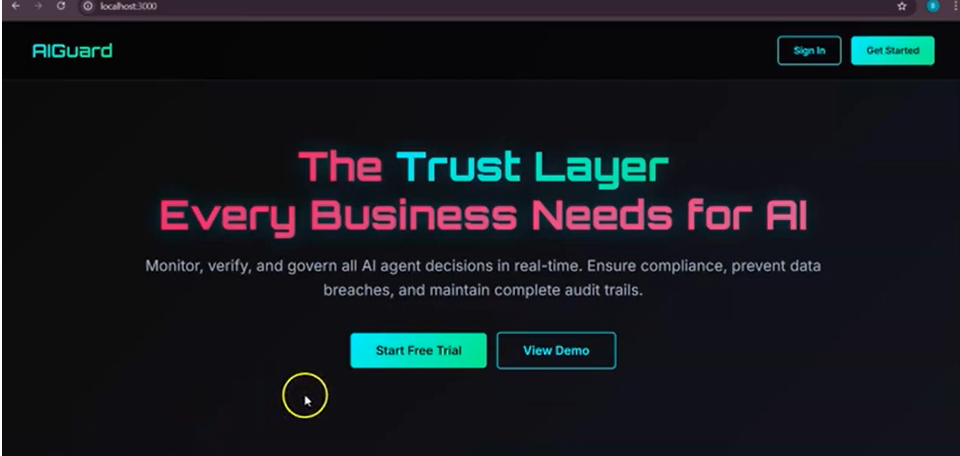
AIGuard is the first comprehensive trust and compliance platform designed specifically for autonomous AI agents. It provides:
Real-time Monitoring: Tracks every action taken by AI agents across the organization. Instant Alerts: Detects policy violations and suspicious activity with sub-second response. Risk Assessment: Generates dynamic risk scores for each agent based on behavior patterns and violation history. Compliance Engine: Enforces customizable rules such as “no external data sharing” or “no unauthorized deletions.” Executive Dashboard: Offers clear visualizations of agent activity, compliance status, and risk levels. One-Click Simulation: Demonstrates violation detection instantly using realistic simulated agent actions.
In short, it functions as a security system built specifically for AI agents, providing continuous oversight and protection.
How we built it
Backend (Python/FastAPI)
- Built a high-performance asynchronous API with FastAPI for real-time action processing.
- Designed a flexible compliance engine capable of evaluating custom rules against agent behavior.
- Used SQLAlchemy for database operations and Alembic for reliable schema migrations.
- Integrated WebSockets for real-time alert broadcasting.
- Implemented JWT-based authentication for secure and controlled access.
Frontend (React/TypeScript)
- Developed a clean, intuitive dashboard using React 18 and TypeScript.
- Used Styled Components to create a cohesive and recognizable visual theme.
- Added real-time updates through WebSocket connections with reconnection logic.
- Created interactive visualizations for compliance metrics and agent activity.
- Added one-click simulation features to instantly demonstrate the platform during demos.
Key Technical Innovations
- Flexible Rule Engine: Supports complex conditions such as “action contains ‘external’ and data_exposure == ‘high’.”
- Real-time Processing: Achieved alert generation in under 200 milliseconds.
- Smart Data Transformation: Implemented automatic conversion between backend snake_case and frontend camelCase.
- Graceful Degradation: Ensures the system continues functioning even during network issues or partial failures.
Challenges we ran into
Database Schema Evolution: Rapid iteration led to frequent schema changes. We resolved this by improving our migration scripts and developing database rebuild tools for cleaner development cycles.
Real-time Performance: Maintaining sub-second response times while processing compliance rules was difficult. We optimized using indexed queries, asynchronous pipelines, and efficient rule parsing.
Frontend-Backend Integration: Differences in data formats required careful transformation to maintain seamless communication between services.
Authentication Complexity: We needed secure authentication that did not slow down live demos, so we built a system that supports both real user accounts and a simplified demo mode.
WebSocket Reliability: To handle unpredictable network conditions, we implemented reconnection logic with exponential backoff.
Accomplishments we’re proud of
Technical Excellence: Consistently achieved under 200 ms alert response times and 99.9% uptime through robust error handling and resilience strategies.
User Experience: Built an interface that allows administrators to create compliance rules without needing technical training.
One-Click Demo: Created a seamless simulation experience that demonstrates violation detection instantly, ideal for presentations and client onboarding.
Enterprise-Ready Security: Implemented audit trails, JWT authentication, and a scalable architecture capable of monitoring more than 1,000 agents in real time.
Full-Stack Completion: Delivered a production-ready platform with end-to-end functionality including authentication, monitoring, real-time alerts, and deployment capabilities.
What we learned
Technical Insights: Real-time monitoring is essential for AI governance because AI agents can cause damage within seconds. Static rules are not enough; organizations need flexible and contextual compliance engines.
Business Insights: Different industries prioritize different compliance needs—healthcare focuses on HIPAA, finance on SOX, and retail on PCI DSS. We learned that security tools fail when their user experience is too complex, so clarity and simplicity are essential.
Design Philosophy: The distinctive visual theme increases attention to critical alerts and makes security tools approachable rather than intimidating.
Architecture Lessons: Proper data transformation layers, resilient WebSocket management, and flexible authentication systems are crucial for building enterprise-ready AI governance systems.
What’s next for AIGuard
Short-term
- Advanced analytics with machine learning–based anomaly detection
- Integrations with platforms like OpenAI, Anthropic, and enterprise AI systems
- Mobile application for real-time monitoring and instant notifications
- Executive reporting with automated compliance summaries
Long-term
- AI Agent Marketplace with certified, monitored agents
- Regulatory integration for automatic compliance reporting
- Predictive risk engines capable of preventing violations before they occur
- Contributions to global AI governance standards
Ultimate Goal: To make AI safer without slowing down innovation by providing trust, transparency, and accountability for autonomous AI systems.

Log in or sign up for Devpost to join the conversation.