-
-
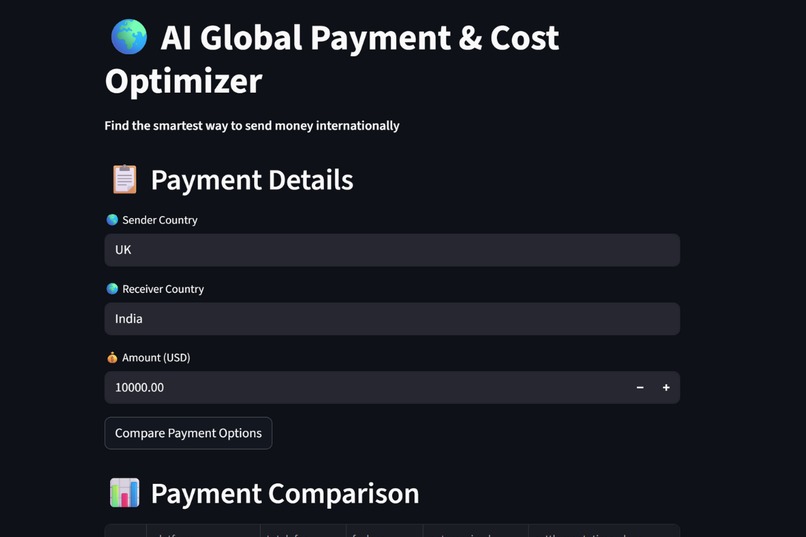
app ui
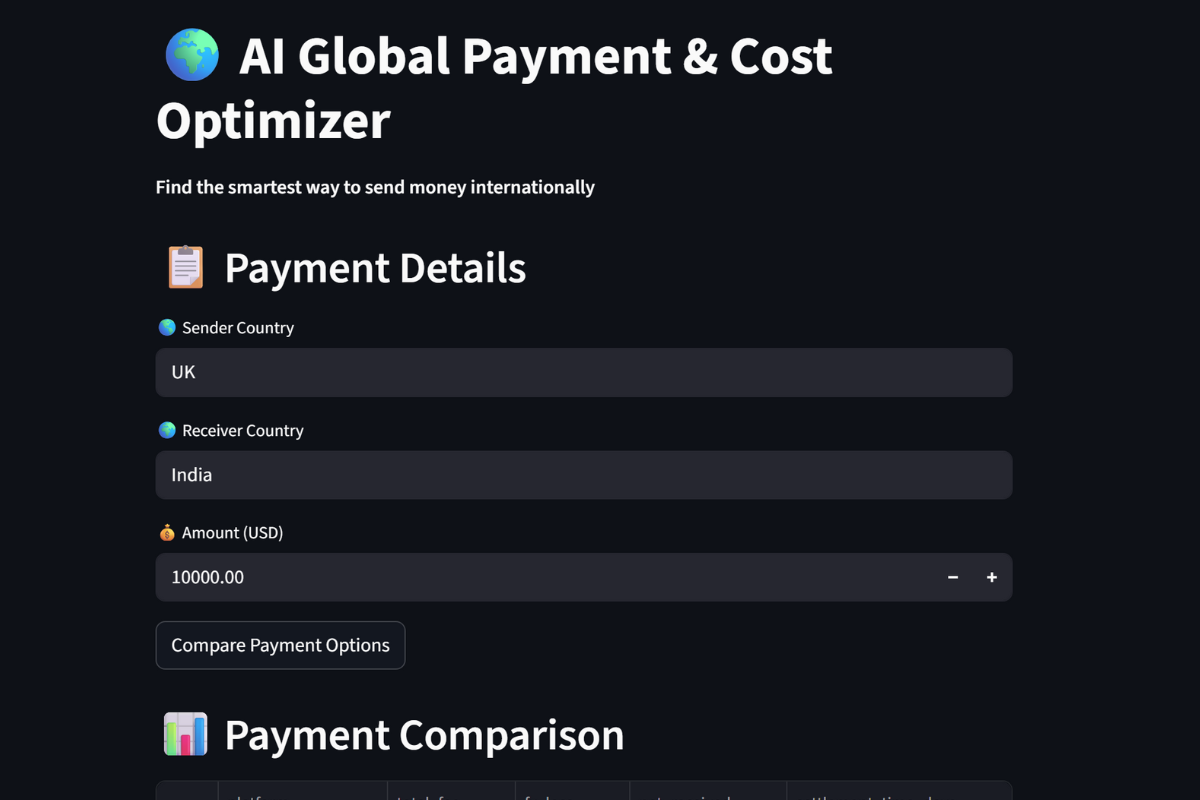
Inspiration
Sending money internationally is something millions of people do every day, freelancers receiving payments, startups paying global teams, and individuals sending money to family abroad. Yet the process is still confusing, opaque, and expensive.
Different platforms advertise convenience, but hide costs in fees and exchange rate markups. Most users don’t know which option actually gives them the maximum amount in hand. The inspiration behind this project was to remove that confusion and help users make clear, informed decisions instead of guessing or trusting a single provider.
What it does
AI Global Payment & Cost Optimizer helps users choose the best international payment platform for their specific needs.
Users enter:
- Sender country
- Receiver country
- Amount to transfer The system compares multiple payment platforms and shows:
- Total fees
- Exchange rate (FX) loss
- Net amount received
- Settlement time
An AI engine then analyses these results and recommends the best overall option, explaining why that choice makes sense in simple language. The focus is not just on giving an answer, but on making the decision transparent and understandable.
How we built it
The project was built using a modular and low-code friendly approach:
- Python for backend logic and calculations
- Streamlit for the interactive web interface
- CSV-based data layer to represent payment platforms, fees, FX markups, and supported corridors
- Cline CLI to rapidly scaffold and iterate on the project using prompts
- OpenRouter API with the Mistral Devstral model for AI reasoning and explanation
The architecture separates concerns clearly:
- Deterministic calculations handle all financial math
- AI is used only for comparative reasoning and explanation
This ensures transparency, reliability, and explainability.
Challenges we ran into
One major challenge was ensuring the AI recommendation did not feel biased. Initially, some corridors had only one payment option, which made the AI fallback logic trigger. This was solved by expanding the dataset to include multiple realistic payment providers per corridor.
Another challenge was handling local development environments, especially managing virtual environments and Python dependencies across different systems. This was resolved by explicitly binding the application to a project-specific virtual environment and improving setup documentation.
Finally, formatting AI-generated explanations cleanly in the UI required careful handling to ensure text readability and a polished user experience.
Accomplishments that we're proud of
- Built a working AI-powered decision support tool, not just a concept
- Designed the system to be explainable, not a black box
- Ensured AI is used meaningfully for reasoning, not basic calculations
- Created a clean, professional UI suitable for real users
- Delivered a complete end-to-end prototype ready for real-world extension
What we learned
This project reinforced the importance of using AI responsibly. Not every problem needs AI, but when used correctly as a reasoning and explanation layer, AI can significantly improve user understanding and trust.
We also learned the value of separating deterministic logic from AI-driven decisions, which makes systems easier to debug, explain, and scale.
What's next for AI Global Payment & Cost Optimizer
Future improvements include:
- Integrating real-time FX rates and payment provider APIs
- Adding user preferences such as “fastest transfer” vs “maximum savings”
- Supporting recurring payments and frequency-based optimisation
- Expanding to more countries and payment corridors
- Providing personalised insights based on historical usage
The long-term vision is to make cross-border payments transparent, fair, and accessible for everyone.

Log in or sign up for Devpost to join the conversation.