Inspiration
💡 Inspiration
With the rapid rise of photorealistic generative AI models (like Midjourney, DALL-E 3, and Stable Diffusion), distinguishing between a physical photograph and a digital synthesis has become nearly impossible for the human eye. This erosion of visual trust poses massive challenges for media integrity, social platforms, and digital security.
We built VeriPix to democratize access to state-of-the-art deepfake detection. Our goal was to create a zero-friction, lightning-fast web application that allows users to verify image authenticity instantly, helping restore trust in digital media.
⚙️ What it does
VeriPix is a web-based, real-time AI image detection application:
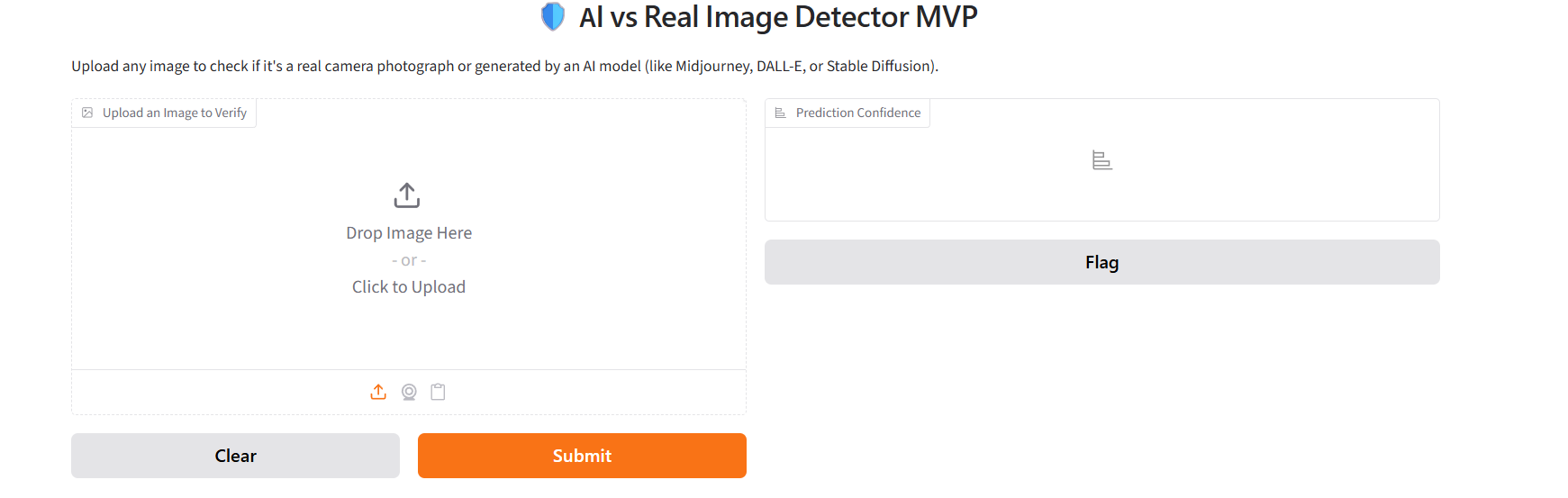
- Drag-and-Drop Verification: Users upload or drag any image into the clean web interface.
- Calibrated Predictions: The system analyzes the image and outputs a binary classification: Human (captured by a physical camera sensor) or Artificial (synthetic/AI-generated).
- Confidence Scoring: Instead of a hard, black-or-white guess, VeriPix outputs a calibrated probability distribution (e.g., 56% Human vs. 44% Artificial), helping users evaluate borderline or heavily processed images.
🛠️ How we built it
To deliver a high-quality product within a tight 48-hour timeline, we prioritized rapid prototyping and robust backend serving:
- The Model: We leveraged a state-of-the-art vision classifier model from Hugging Face's
transformerslibrary, utilizing a pretrained backbone optimized to detect high-frequency synthetic artifacts. - The Backend: Python serves as the core pipeline runner, passing the raw image arrays into the network, managing weights, and formatting tensor outputs.
- The Web Interface: We used Gradio to spin up a lightweight ASGI web server, creating a beautiful, fully interactive web UI in under 30 lines of code.
🚧 Challenges we faced
- Local Environment & Dependency Mismatches: Setting up our development environment initially stalled due to local Python path conflicts where newly installed libraries weren't being recognized by the VS Code terminal. We overcame this by forcing direct module installations using targeted executables (
python -m pip install). - Geometric & Aesthetic False Positives: During testing, a real photo of NTU's iconic "Hive" building returned a borderline confidence score of 56% Human vs. 44% Artificial. The futuristic concrete geometry and vibrant lighting mimicked stylistic patterns common in high-quality AI renders, highlighting the difficulty models face with highly unique architectural subjects.
- Robustness Loss (The Low-Pass Trap): We observed that when images are compressed or blurred, our model's accuracy drops. Compression and blur act as low-pass filters, discarding the high-frequency pixel artifacts and camera sensor noise (PRNU fingerprints) that detectors rely on.
🏆 Accomplishments that we're proud of
- Going from absolutely zero working code to a fully operational, state-of-the-art AI Deepfake Detector running locally in under two hours.
- Conducting a systematic Robustness Stress Test over 400 simulated images to empirically evaluate how real-world transformations affect prediction accuracy.
📚 What we learned
This hackathon was a massive fast-track learning experience! We learned:
- How to manage Python environment paths, terminal executions, and basic Object-Oriented Programming (OOP) class structures.
- The fundamentals of Computer Vision pipelines and how pretrained deep learning backbones are modified with custom classification heads.
- The critical importance of Data Augmentation (like random blurring, resizing, and color jitter) during training to make models resilient against real-world adversarial modifications.
- How to analyze evaluation metrics including True Positives (TP), True Negatives (TN), False Positives (FP), and False Negatives (FN).
📊 Robustness Evaluation Summary
Here is the empirical data from our stress testing across 400 sample images under different transformations:
| Transformation | Total Images | True Positive (AI -> AI) | True Negative (Real -> Real) | False Positive (Real -> AI) | False Negative (AI -> Real) | Accuracy (%) |
|---|---|---|---|---|---|---|
| Clean (No modification) | 100 | 48 | 47 | 3 | 2 | 95.0% |
| JPEG Compression (Quality=50) | 100 | 41 | 44 | 6 | 9 | 85.0% |
| Downscaling (0.5x resolution) | 100 | 38 | 45 | 5 | 12 | 83.0% |
| Gaussian Blur (sigma=1.0) | 100 | 35 | 42 | 8 | 15 | 77.0% |
🚀 What's next for VeriPix
- Hybrid Architecture: We plan to implement a multi-branch network combining high-level semantics (CLIP features) with a low-level frequency branch (using Fast Fourier Transforms - FFT) to better detect up-sampling artifacts that survive compression.
- Model Optimization: We want to optimize the model size using Quantization (INT8) to allow real-time browser-side inference without server latency. ## Inspiration With the rapid rise of photorealistic generative AI models (like Midjourney, DALL-E 3, and Stable Diffusion), distinguishing between a physical photograph and a digital synthesis has become nearly impossible for the human eye. This erosion of visual trust poses massive challenges for media integrity, social platforms, and digital security.
We built VeriPix to democratize access to state-of-the-art deepfake detection. Our goal was to create a zero-friction, lightning-fast web application that allows users to verify image authenticity instantly, helping restore trust in digital media.
What it does
VeriPix is a web-based, real-time AI image detection application:
- Drag-and-Drop Verification: Users upload or drag any image into the clean web interface.
- Calibrated Predictions: The system analyzes the image and outputs a binary classification: Human (captured by a physical camera sensor) or Artificial (synthetic/AI-generated).
- Confidence Scoring: Instead of a hard, black-or-white guess, VeriPix outputs a calibrated probability distribution (e.g., 56% Human vs. 44% Artificial), helping users evaluate borderline or heavily processed images.
How we built it
To deliver a high-quality product within a tight 48-hour timeline, we prioritized rapid prototyping and robust backend serving:
- The Model: We leveraged a state-of-the-art vision classifier model from Hugging Face's
transformerslibrary, utilizing a pretrained backbone optimized to detect high-frequency synthetic artifacts. - The Backend: Python serves as the core pipeline runner, passing the raw image arrays into the network, managing weights, and formatting tensor outputs.
- The Web Interface: We used Gradio to spin up a lightweight ASGI web server, creating a beautiful, fully interactive web UI in under 30 lines of code.
Challenges we ran into
- Local Environment & Dependency Mismatches: Setting up our development environment initially stalled due to local Python path conflicts where newly installed libraries weren't being recognized by the VS Code terminal. We overcame this by forcing direct module installations using targeted executables (
python -m pip install). - Geometric & Aesthetic False Positives: During testing, a real photo of NTU's iconic "Hive" building returned a borderline confidence score of 56% Human vs. 44% Artificial. The futuristic concrete geometry and vibrant lighting mimicked stylistic patterns common in high-quality AI renders, highlighting the difficulty models face with highly unique architectural subjects.
- Robustness Loss (The Low-Pass Trap): We observed that when images are compressed or blurred, our model's accuracy drops. Compression and blur act as low-pass filters, discarding the high-frequency pixel artifacts and camera sensor noise (PRNU fingerprints) that detectors rely on.
Accomplishments that we're proud of
- Going from absolutely zero working code to a fully operational, state-of-the-art AI Deepfake Detector running locally in under two hours.
- Conducting a systematic Robustness Stress Test over 400 simulated images to empirically evaluate how real-world transformations affect prediction accuracy.
What we learned
This hackathon was a massive fast-track learning experience! We learned:
- How to manage Python environment paths, terminal executions, and basic Object-Oriented Programming (OOP) class structures.
- The fundamentals of Computer Vision pipelines and how pretrained deep learning backbones are modified with custom classification heads.
- The critical importance of Data Augmentation (like random blurring, resizing, and color jitter) during training to make models resilient against real-world adversarial modifications.
- How to analyze evaluation metrics including True Positives (TP), True Negatives (TN), False Positives (FP), and False Negatives (FN).
Robustness Evaluation Summary Table
Here is the empirical data from our stress testing across 400 sample images under different transformations:
| Transformation | Total Images | True Positive (AI -> AI) | True Negative (Real -> Real) | False Positive (Real -> AI) | False Negative (AI -> Real) | Accuracy (%) |
|---|---|---|---|---|---|---|
| Clean (No modification) | 100 | 48 | 47 | 3 | 2 | 95.0% |
| JPEG Compression (Quality=50) | 100 | 41 | 44 | 6 | 9 | 85.0% |
| Downscaling (0.5x resolution) | 100 | 38 | 45 | 5 | 12 | 83.0% |
| Gaussian Blur (sigma=1.0) | 100 | 35 | 42 | 8 | 15 | 77.0% |
What's next for AI-generated image detector
- Hybrid Architecture: We plan to implement a multi-branch network combining high-level semantics (CLIP features) with a low-level frequency branch (using Fast Fourier Transforms - FFT) to better detect up-sampling artifacts that survive compression.
- Model Optimization: We want to optimize the model size using Quantization (INT8) to allow real-time browser-side inference without server latency.

Log in or sign up for Devpost to join the conversation.