-
-
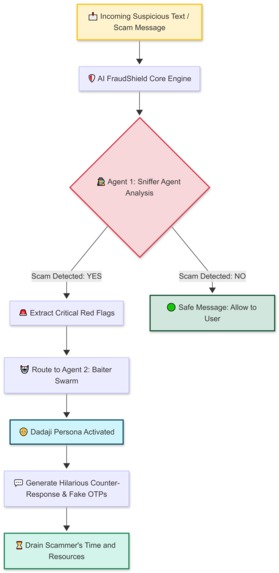
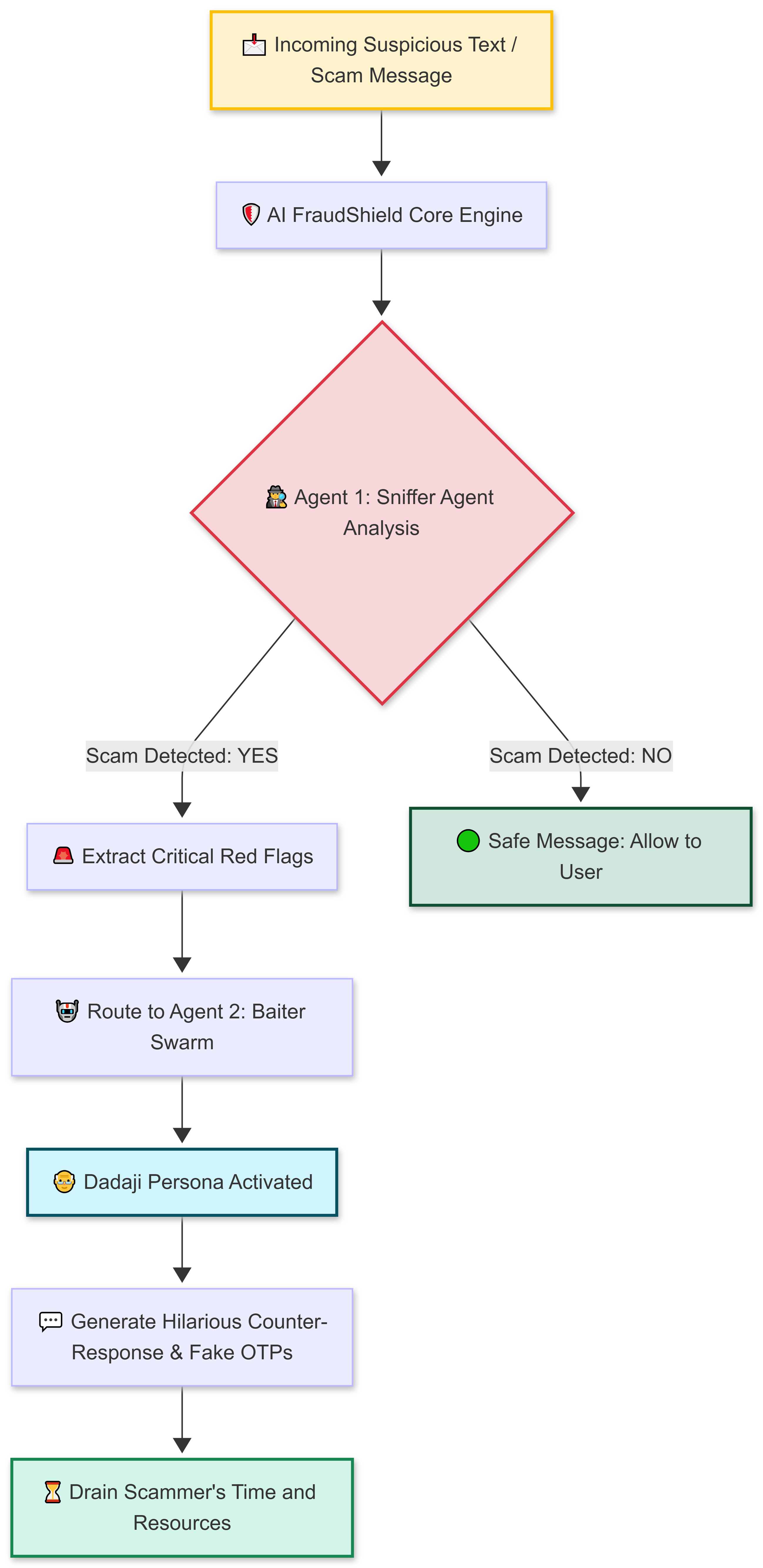
AI FraudShield Multi-Agent Swarm Architecture Diagram
💡 Inspiration
The inspiration for AI FraudShield comes from a real-world multi-crore digital fraud incident right in my home region of Himatnagar, Gujarat, where victims lost over ₹14 Crores to sophisticated cybercriminals using fake stock market and digital arrest scams. Seeing vulnerable individuals and senior citizens fall prey to these high-pressure social engineering tactics made me realize that passive blocking is no longer enough. We needed an active-defense system that could neutralize scammers in real-time.
⚙️ What it does
AI FraudShield is an advanced AI-powered multi-agent framework designed to detect spam, phishing, and financial threats. It employs a two-tier agent swarm:
- Sniffer Agent: Parses incoming suspicious texts, emails, or transcripts to instantly identify potential scams and red flags.
- Baiter Agent (Dadaji Persona): If a scam is confirmed, this agent spins up an automated conversational honeypot mimicking a tech-illiterate Indian grandfather. It chats with the scammer using funny, confusing broken Hinglish and fake OTPs, successfully draining their operational time and keeping them away from actual victims.
🛠️ How we built it
The project is completely built using Python and Streamlit for a responsive, modern live dashboard interface. The intelligent multi-agent network is engineered using the Strands Agents SDK and connected to high-performance inference models via the Groq Cloud Infrastructure to guarantee ultra-fast response times.
🧠 Challenges we faced
One of the key technical hurdles was handling Python's updated object structure inside the modern Groq SDK when processing chat completions. We also spent significant effort fine-tuning the system instructions to ensure the Baiter Agent accurately maintains the 'Dadaji' persona consistently without dropping out of character, while ensuring the entire response fits under tight token budgets.
🏅 What we learned
Through this hackathon, we mastered orchestrating autonomous agent networks using the Strands SDK and learned how to leverage low-latency AI pipelines using Groq. Most importantly, we learned how to model AI personalities designed specifically for defensive honeypot scenarios.
Built With
- generative-ai
- groq-cloud-api
- multi-agent
- python
- strands-agents-sdk
- streamlit

Log in or sign up for Devpost to join the conversation.