-
-
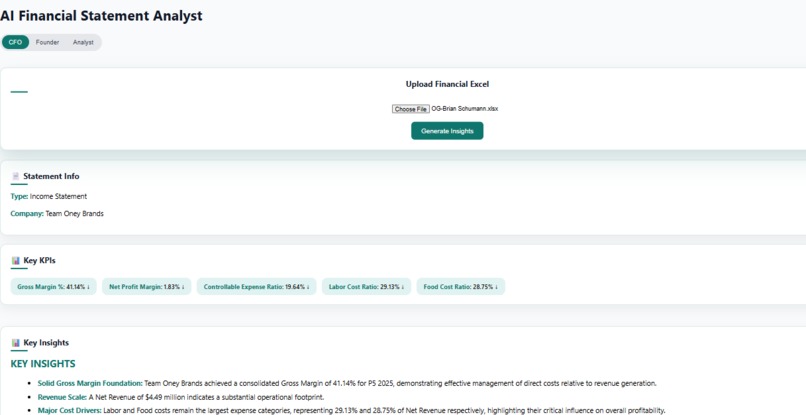
Home page
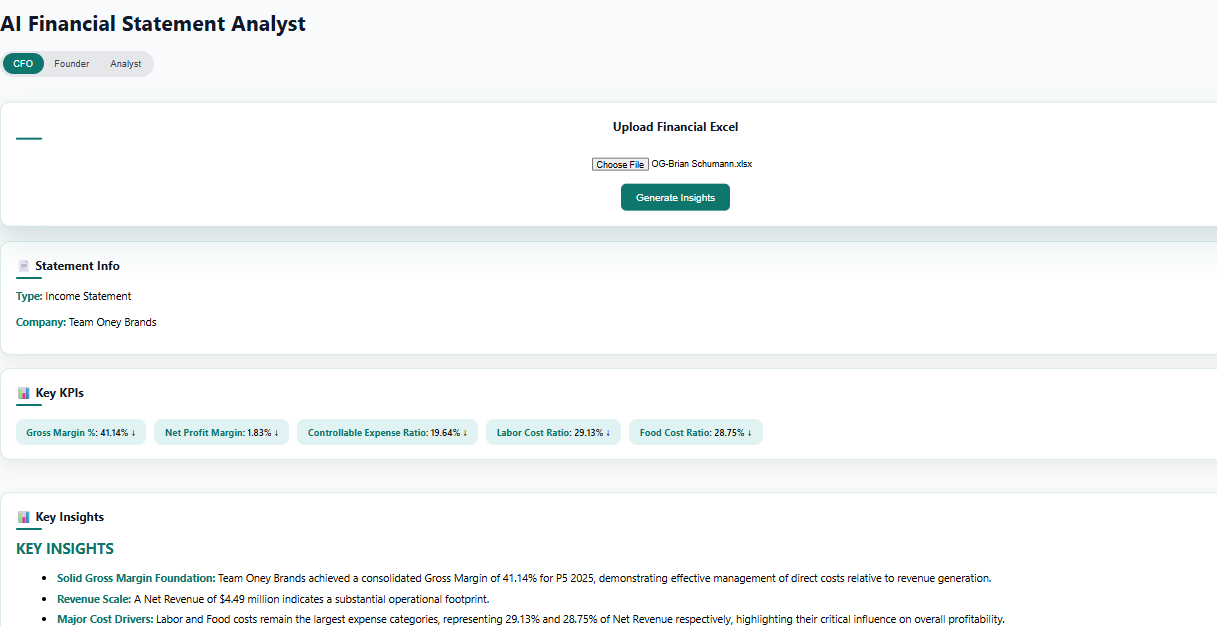
Inspiration
As an FP&A professional, I spend a significant amount of time not just analyzing numbers, but explaining them. Variance analysis, executive summaries, and management commentary are still largely manual — even though the data already exists in Excel.
The inspiration behind AI FP&A Analyst came from a simple question: Why can’t financial data explain itself?
With recent advances in generative AI reasoning, I wanted to build a tool that goes beyond reporting and acts like a true AI finance partner — one that understands numbers, context, and business impact.
What it does
AI FP&A Analyst is not just about automation — it’s about augmenting financial thinking. By turning spreadsheets into narratives and insights, this project demonstrates how generative AI can support better, faster, and more confident business decisions. From numbers → narratives → decisions.
How we built it
The project follows a simple but effective architecture:
Users upload a live Excel file (.xlsx) containing financial data. The backend parses and structures the data using Python. Key metrics are calculated, including: Variance=Actual−Budget Variance %=Actual−Budget
Structured financial tables and calculated metrics are passed to Gemini, guided by FP&A-specific prompts. Gemini generates: Variance explanations Executive summaries Risk highlights Natural-language answers to user questions All responses are constrained to the uploaded data to ensure accuracy and transparency. The frontend provides a clean, minimal interface focused on insight, not complexity.
Challenges we ran into
Handling unstructured Excel files without forcing a fixed template. Preventing generic AI responses by carefully designing prompts. Ensuring the AI does not hallucinate when data is missing. Balancing speed and clarity for a live demo environment. Building a polished, end-to-end solution as a solo developer within a limited timeframe.
Each challenge pushed me to design smarter guardrails and lean into domain-specific reasoning rather than generic automation.
What we learned
Building this project taught me several key lessons: How to use Gemini’s reasoning capabilities to explain why financial changes occur, not just summarize data. The importance of prompt structure and guardrails to keep AI outputs factual and data-driven. Designing AI systems that are trustworthy, especially in finance where assumptions can be risky. How small preprocessing steps (like variance calculations) significantly improve AI insight quality. Most importantly, I learned that AI becomes far more powerful when paired with domain expertise, not just raw data.


Log in or sign up for Devpost to join the conversation.