-
-
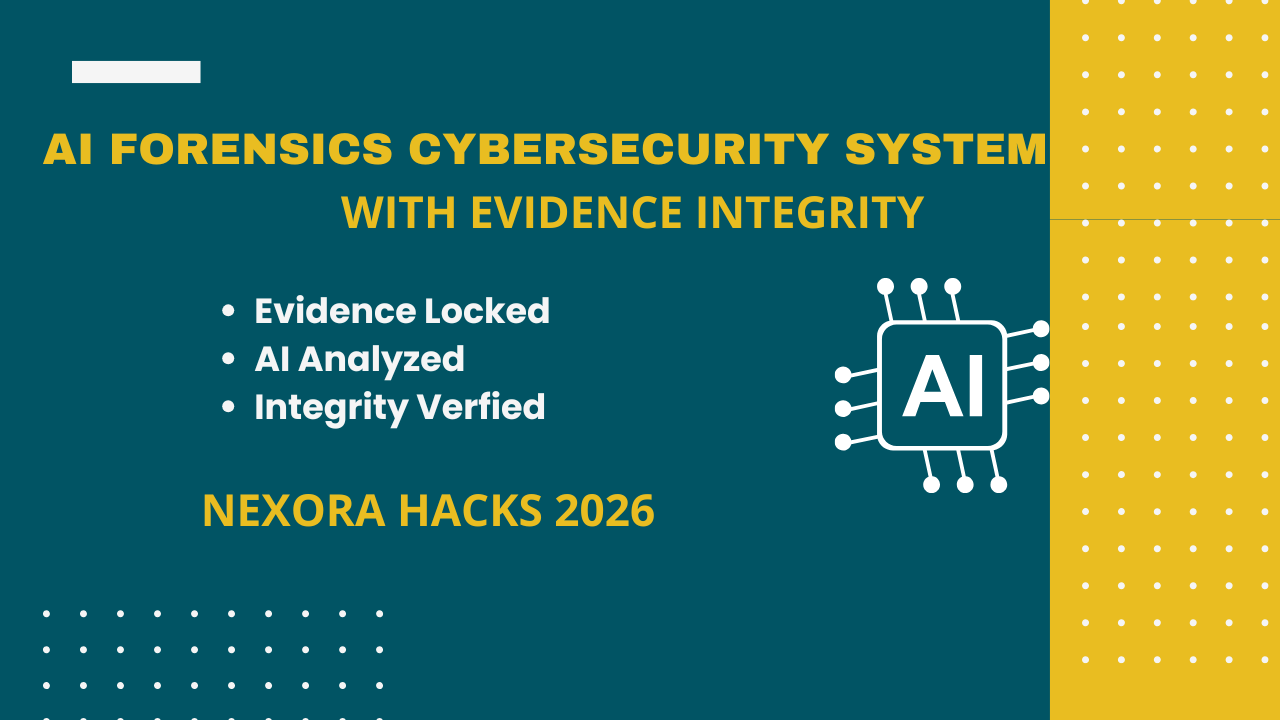
CyberTrust-Thumbnail
-
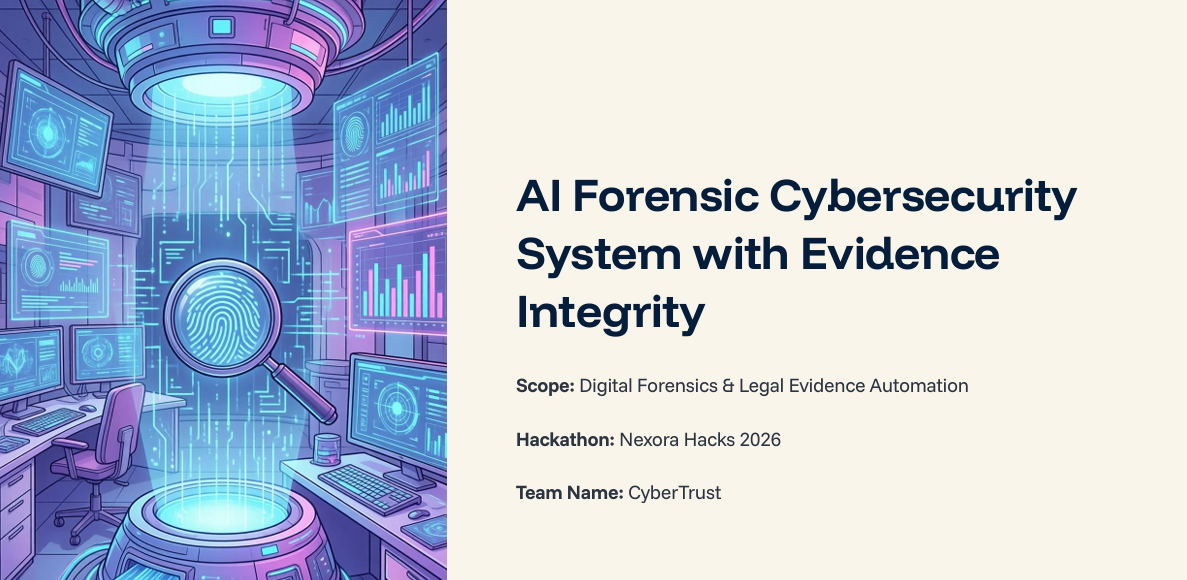
Presentation-Overview
-
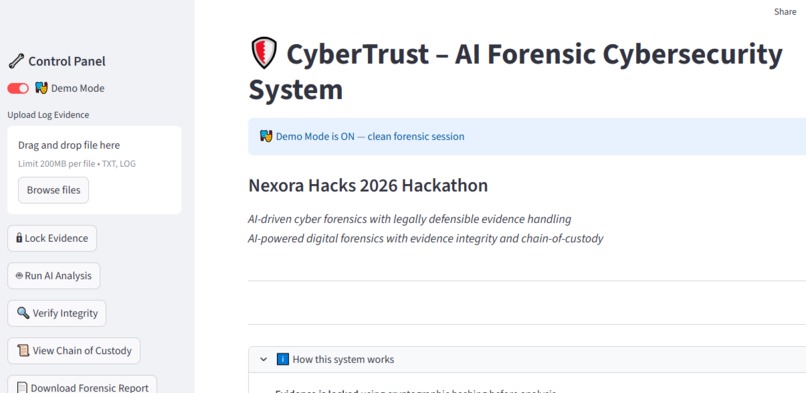
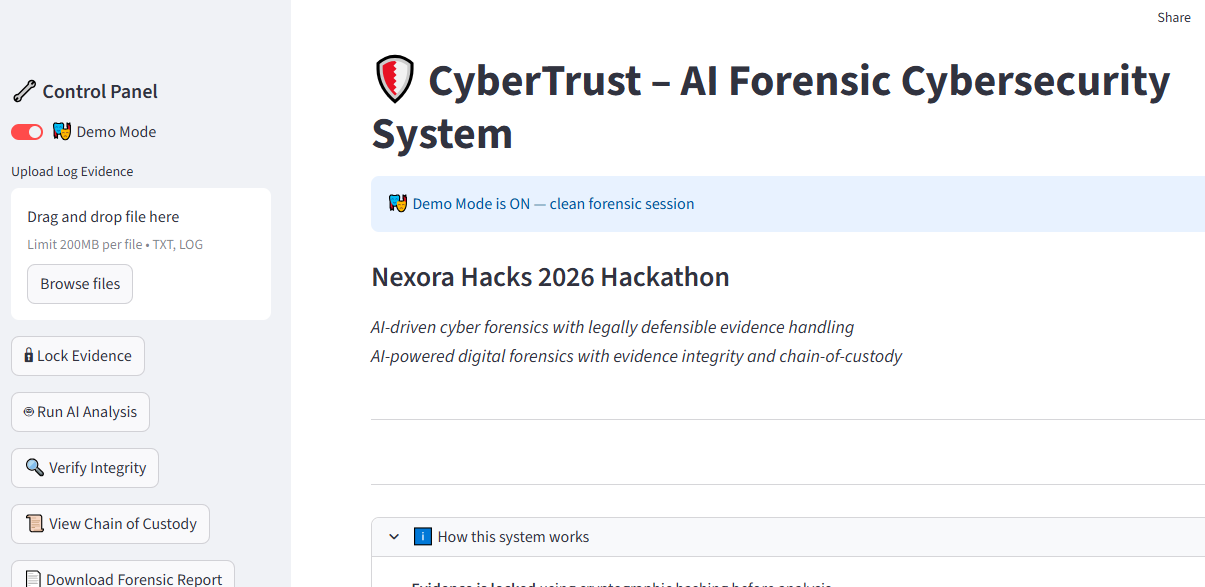
StreamlitApp
-
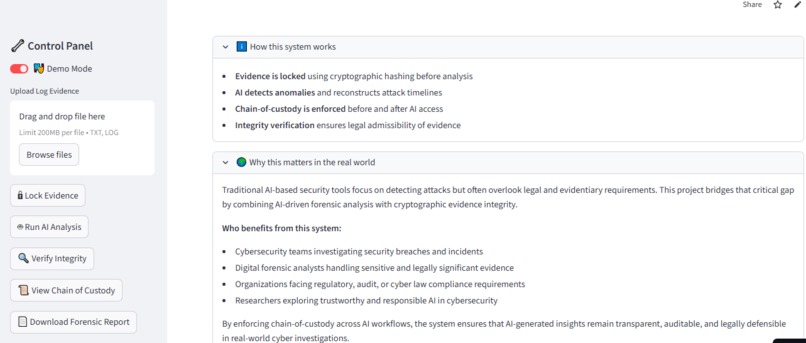
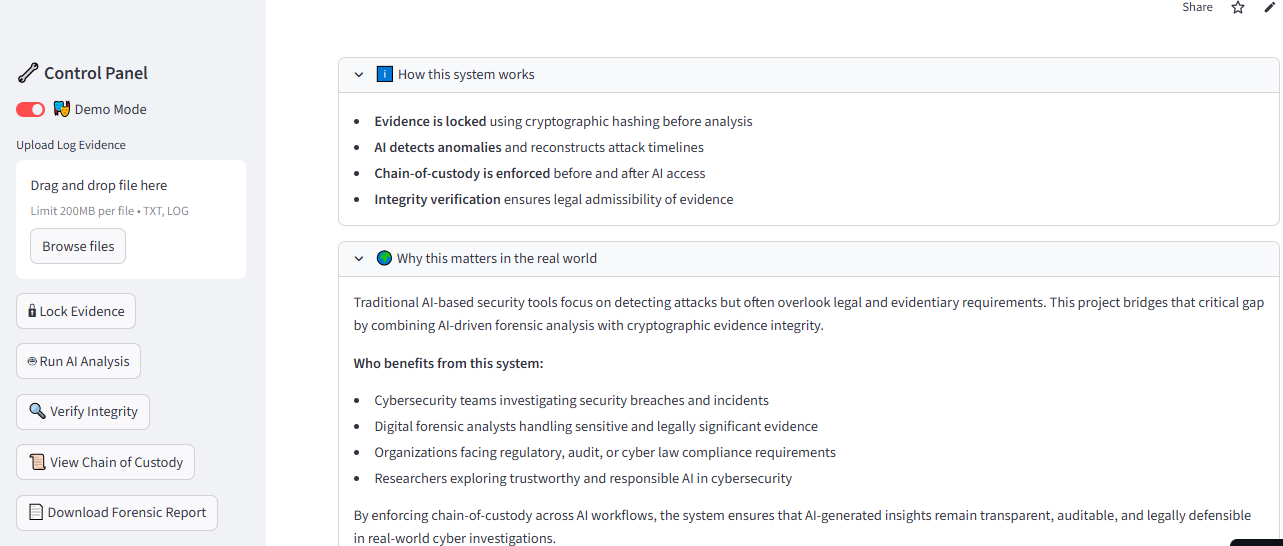
Working-Overview
-
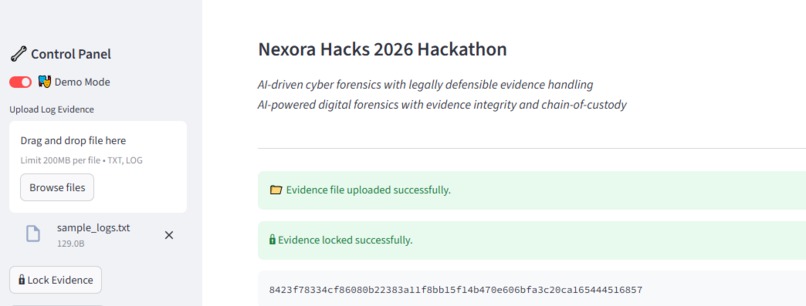
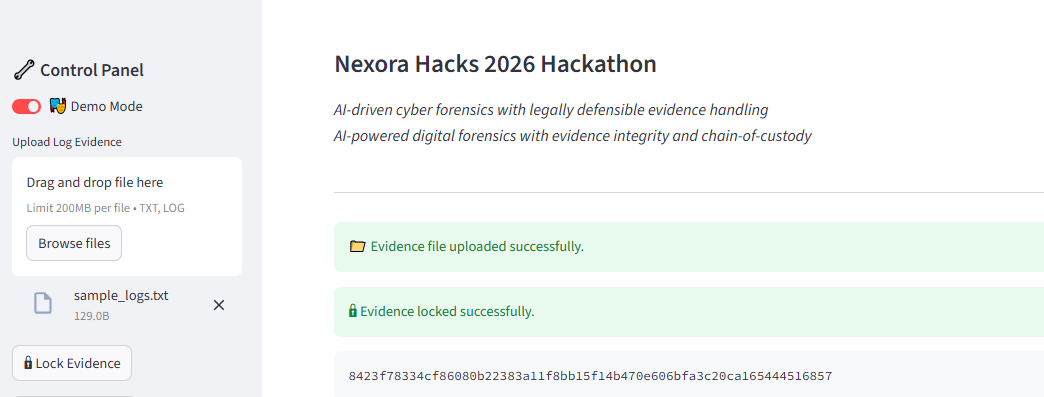
FileUploaded $ Locked
-
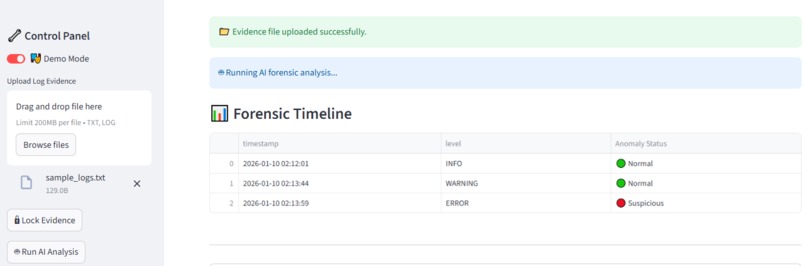
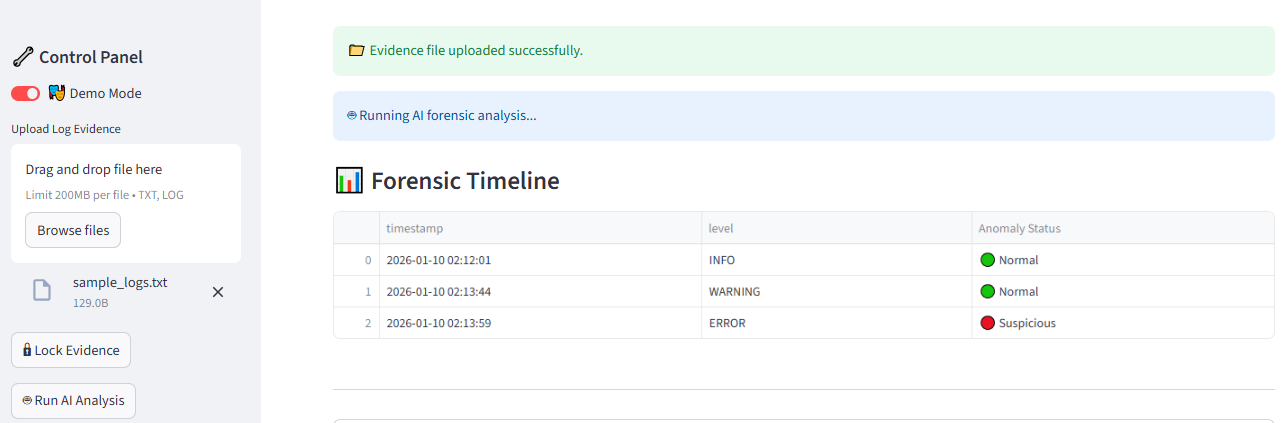
AI Analysis
-
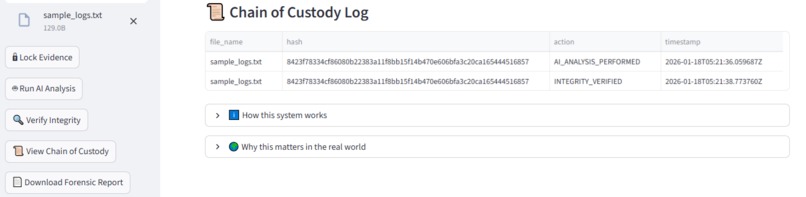
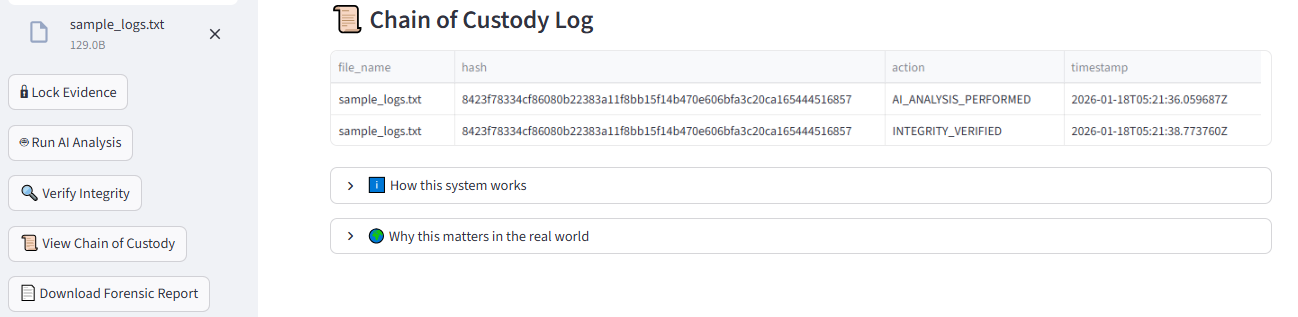
View Chain Of Custody
-
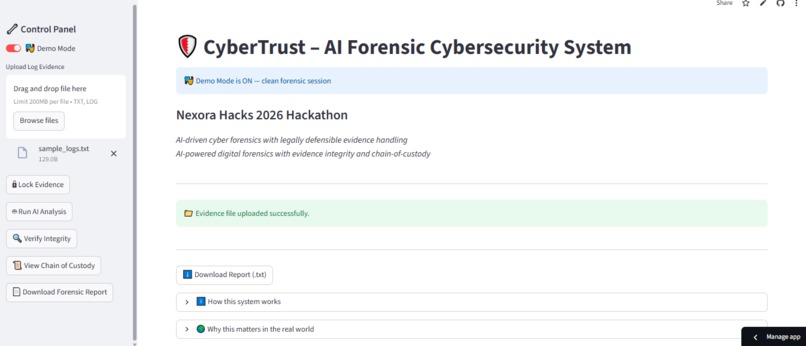
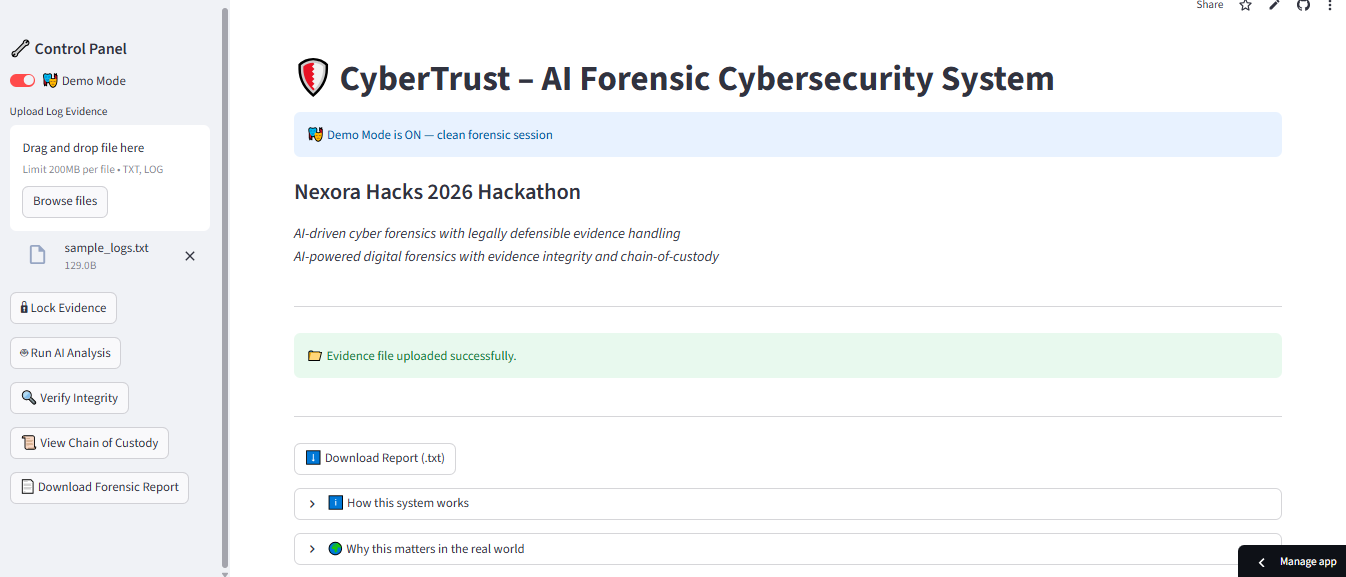
Complete CyberTrust App Overview
💡 Inspiration
The inspiration for this project came from a critical gap we observed in modern cybersecurity systems.
While artificial intelligence is increasingly used to analyze logs and detect cyberattacks, its results are often not trusted in legal or regulatory contexts. Courts and investigators require proof that digital evidence has not been altered, yet most AI-based tools focus only on detection accuracy and ignore evidence integrity and chain-of-custody.
This raised a fundamental question for us:
How can AI-driven digital forensics be made legally trustworthy?
That question became the foundation of CyberTrust.
Key Learnings
Through this project, we learned that effective digital forensics is not just a technical problem, but also a legal and procedural one.
We gained insights into:
- The importance of chain-of-custody in digital investigations
- Why cryptographic hashing is essential for proving evidence integrity
- How AI analysis must be auditable to be legally defensible
- The challenges of aligning AI workflows with cyber law and compliance requirements
Most importantly, we learned that trust in AI systems must be provable, not assumed.
Build Process
CyberTrust was built as an AI-assisted digital forensics system with legal evidence automation at its core.
The system works as follows:
- Digital log evidence is uploaded into the system
- Evidence is immediately locked using cryptographic hashing (SHA-256)
- All actions are recorded in an automated chain-of-custody.
- AI-based analysis detects anomalies and reconstructs forensic timelines
- Evidence integrity is verified before and after AI access
- A legally meaningful forensic report is generated
We implemented the system using Python, with Streamlit for the interactive interface and scikit-learn for anomaly detection.
Special care was taken to ensure that AI analysis is read-only, and that every interaction with evidence is logged and auditable.
Challenges
One of the main challenges was ensuring that the system design met legal expectations, not just technical ones.
Unlike typical AI projects, we had to think carefully about questions such as:
- How do we prove that AI did not modify the evidence?
- How can every action be traced and verified later?
- How do we make the system suitable for real-world investigations? Another challenge was deployment and environment compatibility, especially ensuring that the system behaves consistently across local and cloud environments while maintaining forensic integrity.
Outcome
The result is CyberTrust, a system that bridges the gap between AI-based cybersecurity analysis and legal evidence requirements.
Rather than only detecting cyber incidents, the project ensures that AI-generated insights are transparent, auditable, and legally defensible.
CyberTrust demonstrates how responsible and trustworthy AI can play a meaningful role in real-world digital forensics and cyber law.
Final Reflection
This project reinforced our belief that the future of cybersecurity lies not only in smarter AI, but in AI systems that can be trusted, explained, and defended in legal contexts.
Future Enhancement
Future work will focus on improving scalability, legal strength, and real-world adoption.
- Blockchain-backed chain of custody for immutable evidence tracking
- Advanced AI models for threat classification and attack attribution
- Expanded evidence sources, including network and cloud logs
- Role-based forensic access for analysts, auditors, and compliance teams
- Enhanced forensic reporting with visual timelines and court-ready exports
Vision
The long-term vision is to evolve this system into a trusted AI-driven forensic platform where cybersecurity analysis, legal compliance, and evidence integrity coexist seamlessly.


Log in or sign up for Devpost to join the conversation.