-
-
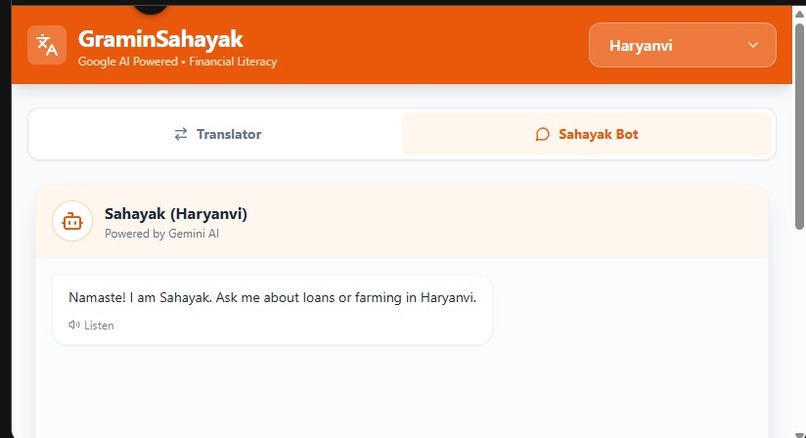
GraminSahayak AI bot in training
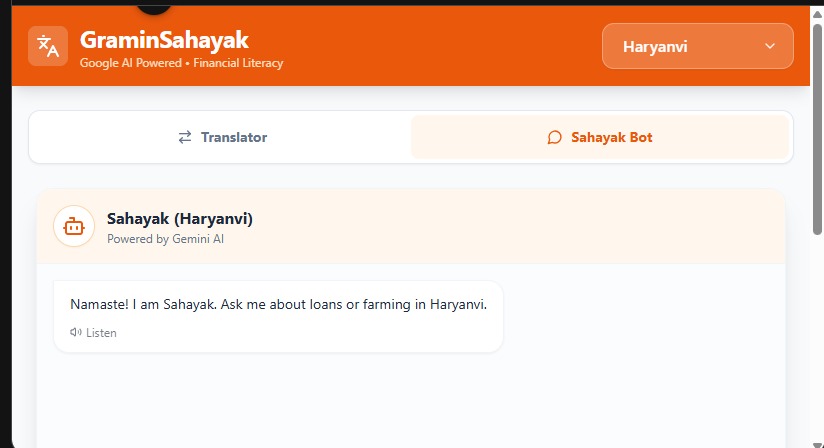
Project Story
Inspiration
Our inspiration came from recognizing a critical disparity in India: the vast financial literacy gap between urban and rural communities. We observed that financial empowerment—understanding savings, loans, insurance, and government schemes—is foundational to economic stability. However, rural populations face triple barriers: limited access to financial advisors, language barriers with existing resources (which are often only in English or major regional languages), and low overall awareness of the many available government subsidies and bank programs. We realized that a high-tech solution, if designed with low-tech accessibility in mind, could be the key to empowering millions. Our goal was to build a trusted, personalized digital financial guide that speaks their language, literally and figuratively.
What it does
"AI for Financial Literacy to Rural People" is a data-driven web platform designed to act as a personal financial advisor accessible in remote areas.
Core Features:
Multilingual AI Chatbot with Voice Support: The central feature allows users to converse naturally in multiple Indian regional languages and local dialects (like Hindi, Tamil, Telugu, and Bengali) about finance. Voice input/output ensures literacy is not a barrier.
Offline Personal Finance Tracker: This feature allows users to monitor their income (from crops, wages, or business), categorize expenses, and track savings goals, even without an internet connection, ensuring continuous financial discipline.
Personalized Scheme Finder: Based on a unique user profile (built during sign-up with details like age, income, language, occupation, and village), the system intelligently recommends relevant government schemes, subsidies (like PM-KISAN), and bank loans (like MUDRA loans) specifically tailored for farmers, small businesses, and households.
Local Financial News: Provides curated, localized headlines about interest rates, market trends, and economic changes relevant to their daily lives, helping them stay informed.
How we built it
We built this project using a JavaScript-centric tech stack to ensure high interactivity and a responsive user experience.
Structured Sign-up: The project starts with a detailed sign-up process to capture essential user data (Occupation, Income, Village, Language). This data is the foundation of the personalized Unique User Profile.
AI Integration: We utilized a large language model (LLM) through the Gemini API for the AI Chatbot. The core challenge was fine-tuning the model's instructions (systemInstruction) to act as a reliable financial guide, ensuring accuracy, avoiding jargon, and integrating the necessary code to handle the multi-lingual voice recognition and synthesis.
Localization and Language Handling: The chatbot was configured to use natural language understanding (NLU) to process regional dialects and deliver responses that are culturally and contextually appropriate, making the advice feel personal and trustworthy.
Feature Integration: The platform logic connects the user's profile data to the Scheme Finder database, allowing the system to run filtering queries and present applicable opportunities (e.g., crop insurance for farmers, MUDRA loans for small businesses) as "AI Suggestions" on the main dashboard.
Offline Capability: For the Personal Finance Tracker, we designed the data structures to be saved locally when offline, with a synchronization mechanism to update the main database when connectivity is restored.
Challenges we ran into
The most significant challenge was mastering the multilingual conversational AI. While the underlying model supports many languages, ensuring the advice was consistently accurate, practical, and devoid of complex jargon across 10+ regional dialects required extensive testing and careful prompt engineering. We had to train the system to understand local financial terminology and cultural nuances (like specific types of crops or informal savings methods).
Another hurdle was building a robust offline-first tracker that could reliably manage income and expense logging in intermittent connectivity environments without data loss. We overcame this by implementing a clear state management and data syncing protocol.
Accomplishments that we're proud of
We are incredibly proud of achieving two major milestones:
True Multilingual Voice Access: We successfully integrated voice input and output that works fluently in multiple Indian regional languages, making the application accessible to users regardless of their literacy level.
Hyper-Personalized Scheme Matching: The Scheme Finder successfully demonstrates the power of AI in social impact by automatically matching complex government policies and bank requirements to a user's simple profile, thereby unlocking direct financial opportunities that were previously hidden due to lack of awareness.
What we learned
We learned that technology development for rural audiences requires a fundamentally different design approach: simplicity, language-first design, and connectivity resilience are non-negotiable. We also learned the importance of leveraging AI not just for conversation, but as an intelligent filter and personalization engine to distill complex institutional information into actionable personal insights.
What's next for AI for Financial Literacy to Rural People
Our next steps include:
Integration with Local Partners: Collaborating with NGOs or local banks to pilot the platform in a few villages, gathering real-world usage data, and refining the scheme matching and language models.
Gamified Learning Modules: Developing short, interactive modules to teach basic concepts like compounding interest and managing debt in a fun, engaging, and localized manner.
Advanced Predictive Modeling: Using the expense tracker data to provide predictive budgeting advice and identify opportunities for increased savings or debt reduction.


Log in or sign up for Devpost to join the conversation.