Alzheimer’s MRI Classification Using Deep Learning
Inspiration
Alzheimer’s disease affects memory, independence, and families. We wanted to explore how AI + MRI imaging could support research into early understanding of cognitive decline — not to replace doctors, but to learn how deep learning can recognize meaningful brain-scan patterns.
What We Built
We trained a ResNet-based deep learning model to classify MRI scans into four stages:
- Non-Demented
- Very Mild Demented
- Mild Demented
- Moderate Demented
We used transfer learning, a reproducible notebook, and a clean evaluation pipeline so others can easily follow and extend our work.
How We Built It
- Preprocessed MRI scans: resize → normalize → augment
- Fine-tuned a pretrained model on the dataset
- Evaluated using accuracy and weighted F1-score
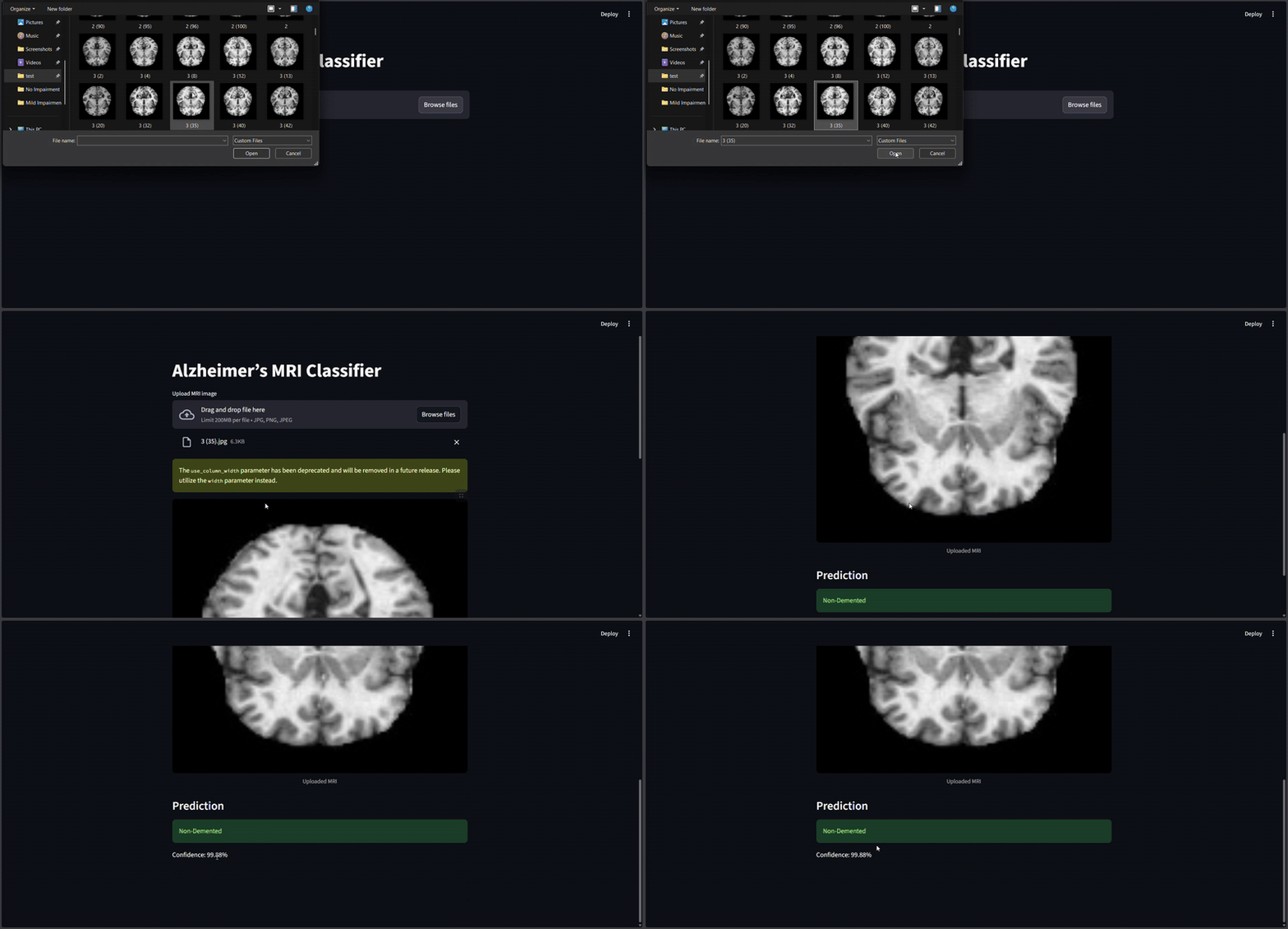
- Integrated the trained model into a simple prediction app
Inline math example: ( \mathcal{L} = - \sum_i y_i \log(\hat{y}_i) )
Displayed math example:
$$
\text{Accuracy} = \frac{\text{Correct Predictions}}{\text{Total Samples}}
$$
What We Learned
We learned a lot about:
- Transfer learning techniques
- Handling dataset imbalance
- Evaluation metrics and debugging model collapse
- The importance of reproducibility and transparency in healthcare AI
Results
Our final model achieved:
- Accuracy: 92.89%
- Weighted F1-score: 92.83%
These scores showed strong, consistent performance across all four classes.
Challenges
We encountered real-world issues such as:
- Class-label inconsistencies
- Environment differences
- Early model collapse (fine-tuning pitfalls)
- Maintaining full notebook reproducibility
Each challenge helped us strengthen the project and improve our workflows.
Example Code Block
puts "Hello World!"


Log in or sign up for Devpost to join the conversation.