-
-
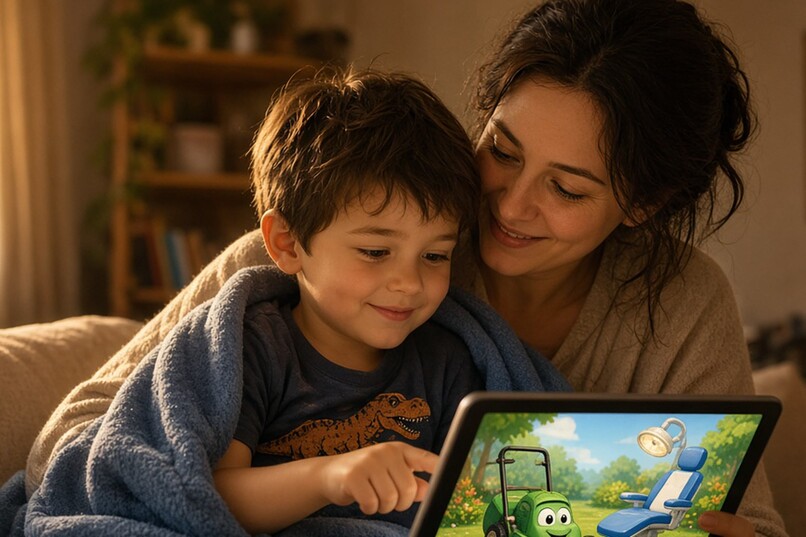
We never say "it won't hurt." The story tells the truth: a sharp poke, 2 seconds, then done. Kids trust you more when you're honest.
-

This is a normal visit for many autistic kids

Inspiration
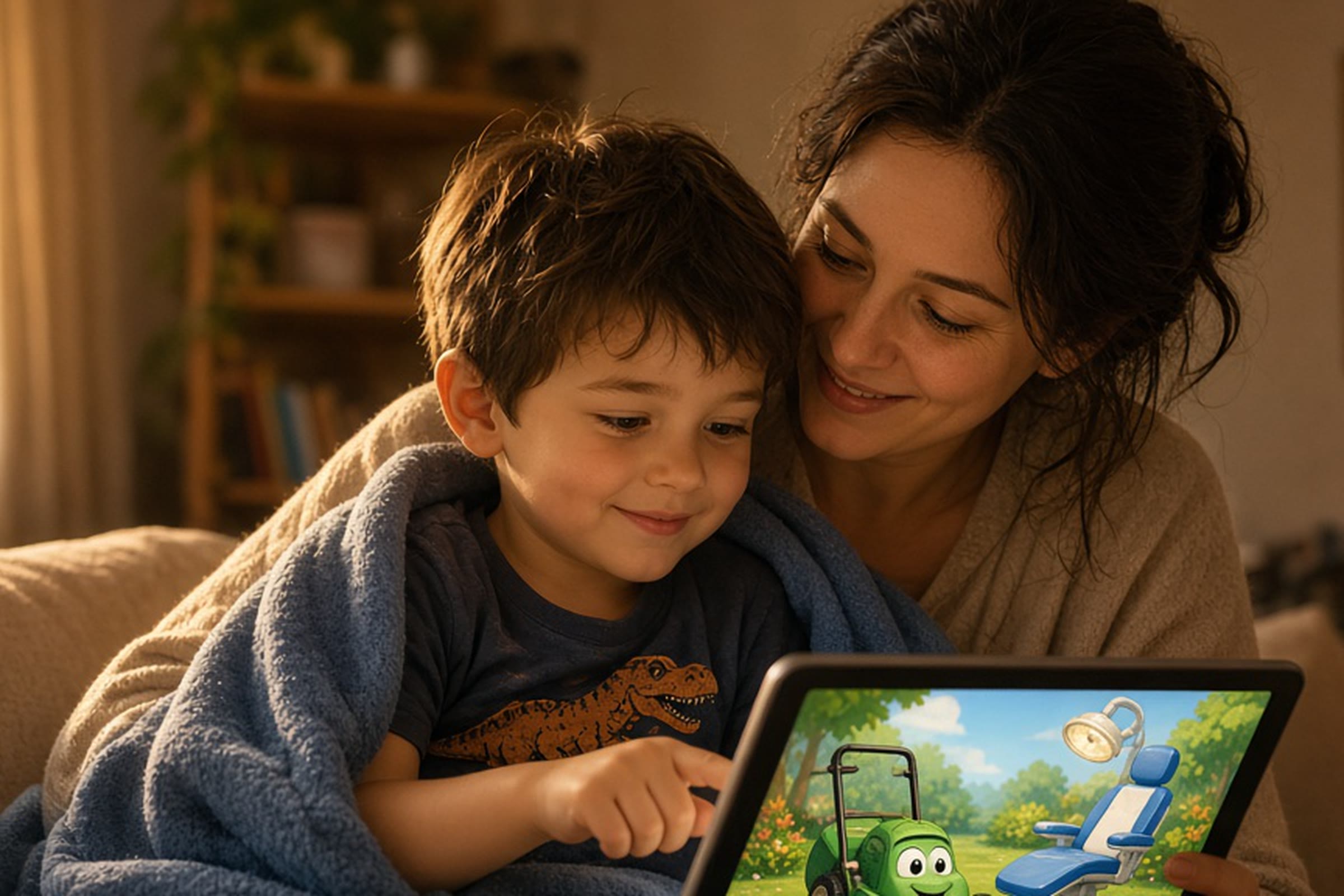
Imagine your child is scared of a haircut. Not a little scared. Screaming, kicking, crying so hard they can't breathe. The barber is waiting. People are looking. You are holding your child down and saying "it's okay" while your heart breaks, because you know it is not okay for them.
This is real life for many parents of autistic kids. And it is not just haircuts. It is the dentist. It is a shot. It is a blood test. Sometimes it is even bath time, brushing teeth, or going to bed.
For an autistic child, the scariest part is often not the pain. It is not knowing what will happen next. A new room. A stranger touching them. A loud buzz near their ears. A bright light in their face. Nobody told them it was coming.
When a visit goes badly, kids get held down. Parents start skipping visits because they can't watch their child go through it again. And the next visit becomes even harder.
The numbers hurt too:
- 1 in 31 kids in the US is autistic (CDC, 2025).
- In one dental study, 25 out of 85 autistic kids had to be held down with a restraint (Marshall et al., 2008).
- 96% of parents said medical visits were really hard for their child. But only 14% had explained the visit to their child before it happened (Koh et al., 2005).
There is something that helps. Therapists use social stories: short picture stories that show a child, step by step, what will happen. When kids see it first, it is not a surprise anymore. But making one takes a parent about an hour. And it has to be about that visit, for that child. Tired parents don't have that hour.
There was a second problem I kept hearing about. After a diagnosis, families often wait months for therapy. Those months between ages 1 and 5 matter most, and parents are left at home asking, "What can I do with my child today?" Most help that exists costs money or needs a therapist.
I work in healthcare, and I have young kids. I know how fast little kids lose focus, and how long sentences just go over their heads. I wanted any parent, anywhere, to be able to help their child for free, starting today.
That is why I built VisitBridge.
What it does
VisitBridge has two parts: Visit Stories for the scary days, and Play Coach for every day.
1. Visit Stories: show your child what is coming
VisitBridge makes a short story video that shows your child what is going to happen, told by a friend from the thing they love most.
- Tell us about your child once: their age, their favorite thing (lawn mowers, trains, dinosaurs), their comfort item, what is hard for them, and what helps. It stays only on your phone.
- Pick what the story is about: a haircut, the dentist, a shot, a blood test. Or everyday things like bath time, brushing teeth, bedtime, or going to school.
- Tell us what scares them most: needles, loud noise, being held, or just type it, like "he cries when the clippers buzz near his ears."
- VisitBridge makes the story:
- A friend tells it out loud, like Mozy the Mower. Mozy goes through everything with your child. When your child opens their mouth at the dentist, Mozy opens his mouth too.
- The words are short and simple, made for your child's age. For little kids: "Ooooh! Look, Leo! The big chair. The big chair! It goes up… up… up!"
- It tells the truth. It never says "it won't hurt." It says "A sharp poke. It hurts for 2 seconds. One… two… done!"
- Right before the scary part, Mozy and your child make a plan together: "Let's cover our ears and count to 5."
- Every page has a real-looking picture. The same child, the same grown-up, the same clothes, and the same place on every page, so it feels like one real day, not random pictures.
- Any page can become a short video. The video moves at the speed of the voice, so what your child sees matches what they hear.
- Your child watches it again and again before the day. The words light up as they are spoken. A turtle button makes the voice slower.
2. Play Coach: 5 minutes of play a day, ages 1 to 5, free
Play Coach gives parents one short game a day that helps their child connect and communicate. It needs no video and no paid AI, so it can stay free for every family.
- The parent picks their child's age, how much they talk (no words yet, a few words, short phrases), and their favorite thing.
- The parent picks 1 or 2 goals:
- Connect and play with me
- First words, or more words
- Ask for things instead of crying or grabbing
- Take turns and play with others
- Do daily tasks: teeth, shoes, clean-up
- Fewer meltdowns at hard moments
- Play Coach shows what research says for a child of that age, and the plan it will follow, skill by skill. For example: follow their lead, copy them, people games, wait and give a reason to ask, add one word.
- Every day there is one game, built around the child's favorite thing. If they love trains, it is a train game. One game teaches "First clean up, then the train." The child does a small task and gets the thing they love right away. That is how many therapists teach daily routines.
- Every game card answers the question parents really ask: "Has this worked for other kids?" It shows the published studies behind that skill and how many children were in them.
- After playing, the parent taps how it went. Play Coach moves to the next skill when the child is ready. On a hard day it offers a gentler game, with no guilt.
- The parent can copy a simple summary to share with a therapist or doctor. There is also a list of free help: every child under 3 in the US can get a free early intervention evaluation, and the app links to each state's program.
Play Coach is built on parent-led play approaches with strong research:
- PACT: 152 children, ages 2 to 5 (Green et al., Lancet 2010; Pickles et al., Lancet 2016).
- ESDM: 48 children, ages 1½ to 2½ (Dawson et al., Pediatrics 2010).
- PRT: 48 children, ages 2 to 5 (Gengoux et al., 2019).
- JASPER: 96 children, ages 2 to 4 (Kasari et al., 2006 and 2010).
- The US national review of autism practices (NCAEP): 972 studies.
VisitBridge works in 40 languages, so families who don't speak English are not left behind.
How we built it
- The app is simple JavaScript with no build step, so it is fast on any phone. Stories, pictures, videos, and the play log are saved on the phone itself. No accounts, no sign up.
- The server runs on Cloudflare Workers.
- The AI:
- Llama 3.3 70B writes the story, page by page. It also changes each play game to fit the child's favorite thing and talk level.
- Leonardo Lucid Origin draws each page so it looks real, so what the child sees in the story matches what they see on the day.
- Deepgram Aura and MeloTTS give the friend a warm, happy voice.
- Kling video (fal.ai) turns pictures into short videos.
- ElevenLabs (optional) lets a parent record their voice, so the story can be told in Mom's or Dad's voice. Only if the parent says yes.
- Making the pictures match:
- Each story gets one "cast": the place, the grown-up, and the child's outfit, plus one fixed drawing seed. Every page uses them, so the barber shop and Mom's sweater stay the same from page 1 to page 13.
- Keeping kids safe:
- Your child's name is never sent to the AI. The AI writes "NAME" and the phone puts the real name in.
- The ideas for handling fears come from a fixed list from children's doctors and autism groups (AAP, pediatric dentists, Autism Speaks, child life programs). The AI picks from that list. It can't make up medical advice.
- If the AI forgets the comfort item, the "it's OK to feel worried" page, or the happy ending, the app adds them back.
- Play games come from a fixed, tested library. The AI can only change the wording to fit the child. If its steps are too short or unclear, the app uses the tested steps. Games never force eye contact, and there are no small objects or balloons for kids under 3.
- The research numbers come from a fixed list of published studies, not a live web search, so the AI can never make up a study.
- Security:
- A strict Content Security Policy, a same-site check on every API call, size limits, and rate limits.
- Automatic code scanning, a secret scanner, and dependency updates on GitHub.
Challenges we ran into
- The sentences were too long. My first stories were correct, but a 5-year-old would get lost. I changed the rules so little kids get very short sentences, the main word twice, slow pauses, and a small question on each page.
- The AI copied my examples. A train friend called itself "Mo the Mower" because that was my example name. Another story repeated every word three times: "It shows… shows… shows!" I had to show the AI good and bad examples to fix it.
- The wrong friend picture. For "lawn mowers," the AI picked a ladybug once. Now the app matches the friend picture itself first.
- The pictures didn't match each other. On one page Mom wore a red shirt, and on the next page a blue one. The barber shop turned into a kitchen. I fixed it by giving every story one place, one grown-up, one outfit, and one drawing seed.
- The videos felt like a slideshow, and the voice didn't line up. Clips looped and jumped. I rebuilt the player so pages fade into each other, each clip plays at the speed of the voice, and the last frame holds until the voice is done.
- Videos were huge and cost money. Each video was about 17 MB. I shrank them to about 300 KB:
$$\frac{17\ \text{MB}}{0.3\ \text{MB}} \approx 57\times \text{ smaller}$$
Each 5-second clip costs about \$0.25, so a 13-page story is about \( 13 \times \$0.25 \approx \$3.25 \). That's why video only happens when the parent taps the button, and why Play Coach needs no video at all.
- The AI made play steps too short to follow, like "Hold toy." Now if any step is too short, the app uses the tested steps instead.
- Parents asked "Will this work?" I didn't want the AI to make up an answer. So every skill links to real published studies, with the number of children in them.
- I ran out of free AI use in the middle of building. Now the app shows a sample story instead of breaking, and Play Coach still works with no AI at all.
Accomplishments that we're proud of
- A parent can go from "my child is scared of the clippers" to a story video in about a minute.
- The story is honest and gentle. No fake promises, and a real plan for the scary part.
- The pictures look like one real day, with the same place, the same people, and the same clothes.
- Play Coach gives families something real to do every day while they wait for therapy, for free.
- Every play suggestion shows the research behind it and how many kids were in those studies.
- Your child's name, photos, and play log never leave your phone.
- It helps with everyday life, not just doctor visits.
- 40 languages.
- Every tip for handling fear comes from a real, trusted source.
What we learned
- For kids, slower is better. Short words, repeating, pausing, and grabbing their attention mattered more than anything fancy.
- Kids trust the truth. If you say "it won't hurt" and it does, they never believe you again.
- Kids learn best through what they already love. A train game works better than a plain game.
- Parents want proof, not promises. Showing "tested with 152 children" builds more trust than "AI recommends."
- AI needs rules. On its own it can say strange or wrong things. Fixed lists, tested fallbacks, and checks in the code made it safe for kids.
- Privacy can be simple. If the name never leaves the phone, it can never leak.
What's next for AI for Accessibility & Disability Inclusion (VisitBridge)
- Test it with real families, therapists, and kids' dentists, and see if visits get calmer.
- Work with early intervention programs, so Play Coach can be shared with families on the waiting list.
- Real clinic photos, so the story shows the exact room the child will walk into.
- More voices for Hindi, Telugu, Arabic, Vietnamese, and Tagalog.
- Kids who don't talk can tap pictures to answer the friend.
- Works offline, so it plays in a waiting room with no signal.
- Keep it free for families by working with autism groups and children's clinics.
Because no child should be held down and scared just because nobody showed them what was coming. And no parent should have to wait months to start helping their child.
Built With
- cloudflare-workers
- css3
- deepgram
- elevenlabs
- fal.ai
- html5
- indexeddb
- javascript
- kling
- leonardo-ai
- llama-3.3
- melotts
- node.js
- web-speech-api
- workers-ai


Log in or sign up for Devpost to join the conversation.