-
-
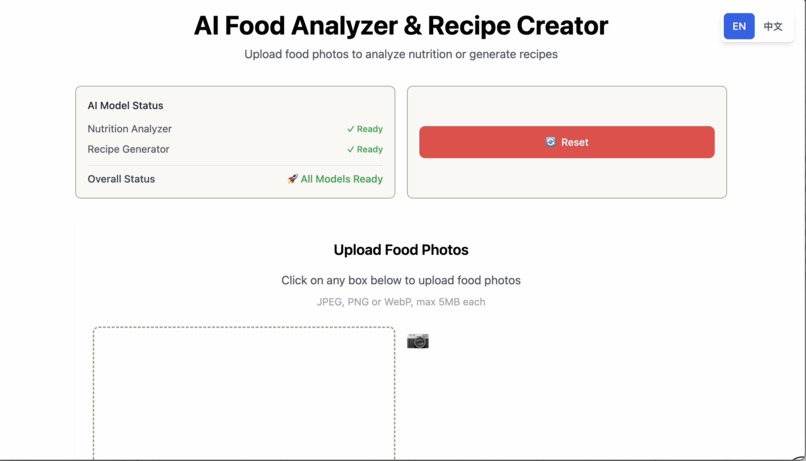
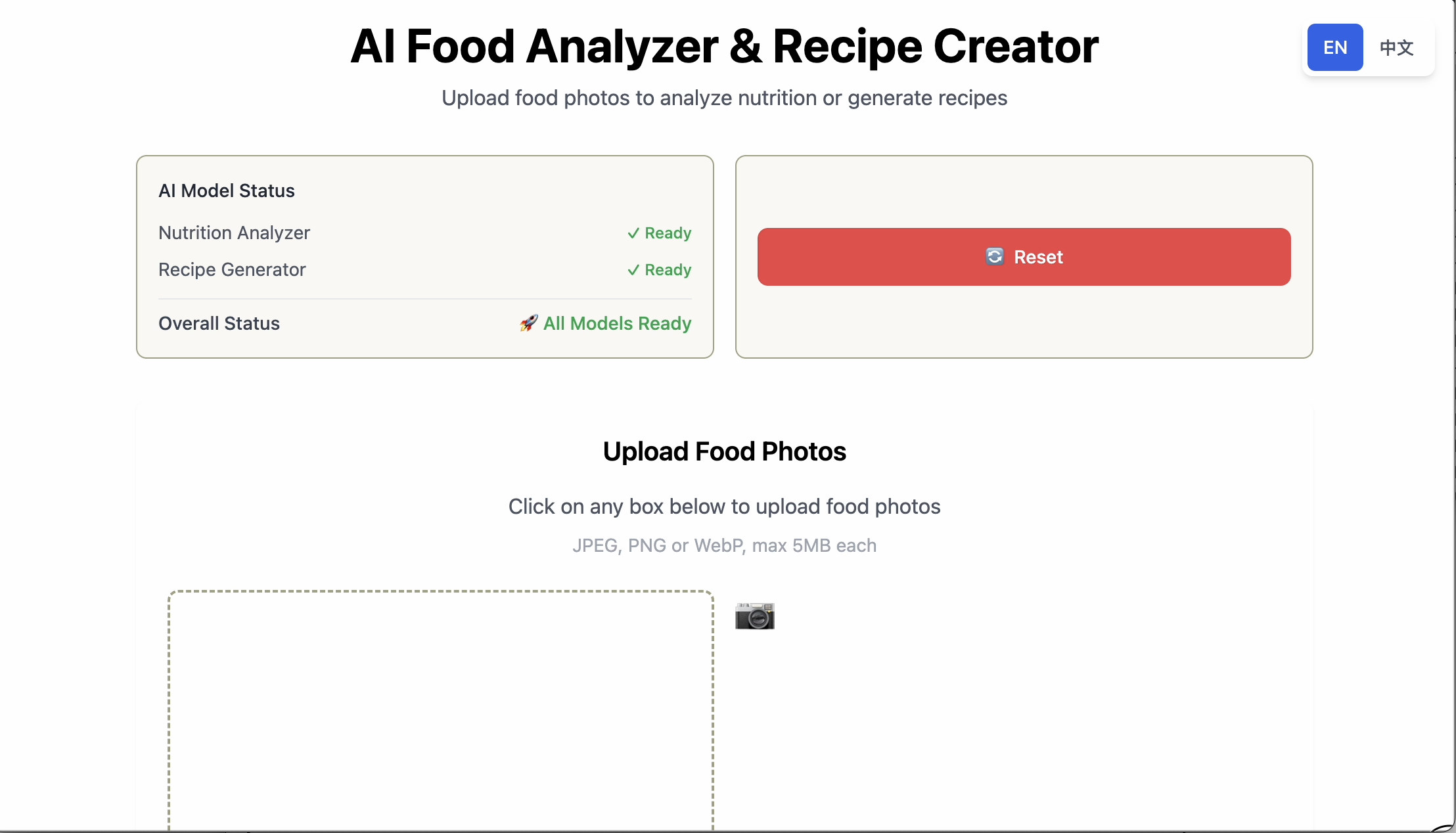
landing page showing the AI model status and photo upload area.
Inspiration
Most nutrition apps today are too complicated — they require manual logging of ingredients, portions, and brands.
I wanted something simple and instant: snap one photo and get a quick idea of how healthy the food is.
I was inspired by research from top universities:
- Tufts University – Food Compass system
- University of Oxford – Nutrient Profiling Model (NPM)
These frameworks prove that food health can be scored systematically. My goal was to condense this science into a single 0–10 health score that anyone can understand at a glance.
What It Does
The app is a mobile-friendly web tool with one mode: Ingredient Analyzer.
- Upload one food photo
- AI predicts calories, sugar, and fat per 100g
- A 0–10 health score (1 decimal place) is calculated
- The system provides a short nutritionist-style tip, such as:
- “High sugar — limit intake.”
- “Balanced nutrients — good choice.”
- “High sugar — limit intake.”
This makes food evaluation fast, clear, and accessible, even for users without nutrition knowledge.
Challenges We Ran Into
- Image ambiguity: sauces, mixed dishes, or hidden ingredients reduce accuracy.
- Portion vs per-100g confusion: science prefers per-100g scoring, but users think in servings.
- Data scarcity: hard to benchmark predictions without a large labeled dataset.
- On-device constraints: ensuring models run under 5 seconds on mid-range phones.
Accomplishments That We're Proud Of
- Built a working MVP that analyzes one photo and gives a clear health score.
- Achieved fast on-device inference (~3–5 seconds per photo).
- Added nutritionist-style advice, making the score more understandable.
- Designed a minimal, mobile-first UI for frictionless use.
What We Learned
- Scientific scoring systems (Food Compass, NPM, HSR) can be adapted into a simple user-facing number.
- Explainability matters — users trust the score more when paired with a short advice line.
- Mobile-first design forces efficient preprocessing and model optimization.
- Accuracy is important, but speed and clarity are equally critical for user adoption.
What's Next for AI-Food-Analyzer
- Add more nutrient predictions: sat fat, sodium, protein, fiber.
- Calibrate against Food Compass or Oxford NPM scores with larger datasets.
- Introduce confidence ranges (e.g., 6.2–6.8 instead of just 6.5) when predictions are uncertain.
- Explore portion-size estimation using hand/utensil scale cues.
- Long-term: expand into multi-photo support and recipe generation mode.

Log in or sign up for Devpost to join the conversation.