Inspiration
Flight delays remain one of the most persistent and costly challenges in modern aviation. Weather disruptions, maintenance issues, and system inefficiencies often propagate across the National Airspace System, resulting in billions of dollars in losses and widespread passenger inconvenience.
Our team, D-Fliers from Morgan State University’s CEAMLS, set out to create a real-time, privacy-preserving flight delay predictor that operates entirely within a web browser. Inspired by our ongoing NASA ULI research on climate-resilient airspace management, we asked a fundamental question:
Can AI-driven prediction and advisory systems be made instant, secure, and accessible to users without the need for cloud servers or complex installations?
This question led to the development of the AI-Driven Flight Delay Predictor (Web Dashboard Edition) — a hybrid web application leveraging TensorFlow.js, WebGPU acceleration, and Chrome Built-in AI (Gemini Nano) to deliver real-time insights directly in the browser.
What It Does
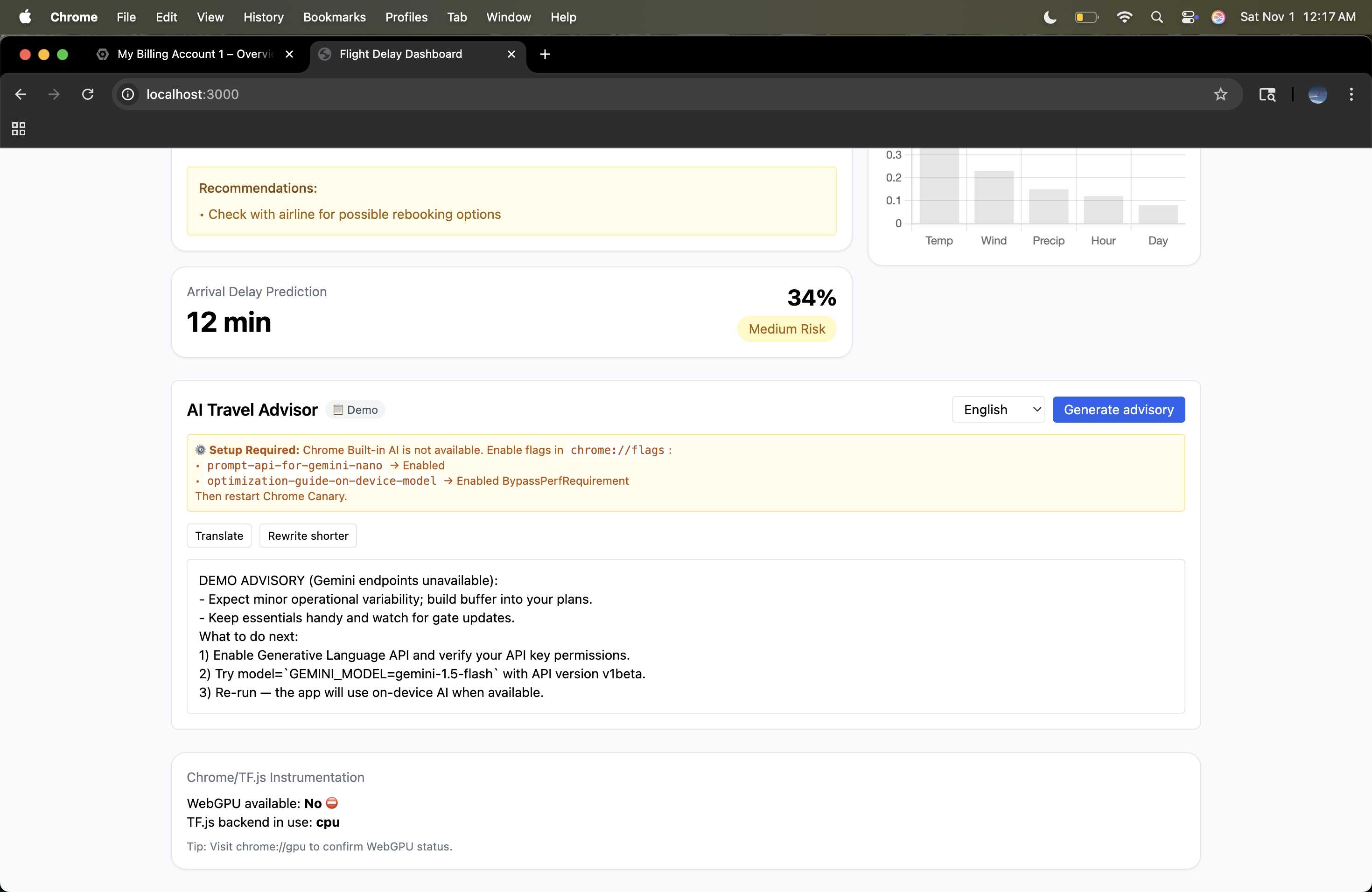
The AI Flight Delay Predictor (Web Dashboard Edition) provides real-time delay predictions and generates personalized travel advisories locally on the user’s device.
Core functionalities include:
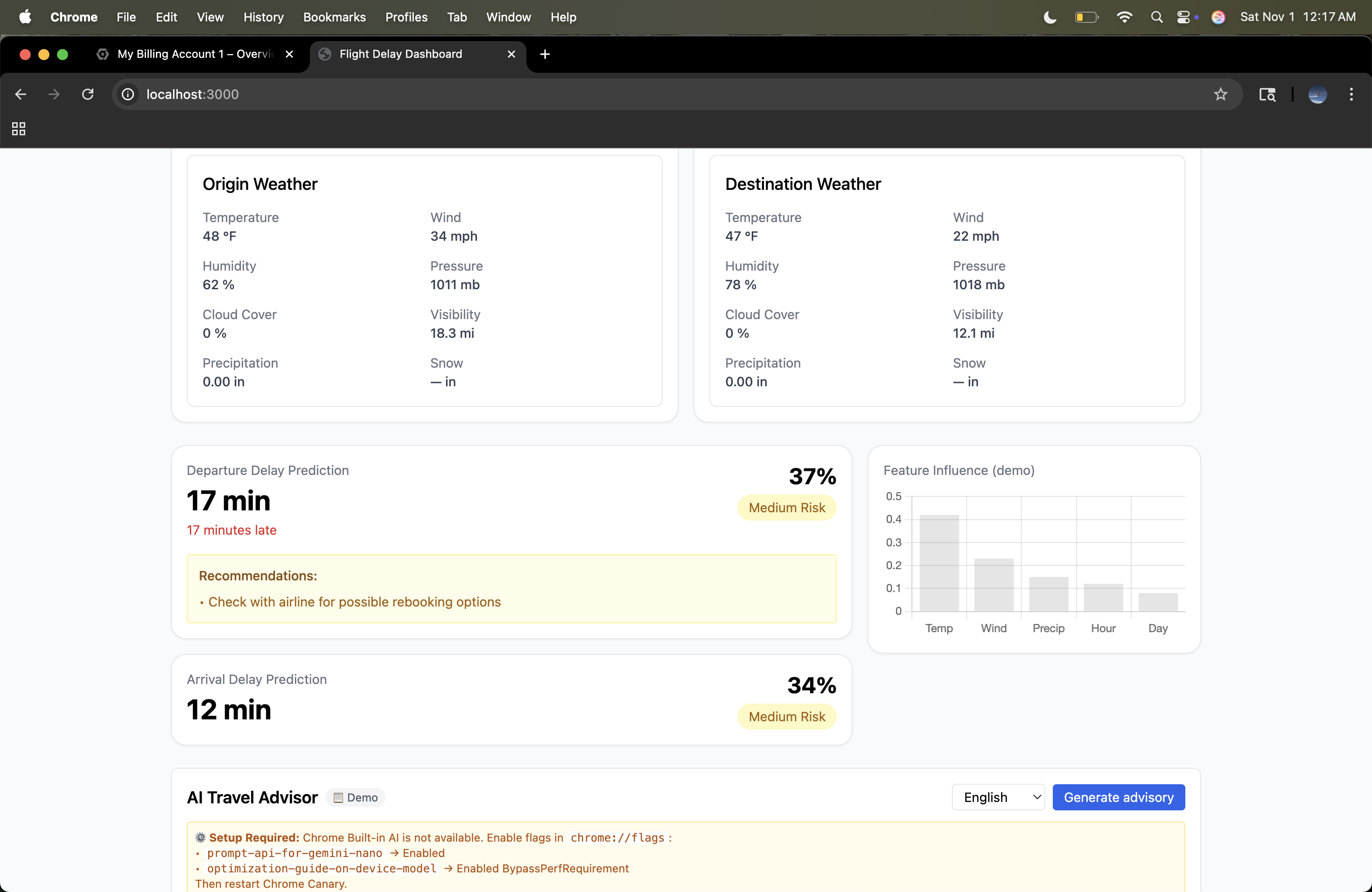
- Real-time delay prediction: Uses in-browser machine learning models (TensorFlow.js) trained on historical weather and flight data.
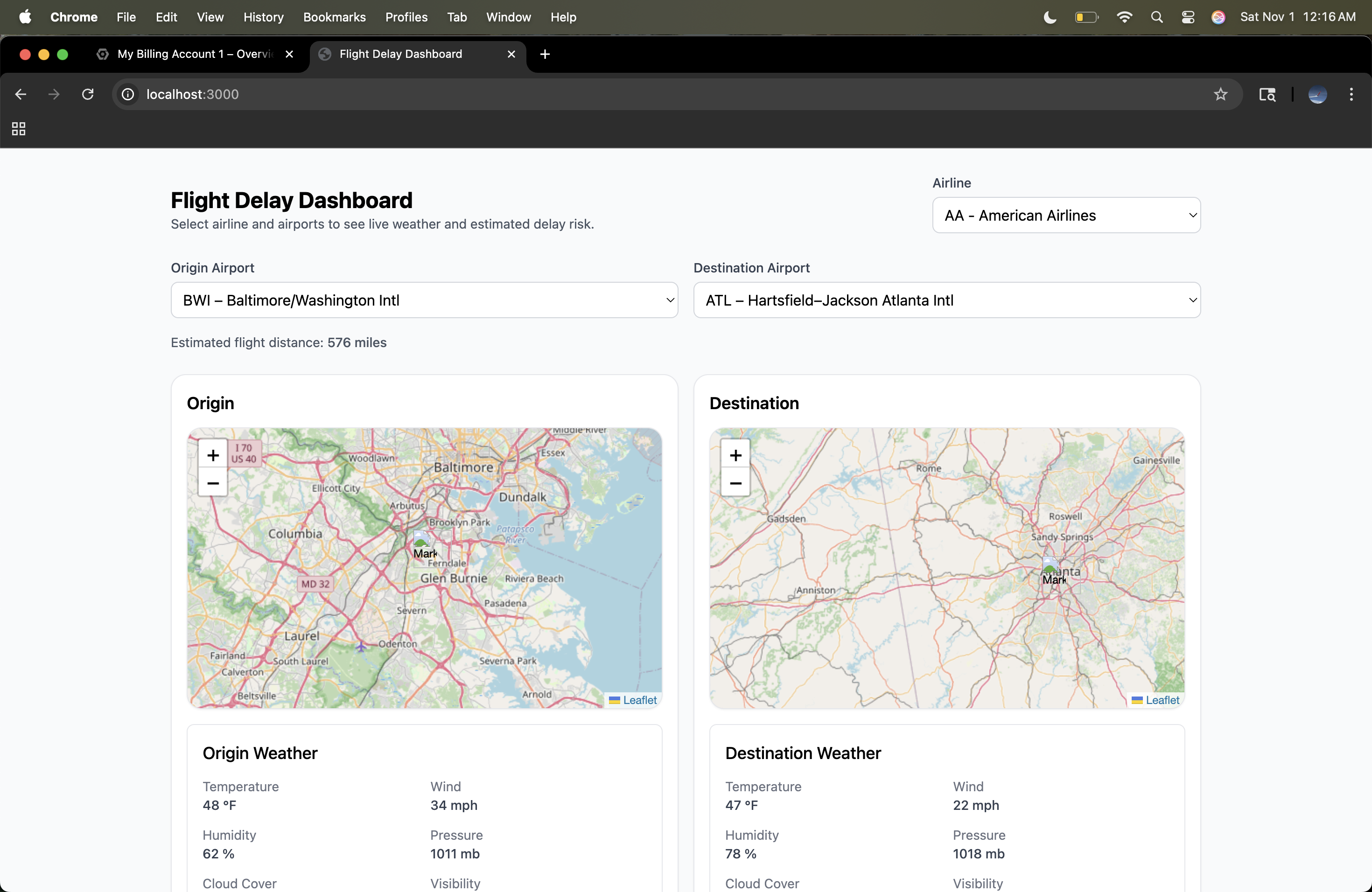
- Weather integration: Incorporates live conditions via the Open-Meteo API.
- On-device AI advisory generation: Employs Chrome’s Built-in AI (Prompt API / Gemini Nano) to generate, translate, or rewrite travel advisories locally, without internet inference.
- Privacy preservation: No user data is transmitted externally during on-device operations.
- Hybrid fallback system: Automatically reverts to a secure server or demo AI model when Built-in AI is unavailable.
Users can select airports, view real-time weather and predicted delay probabilities, and instantly generate AI-based travel recommendations directly in the browser interface.
How We Built It
- Frontend Framework: React and Next.js with Tailwind CSS for a modern, responsive interface.
- Machine Learning Engine: TensorFlow.js running with WebGPU acceleration for efficient in-browser inference.
- AI Advisor Component: Integrates Chrome’s Prompt API to access the Gemini Nano model for fully local text generation.
- Data Integration: Weather data sourced through the Open-Meteo API.
- Fallback API: A lightweight
/api/ai-adviceendpoint that emulates AI behavior when local inference is not available. - Privacy and Security Design: No personal data is transmitted; only public weather data is fetched via secure HTTPS requests.
Challenges We Encountered
- Implementing the Prompt API and ensuring proper configuration through Chrome Canary’s experimental features.
- Managing WebGPU memory allocation for ML models within browser performance limits.
- Designing an automatic fallback system that seamlessly switches between on-device AI, server AI, and demo modes.
- Ensuring cross-platform compatibility across different operating systems and browser versions.
- Balancing model complexity with the need for smooth real-time inference within a browser environment.
Accomplishments We’re Proud Of
- Successfully developed a completely client-side AI inference system requiring no backend for prediction or advisory generation.
- Integrated Gemini Nano through Chrome Built-in AI, demonstrating one of the first browser-native LLM deployments for aviation analytics.
- Achieved a zero-data-leak architecture, ensuring that user inputs never leave the local device.
- Implemented a hybrid AI selection system that adapts automatically to the user’s environment.
- Contributed a working prototype aligned with NASA’s objectives for sustainable and climate-resilient aviation systems.
What We Learned
- Configuration and testing of Chrome Built-in AI (Prompt API / Gemini Nano), including model verification and local inference.
- The potential of TensorFlow.js and WebGPU for near-native ML performance in browsers.
- The importance of designing privacy-first AI applications, ensuring computation remains on the user’s device.
- How hybrid AI architectures can combine local efficiency with scalable fallback mechanisms.
- Broader insights into browser-based AI ecosystems, where powerful models can operate without traditional cloud infrastructure.
What’s Next
- Extend prediction coverage to international airport networks and multi-route analysis.
- Integrate explainability tools (e.g., feature importance and model reasoning) for transparency.
- Incorporate speech-based advisory generation using the Web Speech API in combination with Gemini Nano.
- Develop a progressive web app (PWA) version for offline use.
- Fine-tune Gemini Nano with aviation-specific language data to improve the accuracy and contextual quality of generated advisories.
- Explore optional enterprise deployment using Gemini Pro for large-scale air traffic management systems.
Built With
- chrome
- css
- geminiapi
- javascript
- python

Log in or sign up for Devpost to join the conversation.