-
-
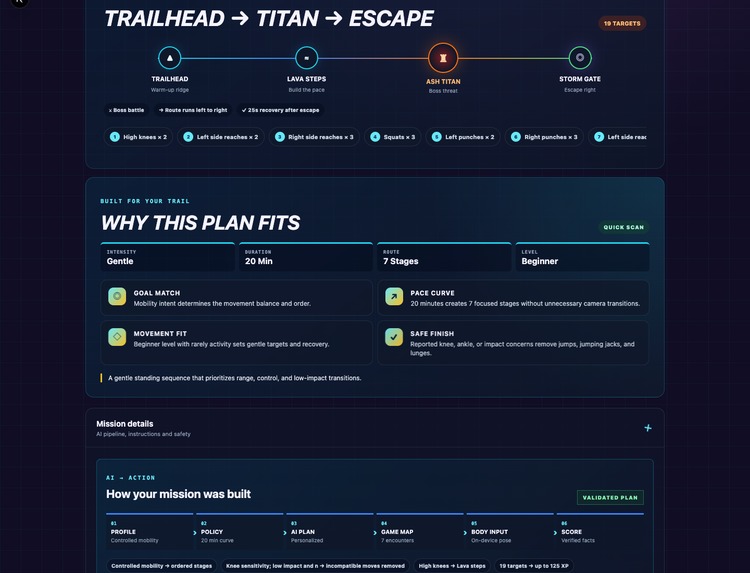
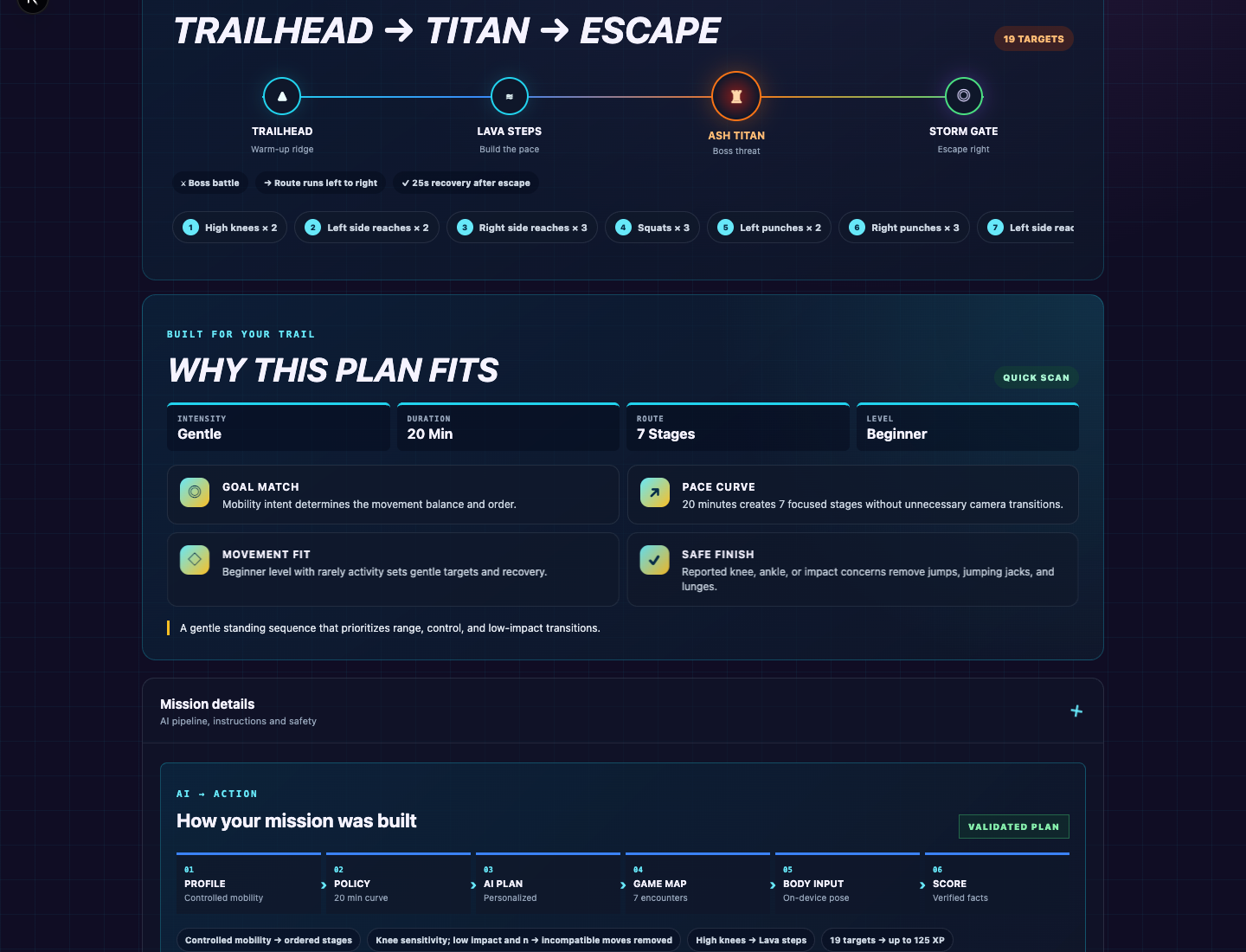
Shows a validated mobility briefing with the route, plan-fit rationale, and AI-to-action pipeline.
-
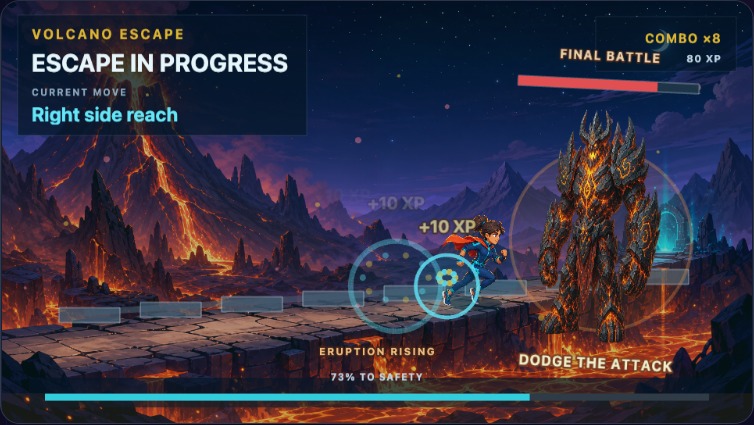
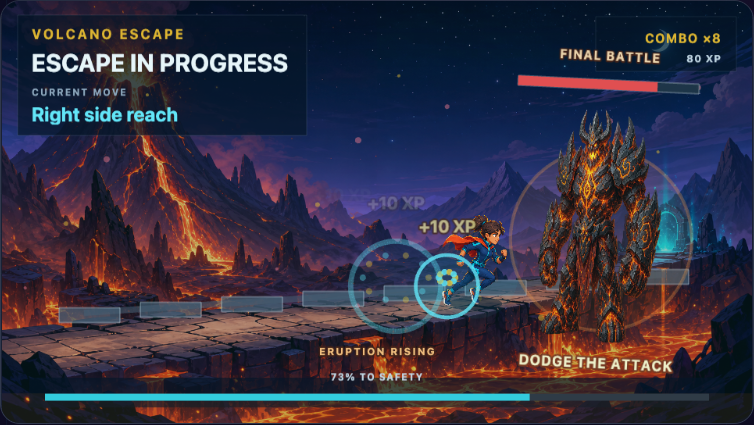
Shows the active Phaser boss encounter after deterministic synthetic movement events advance the mission.
-
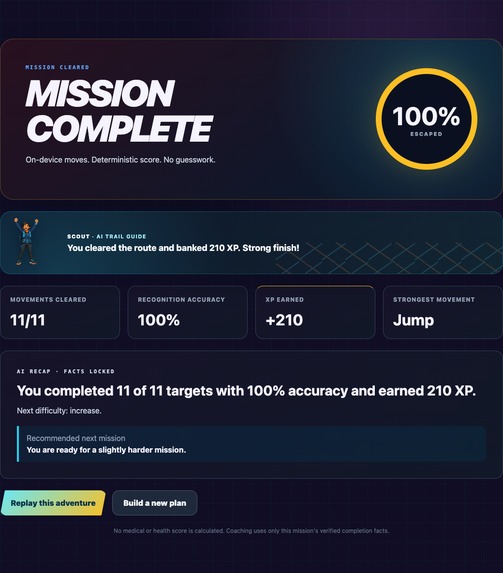
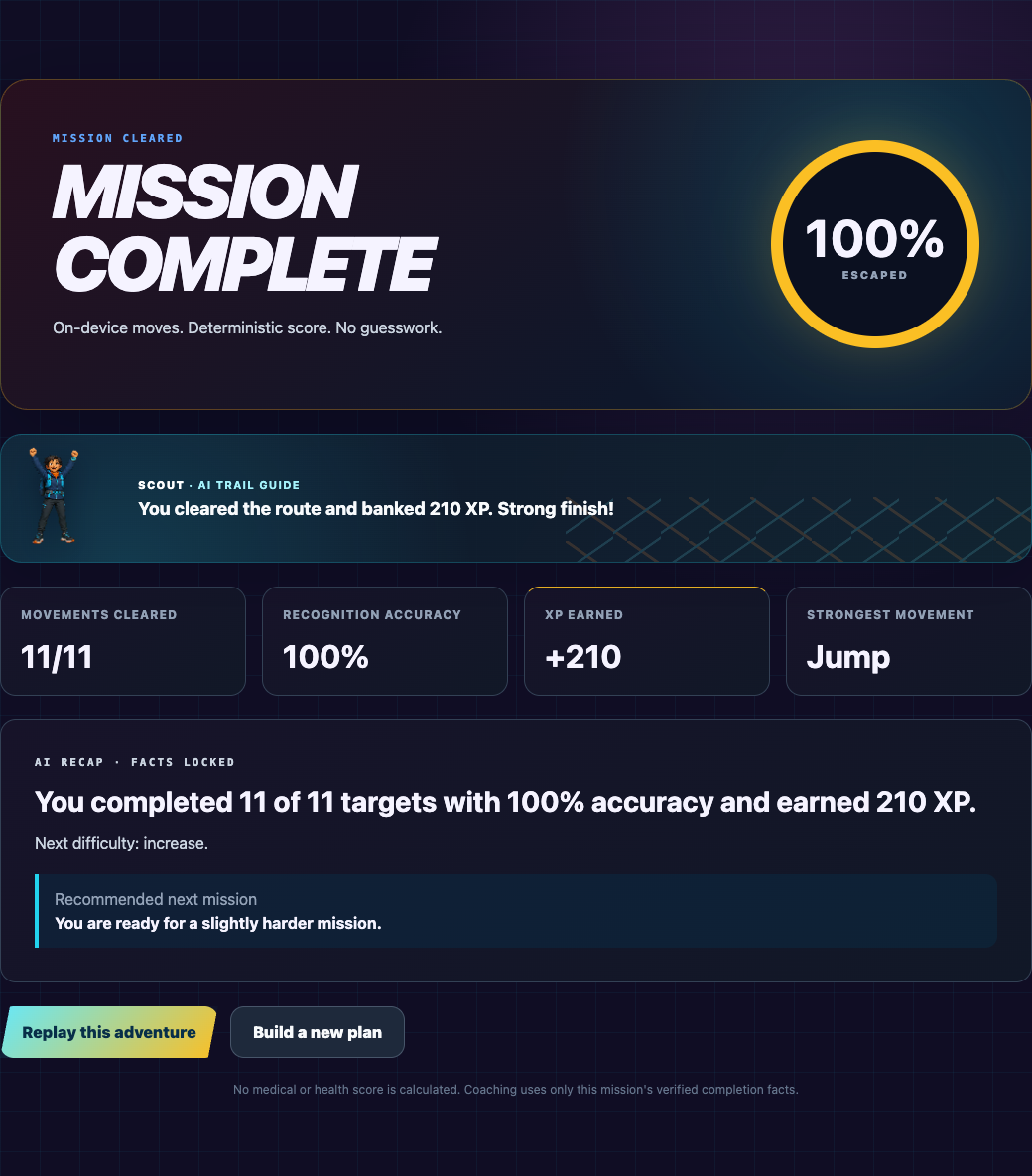
Shows deterministic completion metrics and fact-locked coaching after all verified objectives complete.
QuestFit — Your Body. Your Adventure.
Elevator Pitch
QuestFit transforms personalized workouts into immersive, body-controlled fantasy adventures where every movement powers your journey, defeats powerful enemies, and levels up your fitness.
Inspiration
Working out at home often becomes repetitive. Traditional fitness apps ask users to follow along, count repetitions, and rely on self-discipline to stay motivated. While fitness games make exercise more engaging, many require specialized hardware or provide the same experience for everyone.
I wanted to combine the personalization of an AI fitness coach with the excitement of a fantasy adventure using nothing more than a laptop and webcam.
That idea became QuestFit—a browser-based fitness experience where your body becomes the controller. Instead of simply counting squats, punches, reaches, or jumps, players stabilize collapsing lava paths, dodge hazards, battle the Ash Titan, and escape through the Storm Gate.
What It Does
QuestFit generates a personalized workout based on:
- Fitness goal
- Available workout time
- Experience level
- Weekly activity level
- Movement considerations
Every workout follows a structured progression:
Warm-up → Build → Surge → Peak → Cooldown
The workout is transformed into a playable fantasy mission.
| Exercise | Adventure Mechanic |
|---|---|
| Squats | Stabilize collapsing lava steps |
| Punches | Attack the Ash Titan |
| Side Reaches | Dodge incoming hazards |
| Jumps | Clear dangerous obstacles |
Every verified movement earns XP and advances the mission.
An AI trail guide named Scout welcomes the player, explains the workout, provides encouragement throughout the mission, and celebrates successful completion.
All pose estimation happens locally. Webcam frames and body landmarks are never uploaded, keeping user privacy protected.
How I Built It
QuestFit is built as a browser application using:
- Next.js + React for the application experience
- TypeScript for strongly typed logic
- MediaPipe Tasks Vision for on-device pose detection
- Phaser for real-time gameplay
- Zod for schema validation
- Vitest + Playwright for automated testing
The application follows a validation-first pipeline:
Player Profile
      ↓
Workout Policy
      ↓
Validated Workout
      ↓
Mission Blueprint
      ↓
Pose Recognition
      ↓
Mission Controller
      ↓
Adventure Results
The workout policy determines exercise eligibility, intensity, recovery, ordering, and repetition targets before creating a mission.
MediaPipe detects body landmarks while movement classifiers recognize verified actions such as squats and punches. Those verified events are processed by an authoritative mission controller responsible for progress, XP, scoring, and rewards.
Phaser only renders gameplay from validated mission snapshots, ensuring visual effects cannot accidentally modify game logic or scoring.
Mission completion is calculated deterministically:
$$ Completion\ Rate = \frac{Verified\ Work}{Target\ Work}\times100 $$
AI-generated content can personalize explanations, but it never controls scoring or safety decisions. Every AI response must pass validation before becoming part of the player experience.
AI Development Workflow
QuestFit was developed as a solo project with GPT-5.6 and Codex acting as development accelerators.
I used GPT-5.6 to brainstorm gameplay concepts, refine the user experience, evaluate architecture trade-offs, improve the adventure narrative, and polish documentation.
I used Codex to accelerate implementation by generating boilerplate code, scaffolding React components, refactoring modules, debugging issues, writing tests, and speeding up feature development.
All product decisions, architecture, gameplay mechanics, validation rules, computer vision integration, and final implementation were designed and implemented by me. AI served as a productivity multiplier rather than an autonomous developer.
Challenges
Reliable Movement Recognition
Pose estimation is affected by lighting, camera angle, body proportions, and partial visibility.
I improved reliability through:
- Personal calibration
- Confidence thresholds
- Temporal filtering
- Neutral-position rearming
- Specialized movement detectors
Connecting Exercise to Gameplay
The biggest challenge was making workouts feel meaningful instead of simply counting repetitions.
I created a shared movement registry so every planned exercise directly influences the game world.
Safe AI Personalization
AI recommendations cannot be trusted blindly for fitness.
I built deterministic validation rules that control exercise eligibility, ordering, recovery, and intensity while AI focuses only on personalization and storytelling.
Real-Time Performance
Pose detection, React, Phaser, audio, and voice guidance all run simultaneously.
Keeping these systems independent ensured smooth performance and predictable gameplay.
Hands-Free Experience
Players stand away from the screen during workouts.
To support this, I designed large readable interfaces, voice guidance, automatic framing checks, concise coaching, and automatic navigation between stages.
What I Learned
Building QuestFit taught me that combining AI, computer vision, and game development requires strong system boundaries.
Key lessons include:
- AI should personalize—not determine safety.
- Reliable movement recognition requires temporal state, not only pose estimation.
- Every physical movement should produce meaningful gameplay feedback.
- Deterministic fallbacks are essential for dependable demonstrations.
- Local-first processing greatly simplifies privacy.
- Storytelling dramatically improves workout engagement.
What's Next
Future improvements include:
- User accounts and cloud synchronization
- Session history and achievement tracking
- Leaderboards and multiplayer challenges
- Additional fantasy worlds and bosses
- Expanded browser and device support
- Better movement recognition through larger datasets
- Optional AI providers behind the existing validation layer
Vision
My long-term vision is for QuestFit to become a platform where every workout becomes a unique adventure—personalized by AI, powered by movement, and accessible from any modern browser with nothing more than a webcam.
Built With
- mediapipe
- nextjs
- phaser.js
- playwright
- react
- typescript
- vitest
- zod

Log in or sign up for Devpost to join the conversation.