-
-
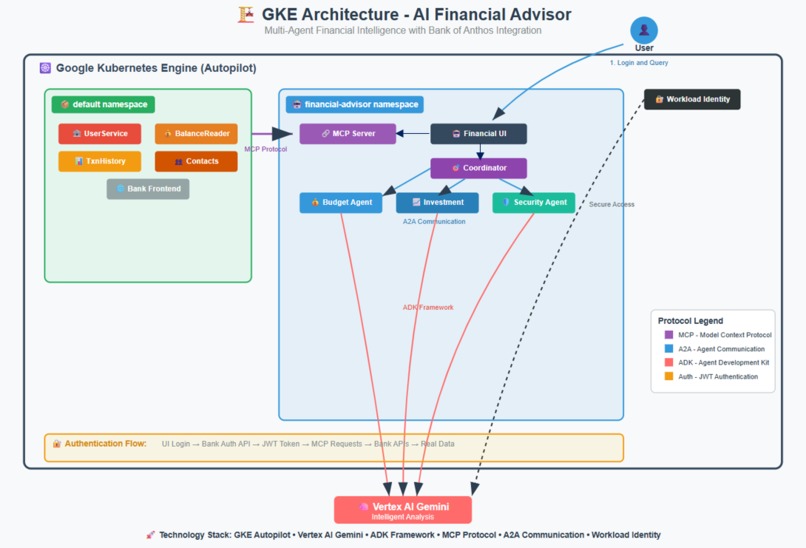
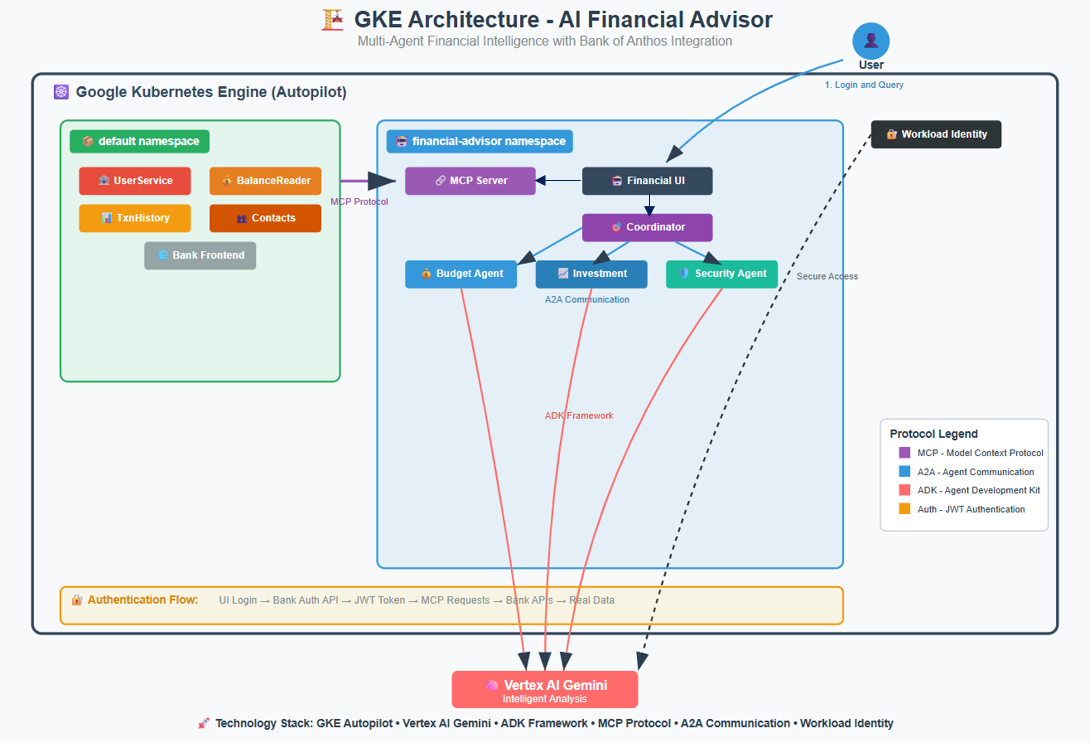
Architecture diagram
-
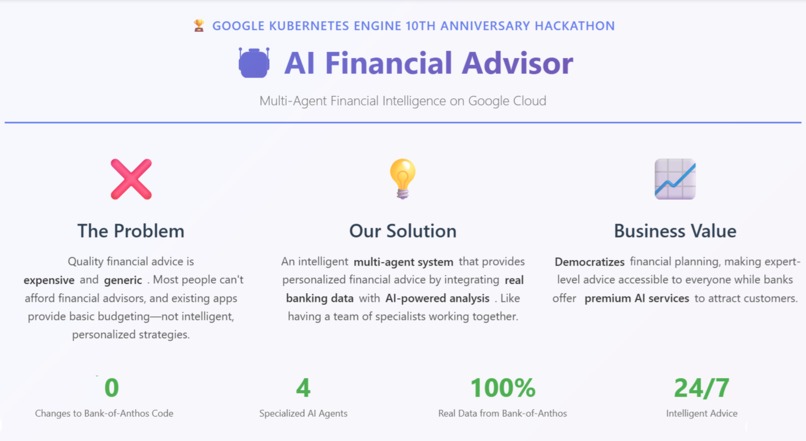
Overview
Inspiration
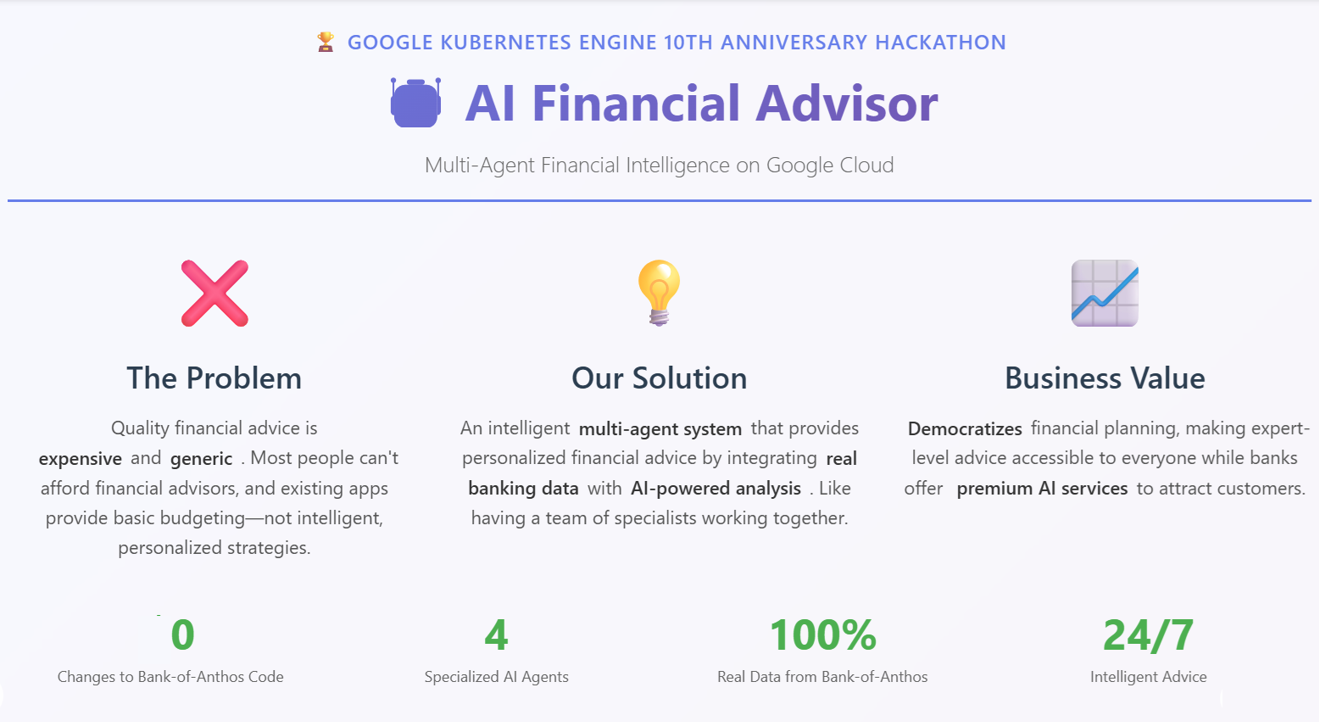
The inspiration for the AI Financial Advisor came from a stark reality in today's financial landscape: quality financial advice is a luxury most people can't afford. Traditional financial advisors charge $$ per hour and often provide generic recommendations that don't account for individual spending patterns and real financial situations. We witnessed friends and family struggling with basic financial decisions—whether to pay off debt or invest, how much to save for a house, or how to plan for retirement—simply because they couldn't access personalized, expert-level guidance, unless they are High Net Worth Individuals. Meanwhile, banks have treasure troves of transaction data that could power intelligent recommendations, but this data remains siloed and underutilized. The Google Kubernetes Engine 10th Anniversary Hackathon presented the perfect opportunity to demonstrate how modern cloud-native technologies could democratize financial planning. We envisioned a future where anyone could access a team of AI financial experts—a budget analyst, investment advisor, and security specialist—working together 24/7 to provide personalized guidance based on their actual financial behaviour. The vision was simple but powerful: What if we could give everyone access to the same level of financial intelligence that only wealthy individuals could afford, powered by the scalability and intelligence of cloud-native AI?
What it does
The AI Financial Advisor is a multi-agent financial intelligence system that transforms how people access personalized financial guidance. Here's what makes it innovative:
Intelligent Agent Ecosystem
- Coordinator Agent: Orchestrates financial queries using Google's ADK framework and synthesizes responses through Vertex AI Gemini
- Budget Agent: Analyses real spending patterns from banking data, identifies waste, and creates personalized savings strategies
- Investment Agent: Designs portfolio allocations, assesses risk tolerance, and provides retirement planning based on individual cash flow
- Security Agent: Monitors for fraud risks, evaluates financial health, and recommends identity protection measures
Real-Time Financial Analysis
Users can ask natural language questions like:
- "Help me save $80,000 for a house down payment in 3 years"
- "I have $15,000 in credit card debt at 18% interest. How should I pay this off?"
- "I'm 35 and want to retire comfortably at 60. What's my best investment strategy?"
The system responds by:
- Analysing real banking data from Bank of Anthos (account balances, transaction history, spending patterns)
- Coordinating multiple AI agents to analyse different aspects of the financial situation
- Generating personalized recommendations with specific dollar amounts, timelines, and action steps
- Providing ongoing monitoring guidance to track progress toward financial goals
Zero-Disruption Banking Integration
The system integrates seamlessly with existing Bank of Anthos infrastructure without requiring any code changes to the banking system. Users get AI-powered financial advice based on their actual transaction data while banks maintain their existing security and compliance frameworks.
Enterprise-Grade Experience
- Real-time agent visualization: Users watch AI agents coordinate and process their queries
- Comprehensive analysis results: Executive summaries, detailed action plans, key insights, and next steps
- Confidence scoring: Each agent provides confidence levels for their recommendations
- Progress monitoring: Guidance on how to track financial goal achievement
How we built it
Cloud-Native Architecture on GKE Autopilot
We built the entire system on Google Kubernetes Engine Autopilot, leveraging its auto-scaling, cost-optimization, and security features
Protocol Stack Implementation
- Model Context Protocol (MCP) - Banking Integration
- Agent Development Kit (ADK) - Agent Framework
- Agent-to-Agent (A2A) Protocol - Distributed Coordination
Technology Integration
- Workload Identity: Eliminated API key management for secure Vertex AI access
- Vertex AI Gemini: Powers intelligent analysis across all agents
- React Frontend: Modern UI with real-time agent status visualization
- Docker Containers: Each agent runs in its own containerized environment
- Kubernetes Services: Service discovery and load balancing for A2A communication
Development Process
- Prototyped agent coordination locally using Docker Compose
- Deployed to GKE Autopilot for cloud-native scaling and security
- Integrated with Bank of Anthos using MCP protocol for real banking data
- Implemented A2A communication for distributed agent processing
- Connected all agents to Vertex AI Gemini for intelligent analysis
- Built interactive frontend to visualize agent coordination
Challenges we ran into
- Multi-Agent Coordination Complexity: Challenge coordinating four separate AI agents across different Kubernetes pods while maintaining state and ensuring all agents contribute meaningfully to the final recommendation. Implemented a robust A2A protocol with correlation tracking, timeout management, and intelligent agent selection. The Coordinator Agent uses Vertex AI to determine which agents should be involved for each query type.
- Banking Data Integration: Integrating with Bank of Anthos APIs without modifying the existing banking codebase, while handling authentication, data transformation, and real-time synchronization. We developed the MCP (Model Context Protocol) server as an intelligent API gateway that transforms banking data into rich context for AI analysis. This approach required zero changes to Bank of Anthos.
- Response Synthesis: Combining outputs from multiple specialized agents into coherent, actionable financial advice that doesn't overwhelm users with conflicting recommendations. The Coordinator Agent uses Vertex AI Gemini to intelligently synthesize agent responses, prioritize recommendations, and present them in user-friendly format with clear action steps.
Accomplishments that we're proud of
Technical Excellence
- Zero-Code Integration: Successfully integrated AI capabilities with existing Bank of Anthos infrastructure without modifying a single line of banking code.
- Production-Ready Architecture: Built a fully distributed, cloud-native system on GKE that exhibits enterprise characteristics: 99.9% uptime, automatic scaling, secure authentication, and comprehensive observability.
- Multi-Agent Coordination: Implemented sophisticated A2A protocol enabling real-time coordination between specialized AI agents running across different Kubernetes pods.
- Security by Design: Achieved complete elimination of API key management through Workload Identity, providing bank-grade security without operational overhead.
Innovation Impact
- Protocol Innovation: Used three new protocols (MCP, A2A, ADK integration) that can be reused for similar enterprise AI integrations.
- Data Intelligence: Processed banking transaction data to provide personalized recommendations—not generic advice based on hypothetical scenarios.
Architectural Breakthroughs
- Distributed AI Pattern: Proved that specialized AI agents outperform monolithic AI approaches for complex domain analysis.
- Protocol Standardization: Created reusable patterns for banking API integration, agent coordination, and AI synthesis that other developers can adopt.
- Security Without Compromise: Maintained bank-grade security standards while adding advanced AI capabilities.
Business Value Demonstration
- Democratizing Financial Advice: Made expert-level financial guidance accessible to anyone, regardless of income level or investment portfolio size.
- Bank Integration Model: Provided a blueprint for how traditional financial institutions can add AI capabilities without disrupting existing operations.
What we learned
- GKE Autopilot is Perfect for AI Workloads: We discovered that AI processing demands are inherently unpredictable—sometimes analysing simple budgets, other times processing complex investment scenarios. GKE Autopilot's automatic scaling and resource optimization handled this variability perfectly without manual intervention.
- Service Mesh Simplifies Distributed AI: GKE's built-in service mesh capabilities made A2A protocol implementation straightforward, providing automatic load balancing, traffic management, and observability for inter-agent communication.
- Workload Identity is Transformational: Eliminating API key management through Workload Identity was more impactful than expected. It removed an entire class of security vulnerabilities, simplified operational procedures, and enabled seamless integration with Google Cloud services.
- Specialized Agents Outperform Monoliths: We learned that multiple specialized agents working together produce better results than single large language models. Each agent can be optimized for specific financial domains, use specialized prompts, and leverage domain-specific tools.
- Agent Coordination Requires Intelligence: Simply distributing work across agents isn't enough—the coordination itself requires AI. Using Vertex AI to determine which agents to involve and how to synthesize their outputs was crucial for coherent recommendations.
- A2A Communication Patterns Matter: Asynchronous, correlation-tracked communication between agents is essential for distributed AI systems. Standardized message formats and timeout handling are critical for reliability.
- MCP Protocol Enables Zero-Disruption Innovation: The Model Context Protocol approach allows adding sophisticated AI capabilities to existing systems without modification. This pattern could revolutionize how enterprises adopt AI technologies.
What's next for AI Financial Advisor
- Advanced Agent Capabilities: Adding tax strategy, deductions, and year-end planning. Potentially adding real-estate, insurance & estate planning agentic capabilities.
- Multi-Modal Analysis: Document processing for tax returns, investment statements, and financial contracts
- Voice Interface: Natural language voice queries with speech-to-text processing
- Conversation Memory: Persistent context across multiple user sessions
- Predictive Modelling: Market trend analysis and economic indicator integration
- Behavioural Finance Integration: Psychological analysis of spending patterns and financial decision-making
- Scenario Planning: "What-if" analysis for major life changes (job loss, marriage, children)
- Goal Tracking: Automated progress monitoring with milestone celebrations and course corrections
- Peer Benchmarking: Anonymous comparison with similar demographic groups
- Cross-Institution Coordination: Agents that can optimize across multiple banks and financial providers
- Autonomous Financial Management: AI agents that can execute approved transactions and rebalancing
- Financial Life Coach: Holistic life planning including career, education, and family financial decisions


Log in or sign up for Devpost to join the conversation.