-
-
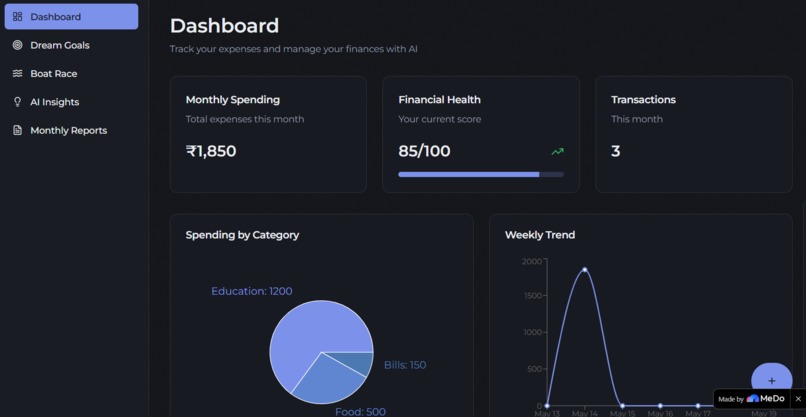
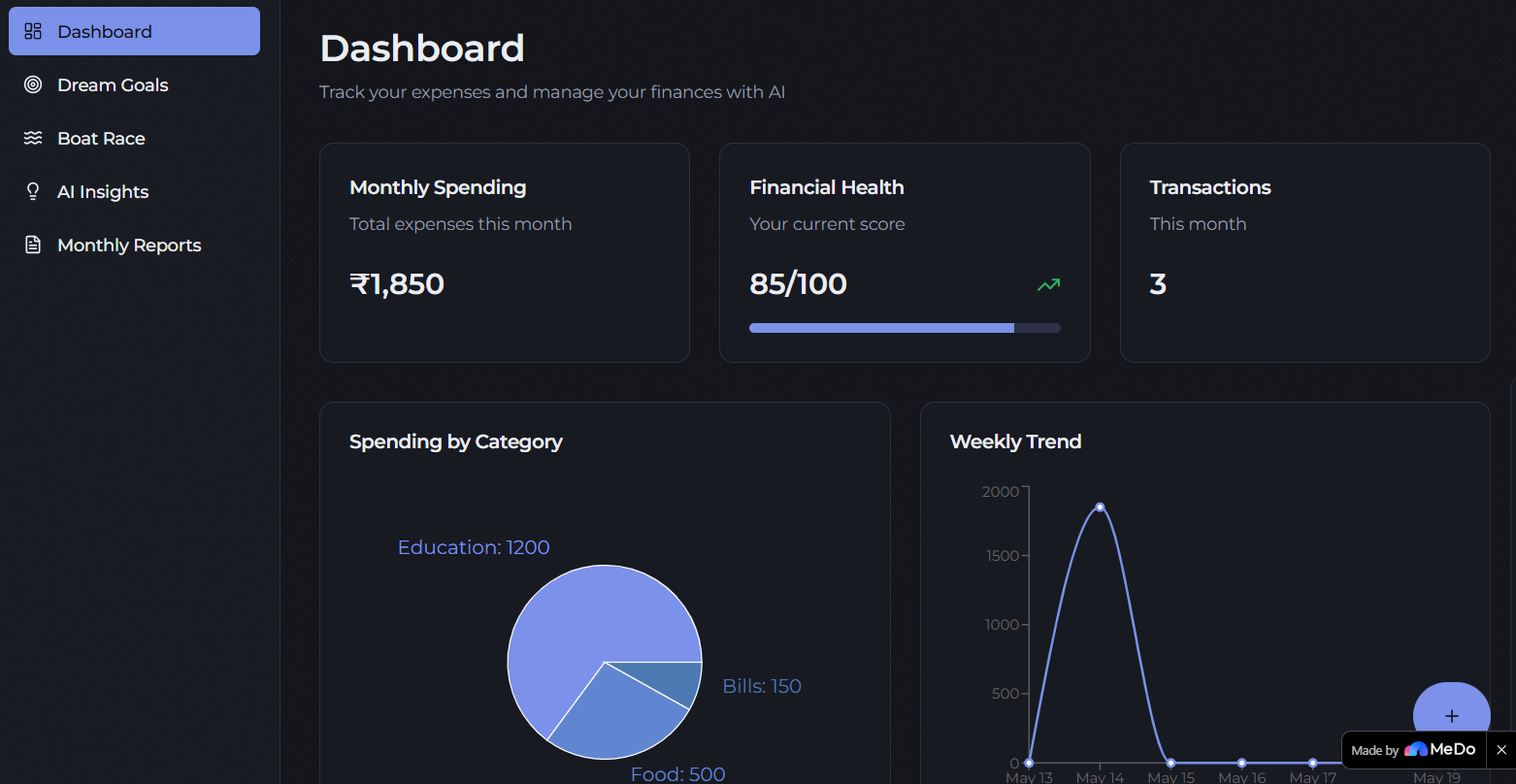
DASHBOARD
-
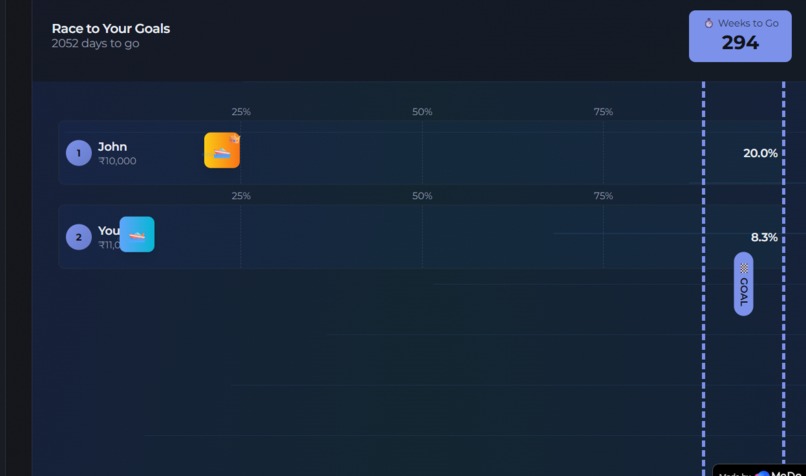
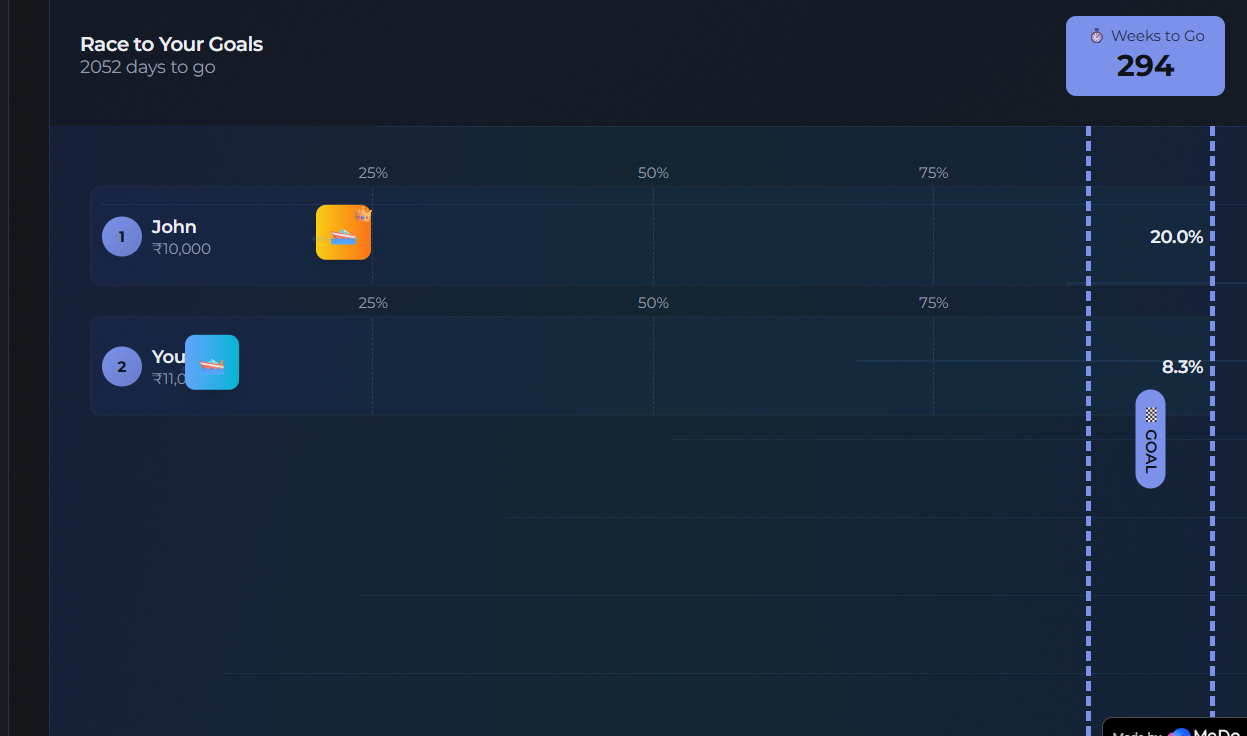
BOAT RACING
-
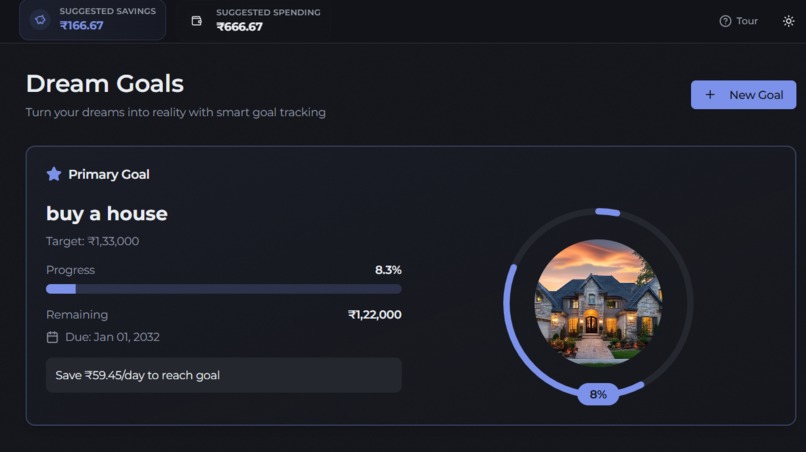
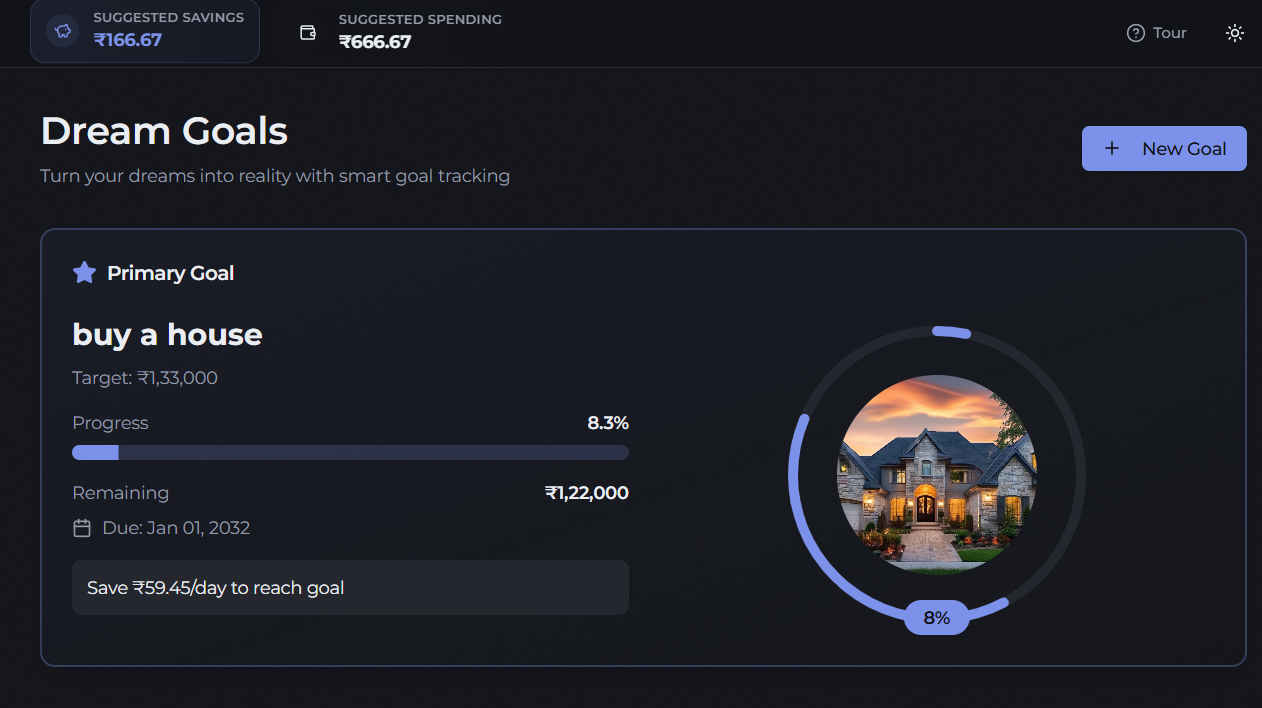
DREAM GOAL PROGRESS
-
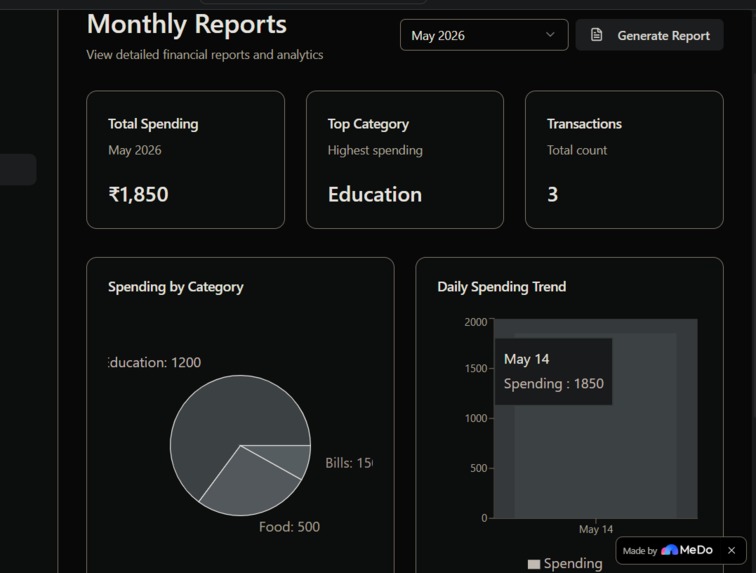
MONTHLY REPORT
-
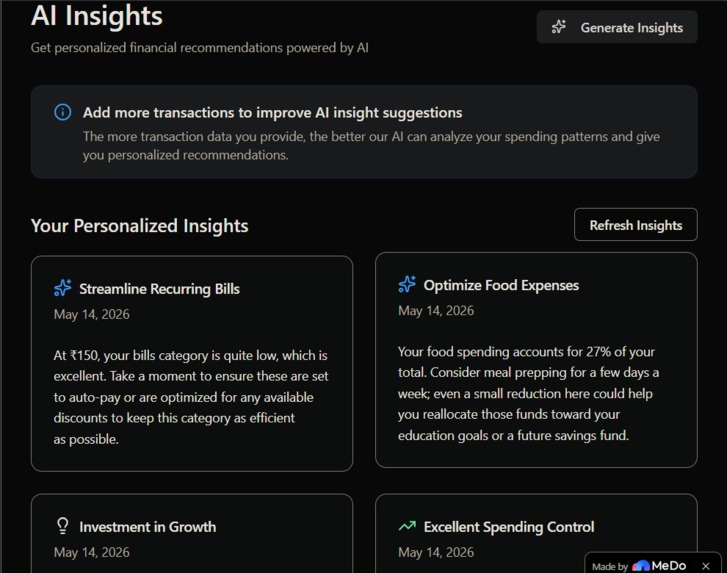
AI INSIGHTS
The Broken Habit
Meet Alex. Alex has three different personal finance apps installed on their phone. They downloaded each one with the best intentions: to track expenses, save for a dream vacation, and finally build good money habits.
Two weeks later, those apps sit unopened.
Logging every coffee felt like a chore. The static graphs felt depressing. The apps functioned perfectly as passive ledger books, but they completely failed to keep Alex engaged.
The Real Problem
Traditional personal finance applications fail because they track history instead of changing behavior.
For students and young adults struggling to build consistent financial habits, manual expense tracking is tedious. People do not just need a pie chart of past mistakes. They need:
- Actionable guidance tailored to their exact spending.
- Psychological motivation tied to real-world dreams.
- Social accountability to prevent them from quitting.
- Positive behavioral reinforcement when they do the right thing.
When managing money feels like a boring, isolating chore, users simply walk away.
The Solution: AI Finance Assistant
AI Finance Assistant fundamentally rethinks how people interact with their money. We built a platform operating on one core philosophy: saving is another form of income.
Instead of passive tracking, we combined frictionless AI voice logging, personalized LLM coaching, and highly engaging UI gamification to shift the user experience from tedious data entry to active financial growth.
Core Features Breakdown
- Frictionless Voice Dashboard: No more manual form filling. A clean, dark-mode modal prompts users to "Tap the mic and speak naturally!" An underlying LLM instantly extracts context from phrases like "Paid 1200 for electricity bill", categorizes it under "Bills," and dynamically updates the user's Financial Health score (e.g., 85/100) and pie charts in real-time.
- Dream Goal Motivation: We turn abstract savings into tangible, daily milestones. When a user sets a primary goal like "buy a house," the UI wraps their progress in a beautiful circular graphic. The system breaks down the intimidating ₹1,33,000 target into a highly actionable metric: "Save ₹59.45/day to reach goal," creating a strong, manageable emotional connection to saving.
The Boat Race (Gamified Social Savings): Our flagship feature. Users connect with friends to enter a visual, gamified financial race. The dashboard displays horizontal tracks comparing your percentage completion (e.g., You at 8.3%) against peers (e.g., John at 20.0%). With countdowns like "2052 days to go," animated boats physically move forward on the track as users save, turning an isolating task into a socially engaging, competitive experience.
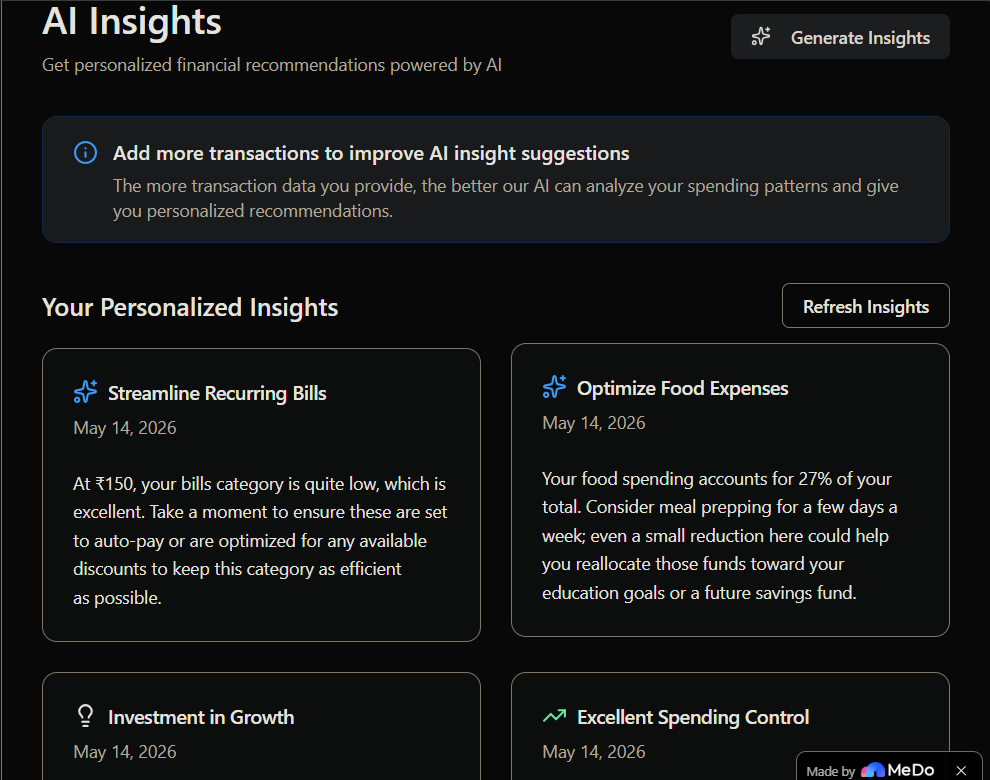
Prescriptive AI Insights: A real LLM analyzes your specific transaction history to generate custom advice cards. Instead of generic tips, it reads the data and provides hyper-specific insights—for instance, noticing that Food accounts for 27% of spending and suggesting targeted meal prep, or recognizing optimized utility bills and recommending auto-pay setups.
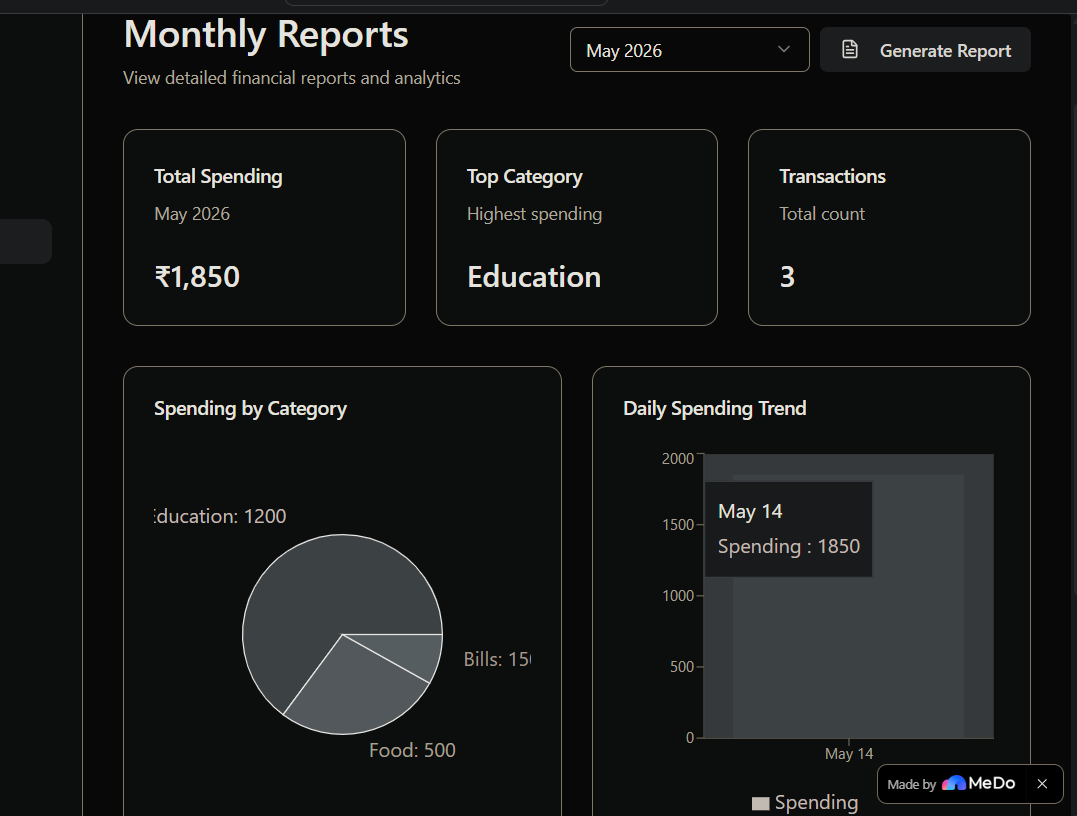
Monthly Performance Reports: Scannable analytics breakdowns showing exactly where money went (e.g., ₹1,850 total spent, with Education as the top category), paired with daily spending trend bar charts to encourage continuous month-over-month improvement.
The Innovation
AI Finance Assistant stands out by solving the "motivation drop-off":
- Behavioral Gamification: The Boat Race introduces multiplayer accountability to personal finance, replacing static progress bars with competitive motion.
- Zero-Friction Logging: Voice-to-data AI removes the tedious data entry that kills user retention.
- Prescriptive, Not Descriptive: We don't just show you where your money went; our AI reads the specific context of your habits and tells you exactly how to improve tomorrow.
Built Entirely With MeDo
This entire platform was generated 100% using MeDo.
- Zero Manual Code: Not a single line of code was manually written, edited, or tweaked.
- Complete Full-Stack Architecture: MeDo handled the dark-theme frontend UI, the backend data logic, the voice-to-text workflows, and the complex LLM integrations for the AI Insights engine.
- Developer as Director: The developer's role shifted entirely from syntax typing to product thinking—guiding architecture, refining visual outputs, and perfecting the prompt engineering.
The Iteration Story
Great products are not one-shot generations. This project reached Version 21. Continuous iteration was our secret weapon. With every version, we prompted MeDo to refine the UX, tighten logic, and polish the exact layouts you see on the dashboard.
- Prompt: Define the core feature and required data points.
- Review: Audit the flow, such as ensuring the daily savings calculation accurately reflects the target date.
- Refine: Instruct MeDo to adjust edge cases and aesthetics (e.g., changing a standard list into the polished AI Insight cards).
- Integrate: Connect the new feature directly into the unified full-stack ecosystem.
Standout MeDo Experiences
Bringing The Boat Race to Life Translating a gamified, multiplayer competition into a working UI is historically highly complex and code-intensive. When we asked MeDo to visualize users racing based on savings data, it didn't just give us a boring table. It intelligently generated dynamic horizontal race tracks, complete with floating animations and boats that visibly progress as the backend percentage data updates. MeDo flawlessly bridged raw numbers with a highly polished, interactive experience.
Intelligent Dashboard Analytics When prompted to build the main dashboard, MeDo instantly understood the assignment. Without needing granular instructions for every visual component, it automatically structured interactive donut charts for category spending, calculated the dynamic 85/100 Financial Health score, and perfectly positioned the "Suggested Savings" top bar, making the application feel production-ready immediately.
Challenges & Learnings
- Directing AI Requires Intense Vision: Because MeDo writes the code, the human must be relentlessly precise about user flows, data structures, and the "why" behind every feature. Vague prompts lead to vague products.
- Iteration is Everything: The first output is just a baseline. Pushing to Version 21 taught us how to communicate micro-adjustments effectively to achieve a truly robust UI.
- Prompting Complex Visuals: Getting the Boat Race animations perfectly synced with user percentage data required careful, deliberate prompt engineering to ensure the frontend accurately reflected the backend logic.
What's Next
- Direct Bank Integrations: Transitioning to real-time transaction syncing via open banking APIs to complement the voice-input system.
- Co-op Savings Modes: Introducing team-based goals (e.g., roommates saving for rent together on a shared boat).
- Predictive Forecasting: Expanding the LLM to predict end-of-month financial shortfalls based on early-month daily spending trends.
Demo userid
- username : john
- password : 12345678
Category
Business & E-commerce
Built With
- medo
- typescript
- vibecoding


Log in or sign up for Devpost to join the conversation.