Inspiration
As AI data centers keep growing, I kept thinking about how much energy and water is wasted on cooling. Most systems wait until servers are already too hot before flooding them with water. That seemed backwards to me. I wanted to build something that could anticipate those heat spikes and only cool what needed cooling, saving resources and preventing overheating.
What it does
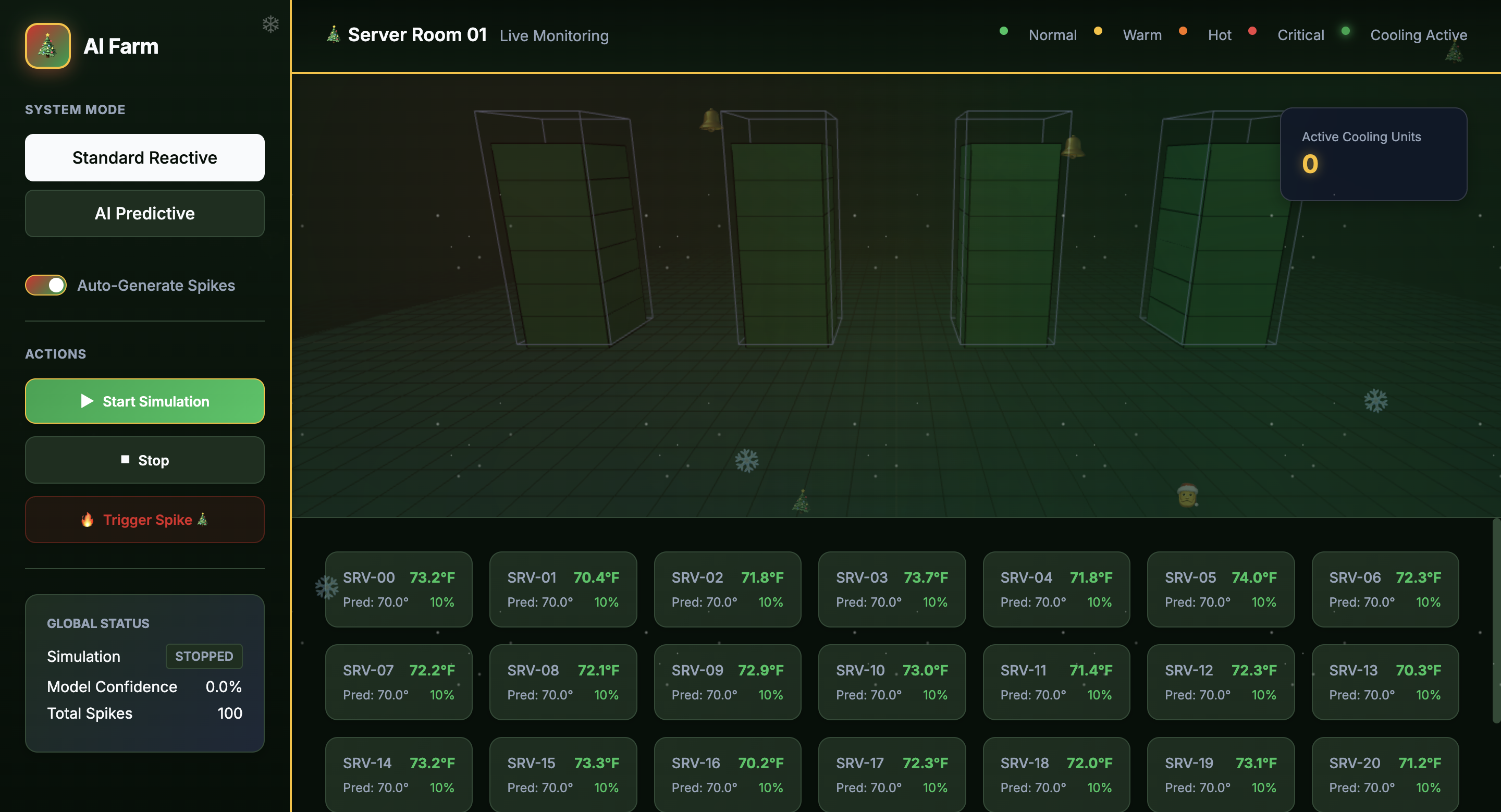
AI Farm Water Management System is like a brain for a server room. It keeps an eye on 24 server areas spread across four racks and learns their patterns. Instead of reacting when things get too hot, it uses machine learning to see a spike coming and starts cooling early. You can switch between a simple reactive mode (cool when temps go above 85°F) and a smart AI mode that looks at spike probabilities. On the front end there's a slick 3D visualization of the server room that changes colors based on each server’s temperature and status. There’s also a control panel where you can start and stop the simulation, trigger spikes, retrain the model and see how confident the system is.
How I built it
I built the backend with Flask and hosted it on Render. To mimic a real server farm, I wrote a simulation that updates every second. It generates random heat spikes, lets heat spread to nearby servers, and decides when to cool based on the mode you’ve chosen. For the machine learning part, I went deep into feature engineering. I looked at time of day, day of week, how temperatures change over time, rolling averages, how long it’s been since the last spike, and even what neighboring servers are doing. These features feed into a pair of models: one that predicts future temperatures (using a Gradient Boosting Regressor with a Random Forest backup) and another that classifies whether a spike is likely.
On the frontend, I used JavaScript and Three.js to build a real‑time 3D view of the server room. The site is deployed on Netlify. The interface is dark-themed and responsive, with controls on the side and a main 3D scene. It polls the backend every couple seconds and updates the temperatures, colors and status bars smoothly.
Challenges I ran into
There were definitely some hurdles. Making the heat simulation feel realistic took a lot of tweaking—servers don’t all heat up and cool down at the same speed. Coming up with features that actually helped the models learn required a lot of trial and error. And making sure the backend and frontend stayed in sync without lagging meant I had to optimize how often I polled the API and updated the 3D scene. Designing an interface that felt intuitive yet showed lots of data was its own challenge too.
Accomplishments that I'm proud of
I’m proud that this project turned into a full‑stack solution. The machine learning models can reliably predict when spikes are about to happen, which feels like magic when you see the cooling kick in before the temperatures soar. The 3D visualization turned out better than I expected and really helps you understand what’s going on inside the server room at a glance. And overall, it feels good to know that this kind of predictive cooling could save water and energy in the real world.
What I learned
This hackathon pushed me to combine so many different skills: time‑series feature engineering, building both regression and classification models, deploying a Flask API, creating an interactive 3D interface, and thinking about user experience. I also learned a lot about how heat actually diffuses through a server rack and how small design tweaks in a UI can make complex data feel simple.
What's next for AI Farm Water Management System
If I had more time, I’d love to test this with real sensor data from a data center. Fine‑tuning the models with real world temperatures would make the predictions even better. I’d also add alerts and logs so operators can see a history of spikes and cooling actions. Eventually, this could scale to larger farms and maybe even integrate with other building management systems.


Log in or sign up for Devpost to join the conversation.