-
-
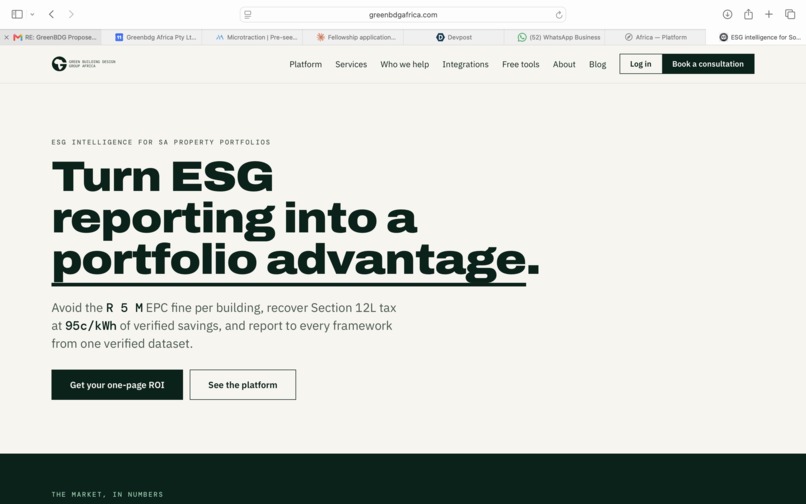
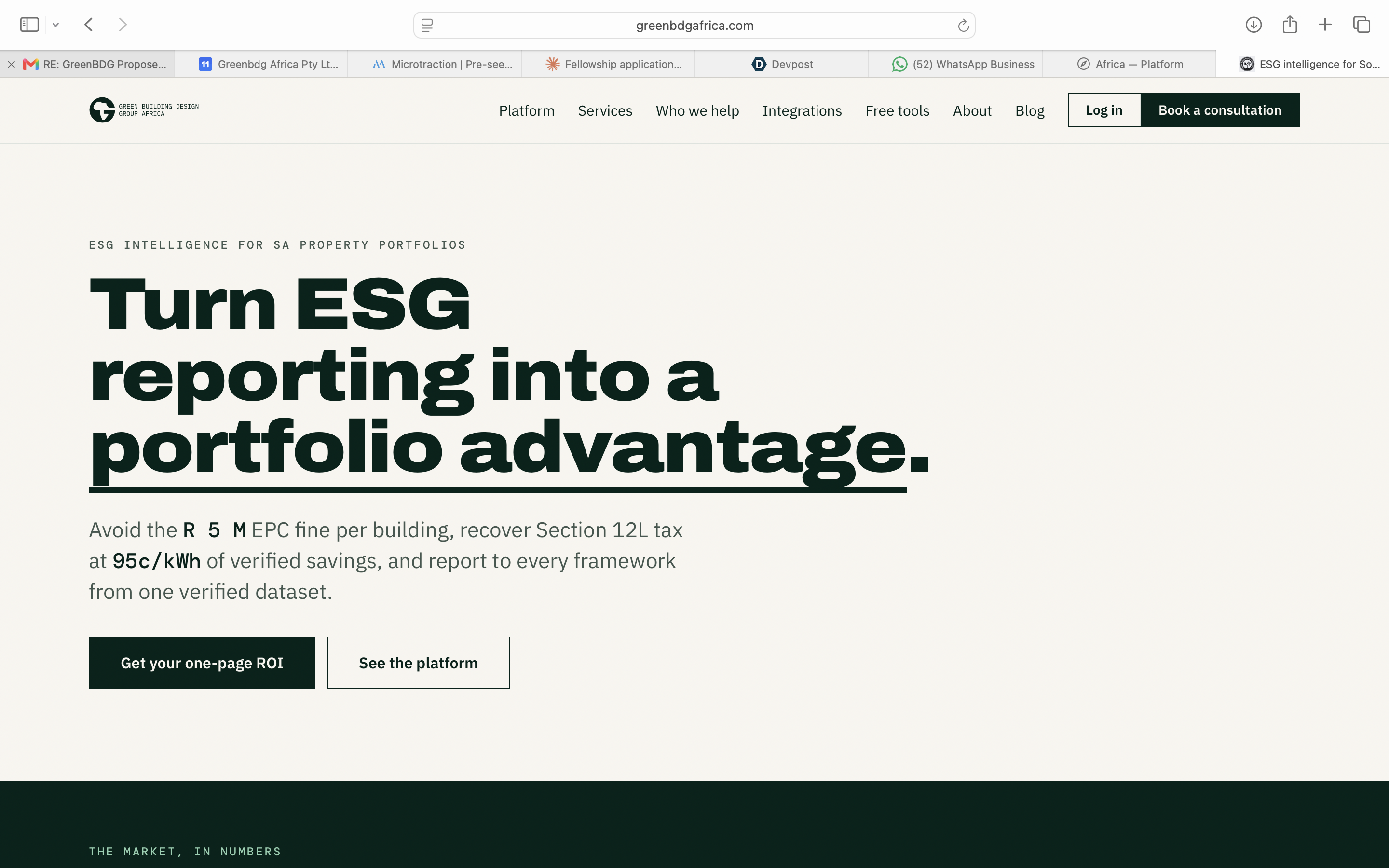
GreenBDG Marketing Website
-
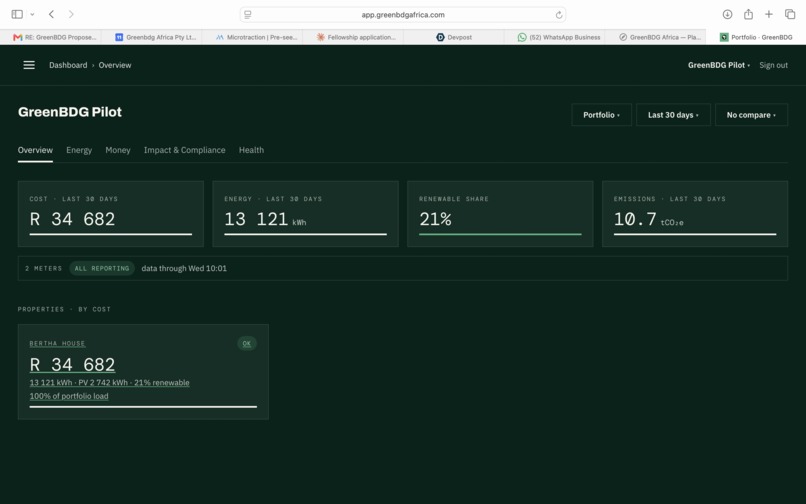
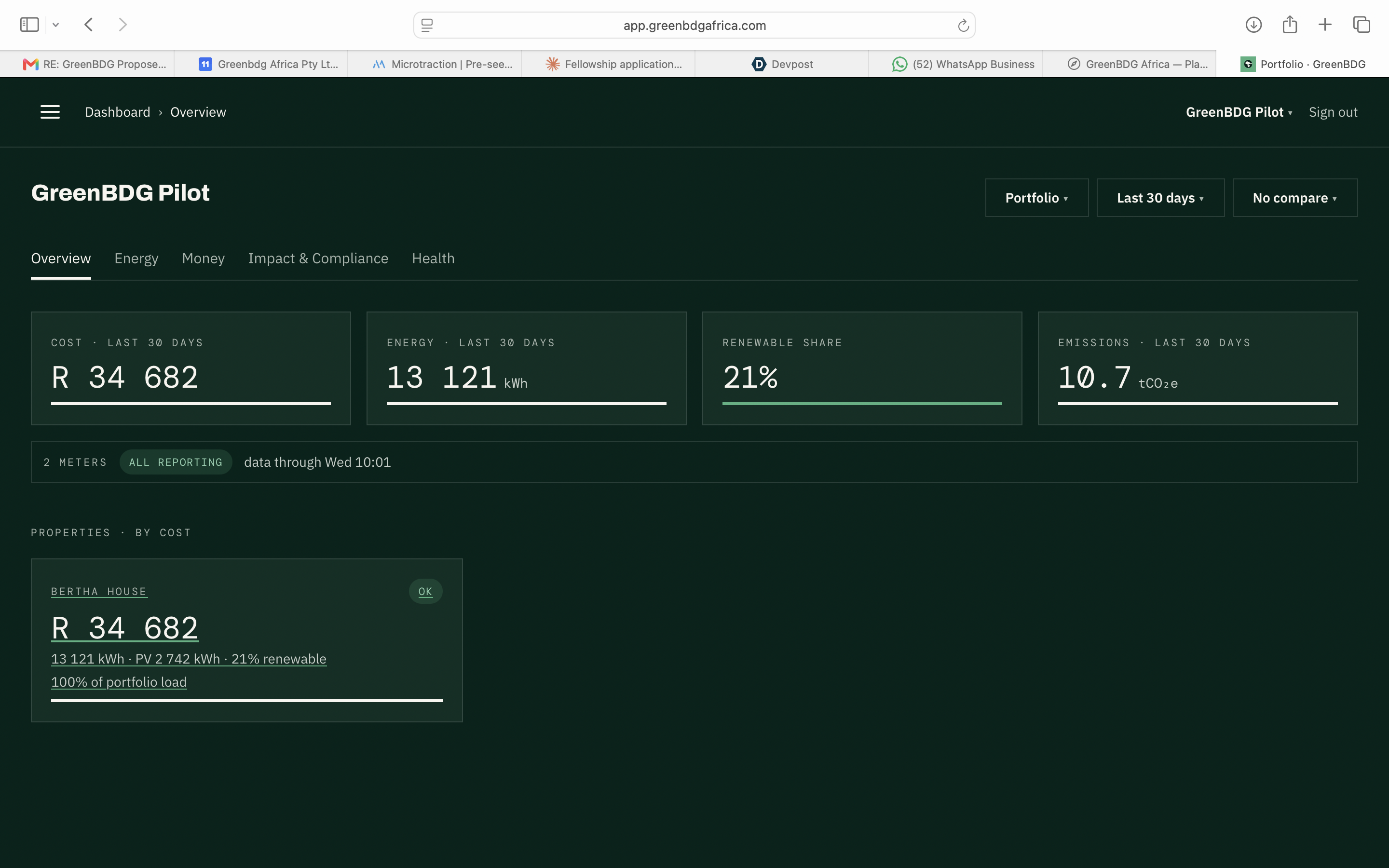
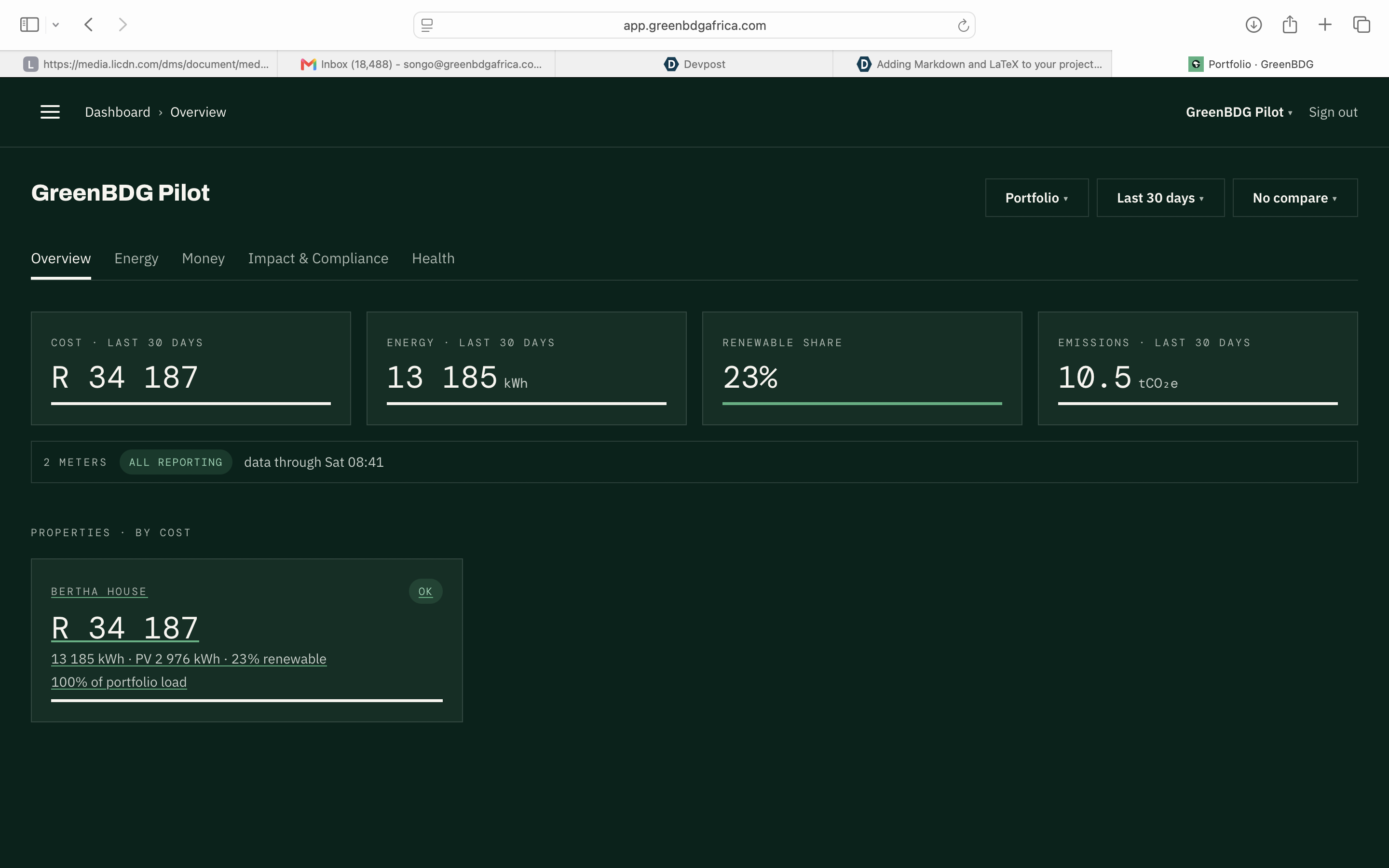
GreenBDG APP Overview
-
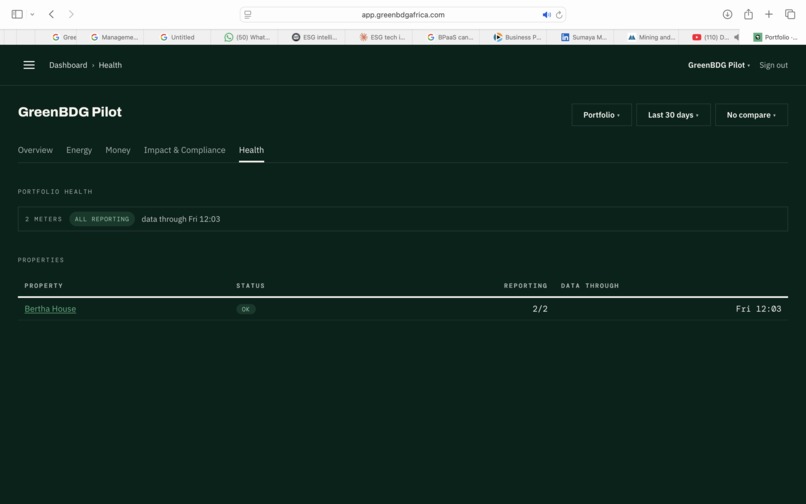
Bertha House Pilot Site
-
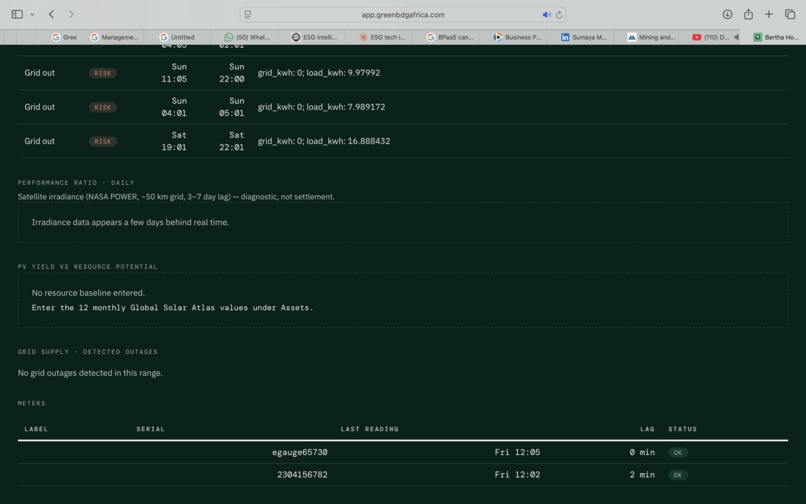
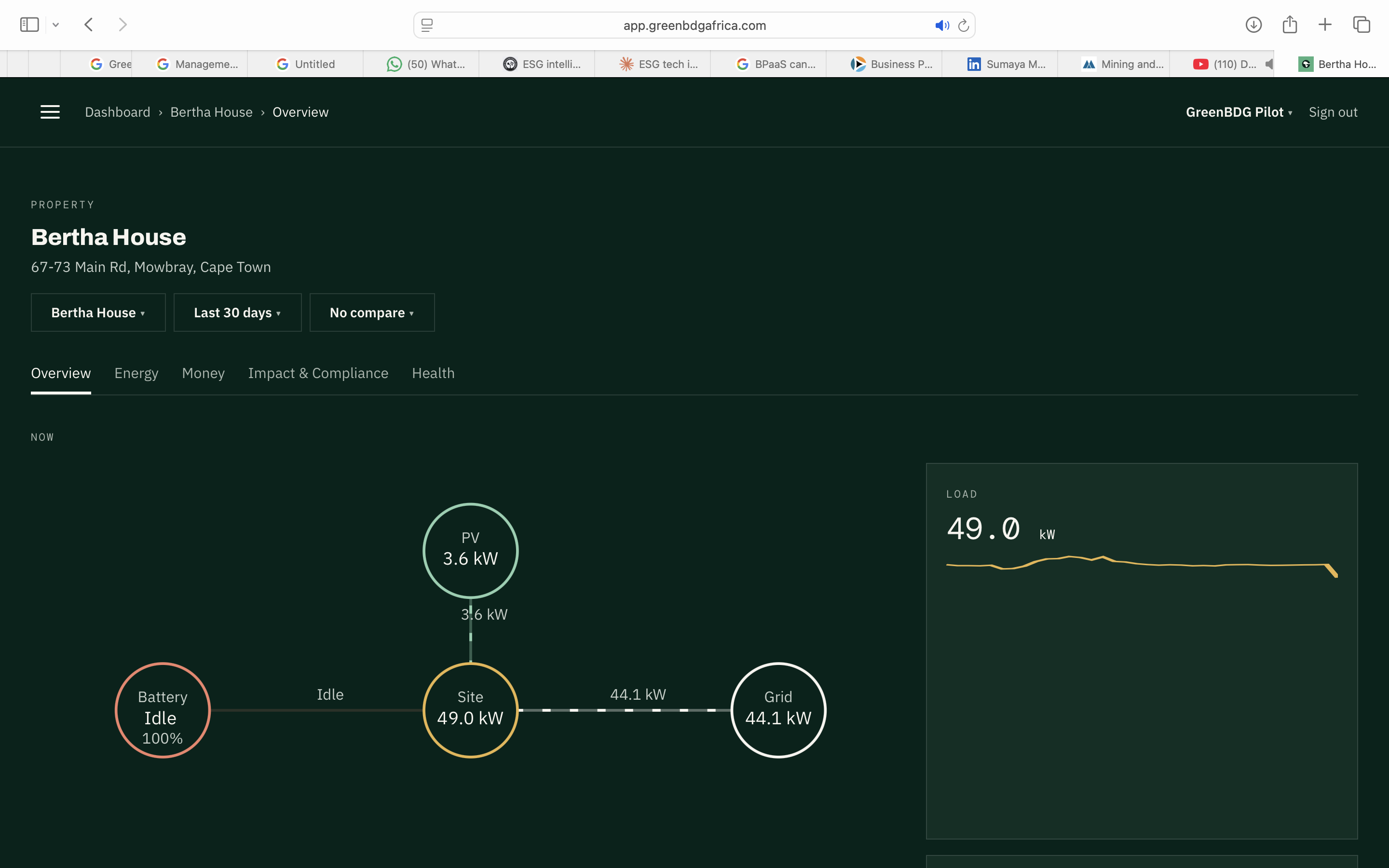
Bertha Real Time Energy Telemetry
-
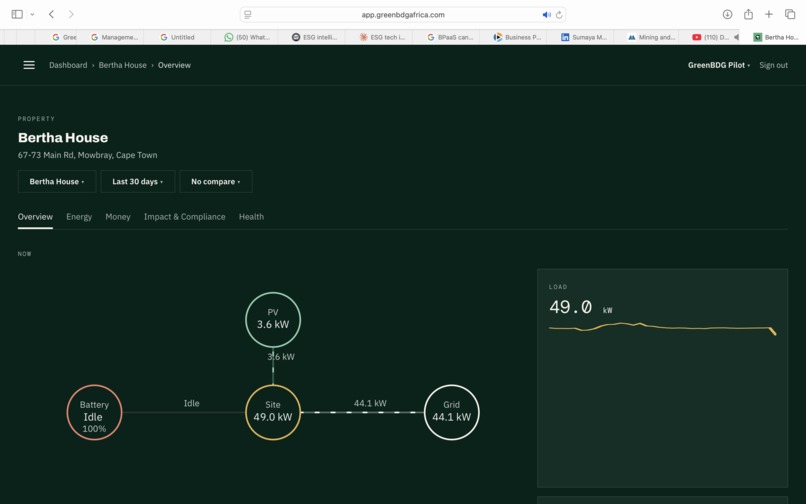
Bertha House Solar and Battery Integration
-
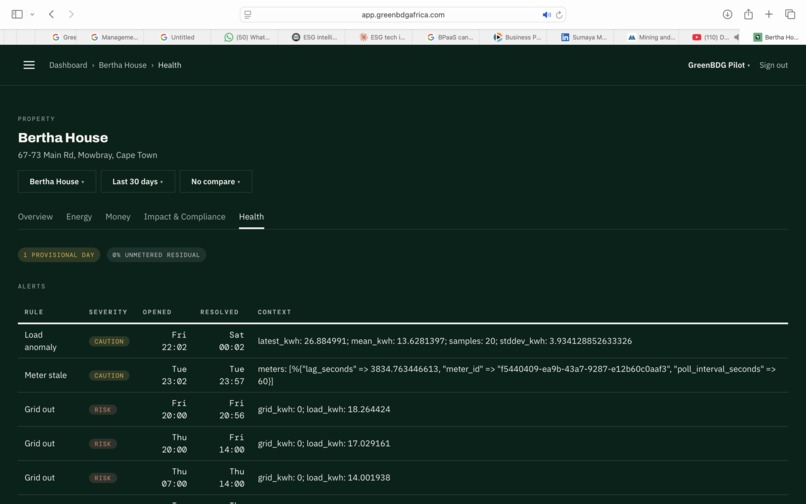
Bertha Real Time Energy Telemetry
-
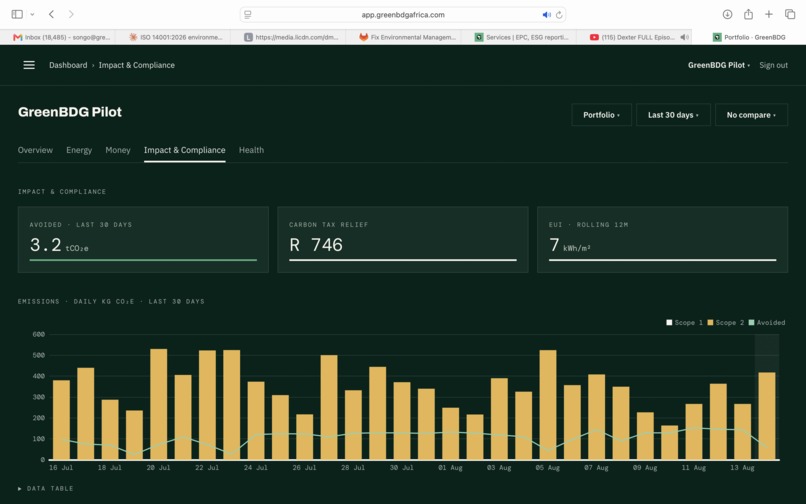
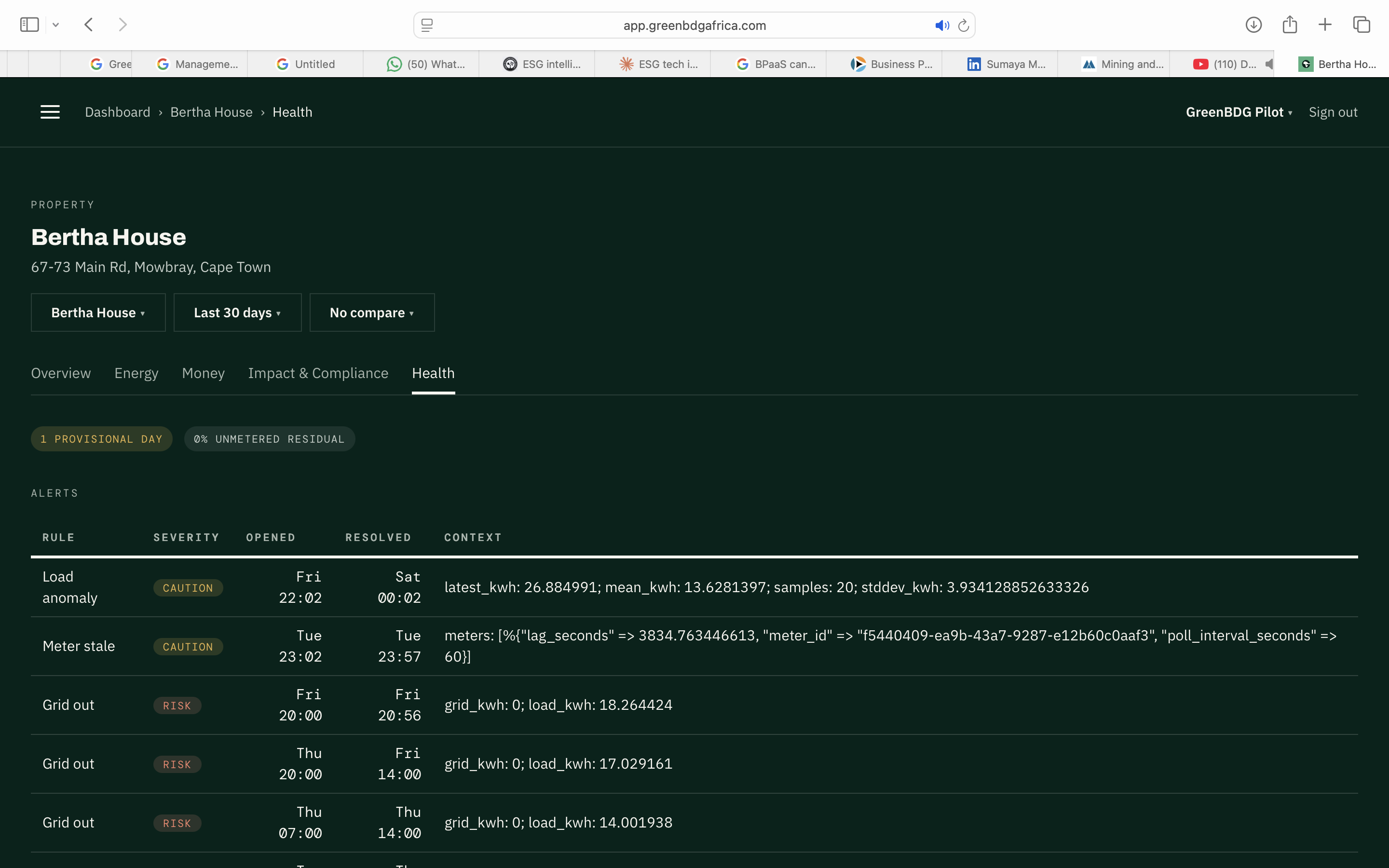
Bertha House Daily KwH
-
-
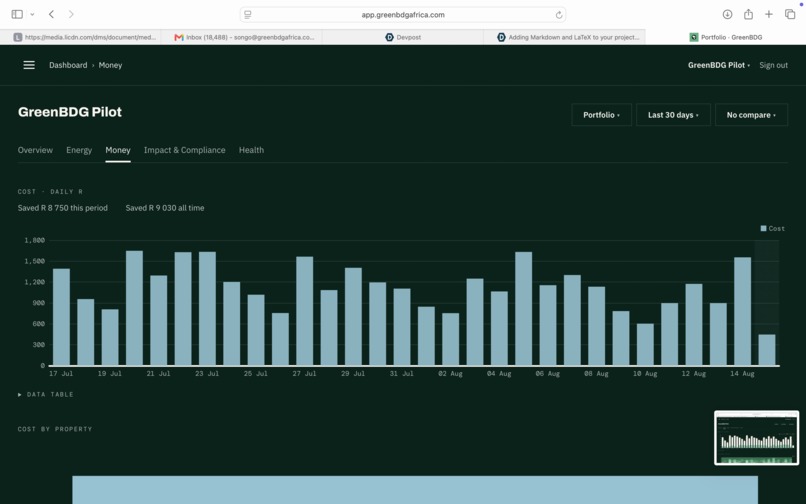
-
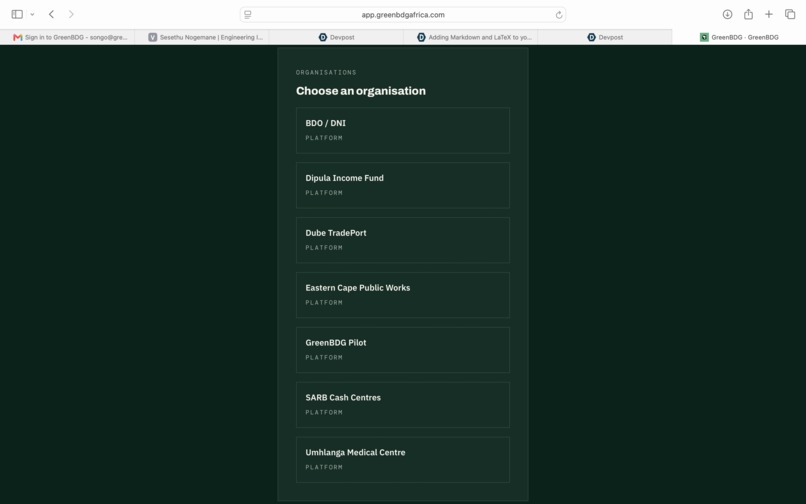
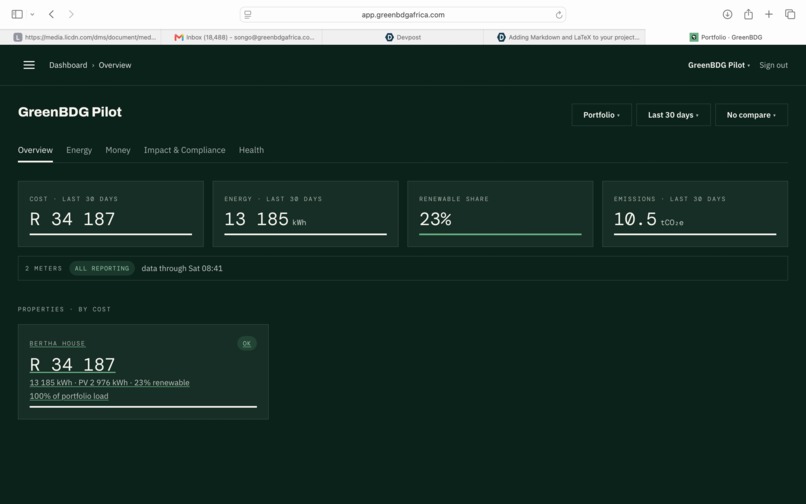
Multi Client Portfolio Onboarded
-
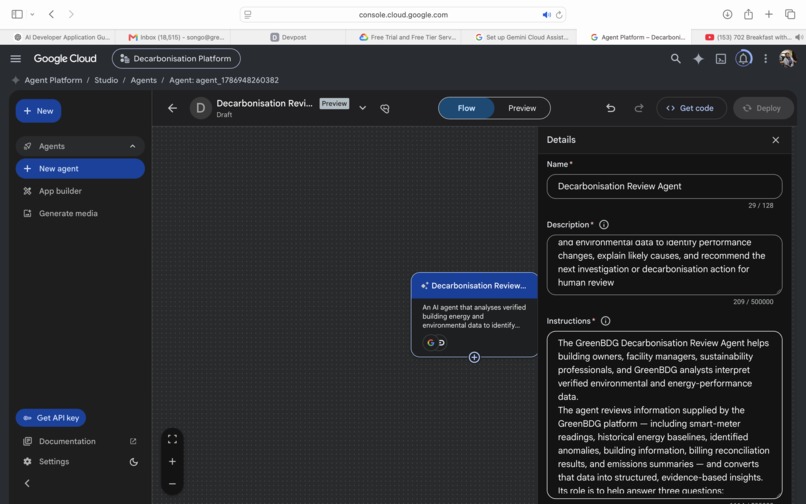
Decarbonisation Review Agent Deployment
-
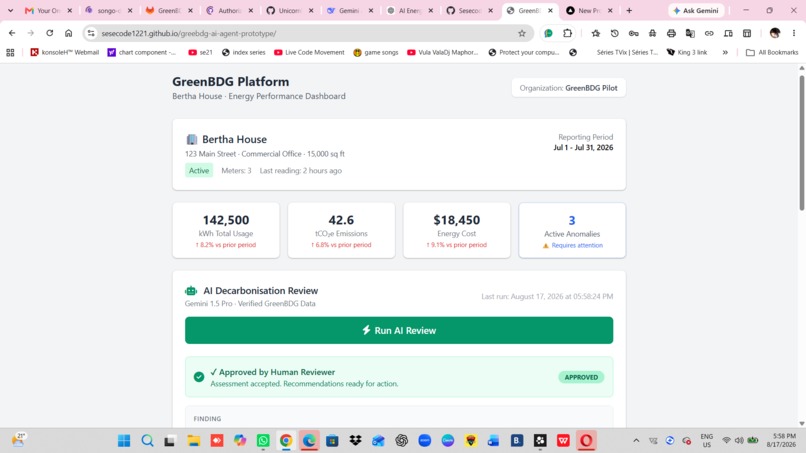
Decarbonisation AI Review Agent
AI-Enabled Decarbonisation Platform
Inspiration Africa's sustainability gap is widening while regulatory pressure accelerates. Yet environmental performance is still often managed through utility bills, spreadsheets, manual meter readings, and quarterly reporting cycles. The result is a fundamental information gap between climate ambition and action. We experienced this first-hand at Bertha House, a mixed-use building in Cape Town. Our energy audit established annual emissions of approximately: $$ E_{baseline}=153\ tCO_{2}e/year $$ We realised that organisations cannot decarbonise what they cannot accurately measure. But we saw a second opportunity: what if solving Africa's decarbonisation challenge with AI could also create African technology businesses and skilled jobs? On 1 July 2026, we began building our AI-Enabled Decarbonisation Platform to test that hypothesis.
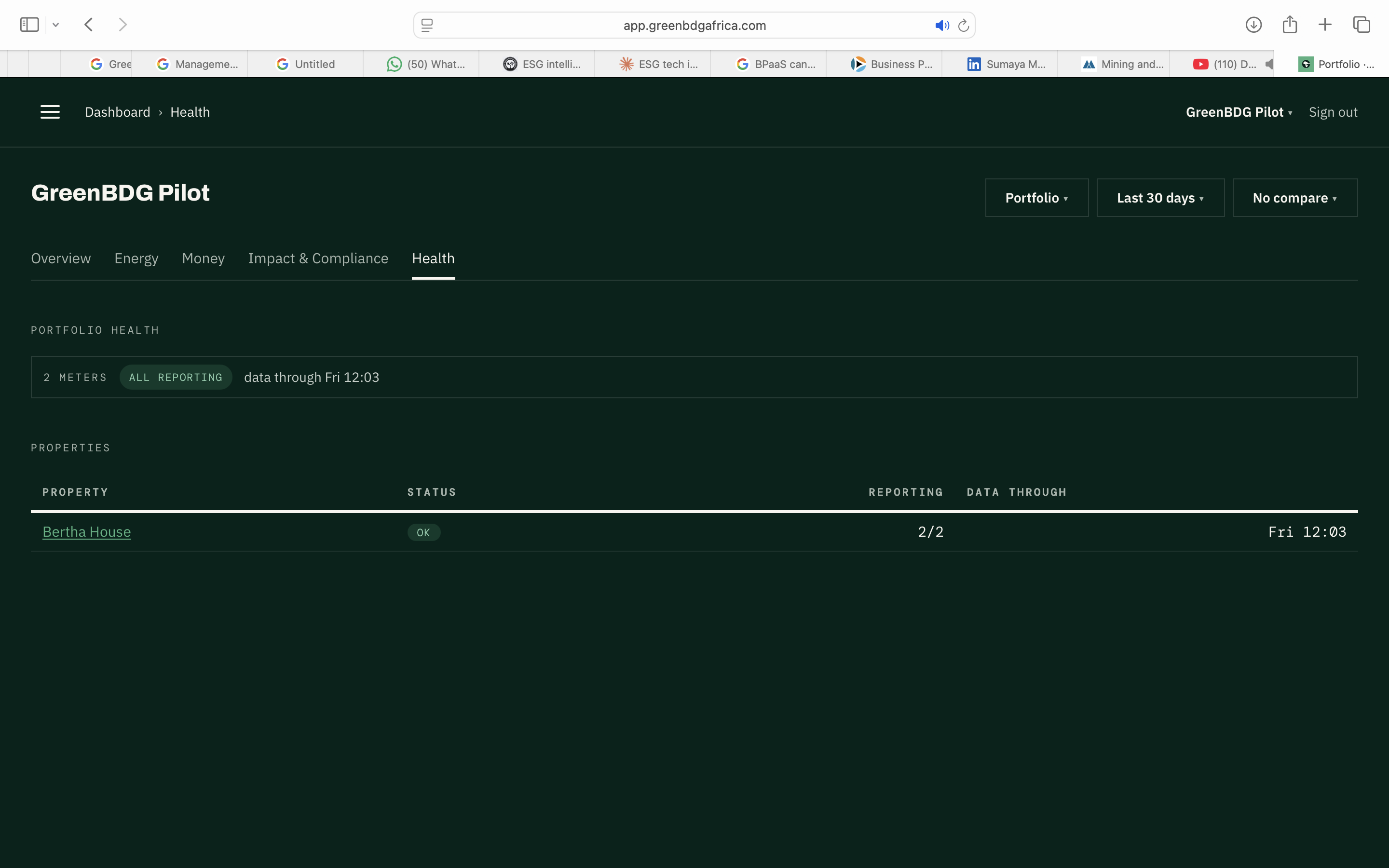
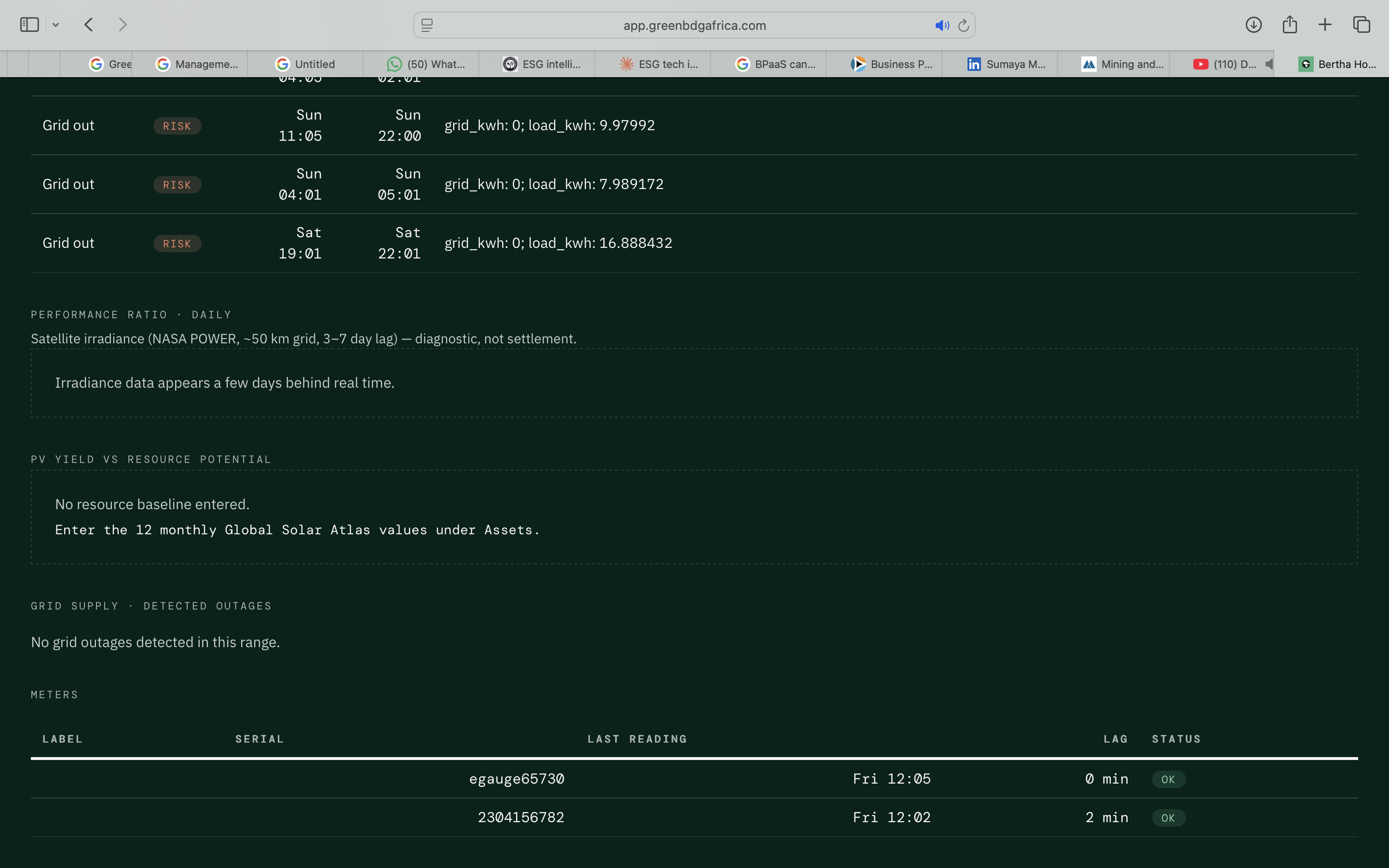
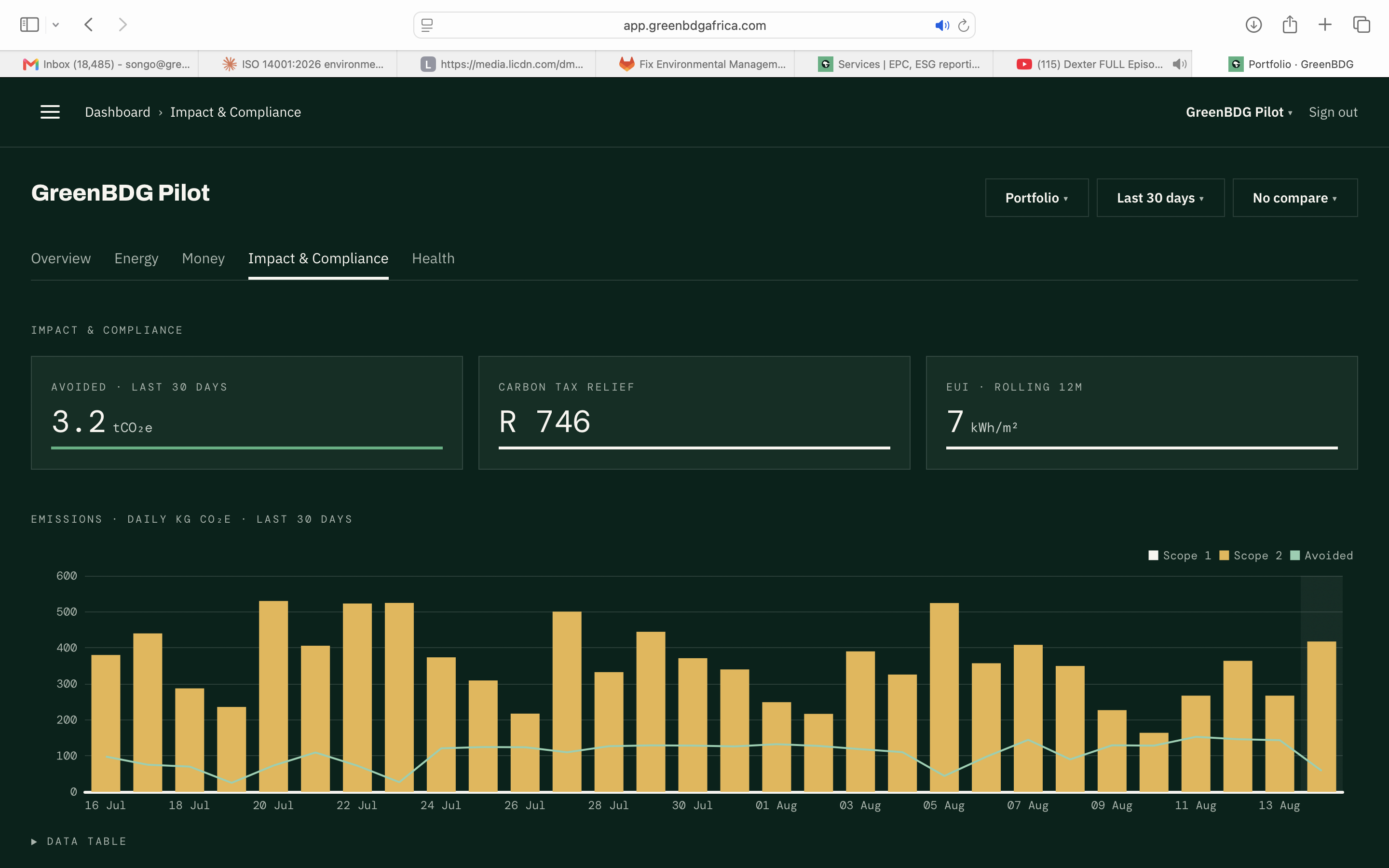
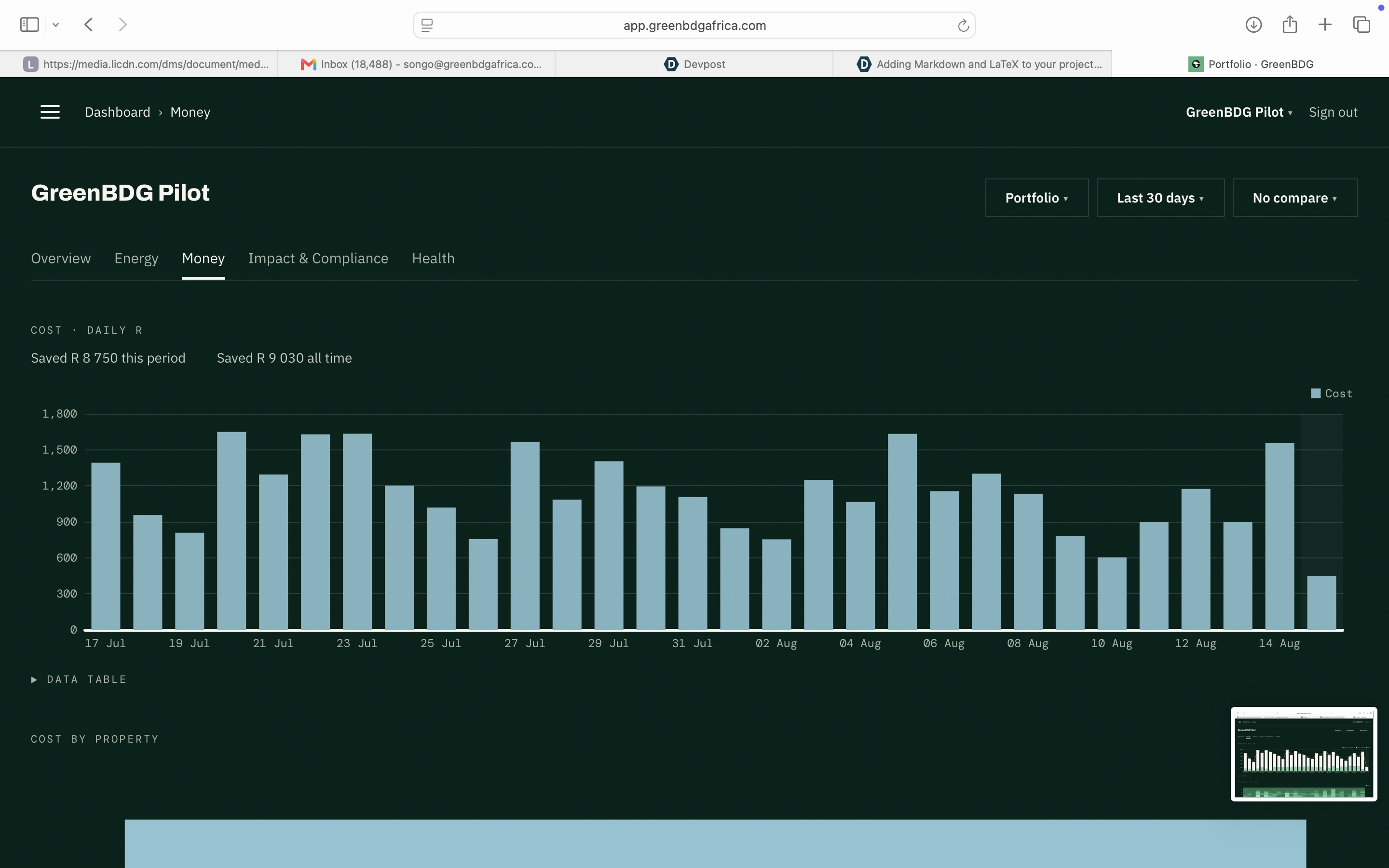
What it does GreenBDG transforms fragmented environmental information into continuous, actionable decarbonisation intelligence. The platform operates across five stages: Collect — IoT devices, smart meters, and integrations capture environmental and operational data. Analyse — validated data is analysed to identify consumption patterns, anomalies, benchmarks, and optimisation opportunities. Visualise — live dashboards allow organisations to monitor energy, carbon, water, and asset performance (Under Investigation). Account — activity data is transformed into defensible Scope 1, 2, and 3 carbon information. $$ CO_{2}e=Activity\ Data\times Emission\ Factor $$ Act — our AI roadmap moves beyond reporting historical emissions toward helping users understand why performance changed and what they should investigate next. Sensor data can update every 15 minutes, replacing delayed spreadsheets with continuous environmental intelligence.
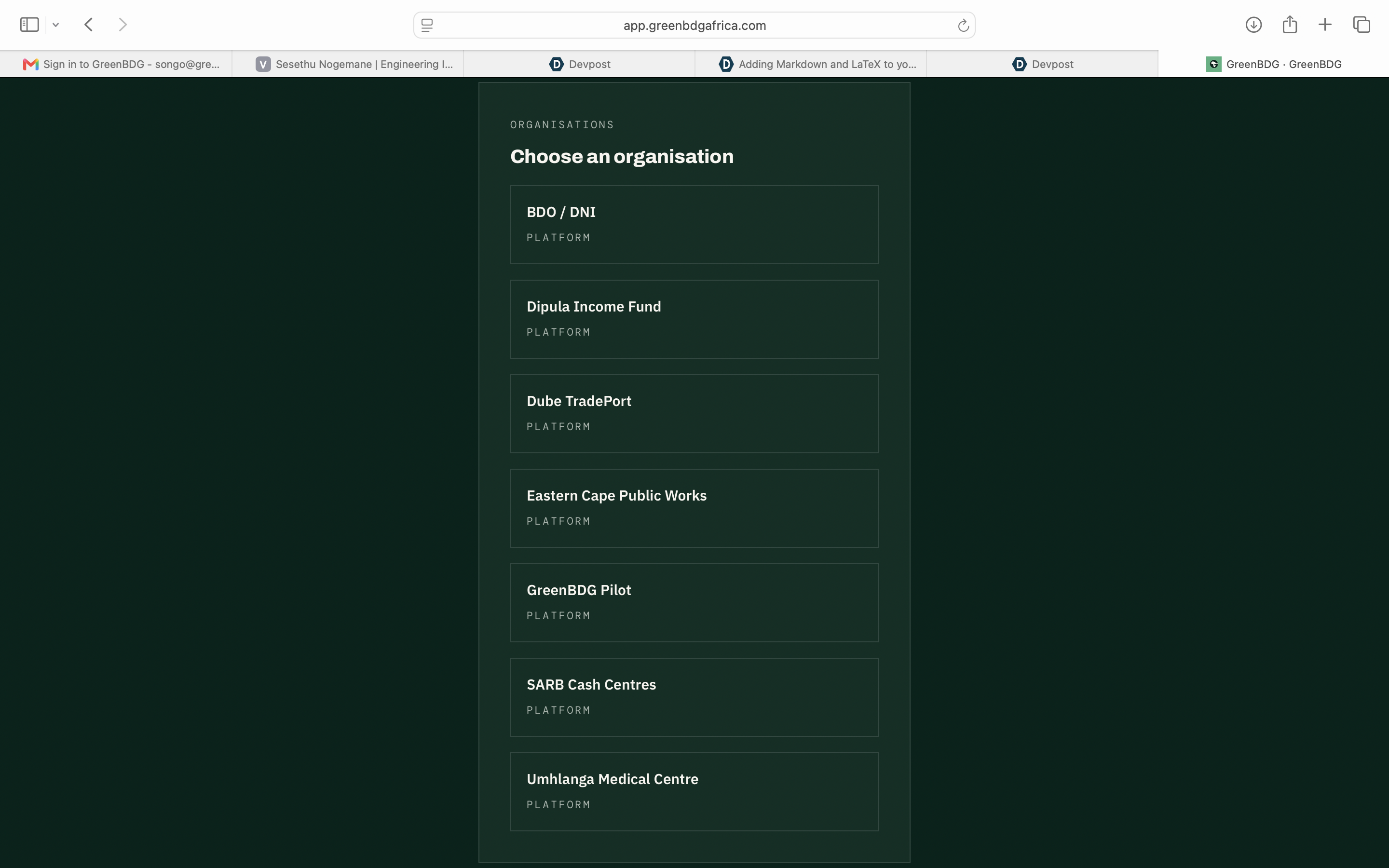
How we built it Our core principle was simple: Trustworthy AI requires trustworthy data. We therefore started with the data infrastructure rather than placing an LLM on top of unreliable environmental information. Our production architecture uses a Go ingestion service (greenbdg_ingestor) to integrate smart meters and environmental data into a shared PostgreSQL schema. The ingestor deliberately owns the database schema and migrations. Our Phoenix 1.8/LiveView web application owns no migrations and operates on top of this shared data model. PostgreSQL row-level security enforces organisation-level tenant isolation at the database rather than application layer. Time-series data is transformed into usable energy datasets, while LISTEN/NOTIFY enables live application updates without browser polling.
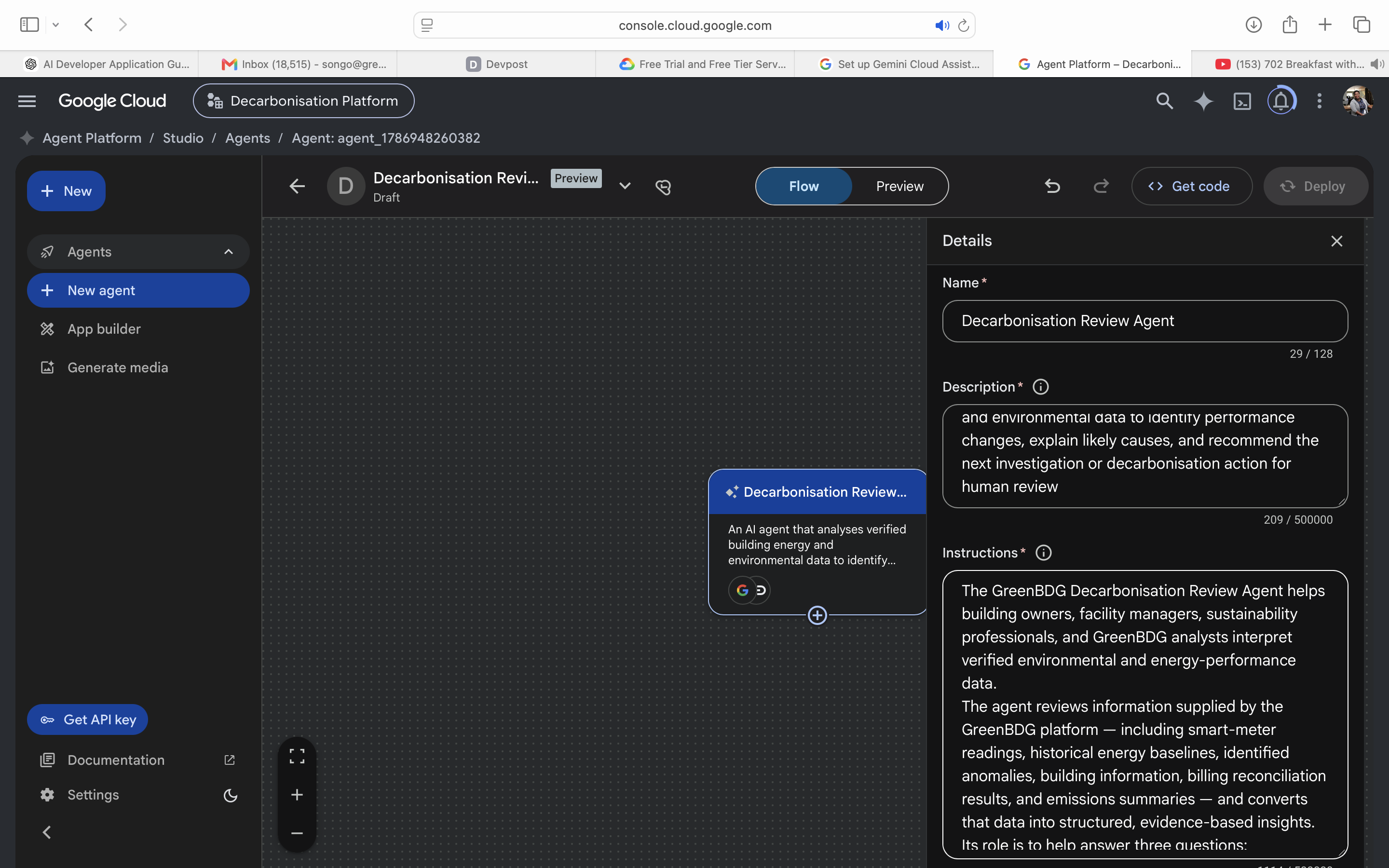
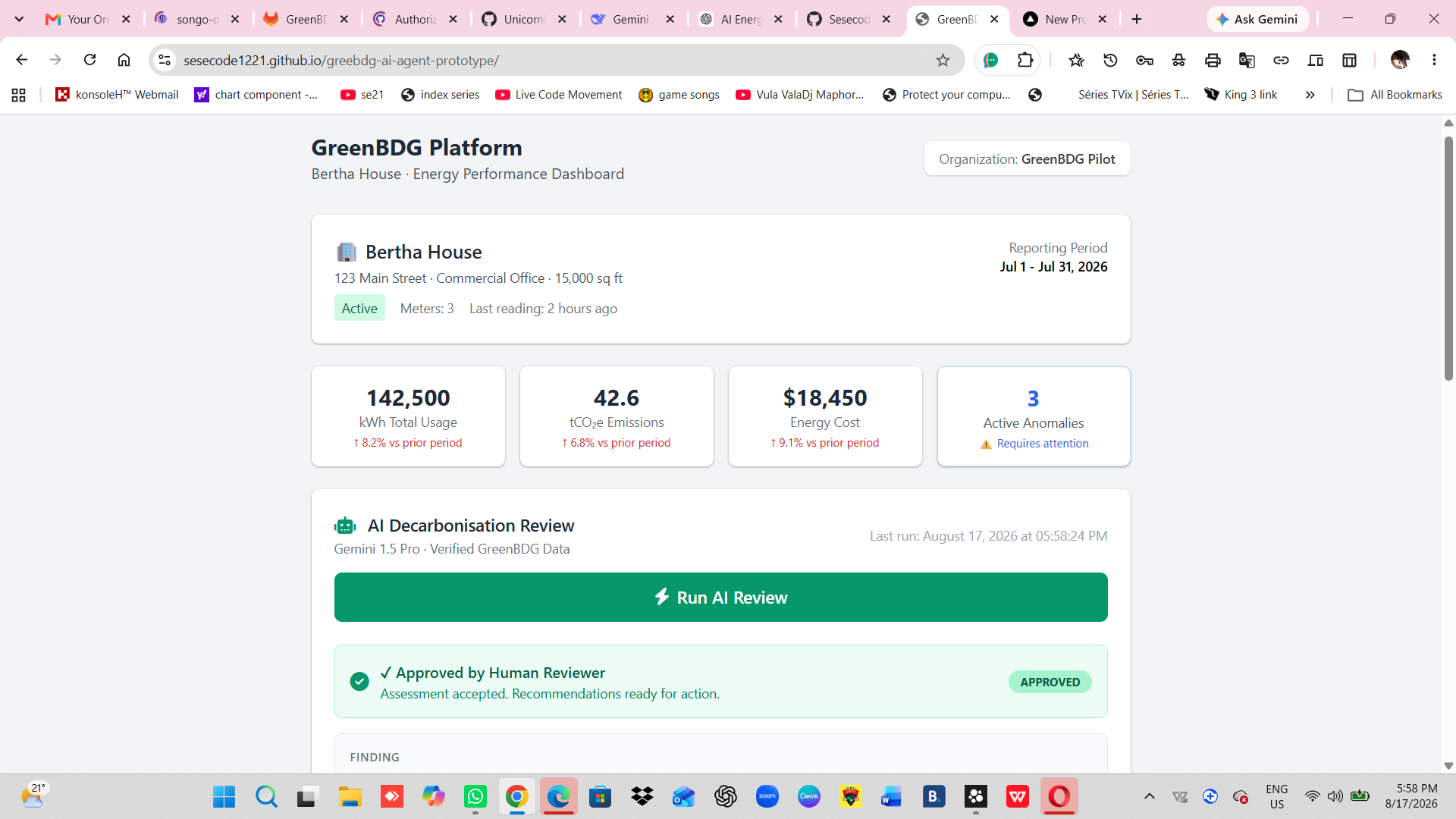
The deployed pathway is: Smart Meter → Go Ingestion → PostgreSQL → Validation → Phoenix LiveView → Customer AI agents are also embedded in our software-engineering workflow. Repository-level instructions define architecture, testing, UI, and code-quality constraints, and agent-assisted changes are subjected to compilation, formatting, and automated testing requirements. Our next AI layer, being deployed before submission, integrates the Gemini API into the customer application as a Decarbonisation Review Agent. Rather than allowing an LLM to generate authoritative carbon numbers, GreenBDG's deterministic data layer establishes the facts. Gemini then reasons over verified building information to investigate changes and return structured recommendations for human review. $$ \text{Verified Data} \rightarrow \text{Gemini Agent} \rightarrow \text{Evidence-Based Recommendation} \rightarrow \text{Human Review} $$ The objective is to move from generative AI toward auditable, agent-assisted decision-making. Challenges & Accomplishments Our biggest technical challenge was not AI; it was data quality. Many African buildings have fragmented or nonexistent digital baselines. Before applying AI, we first had to establish trustworthy asset-level data and ensure that automated systems do not silently convert poor inputs into confident but incorrect carbon outputs. Bertha House became our real-world proving ground. A Level 1 ASHRAE Energy Audit established the baseline required to support a 44 kWp solar investment, now supplying approximately 35% of the building's electricity requirements. But our hackathon experiment is demonstrating another outcome: AI adoption and job creation can happen together. Within three months, we moved from design thinking to a production application ingesting live smart-meter data for a real customer. We appointed a full-time CTO and created three engineering roles: one integration engineer and two AI engineers. $$ \text{AI Adoption} \rightarrow \text{Productivity} \rightarrow \text{Enterprise Growth} \rightarrow \text{Skilled Jobs} $$ Our wider work now supports 100+ buildings and more than 1,000,000 m², while reporting workflows that traditionally require 6–8 weeks can be compressed into hours. Commercially, we generated USD 0k before the MVP and USD 7k following its introduction, allowing us to measure whether technology adoption translates into real enterprise growth. What we learned We learned that the hardest AI problem is not generating an answer; it is generating an answer that someone can trust enough to act on. For environmental decisions, AI must operate alongside verified data, deterministic calculations, traceability, and human expertise. We also learned something important about AI adoption in Africa: AI does not necessarily replace technical talent—it can increase demand for it. Our engineers are not being replaced by AI agents. They are using AI to build and operate systems faster while creating capabilities that did not previously exist within the business. What's next Our next phase is onboarding approximately 57 commercial buildings and expanding toward Zimbabwe, Botswana, Uganda, and Ghana in the coming 12 months. Technically, we are progressing toward an AI agent capable of answering three increasingly valuable questions: $$ \text{What are my emissions?} \rightarrow \text{Why are they changing?} \rightarrow \text{What should I do next?} $$ As deployments increase, we will measure whether customer growth creates corresponding demand for AI engineers, integration engineers, data specialists, software developers, and sustainability professionals. Our ambition is bigger than automating ESG reporting. We want to demonstrate that African-built AI can solve African challenges, grow African technology businesses, and create the skilled African jobs required to scale the transition to a low-carbon economy.


Log in or sign up for Devpost to join the conversation.