-
-
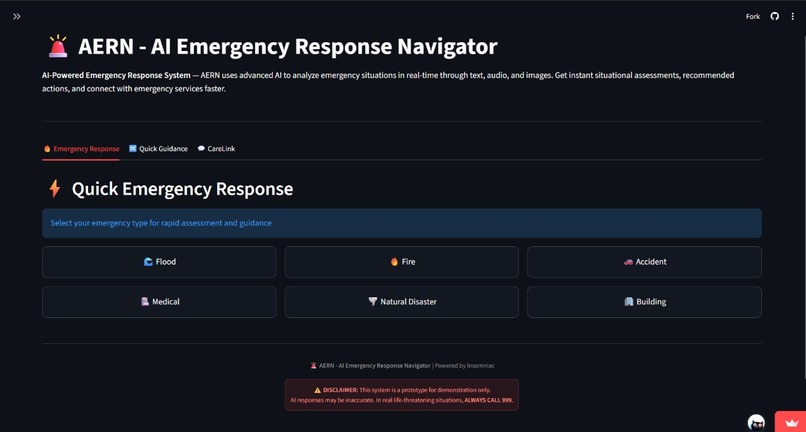
Main page with quick emergency tabs
-
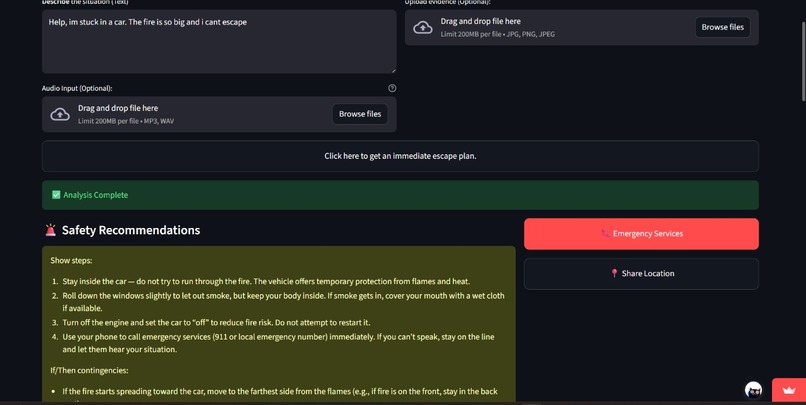
Sample output of user that stuck in a car and their surrounding is full of fire
Project Story: AI Emergency Response Navigator (AERN)
About the Project
AI Emergency Response Navigator (AERN) is an AI-powered system designed to assist individuals during emergency situations by providing clear, structured, and calm guidance in the most critical moments. In emergencies, panic, confusion, and lack of information often delay correct actions. AERN aims to bridge this gap by acting as an intelligent first-response guide that helps users understand what to do immediately while improving the quality of information available for emergency response.
Inspiration
The inspiration for AERN came from observing how easily emergencies can escalate due to delayed decisions or misinformation. In real-life incidents, people often struggle to explain their situation, forget critical details, or take unsafe actions under stress. We wanted to explore how AI could be used not as a replacement for emergency services, but as a supportive decision aid—one that remains calm, logical, and available 24/7.
How We Built It
AERN was built as a web-based prototype focusing on speed, clarity, and usability:
- Frontend & Interface: Built using Streamlit, enabling a simple, responsive UI optimized for fast interactions.
- Backend Logic: Implemented in Python, with modular components separating UI, emergency workflows, and AI reasoning.
- AI Reasoning: Integrated Large Language Models via JamAI to handle natural language input, emergency classification, and step-by-step guidance.
- Prompt Engineering & Guardrails: Carefully designed prompts ensure outputs are concise, action-oriented, and safety-focused.
The system guides users through a structured questioning process, narrowing down emergency types and delivering relevant instructions without overwhelming the user.
Challenges We Faced
Building an AI system for emergency scenarios introduced several challenges:
- Safety & Reliability: Ensuring the AI does not hallucinate or give unsafe advice in high-risk situations.
- Information Overload: Deciding how much information is enough without causing panic or confusion.
- Ambiguous Inputs: Users under stress may provide unclear or incomplete information.
- Ethical Responsibility: Designing the system to support—not replace—professional emergency responders.
Balancing these constraints required continuous testing, refinement of prompts, and careful UX decisions.
What We Learned
Through building AERN, we learned that:
- In high-stress applications, clarity is more important than complexity.
- AI systems must be designed with strong guardrails and limitations, especially in safety-critical domains.
- Good UX design can significantly enhance the effectiveness of AI.
- Real-world context and human behavior are just as important as technical performance.
Mathematically, even simple decision logic can greatly improve outcomes. For example, prioritization follows a basic principle:
$$ \text{Response Priority} = \frac{\text{Severity}}{\text{Time to Action}} $$
Reducing the time to correct action can significantly improve emergency outcomes.
Conclusion
AERN demonstrates how AI can be responsibly applied to emergency response by focusing on guidance, clarity, and support. While still a prototype, it highlights the potential for AI to make critical moments safer, calmer, and more manageable for everyone involved.
Built With
- jamaibase
- python
- streamlit


Log in or sign up for Devpost to join the conversation.