-
-
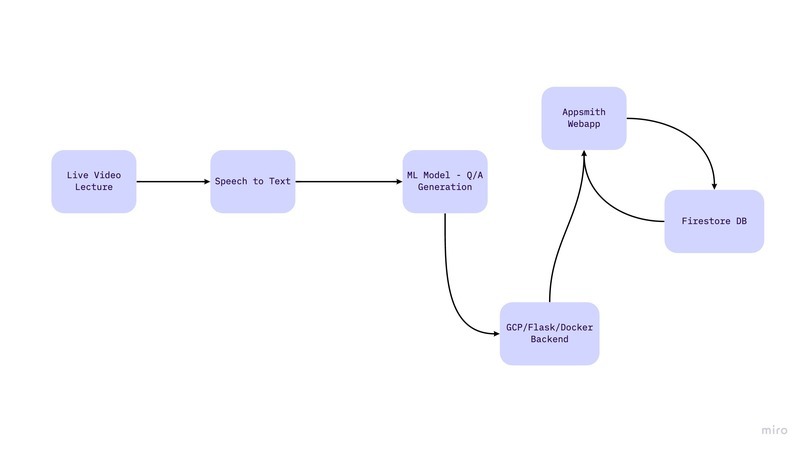
App Architecture
Inspiration
Do online classes not "feel" like a live session? Do you find yourself to be more disconnected from teachers and friends? Do you feel like it is getting more difficult to retain the knowledge being shared? Despite COVID-19 changing the mechanism of learning delivery, wouldn't we want to maintain the same quality of interaction and learning? Yes, absolutely!
It has been proven by research that the secret to learning something effectively is by testing yourself on what you’ve studied — asking yourself questions, retrieving the answers, going back, and restudying what you didn’t know! A short quiz can be very rewarding for teachers to readily assess if what was taught was actually learned.
We were inspired by the power of reflection, and are driven by the concept of enabling the individual to reconnect with learning. Whether it's helping someone gain clarity on a new idea, or providing a superior method for deliberation, we know technology can play a key role.
What it does
Einstein is a context-aware quiz generator that can consume live content (like an online lecture), and generate high-quality, succinct, and thought-provoking questions and answers from its transcript that is coherent with the material covered. It uses state-of-the-art natural language processing techniques like clue extraction and style classification and machine learning techniques like GPT-2 and Transformers.
How we built it
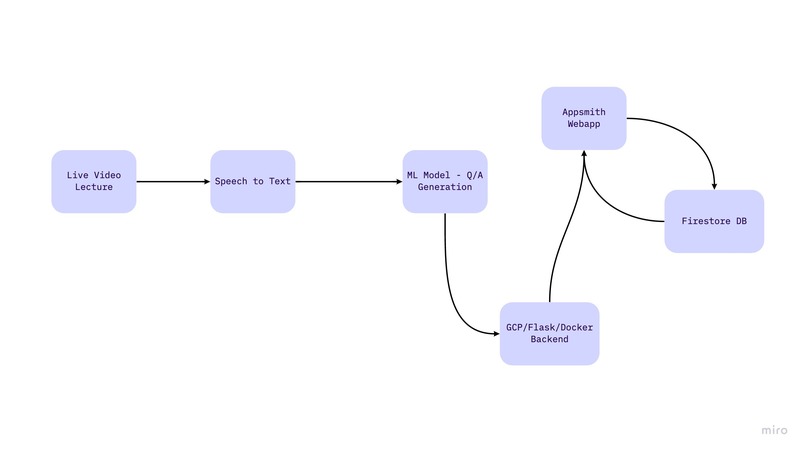
Our system consists of the following components:
- An intuitive user interface using AppSmith with 2 key users: -> professors - to provide textual content for creating a quiz, and evaluating them, and -> students - to attempt the quiz.
- A backend using Python's Flask framework to create REST APIs to pass content between the interface and the ML model.
- A machine learning model trained on lecture transcripts that learns important concepts from the unlabelled text and generates coherent, diverse question types with correct grammer
- A data store that preserves each generated quiz as well as student attempts and scores. ## Challenges we ran into
- Generating new runtime components like input text fields with changing content in AppSmith.
- Training the machine learning model which required GPUs with Nvidia drivers.
- Python dependency management and runtime issues. ## Accomplishments that we're proud of
- Achieved stable results from the machine learning model despite limited training time.
- Built a complete solution including frontend and backend components, database integration, and pipelining of the machine learning tasks.
- Learning new techniques like transformers and sequence-to-sequence models in natural language. ## What we learned
- Learnt about the AppSmith platform and its ease of use to create pleasant interfaces.
- Learnt to train and deploy models on Google Cloud.
- Learnt new techniques like Transformers within transfer learning. ## What's next for AI-Einstein To leverage live video and audio streams of lectures to generate higher-order conceptual questions.
Built With
- appsmith
- firebase
- firestore
- flask
- google-compute-engine
- gpu
- machine-learning
- natural-language-processing
- python
- transformer


Log in or sign up for Devpost to join the conversation.