-
-
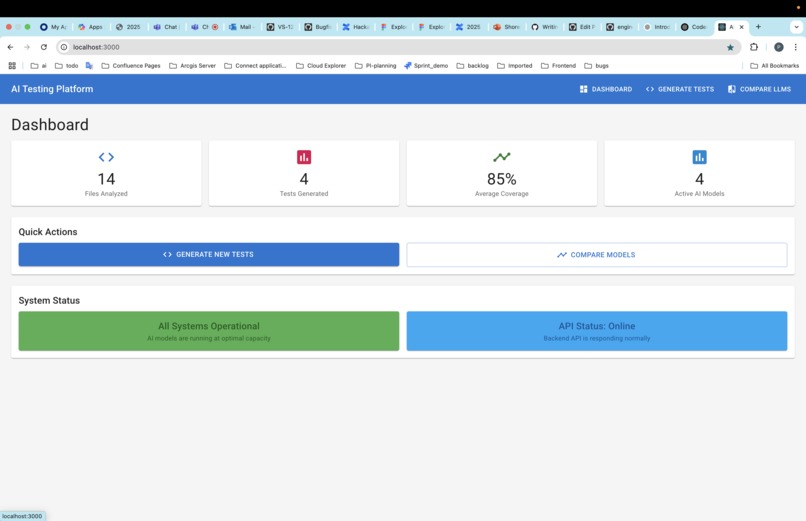
Dashboard Page
-
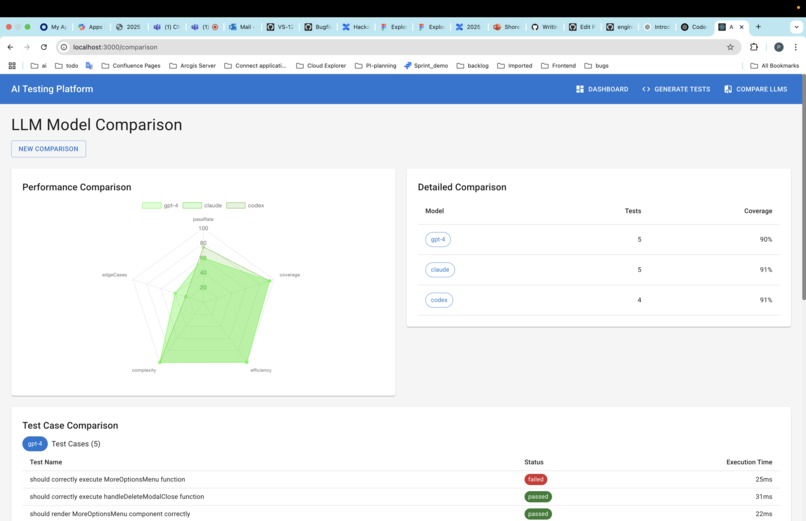
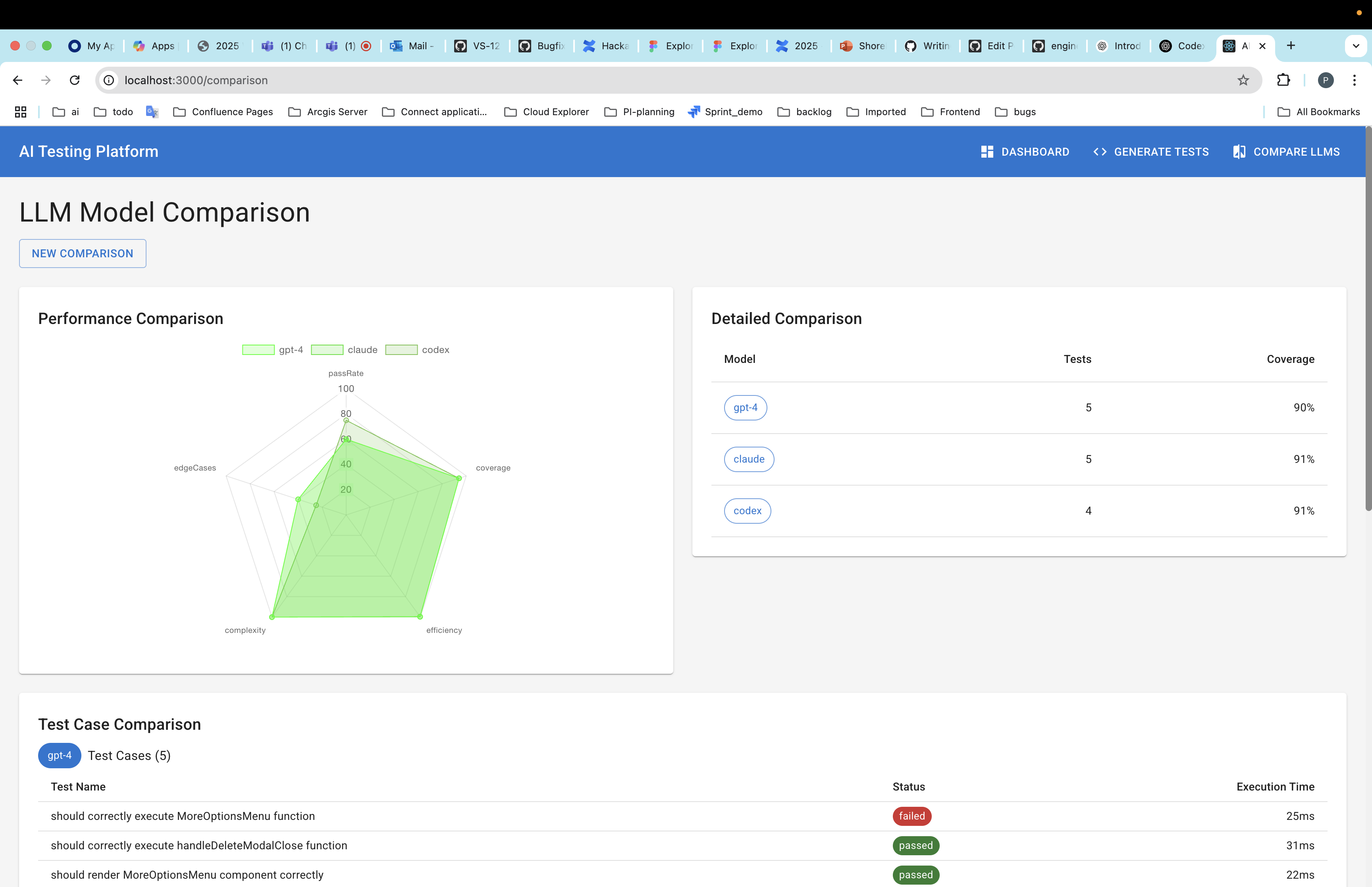
Compare LLM's Page
-
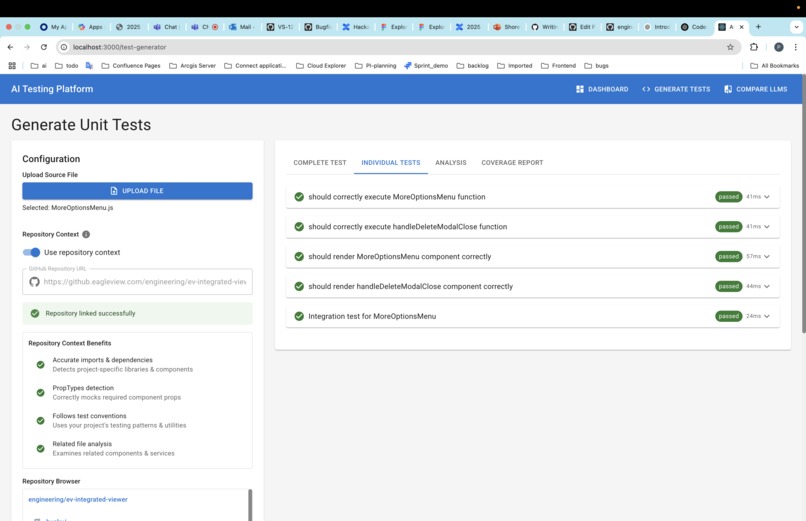
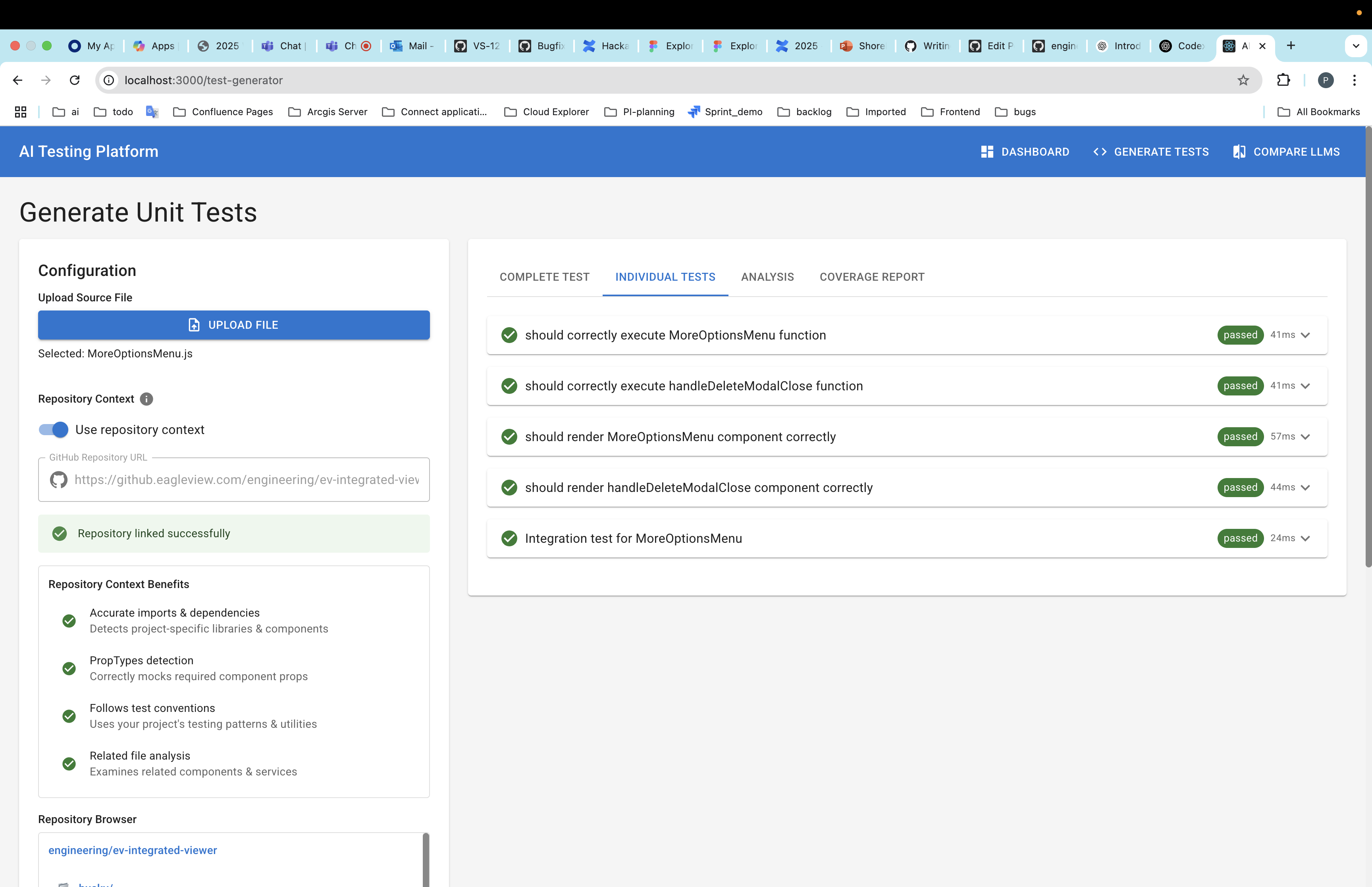
Generate Test Cases Page
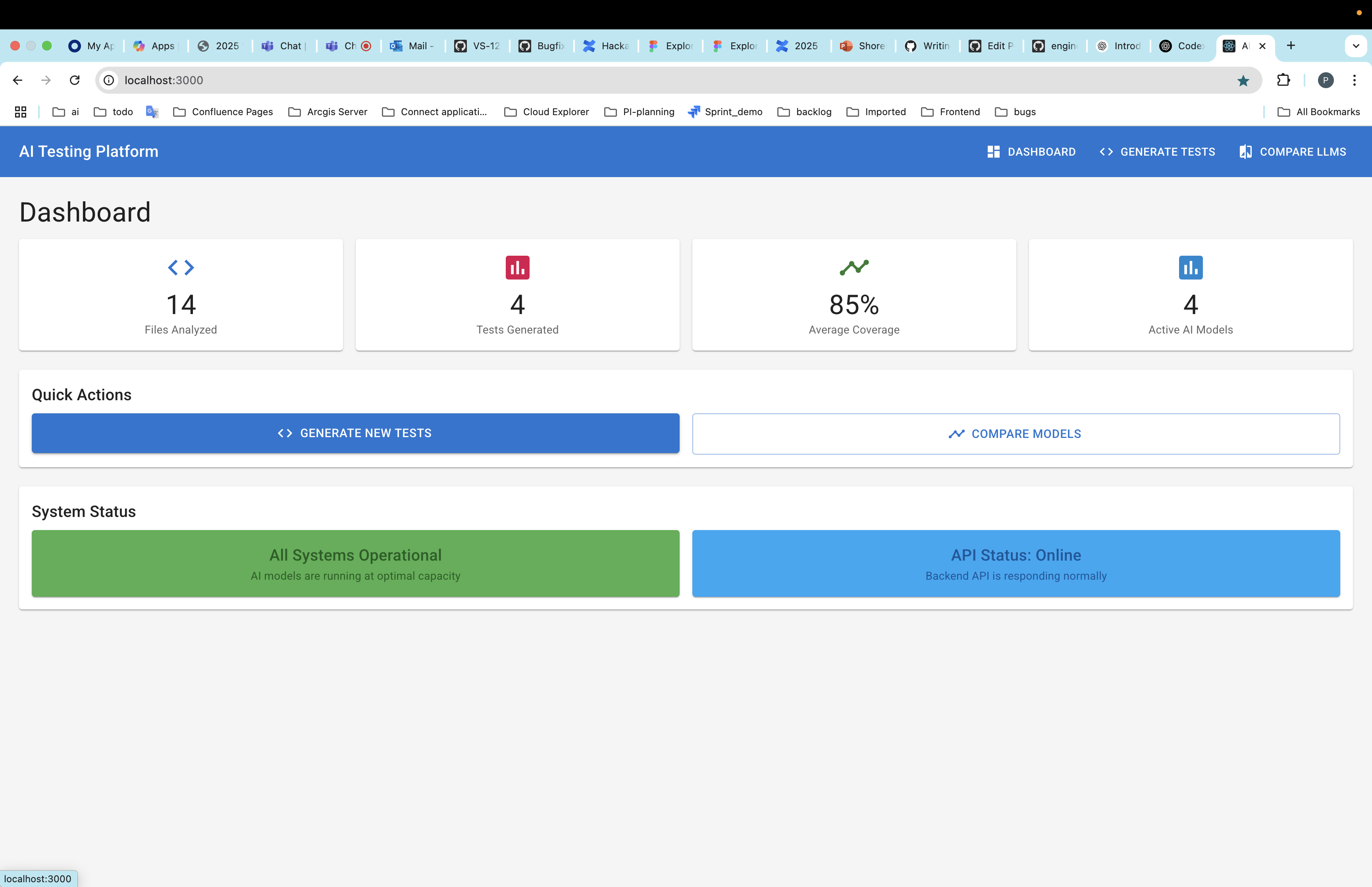
AI-Driven Unit Testing Platform
💡 Inspiration
The idea was inspired by the daily challenges developers face in writing thorough unit tests. While many tools exist for generating test cases, there is still no unified platform that harnesses multiple LLMs to both generate tests and provide in-depth analysis of coverage reports and the quality of test cases produced by different models.
⚙️ What It Does
Our AI-Driven Unit Testing Platform offers a comprehensive solution for automated test generation and analysis. The platform intelligently analyzes codebase structure, detects suitable testing frameworks, and auto-generates mocks for dependencies. It delivers real-time coverage reports, performance insights, and side-by-side comparisons of test cases from different models. Additionally, it generates edge cases, validation tests, and integration tests with setup/teardown, while suggesting improvements to enhance test coverage.
🏗️ How We Built It
The platform is built with a React.js frontend using Material-UI for a modern, responsive interface, and a Node.js backend with Express.js for handling APIs. It integrates directly with OpenAI (GPT-4), Anthropic (Claude), and GitHub Copilot via APIs. Multer handles file uploads, while custom parsers support multi-language code analysis. GitHub API integration enables context-aware test generation. The core testGenerator.js engine uses regex-based parsing, dependency detection, and framework identification. AI orchestration includes fallback logic, context-aware prompt engineering, and backup test generation. It also features pattern recognition to replicate repository test strategies, with real-time asynchronous processing, progress tracking, and robust error handling.
🧗 Challenges We Ran Into
Managing API rate limits across multiple AI services was one of the biggest challenges. Context window constraints required balancing detail and token usage, while ensuring accurate framework detection and cross-language parsing across JavaScript, TypeScript, Go, and Python. Integration issues included handling GitHub authentication for different instances, securing file uploads, and syncing real-time updates between frontend and backend. We also faced challenges in error handling, optimizing performance, and ensuring the accuracy and relevance of generated test cases.
🏆 Accomplishments That We're Proud Of
I'm proud to have developed a powerful platform that integrates multiple AI models with intelligent fallbacks and advanced multi-language code analysis. Through this project, I gained in-depth knowledge of how large language models work and how they can be leveraged across various domains to automate and enhance workflows.
📚 What We Learned
We discovered that each LLM has distinct strengths, and test generation based on repository context is far more effective than isolated analysis. This project also deepened our understanding of how different LLMs work and how they can be leveraged to automate various development tasks.
🔮 What's Next for AI-Driven Unit Testing Platform
Our primary focus is to generate highly reliable and accurate unit test cases while working towards developing our own custom model for test generation. Looking ahead, we also plan to integrate additional LLMs to further enhance test case quality and diversity.
Note: This platform can be extended to support mathematical model validation using LaTeX-rendered formulas, such as: [ \text{Test Coverage} = \frac{\text{Covered Lines}}{\text{Total Lines}} \times 100\% ]

Log in or sign up for Devpost to join the conversation.