-
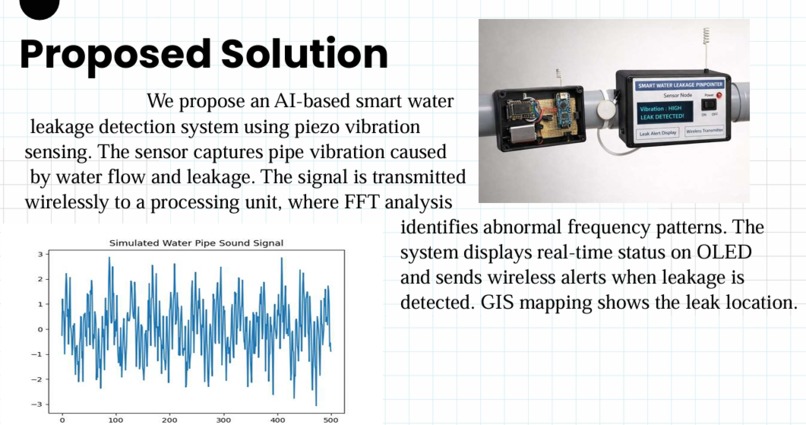
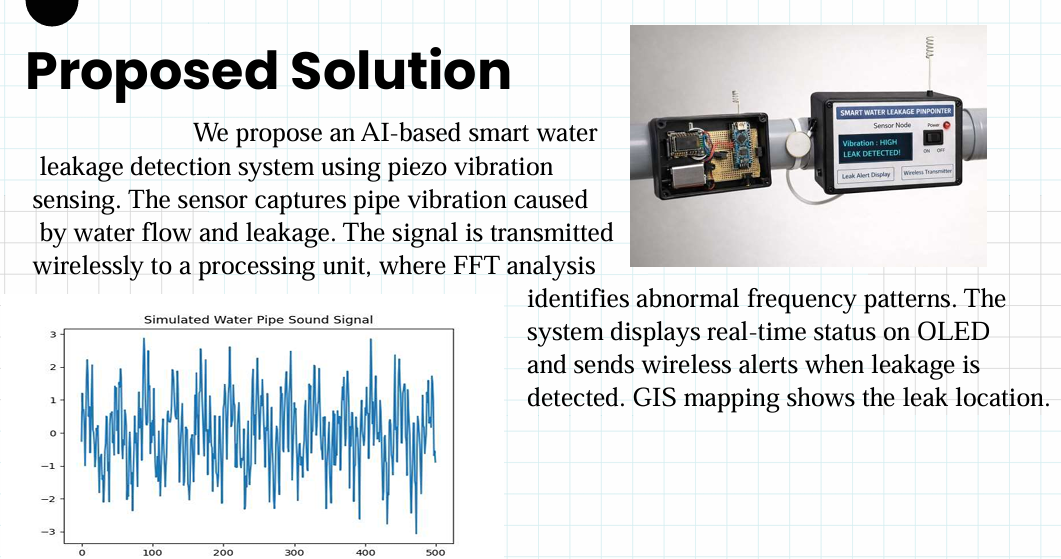
Image Of our proposed Solution
Inspiration
Water leakage in underground pipelines causes huge water wastage, infrastructure damage, and costly repairs. Traditional leak detection methods are slow, expensive, and often inaccurate. Our inspiration was to create a smart, affordable, and efficient system that can detect leaks early and help save water resources using AI and sensor technology.
What it does
The AI-Driven Smart Water Leakage Pinpointer continuously monitors underground water pipelines using piezo vibration sensors. It captures vibration signals caused by water flow, analyzes them using FFT and AI algorithms, detects abnormal leak patterns, and instantly alerts users through wireless notifications. The system also identifies the leak location using GIS mapping.
How we built it
We built the system using piezo vibration sensors attached to pipelines to sense vibration changes. The sensor data is sent to a microcontroller (ESP32/Arduino), where FFT converts time-domain signals into frequency-domain data. AI models analyze these patterns to distinguish normal flow from leakage. The results are displayed on OLED screens and transmitted wirelessly for remote monitoring.
Challenges we ran into
One major challenge was distinguishing normal water flow vibrations from leak vibrations accurately. Noise interference from surrounding environmental vibrations affected sensor readings. Another difficulty was calibrating FFT analysis to identify leak frequency peaks precisely. Integrating wireless communication and ensuring stable real-time alerts was also challenging.
Accomplishments that we're proud of
We successfully developed a low-cost prototype capable of detecting hidden underground leaks in real time. The system provides early warning alerts, reduces water wastage, and works effectively where camera-based systems fail. We are proud that our project combines AI, IoT, and signal processing into a practical smart-city solution.
What we learned
Through this project, we learned how vibration sensors work in real-world leak detection systems, how FFT helps analyze signal frequencies, and how AI improves pattern recognition accuracy. We also gained experience in embedded systems, wireless communication, teamwork, and solving real infrastructure problems with technology.
What's next for AI-Driven Smart Water Leakage Pinpointer
In the future, we plan to improve leak prediction accuracy using advanced machine learning models and multiple sensor fusion. We aim to develop a mobile app for live monitoring, integrate cloud storage for analytics, and scale the system for large smart-city water networks. Our long-term goal is to create a fully automated intelligent water management solution.
Built With
- ai/ml-leak-pattern-analysis-algorithms
- and
- arduino-ide-(c/c++-programming)
- built-with:-esp32-microcontroller
- fft-signal-processing
- gis-mapping-integration
- iot-based
- monitoring
- oled-display-module
- piezo-vibration-sensors
- real-time
- wi-fi-wireless-communication

Log in or sign up for Devpost to join the conversation.