What it does
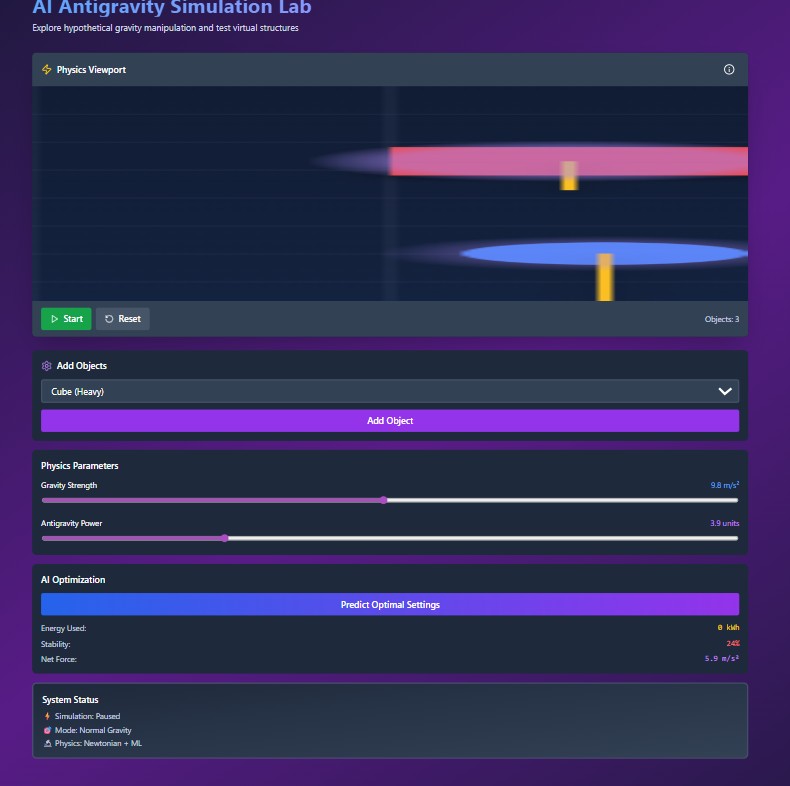
The AI-Driven Antigravity Simulation Platform lets users design virtual objects and environments, adjust gravity parameters, and run real-time simulations. It combines physics-based modeling with AI to predict motion, stability, and energy requirements, helping users explore futuristic concepts like floating vehicles and gravity-controlled structures in a safe, virtual setting.
How we built it
We built a web-based system using React and Three.js for 3D visualization, a Spring Boot backend for data handling, and Python-based AI models for physics calculations and predictions. REST APIs connect all components, and a database stores simulation data.
Challenges we ran into
Modeling realistic physics while keeping simulations fast was difficult. Integrating AI predictions with real-time visualization and managing accurate energy estimates without real-world antigravity data were also major challenges.
Accomplishments that we're proud of
We successfully created an interactive simulation with adjustable gravity, integrated AI-based stability predictions, and built a scalable architecture suitable for future research and expansion.
What we learned
We learned how to combine physics concepts with AI, design modular full-stack architectures, and think beyond current technological limits while staying scientifically grounded.
What’s next for AI-Driven Antigravity Simulation Platform
Next, we plan to add reinforcement learning, multi-object environments, VR support, and cloud deployment to make the platform more immersive and research-ready.
Is this conversation helpful so far?


Log in or sign up for Devpost to join the conversation.