-
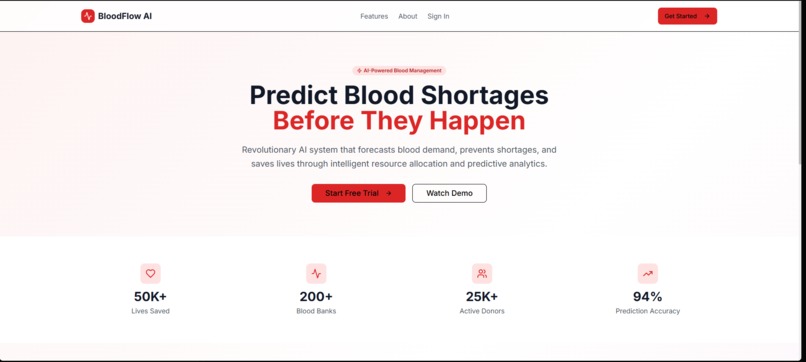
main page
-
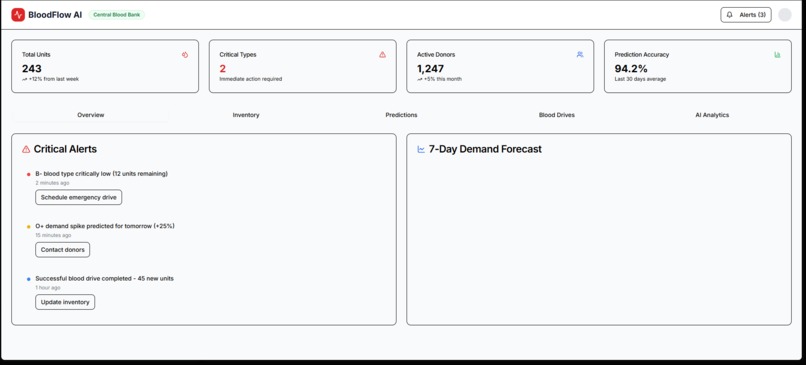
dashboard


Inspiration
Every day, thousands of people around the world die due to shortages in blood supply especially during emergencies, seasonal outbreaks, and in rural or underserved areas. Yet millions of willing donors go untapped due to lack of coordination, awareness, and real-time systems. We were inspired to build AI Drive after seeing reports of patients unable to receive critical blood in tim even when compatible donors lived just a few kilometers away. We asked: What if we could predict shortages before they happen? What if we could connect the right donors, at the right time, using data and tech?
What it does
-AI demand forecasting shows predicted blood shortages by type and region -Live donor alert map with Google Maps integration and geofencing -Real-time dashboard with interactive charts for donors and hospitals -Secure onboarding flow for different user types (donor, hospital, admin) -Mobile-first UI with smooth animations and accessibility-first design -Sample data preloaded for high-impact demo scenarios
How we built it
Frontend: -Built with Next.js + TypeScript + TailwindCSS for blazing-fast, responsive UI -Framer Motion for smooth transitions and animated components -Forms managed with React Hook Form + Zod for validation and user feedback -Dashboard charts built using Recharts
Backend: -Firebase Auth for user authentication (email and Google) -Cloud Firestore for storing user roles, donor history, hospital alerts, and blood stock data -Firebase Functions to simulate ML-based demand prediction and trigger donor alerts
APIs Integrated: -Google Maps API for hospital geolocation and routing -Disease.sh API for simulating regional outbreaks and demand patterns
Accessibility: -WCAG-compliant components, color contrast tested, keyboard navigability -ARIA labels for screen reader support
Analytics: Basic tracking with Firebase Analytics to log donor match events and app usage
Challenges we ran into
-Balancing complexity with MVP scope: We wanted to include deep AI and blockchain components but scoped them into simplified demo-friendly prototypes. -API rate limits and data gaps: Some live health APIs had incomplete coverage, so we created fallback sample data to simulate accurate forecasts. -Designing for accessibility under time pressure: Ensuring all UI components passed accessibility checks took significant effort, but was worth it to serve all users equally.
Accomplishments that we're proud of
-AI demand forecasting shows predicted blood shortages by type and region -Live donor alert map with Google Maps integration and geofencing -Real-time dashboard with interactive charts for donors and hospitals -Secure onboarding flow for different user types (donor, hospital, admin) -Mobile-first UI with smooth animations and accessibility-first design -Sample data preloaded for high-impact demo scenarios
What we learned
-How AI and public health data can be combined to forecast critical medical needs -How to integrate multiple real-time APIs (disease data, mapping, donor alerts) -How to design an accessible, mobile-first dashboard with real-time data updates -The importance of user empathy in designing healthcare tools for diverse communities
What's next for AI-Drive: Smart Blood Demand Forecasting & Donor Network
-Connect to real hospital blood banks via health ministry/public health APIs -Deploy a real machine learning pipeline trained on historical blood demand datasets -Expand the donor network via SMS and WhatsApp integration -Introduce gamification and donor rewards (e.g., NFTs, badges, blood points) -Build a companion Android/iOS app using React Native
Built With
- api
- blockchain
- css
- json
- next.js
- sql
- tailwind
