-
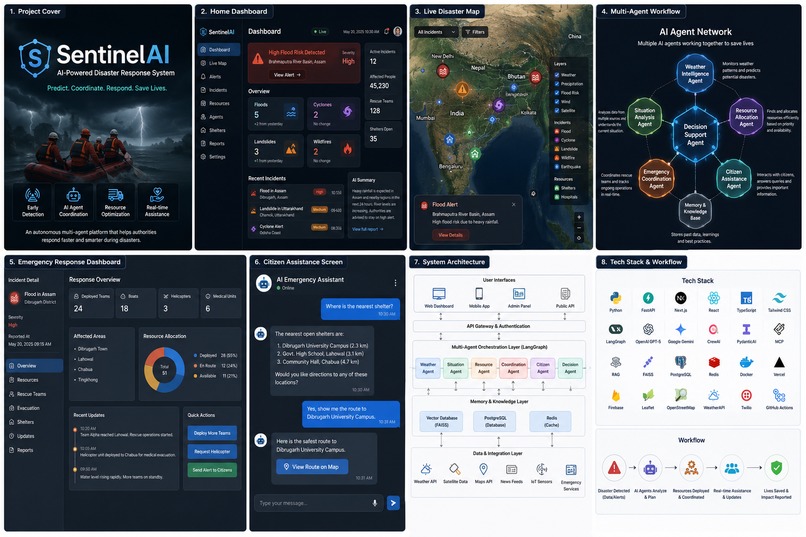
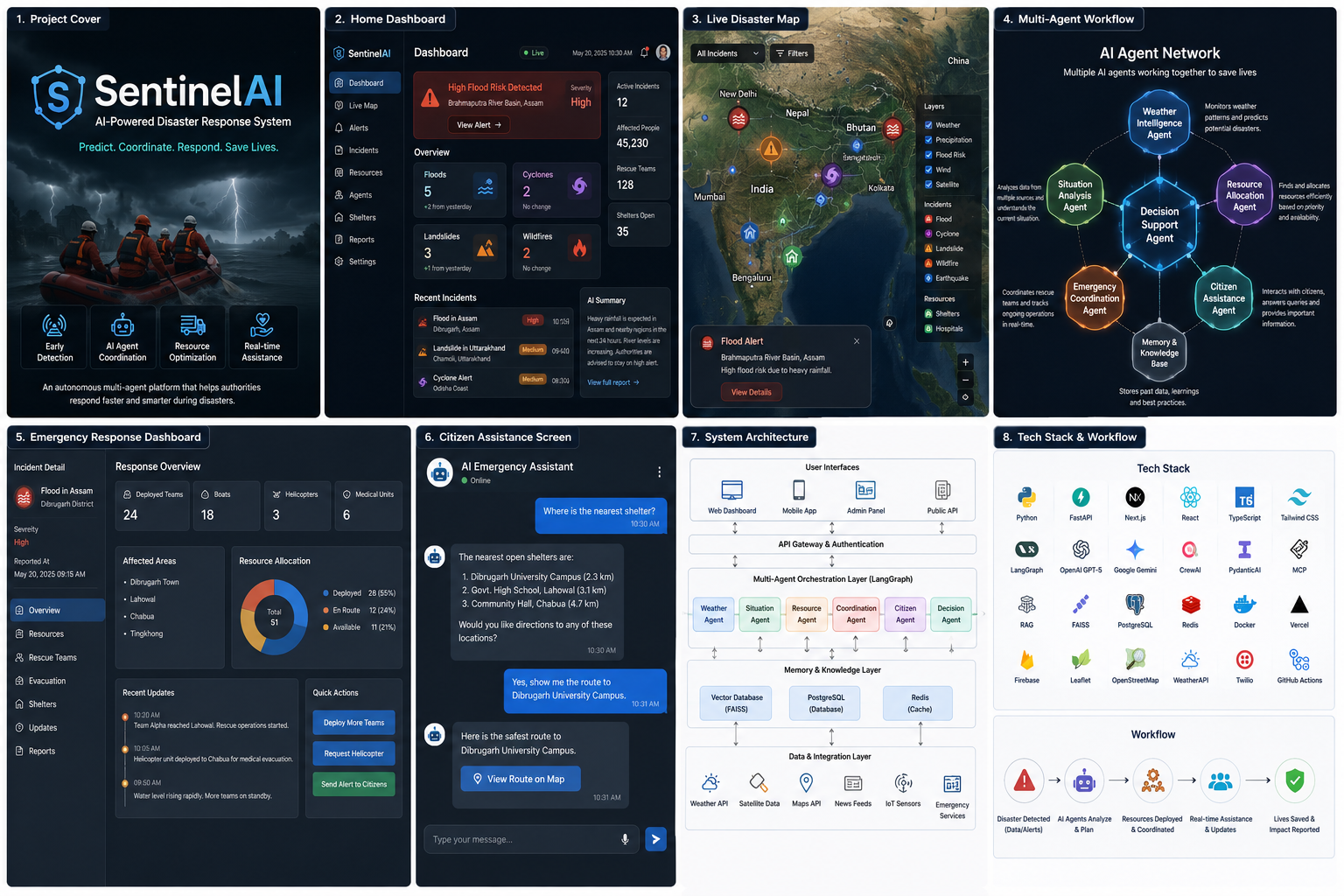
SentinelAI – An Agentic AI-powered disaster response platform that predicts emergencies, coordinates rescue operations .
Inspiration
What it does
🌍 SentinelAI: Multi-Agent Disaster Response System
🚨 Inspiration
Every year, millions of people are affected by natural disasters such as floods, earthquakes, cyclones, wildfires, and landslides. While emergency services work tirelessly to respond, critical information is often scattered across multiple sources, leading to delayed decisions and slower rescue operations.
We asked ourselves:
What if a team of intelligent AI agents could collaborate like an emergency response center—analyzing data, coordinating resources, and helping save lives in real time?
This idea inspired SentinelAI, a multi-agent disaster response platform that transforms fragmented information into coordinated action.
💡 The Problem
During disasters, responders face several challenges:
- Delayed identification of affected areas
- Information spread across weather services, maps, news, and emergency reports
- Difficulty allocating rescue teams efficiently
- Poor communication between agencies
- Lack of real-time situational awareness
- Limited access to reliable information for citizens
These issues can significantly impact rescue operations when every minute matters.
✅ Our Solution
SentinelAI is an Agentic AI-powered emergency response platform where multiple specialized AI agents work together to support disaster management.
Instead of relying on a single chatbot, each AI agent has a dedicated responsibility while collaborating with other agents to make informed decisions.
🤖 Multi-Agent Architecture
🌦️ Weather Intelligence Agent
- Continuously monitors weather forecasts
- Detects extreme weather conditions
- Predicts potential disasters
- Sends early warnings
🛰️ Situation Analysis Agent
- Collects information from multiple trusted sources
- Identifies affected regions
- Estimates disaster severity
- Generates live incident reports
🗺️ Resource Allocation Agent
- Finds nearby hospitals and shelters
- Suggests optimal rescue routes
- Prioritizes emergency requests
- Tracks available rescue resources
🚑 Emergency Coordination Agent
- Coordinates rescue operations
- Assigns emergency teams
- Updates responders in real time
- Tracks ongoing missions
📢 Citizen Assistance Agent
- Answers emergency questions
- Shares evacuation routes
- Provides safety instructions
- Helps locate nearby shelters
📊 Decision Support Agent
- Combines insights from all agents
- Generates executive dashboards
- Provides actionable recommendations
- Predicts resource requirements
⚙️ How We Built It
The platform is designed using an Agentic AI architecture.
Frontend
- Next.js
- React
- Tailwind CSS
Backend
- FastAPI
- Python
AI Layer
- Large Language Models
- LangGraph for multi-agent orchestration
- Retrieval-Augmented Generation (RAG)
Data Sources
- Weather APIs
- Maps APIs
- Emergency databases
- News feeds
- Satellite imagery (future integration)
Database
- PostgreSQL
- Vector Database for long-term memory
Deployment
- Docker
- Vercel
- Cloud backend
🔄 Workflow
Disaster Signal
        │
        ▼
Weather Agent
        │
        ▼
Situation Analysis Agent
        │
        ▼
Decision Support Agent
        │
 ┌──────┼───────────┐
 │      │           │
 ▼      ▼           ▼
Resource  Rescue   Citizen
Agent     Agent    Agent
 │         │         │
 └─────────┼─────────┘
           ▼
 Live Dashboard
✨ Key Features
- 🌦️ Real-time disaster monitoring
- 🤖 Multi-agent AI collaboration
- 🚨 Early warning notifications
- 🗺️ Smart evacuation planning
- 🏥 Shelter and hospital recommendations
- 🚑 Rescue resource optimization
- 📊 Live emergency dashboard
- 💬 AI-powered emergency assistant
- 📈 Predictive analytics
- 🔒 Scalable cloud architecture
🎯 Challenges We Faced
Building an autonomous multi-agent system presented several interesting challenges.
Agent Communication
Designing efficient communication between independent AI agents while avoiding conflicting decisions required careful orchestration.
Real-Time Decision Making
Emergency situations evolve rapidly. Ensuring that the system can continuously process new information while updating recommendations was a significant engineering challenge.
Data Integration
Combining weather reports, maps, emergency alerts, and public information into a unified workflow required thoughtful system design.
Reliability
In disaster response, incorrect information can have serious consequences. We focused on creating a workflow where multiple agents validate information before presenting recommendations.
📚 What We Learned
This project taught us that building Agentic AI is much more than connecting an LLM to a chatbot.
We learned about:
- Multi-agent orchestration
- AI planning and reasoning
- Workflow automation
- Retrieval-Augmented Generation (RAG)
- Context and memory management
- API integration
- Real-time event processing
- Human-in-the-loop decision systems
- Designing AI systems for high-impact, real-world applications
🚀 Future Roadmap
Our vision is to transform SentinelAI into a comprehensive emergency management platform.
Future enhancements include:
- Drone integration for live aerial monitoring
- Satellite image analysis
- IoT sensor integration
- Voice-based emergency assistant
- Offline emergency mode
- Multilingual support
- Mobile application
- Predictive flood and wildfire modeling
- Government emergency response integration
- AI-powered resource demand forecasting
🌍 Impact
SentinelAI is designed to help emergency responders make faster, smarter, and more informed decisions.
By combining autonomous AI agents, real-time intelligence, and coordinated workflows, the platform has the potential to reduce response times, improve resource utilization, and ultimately save lives.
When every second matters, intelligent coordination can make all the difference.

Log in or sign up for Devpost to join the conversation.