-
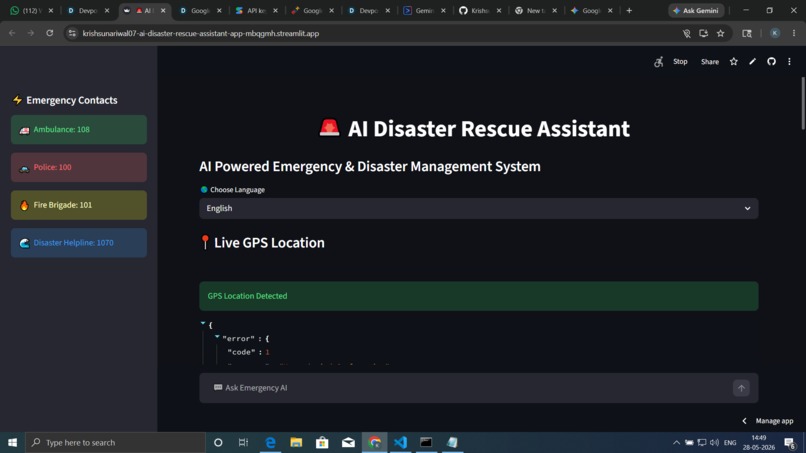
FRONT PAGE
Inspiration
The biggest challenge during disasters and emergency situations is the lack of timely and reliable information. When a disaster like a flood, earthquake, or fire strikes, the resulting chaos leaves people confused about their immediate next steps, where to go, and how to contact emergency teams. Traditional helpline numbers are often busy, or the communication network infrastructure gets damaged, leading to slow response times. To bridge this critical gap and deliver real-time emergency support using AI, we built the AI Disaster Rescue Assistant
What it does
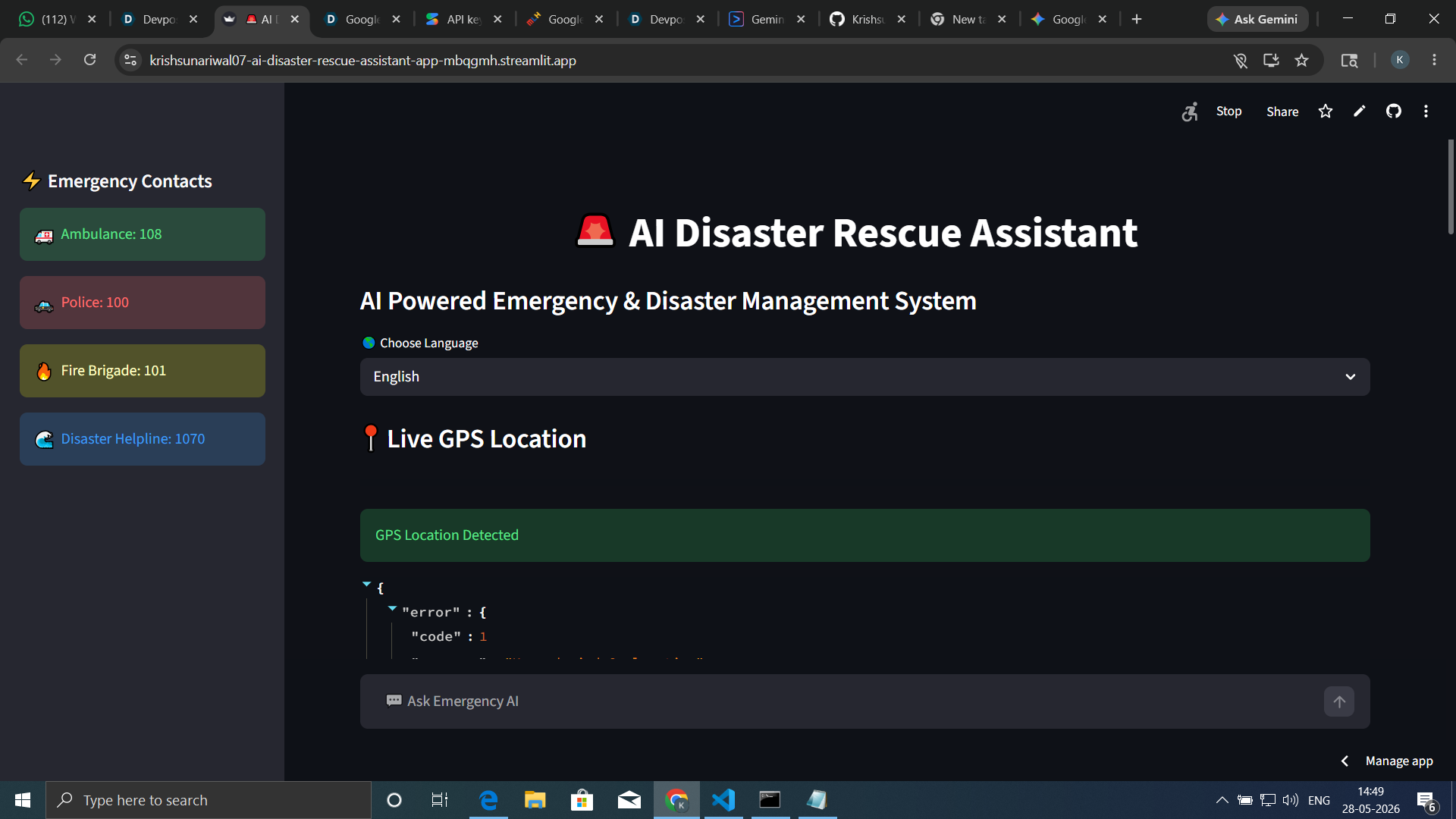
This is an intelligent, real-time web application designed to provide users with critical guidelines and immediate assistance during a disaster. Its core functionalities include: Real-time AI Guidance: Provides instant, disaster-specific safety protocols and first-aid instructions during emergencies like fires, floods, or medical crises. Interactive Assistance: Through a Streamlit-powered dashboard, users can access real-time disaster alerts and dynamic answers tailored to their situation. Emergency Resource Routing: Instantly maps out necessary emergency contact information and standard operating procedures (SOPs) based on different disaster zones
How we built it
The core architecture of this application is designed to be lightweight, highly accessible, and dynamic: Frontend & Dashboard UI: The entire interface is developed using the Streamlit web framework. It is highly user-friendly and built to load smoothly even during chaotic situations. AI & NLP Core: Powerful AI language models and prompt engineering are utilized on the backend to process user inputs, queries, and specific disaster scenarios. Deployment: The application is successfully hosted and deployed on the Streamlit Community Cloud, making it instantly accessible from any mobile or desktop device
Challenges we ran into
During development, we faced a few major technical and design challenges:UI Simplicity under Stress: Emergency applications cannot have a complex interface. We had to keep the layout incredibly clean and minimal so that any user under intense stress could operate it effortlessly without a learning curve. Latency Control: Every single second matters in a disaster situation. Minimizing the processing time of AI responses and API latency was a significant hurdle, which we successfully overcame through code and prompt optimization.
Accomplishments that we're proud of
We are incredibly proud to have built a functional prototype that is not just theoretical but ready for real-world deployment. Through a single-click link, any user can instantly access critical rescue steps, which can truly be life-saving in emergency situations.
What we learned
Through this project, we learned how Generative AI can be practically applied to real-world humanitarian crises and disaster management. It also significantly strengthened our grasp of Streamlit’s rapid prototyping capabilities and fast cloud deployment methodologies.
What's next for AI Disaster Rescue Assistant
Offline Capability: Integrating SMS-based AI support so users can receive critical assistance even without an active internet connection. Real-time Location Tracking: Implementing live user GPS tracking to automatically route them to the nearest relief camps and alert local rescue teams. Multilingual Support: Adding support for Hindi and other regional languages to ensure the app is accessible and easy to understand for everyone.

Log in or sign up for Devpost to join the conversation.