-
-
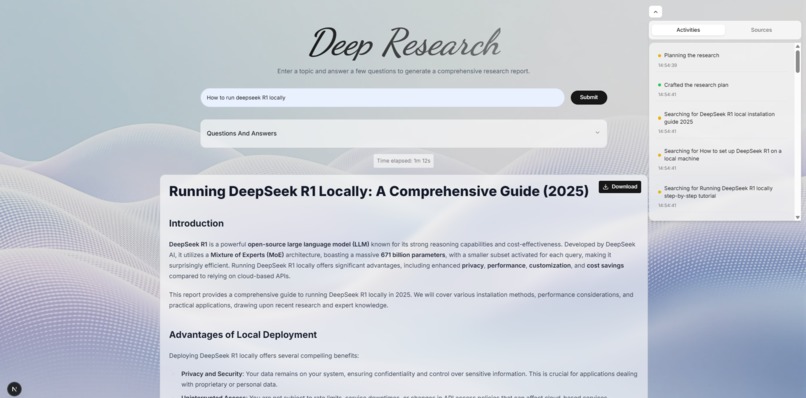
fully functional deepresearch assistant
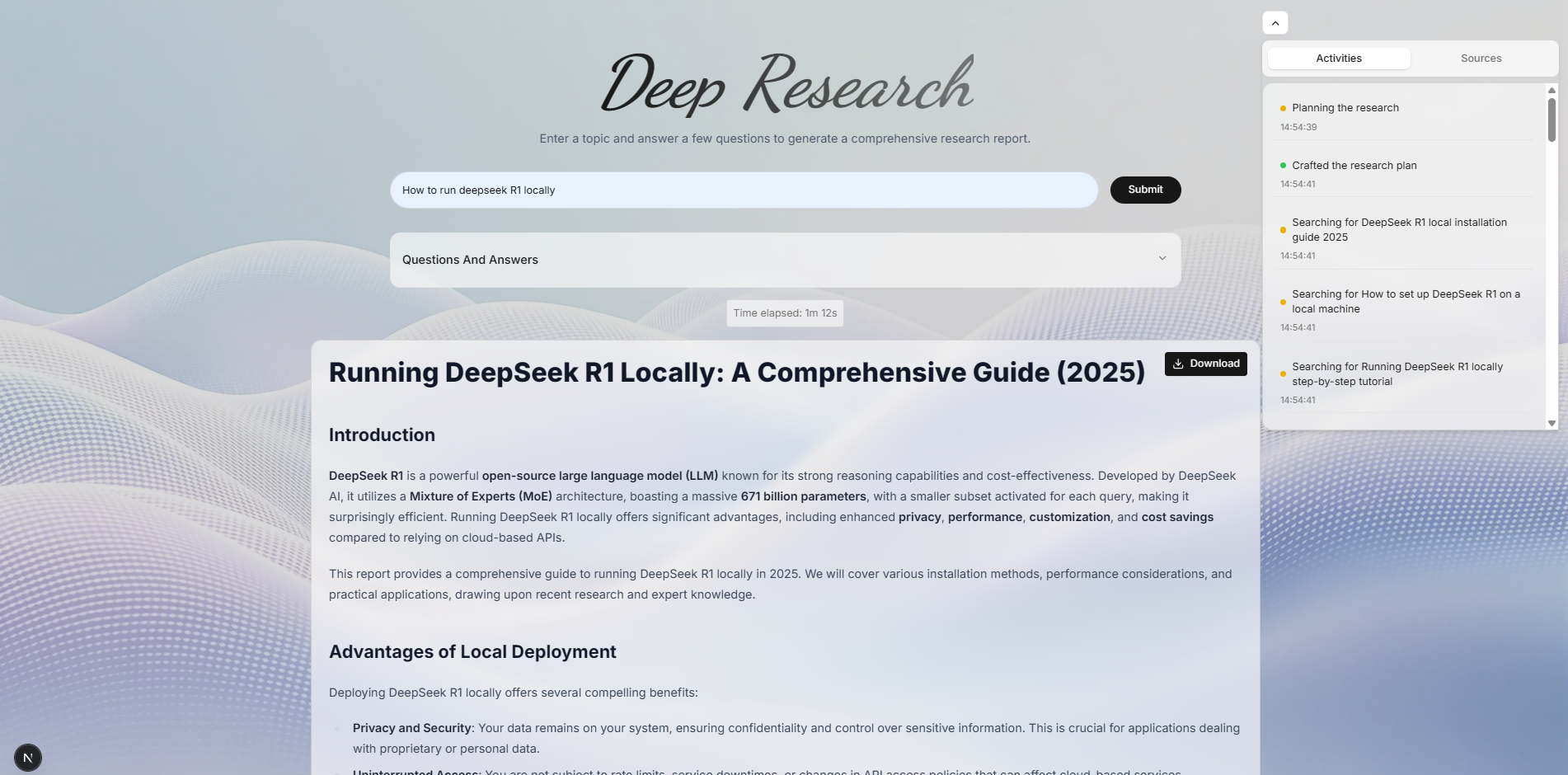
Project DeepResearch: The Story Behind the AI Research Assistant
Inspiration: From Tab-Hopping to True Understanding
The idea for DeepResearch was born out of a persistent frustration—how time-consuming and fragmented online research has become. While search engines are excellent at surfacing information, they often fail to provide synthesized insights. I found myself caught in an endless loop of tab-hopping, reading partial perspectives, and manually stitching together key takeaways.
I envisioned a smarter solution—an AI-powered research assistant that could:
- Understand a research topic deeply,
- Pull content from high-quality, trustworthy sources,
- Synthesize and structure the information coherently,
- Generate insightful follow-up questions for deeper learning.
In short, a system that doesn’t just retrieve links—but delivers knowledge.
The Build Process
DeepResearch was built using a robust, type-safe modern tech stack designed for scalability, efficiency, and seamless AI integration.
Framework: The project is built on Next.js, utilizing its powerful App Router to create modular API endpoints. This allowed both the frontend and backend to co-exist within a single, cohesive codebase.
Language: TypeScript was a deliberate choice. With complex data transformations, API chaining, and AI interactions, static typing proved invaluable. It reduced bugs, ensured type safety, and made the development process more predictable and reliable.
Core AI Logic: The "deep research" engine follows a multi-phase pipeline:
Initial Query The user submits a topic or question they wish to research.
Targeted Search Advanced search APIs such as Tavily AI are used to find a curated list of relevant, credible articles, reports, and academic content.
Content Extraction Raw content from the sources is scraped, cleaned, and pre-processed to remove noise and ensure clarity.
AI Synthesis The extracted information is passed into a large language model (e.g., GPT-4 or Gemini) via a carefully engineered prompt. The model reads, understands, and synthesizes the data into a comprehensive and logically structured report, highlighting key themes, evidence, counterpoints, and conclusions.
Follow-Up Question Generation A secondary AI module reads the synthesized report and generates thought-provoking, topic-relevant questions to guide deeper inquiry or next-stage research.
What I Learned
This project provided hands-on experience in building a production-ready AI system. Key takeaways include:
Prompt Engineering is Everything Getting a language model to generate useful, structured, and factual output requires precision. I spent a significant amount of time refining prompts to ensure reliability and consistency.
Handling Asynchronous Operations Research isn’t instantaneous. I learned to manage long-running background processes in a serverless environment using intelligent task breakdown, status tracking, and error recovery mechanisms.
Data Quality Directly Impacts AI Output The final report is only as good as the sources behind it. I built robust filtering logic to ensure that only top-tier, factual information fed into the AI, minimizing the chance of hallucinations.
Challenges Faced
Every ambitious project comes with its own set of hurdles. These were some of the biggest challenges I had to overcome:
Complex System Orchestration The research flow involves search APIs, scraping tools, AI models, and serverless execution—all needing to communicate seamlessly. Building a fault-tolerant, maintainable architecture with good logging and graceful failure handling was critical.
Maintaining Factual Accuracy Language models are known to hallucinate. To mitigate this, I enforced grounding—forcing the AI to cite, reference, and strictly base its answers on the extracted source material.
Cost Management at Scale AI and search APIs can quickly become expensive. To control costs, I implemented smart caching, deduplication strategies, and minimal data-passing techniques to keep processing efficient.
The Outcome
DeepResearch became more than just a side project—it turned into a fully functional AI-powered research assistant capable of producing expert-level summaries, analysis, and next-step guidance. It represents the power of combining high-quality search, AI synthesis, and thoughtful system design.
This project taught me how to build intelligent, reliable, and efficient software systems—and gave me a real-world appreciation for the intersection of AI and practical utility. .
Built With
- exasearch
- nextjs
- node.js
- openrouter
- prisma
- react
- shadcn
- tailvy
- tailwindcss
- typescript
- vercel
- zod

Log in or sign up for Devpost to join the conversation.