-
-
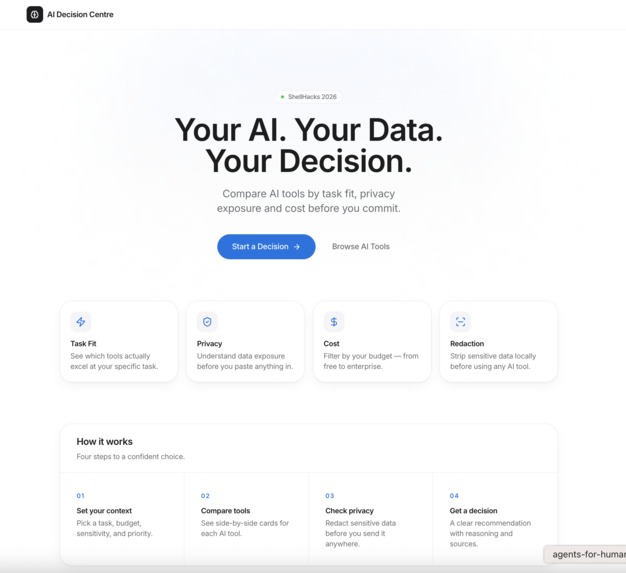
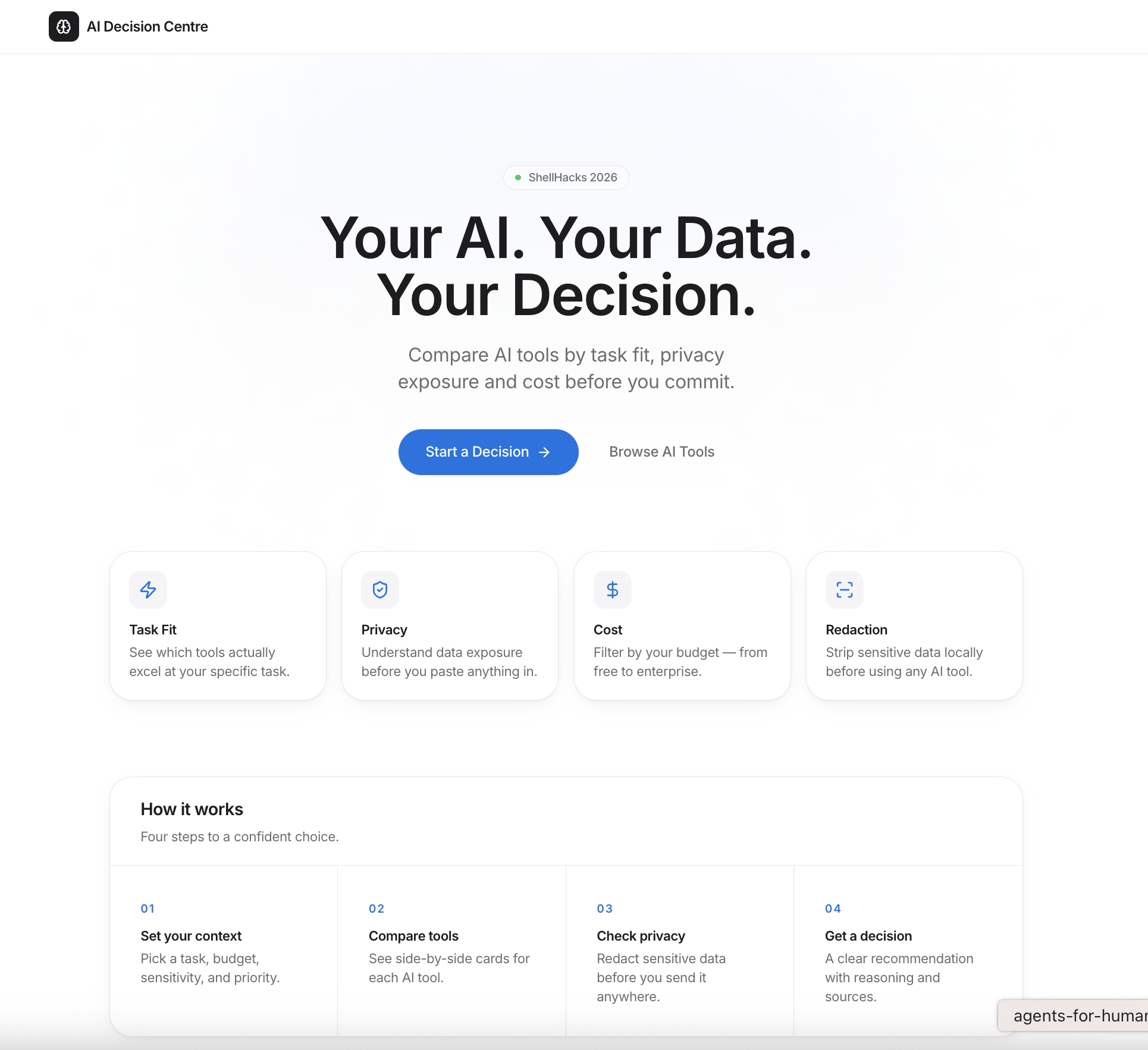
Landing
-
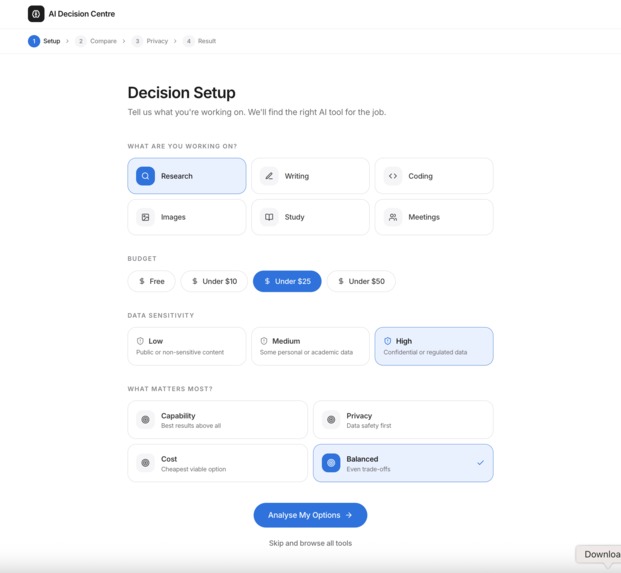
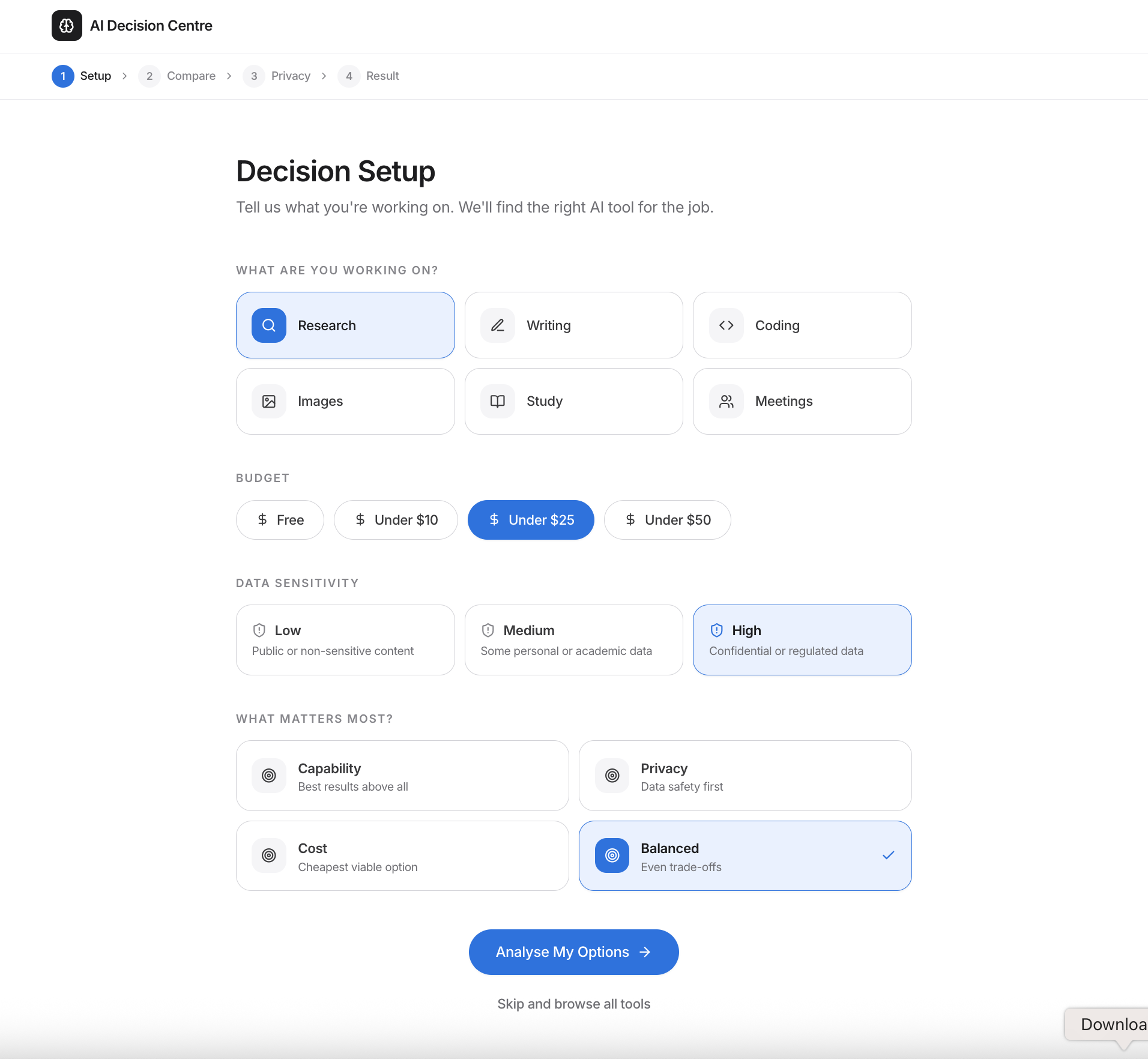
Decision Setup
-
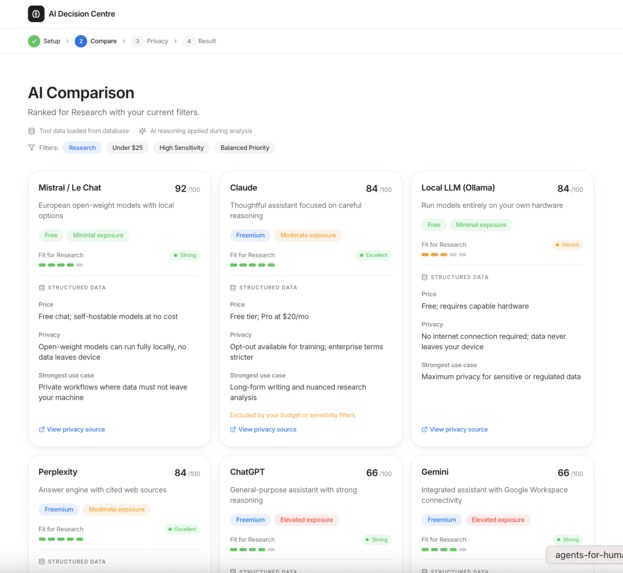
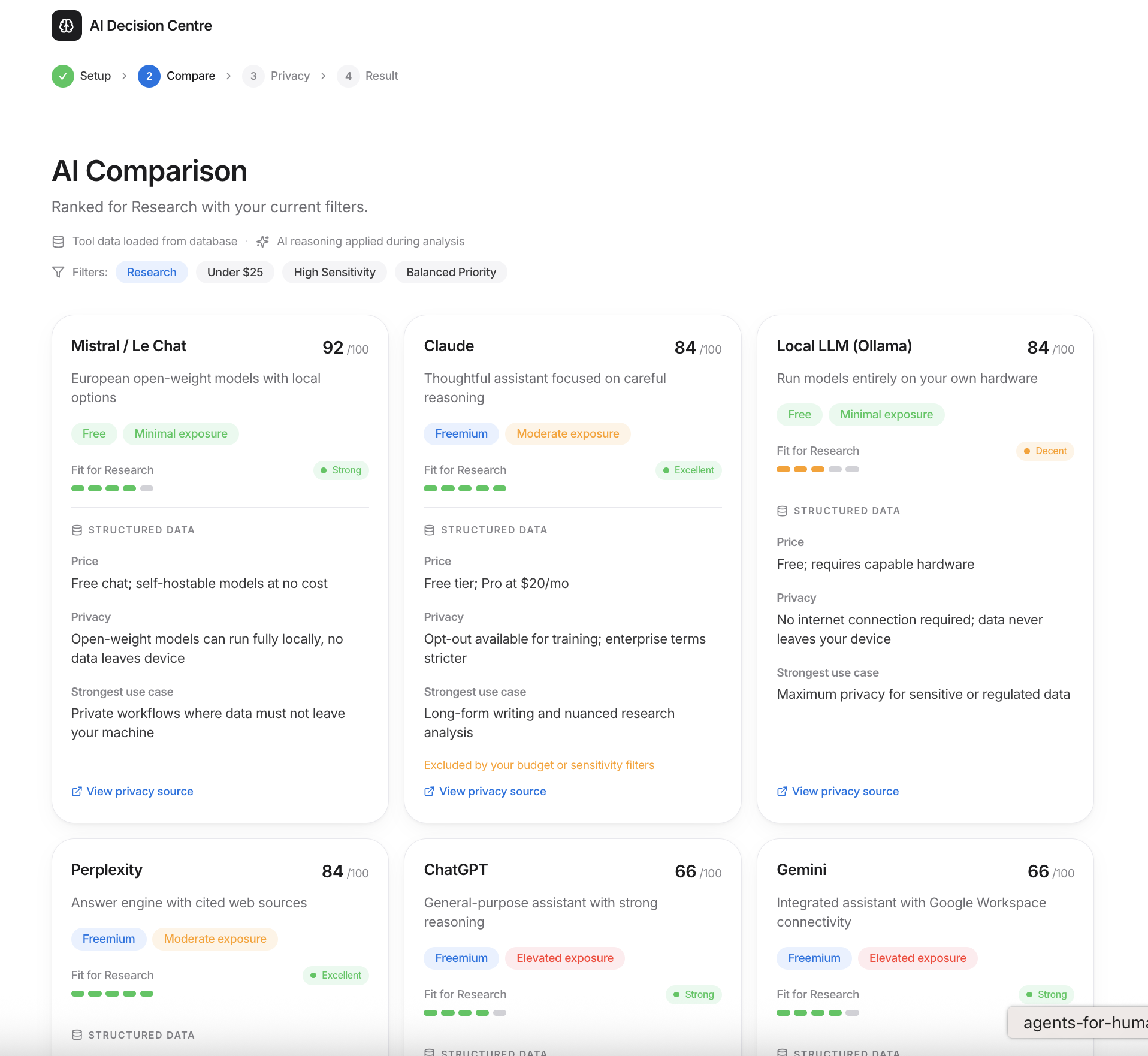
AI Comparison
-
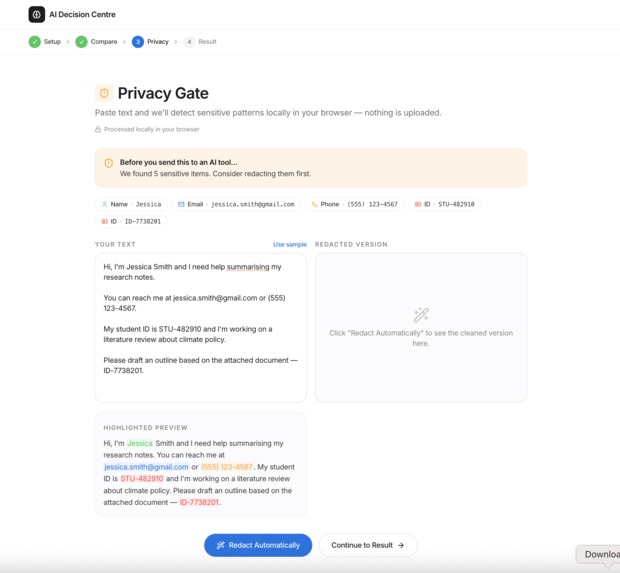
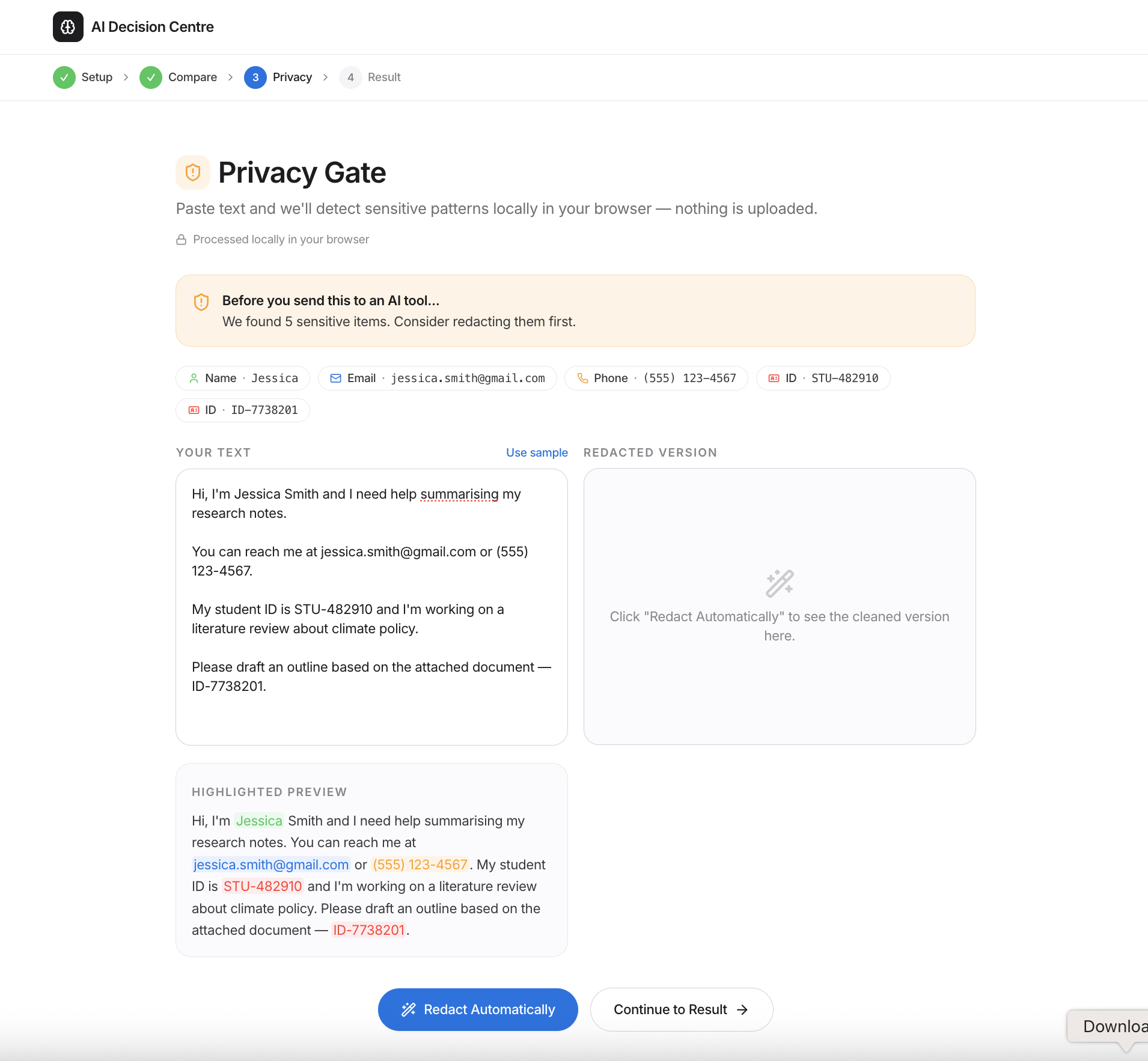
Privacy Detection
-
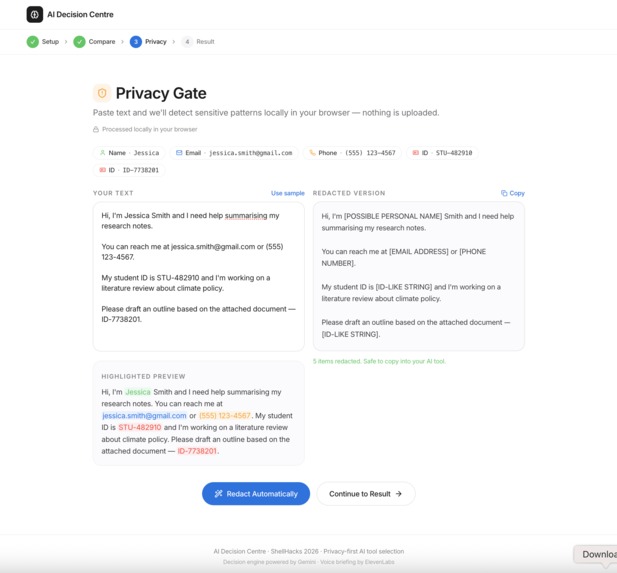
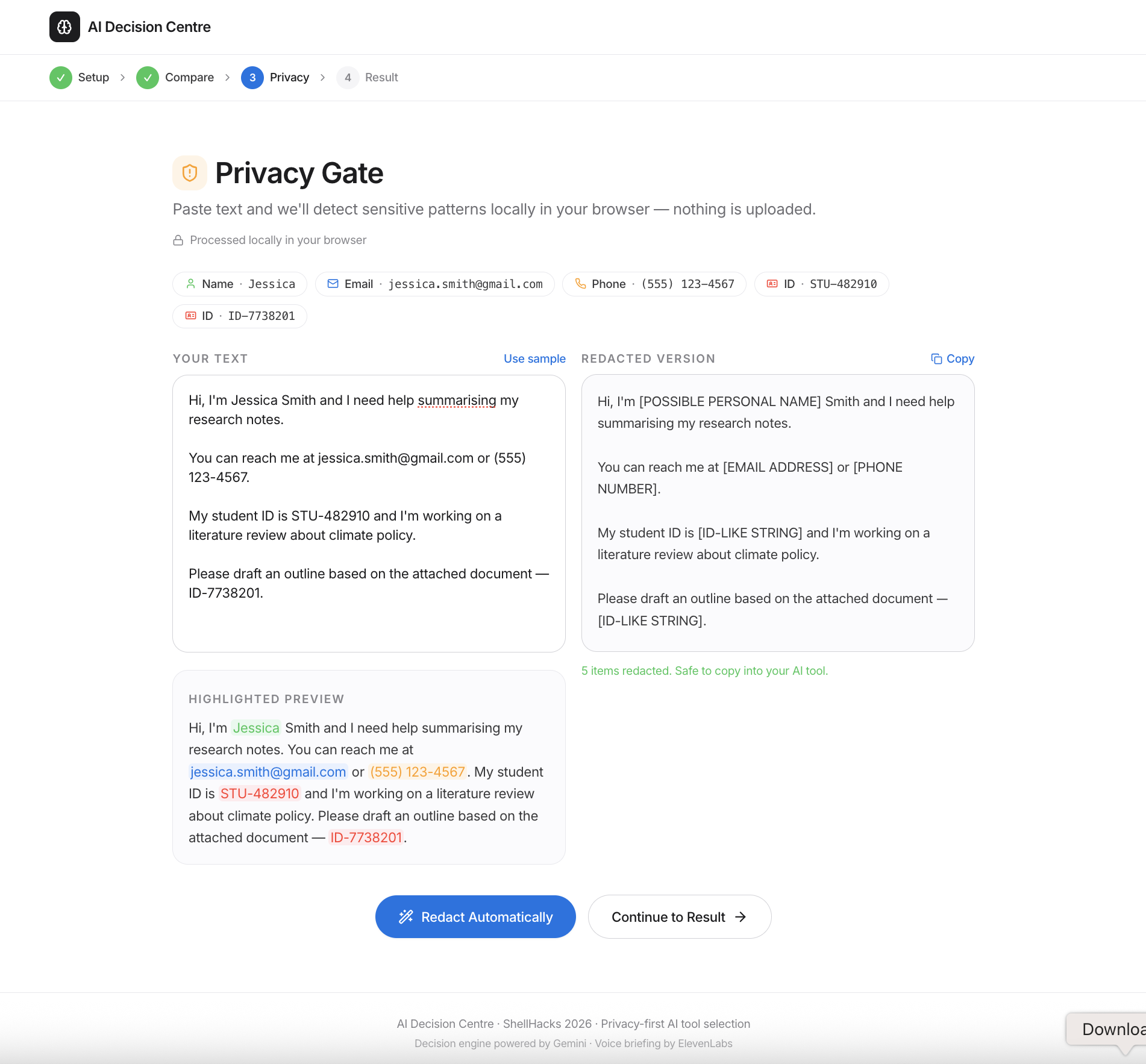
Automatic Redaction
-
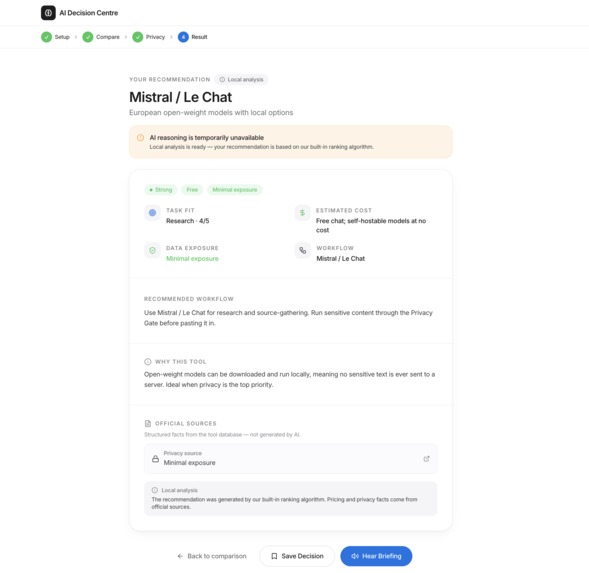
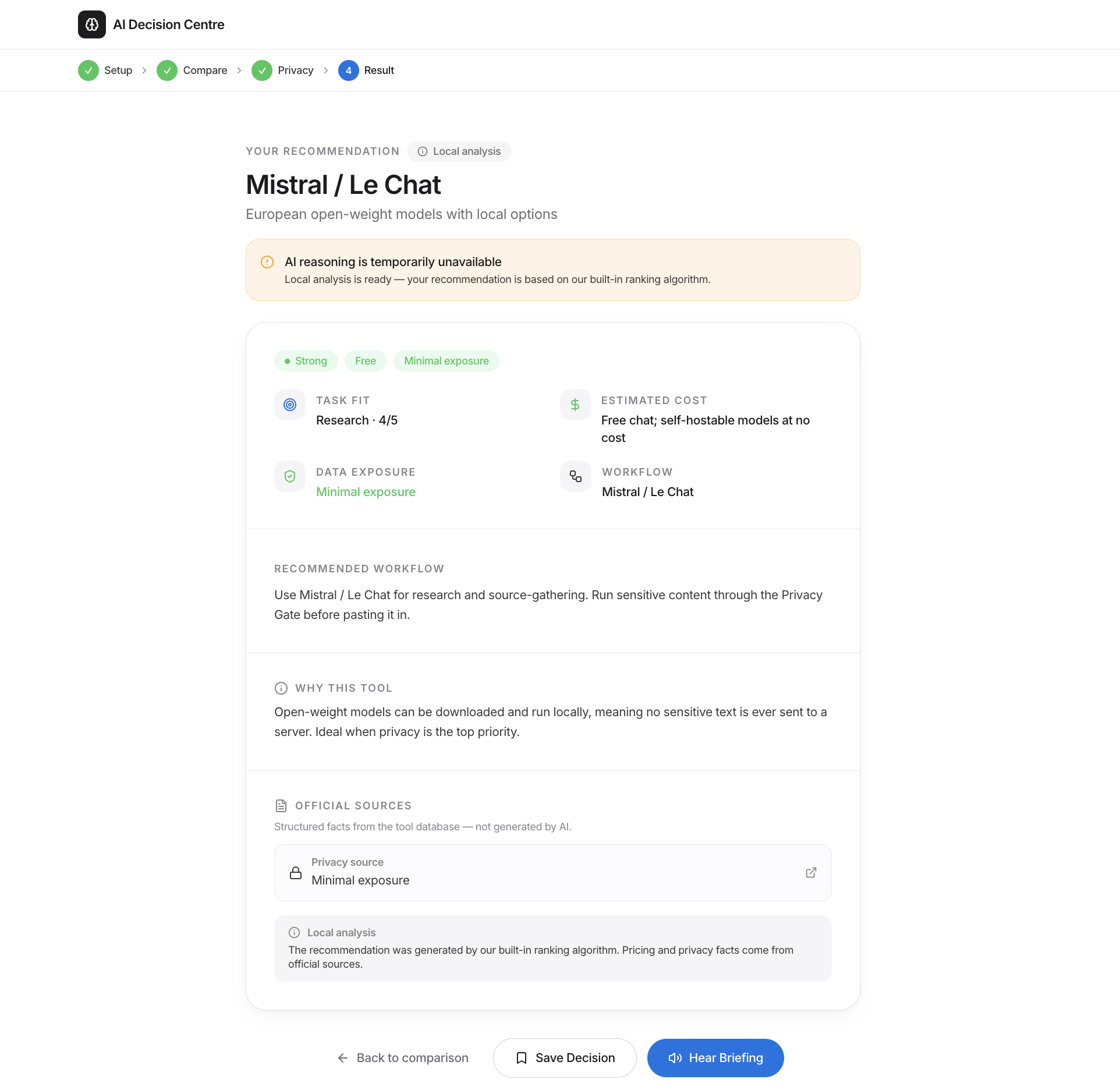
Final Decision
-

Voice Briefing

About the project
The Problem
AI tools are everywhere, but choosing the right one is surprisingly difficult.
People often have to balance several questions at once: Which tool fits my task? How much will it cost? How sensitive is the information I plan to share? What are the relevant privacy details? And can I make that decision without blindly trusting an AI-generated answer?
We built AI Decision Centre to make that decision process clearer, more evidence-based and more privacy-conscious.
What We Built
AI Decision Centre guides a user through a five-step workflow:
Landing → Decision Setup → AI Comparison → Privacy Gate → Decision Result
The user first selects their task, budget, data sensitivity and priority.
The application then combines structured information about available AI tools with the user's constraints. Deterministic filtering narrows the candidate set, while Gemini provides structured reasoning over the supplied evidence and preferences.
The result is a decision card showing task fit, estimated cost, data exposure, workflow, reasoning and supporting official sources.
Privacy Gate
The most important part of the product is the Privacy Gate.
Before users send information to an AI tool, they can paste their text into the browser-based privacy checker. The application detects common sensitive information such as email addresses, phone numbers, ID-like strings and names.
Detection, highlighting and redaction happen locally in the browser.
The original pasted text is not sent to Gemini, ElevenLabs or the database.
Users can automatically redact the detected information and copy the safer version.
This keeps the privacy workflow separate from the AI decision engine.
How Gemini Is Used
Gemini is not presented as a chatbot and is not used as the source of factual pricing or privacy claims.
The application supplies Gemini with structured tool information and the user's selected constraints. Gemini returns structured JSON containing the recommendation, task fit, cost fit, exposure level, reasoning, workflow, confidence and decision factors.
This makes Gemini part of the decision experience while keeping factual source information separate and traceable.
Evidence
The Result screen separates:
Official sources — website, pricing and privacy sources from the structured tool database.
AI reasoning — Gemini's explanation of why the selected option fits the user's requirements.
This distinction helps users understand which information is sourced and which information is generated.
Voice Briefing
The final recommendation can be converted into a short voice briefing using ElevenLabs.
Only the safe decision summary is used for the voice request. Original Privacy Gate text is never transmitted.
A browser voice fallback keeps the experience usable if the external voice service is temporarily unavailable.
Technology
The application uses React and TypeScript for the frontend, Bolt Database for persistence, server-side Edge Functions for external API calls, Gemini for structured decision reasoning, and ElevenLabs for optional voice generation.
API credentials remain server-side.
Challenges
The biggest challenge was combining useful AI reasoning with clear evidence and privacy boundaries without turning the product into another generic chatbot.
We also designed graceful fallback behaviour so a temporary external API failure does not make the application unusable.
What We Learned
We learned that good AI products are not only about model output. The surrounding workflow matters just as much: structured inputs, evidence, privacy controls, understandable results and resilient fallbacks make the experience much more useful.
AI Decision Centre is our attempt to make AI-tool selection a deliberate decision rather than a guess.
Built With
- bolt-database
- edge-functions
- elevenlabs-api
- gemini-api
- postgresql
- react
- tailwind-css
- typescript
- vite


Log in or sign up for Devpost to join the conversation.