-
-
Working the project
Inspiration
AI systems today heavily depend on high-quality data, but most real-world datasets are noisy, inconsistent, and poorly labeled. We realized that bad data leads to poor AI performance, and there is no scalable system that combines human intelligence and AI to fix this problem effectively.
We were inspired to build a platform where humans can collaboratively validate and clean data, while AI ensures consistency and measures improvement. Our goal was to turn data cleaning into a structured, impactful, and measurable process.
What it does
AI Data Validator is a platform that improves dataset quality using human validation and AI assistance.
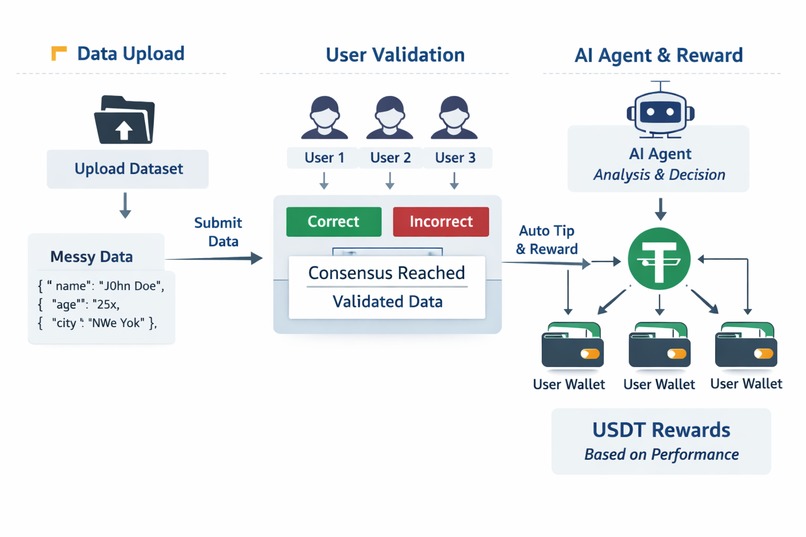
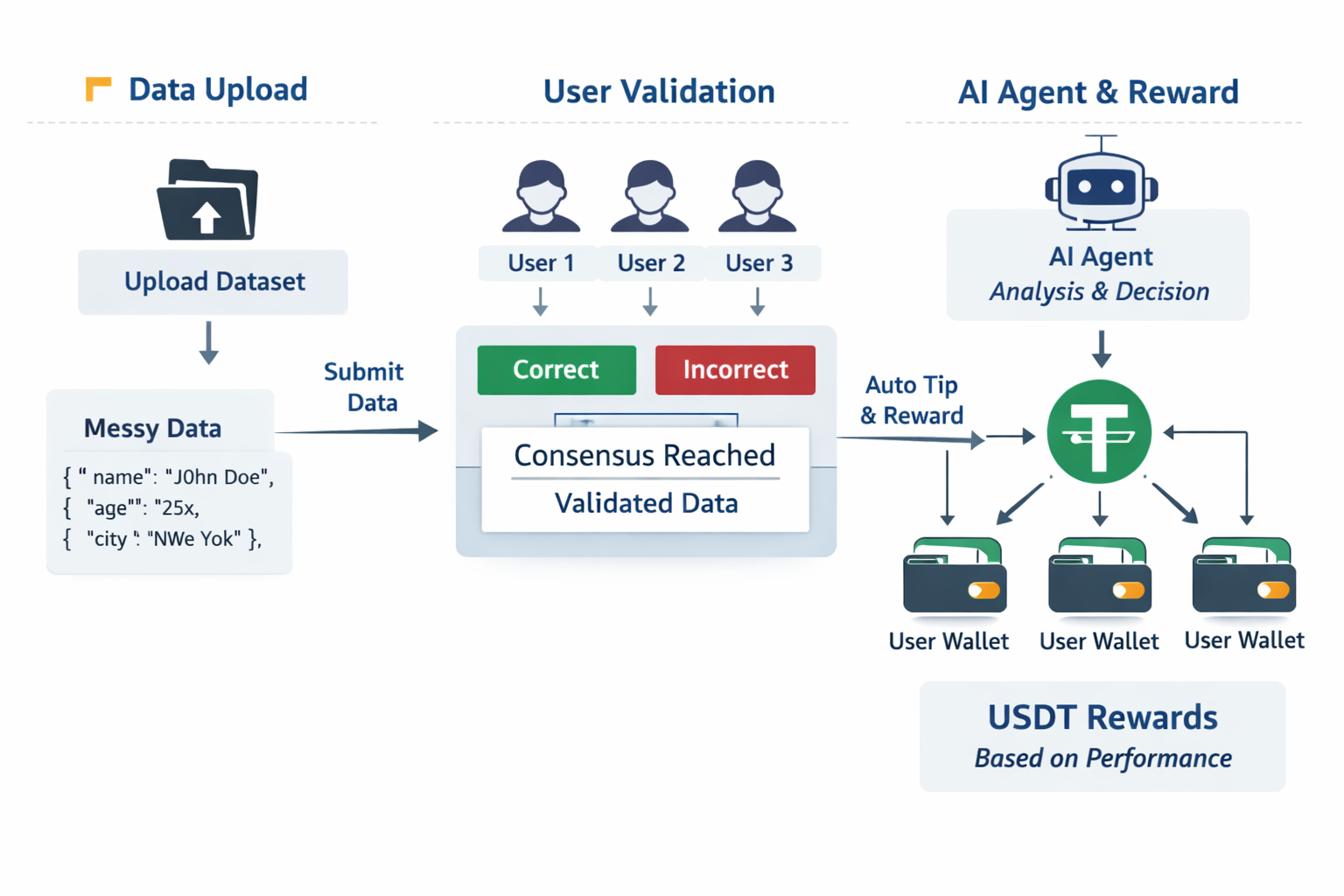
Users upload datasets, which are automatically broken into micro-tasks. Multiple users validate each task, and a consensus mechanism ensures accuracy. Once validated, the system recalculates AI predictions and shows measurable improvement in data quality.
The platform also includes an AI agent that analyzes validation results, detects inconsistencies, and provides insights into data reliability.
Key outcome:
- Improved dataset accuracy
- Better AI model performance
- Transparent validation process
How we built it
We built a full-stack system using React (Vite) for the frontend and Node.js (Express) for the backend.
The backend processes uploaded datasets, normalizes them, and splits them into micro-tasks. A consensus engine ensures correctness using majority voting (2/3 agreement). We track user performance metrics such as accuracy and consistency.
We integrated AI models (Groq LLaMA 3) to evaluate validation quality, detect anomalies, and assist in decision-making.
PostgreSQL is used to store users, tasks, responses, and validation results. The frontend provides a clean interface for task validation, dataset upload, and analytics dashboards.
We also implemented a before-and-after comparison system to demonstrate how data cleaning improves AI accuracy.
Challenges we ran into
One of the biggest challenges was designing a reliable consensus mechanism that prevents incorrect validation while remaining efficient.
Handling real-time synchronization of multiple validators on the same task was also complex. Ensuring fair evaluation of user contributions required careful design of scoring logic.
Another challenge was integrating AI in a meaningful way rather than just as a feature. We focused on making AI assist in validation quality and anomaly detection.
Time constraints also forced us to prioritize core features while maintaining a working and demo-ready system.
Accomplishments that we're proud of
We successfully built a working system that demonstrates real-world impact by improving data quality.
Our consensus-based validation ensures reliability, and our AI integration adds intelligence to the process.
The most impactful feature is the measurable improvement in dataset accuracy, showing clear before-and-after results.
We also built a clean, user-friendly interface that makes complex workflows easy to understand.
What we learned
We learned how critical data quality is for AI systems and how difficult it is to maintain at scale.
We gained hands-on experience in building full-stack applications, designing consensus systems, and integrating AI models into real workflows.
We also learned how to balance innovation with practicality, especially under hackathon time constraints.
What's next for Ai-data-validator
We plan to enhance the platform by adding a reputation system to improve validator reliability and prevent spam.
We also want to integrate more advanced AI models for automated data correction and deeper analysis.
Future versions will include real-time collaboration, enterprise dataset support, and integration with machine learning pipelines.
Our long-term vision is to build a scalable data validation ecosystem that powers better AI systems across industries.
Built With
- groq
- node.js
- polygon
- postgresql
- react
- tether
- walletkit

Log in or sign up for Devpost to join the conversation.