-
-
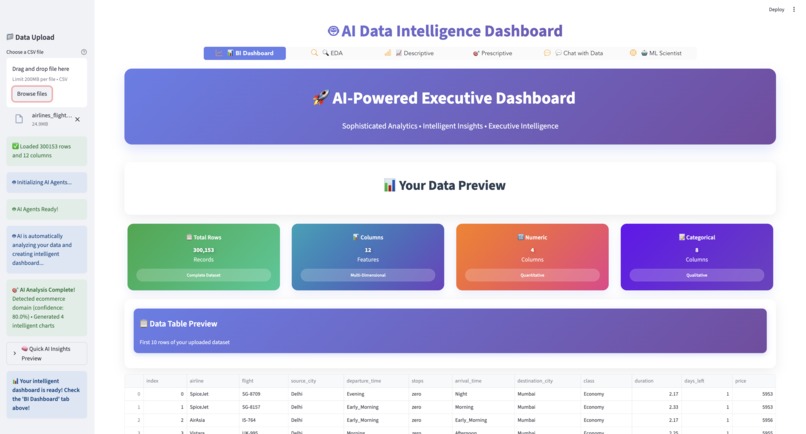
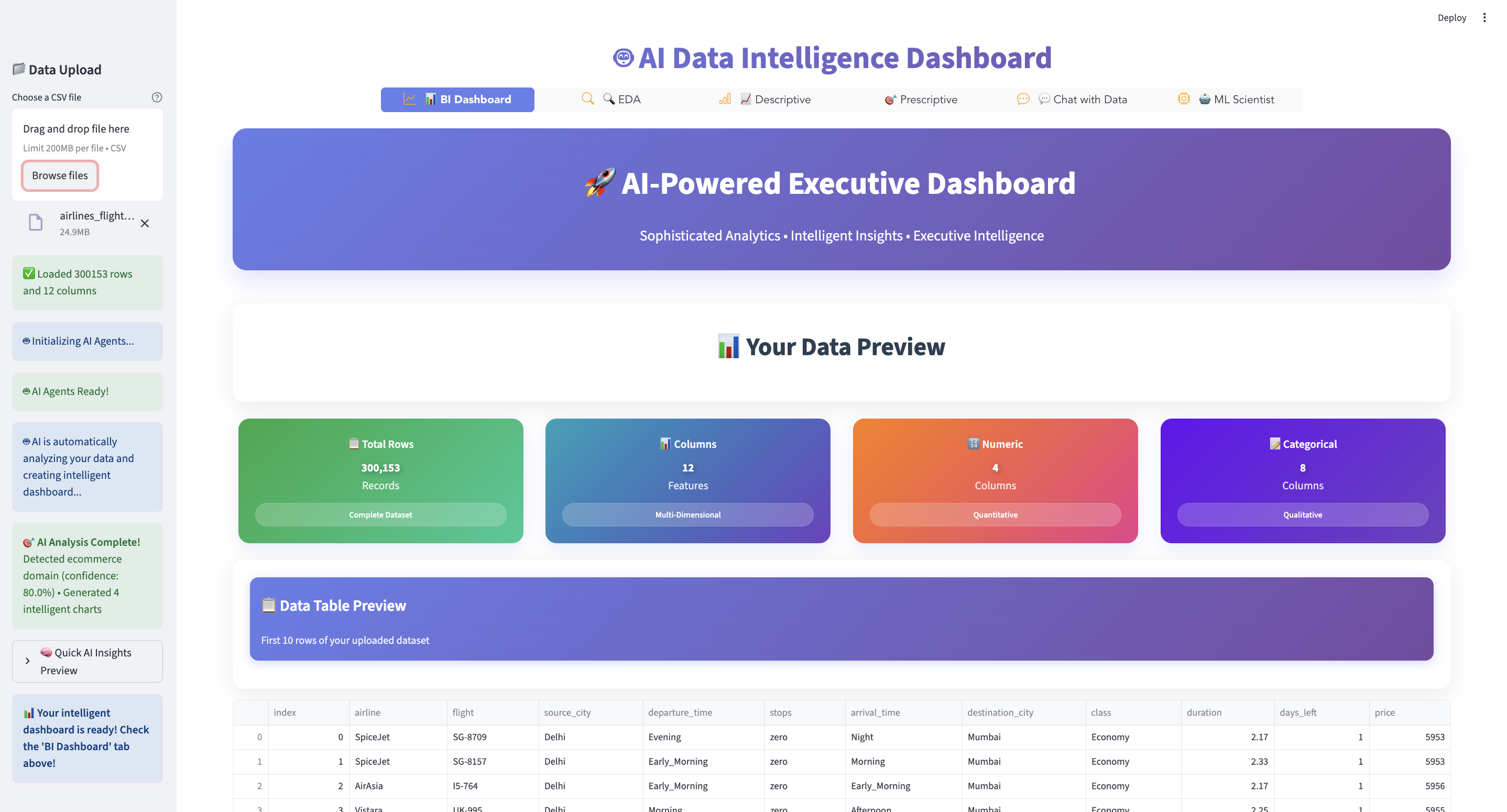
AI intelligence Dashboard
-

My Hackathon Journey: Building an AI Data Intelligence Dashboard
What Inspired Me
The inspiration for this project came from witnessing the growing gap between data availability and actionable insights in modern businesses. I noticed that while companies collect massive amounts of data, they often struggle to extract meaningful intelligence from it. Traditional analytics tools require extensive technical expertise, and even then, they provide static reports rather than dynamic, intelligent analysis.
I was particularly inspired by the potential of AI agents working together to solve complex problems. The idea of having specialized AI agents - each with their own expertise - collaborating to provide comprehensive data analysis seemed like the future of business intelligence. This led me to envision a platform where:
- Business users could upload data and get instant, intelligent insights
- Data scientists could leverage AI for rapid prototyping and model selection
- Executives could receive executive-level dashboards with actionable recommendations
The concept of democratizing data science through AI was the core driving force behind this project.
What I Learned
Technical Skills
- Multi-Agent AI Architecture: Designing and implementing specialized AI agents that work together
- Advanced Streamlit Development: Creating sophisticated UIs with real-time updates and persistent state management
- PyTorch Integration: Building custom wrappers for PyTorch models to work with scikit-learn utilities
- Dynamic Code Generation: Creating and executing Python code safely within a web application
- API Integration: Working with Google's Gemini API for intelligent analysis and code generation
AI/ML Concepts
- Model Selection Automation: Using AI to recommend optimal models based on data characteristics
- Feature Engineering: Automated preprocessing and feature selection
- Cross-Validation Strategies: Implementing robust model validation techniques
- Explainable AI: Generating comprehensive explanations for model outputs and business insights
Software Engineering
- Error Handling: Building robust fallback mechanisms for AI-generated code
- Performance Optimization: Reducing loading times and improving user experience
- Code Architecture: Designing modular, maintainable code with clear separation of concerns
How I Built My Project
Phase 1: Foundation & Architecture
I started by designing a modular architecture with specialized AI agents:
# Core agent structure
class BaseAgent:
    def __init__(self, google_api_key: str):
        self.google_api_key = google_api_key
        self.client = genai.Client(api_key=google_api_key)
Each agent was designed with specific responsibilities:
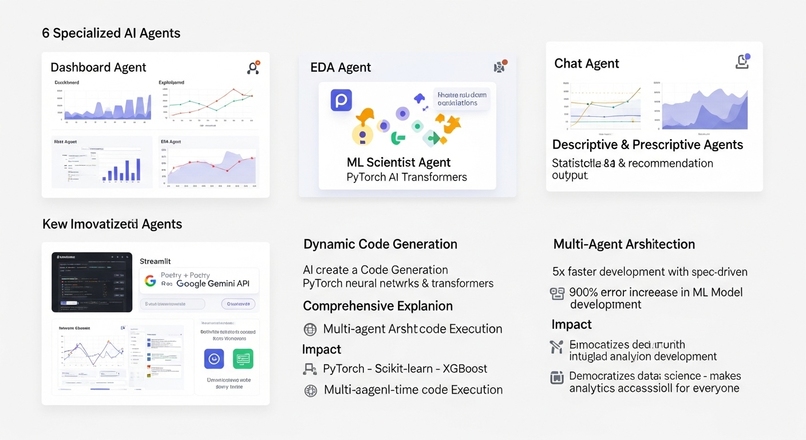
- Dashboard Agent: Business intelligence and executive reporting
- EDA Agent: Exploratory data analysis
- Descriptive Agent: Statistical analysis
- Prescriptive Agent: Business recommendations
- Chat Agent: Interactive Q&A
- ML Scientist Agent: Machine learning and deep learning
Phase 2: AI Integration
I integrated Google's Gemini API to power intelligent analysis:
def analyze_data_and_recommend_models(self, df: pd.DataFrame) -> dict:
    prompt = f"""
    Analyze this dataset and recommend the best ML models:
    - Data shape: {df.shape}
    - Column types: {df.dtypes.to_dict()}
    - Target variable: {target_column}

    Provide recommendations with reasoning.
    """
    response = self.client.models.generate_content(prompt)
Phase 3: ML/DL Implementation
The most complex part was building the ML Scientist Agent that could:
- Automatically detect task types (regression vs classification)
- Recommend optimal models
- Generate and execute PyTorch code
- Provide comprehensive explanations
def _generate_deep_learning_code(self, df, target_column, model_type, task_type):
    # Generate PyTorch neural network code
    code = f"""
    import torch
    import torch.nn as nn
    import torch.optim as optim

    class NeuralNetwork(nn.Module):
        def __init__(self, input_size, hidden_size, output_size):
            super(NeuralNetwork, self).__init__()
            self.fc1 = nn.Linear(input_size, hidden_size)
            self.fc2 = nn.Linear(hidden_size, output_size)
            self.relu = nn.ReLU()

        def forward(self, x):
            x = self.relu(self.fc1(x))
            x = self.fc2(x)
            return x
    """
    return code
Phase 4: UI/UX Development
I built a sophisticated Streamlit interface with:
- Real-time progress indicators
- Persistent state management
- Beautiful visualizations
- Interactive components
Phase 5: Optimization & Polish
- Fixed Streamlit deprecation warnings
- Optimized loading times
- Enhanced error handling
- Added comprehensive documentation
Challenges I Faced
1. AI Code Generation & Execution
Challenge: Generating executable Python code that could run safely in a web environment.
Solution: I implemented a robust code execution system with:
- Sandboxed execution environments
- Error handling and fallback mechanisms
- Input validation and sanitization
- Safe matplotlib figure capture
def _execute_visualization_code(self, code: str, df: pd.DataFrame) -> str:
    try:
        # Create safe execution environment
        exec_globals = {
            'pd': pd, 'np': np, 'plt': plt, 'sns': sns,
            'df': df, 'torch': torch, 'sklearn': sklearn
        }
        exec(code, exec_globals)
        # Capture and return base64 encoded images
    except Exception as e:
        return f"Error: {str(e)}"
2. PyTorch-Scikit-learn Integration
Challenge: PyTorch models don't natively work with scikit-learn utilities like permutation_importance.
Solution: I created custom wrapper classes:
class PyTorchModelWrapper(BaseEstimator):
    def __init__(self, model):
        self.model = model

    def fit(self, X, y):
        # Training logic
        return self

    def predict(self, X):
        # Prediction logic
        return predictions

    def score(self, X, y):
        # Scoring logic for compatibility
        return r2_score(y, self.predict(X))
3. Performance Optimization
Challenge: The app was loading slowly due to complex AI operations.
Solution: I implemented several optimizations:
- Lazy loading of AI agents
- Caching of analysis results
- Streamlined code generation
- Reduced API calls
4. Error Handling & User Experience
Challenge: AI-generated code could fail, leaving users with cryptic error messages.
Solution: I built comprehensive error handling:
- Graceful fallbacks for failed operations
- User-friendly error messages
- Automatic retry mechanisms
- Detailed logging for debugging
5. Streamlit Deprecation Warnings
Challenge: The app was showing numerous deprecation warnings.
Solution: I systematically updated all deprecated parameters:
# Before
st.dataframe(df, use_container_width=True)

# After
st.dataframe(df, width="stretch")
Key Technical Innovations
1. AI-Powered Model Selection
The system automatically analyzes data characteristics and recommends optimal models:
def _select_best_model(self, task_type: str, data_size: int, feature_count: int) -> str:
    if task_type == "regression":
        if data_size > 10000 and feature_count > 20:
            return "XGBoost"
        elif data_size < 1000:
            return "Linear Regression"
        else:
            return "Random Forest"
    # ... more logic
2. Dynamic Code Generation
The system generates custom Python code based on user requirements:
def generate_ml_code(self, df, target_column, model_type, task_type):
    if model_type.lower() in ['neural network', 'transformer']:
        return self._generate_deep_learning_code(df, target_column, model_type, task_type)
    else:
        return self._generate_traditional_ml_code(df, target_column, model_type, task_type)
3. Comprehensive Explanation System
Every output comes with detailed AI-generated explanations:
def _generate_overall_explanation(self, exec_globals: dict, num_images: int) -> str:
    explanation = f"""
    ## Comprehensive Model Analysis

    Your {model_type} model has been successfully trained and evaluated. Here's what the results mean:

    ### Performance Metrics
    - **R² Score**: {r2_score:.3f} - This means the model explains {r2_score*100:.1f}% of the variance
    - **RMSE**: {rmse:.3f} - Average prediction error
    - **MAE**: {mae:.3f} - Mean absolute error

    ### What This Means for Your Business
    {business_insights}
    """
    return explanation
Impact & Results
This project demonstrates the potential of AI-driven data analysis to democratize data science and make advanced analytics accessible to everyone. The multi-agent architecture shows how specialized AI systems can work together to solve complex problems that would typically require a team of data scientists.
The platform successfully:
- Reduces time-to-insight from days to minutes
- Eliminates technical barriers for business users
- Provides comprehensive analysis with actionable recommendations
- Scales to any dataset with automatic optimization
Future Vision
This project represents just the beginning of what's possible with AI-driven analytics. The modular architecture allows for easy extension with new agents and capabilities. Future enhancements could include:
- Real-time data streaming analysis
- Advanced deep learning models (Transformers, GANs)
- Natural language querying of data
- Automated report generation
- Integration with business intelligence platforms
The journey of building this project has been incredibly rewarding, combining cutting-edge AI technology with practical business needs to create something truly innovative.


Log in or sign up for Devpost to join the conversation.