-
-
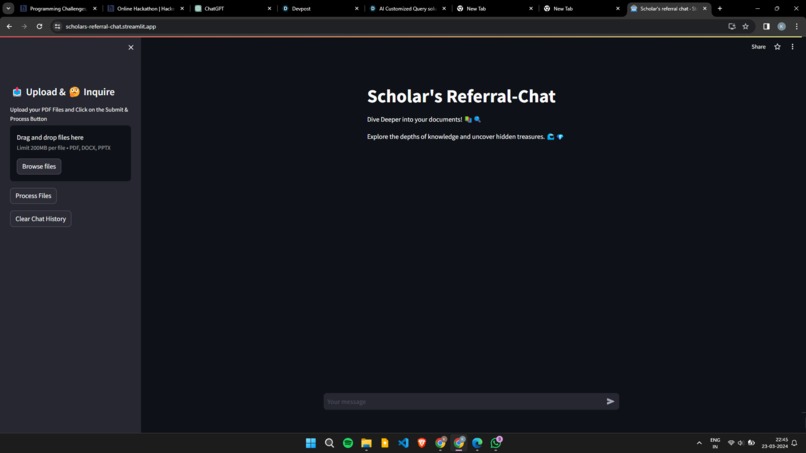
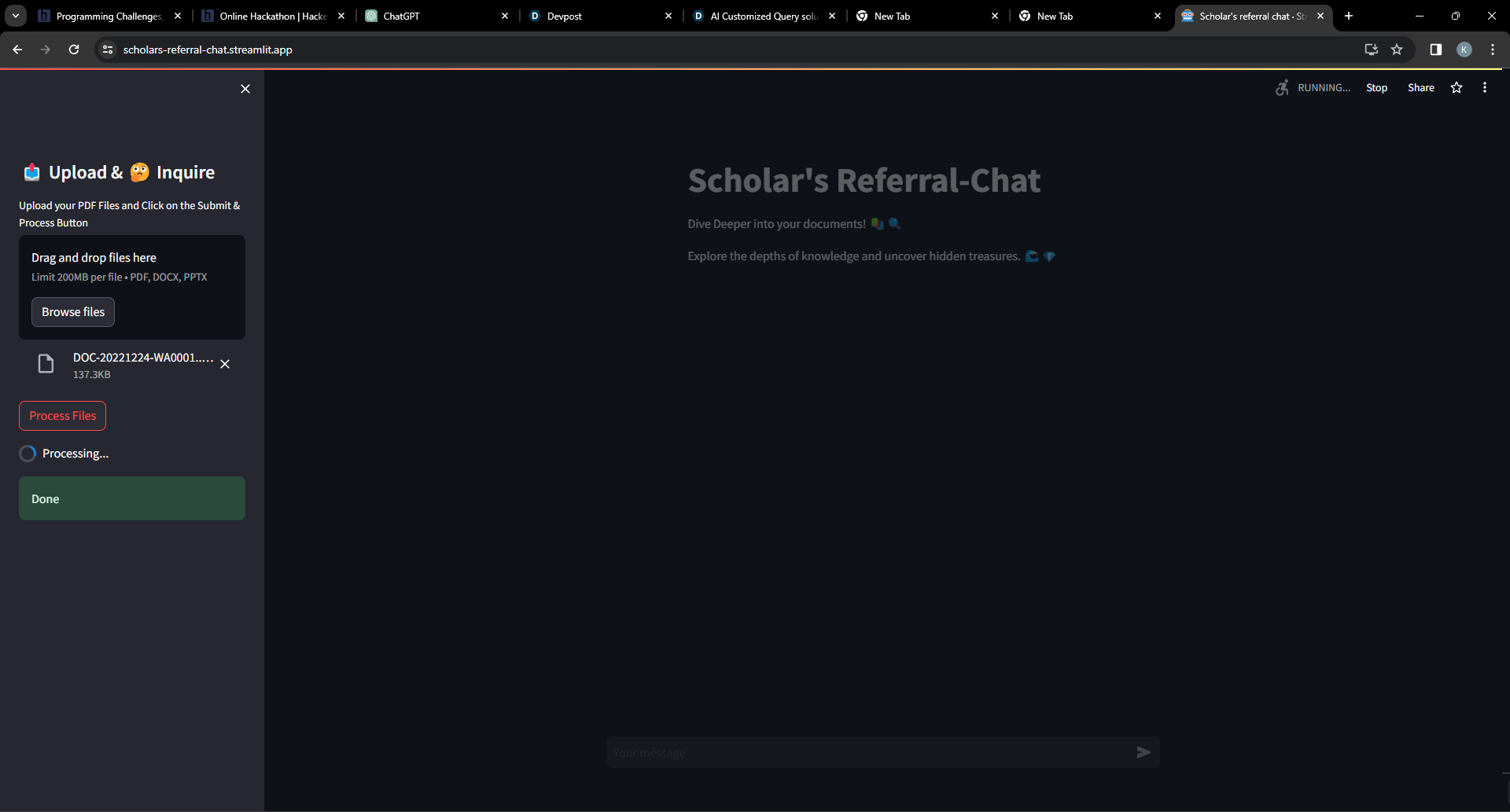
1) upload the document
-
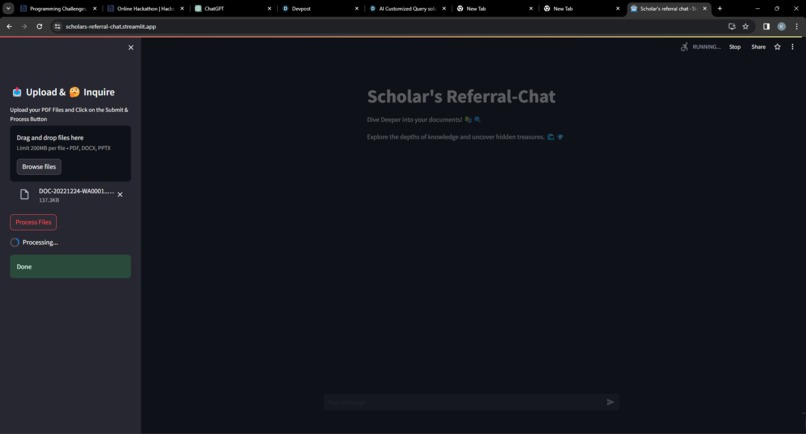
2) process the document
-
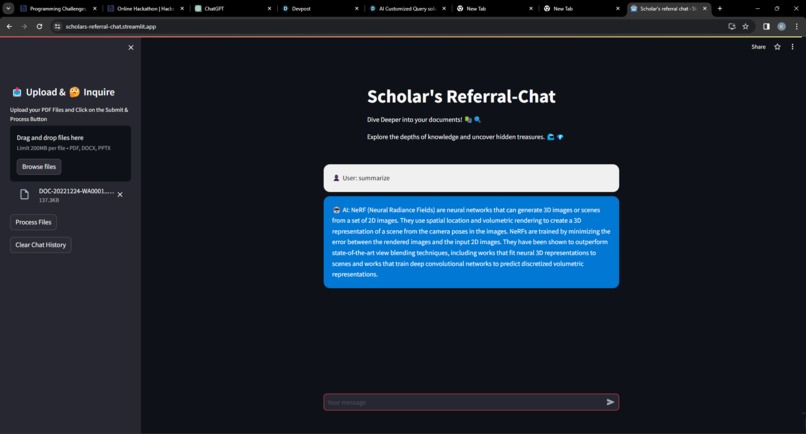
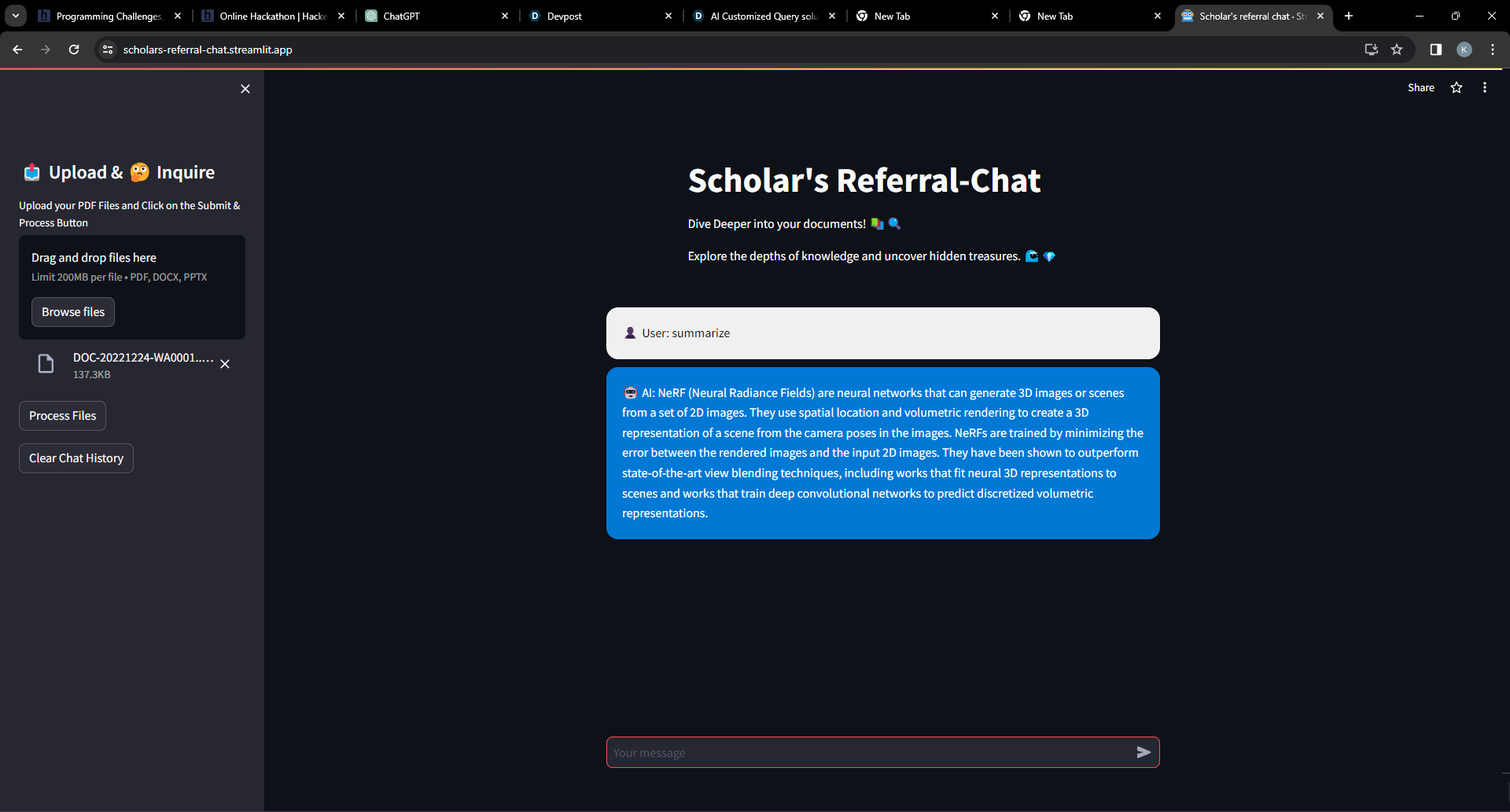
3) Ask the question about the pdf and response comes as from the pdf
Inspiration
The inspiration for our project, the AI Customized Scholar's Referral Chat, stemmed from observing the struggles that researchers, scholars, teachers, and educational institutions face when trying to navigate through vast amounts of documents. We wanted to create a solution that would empower users to effortlessly extract personalized information from various sources, making their research and educational endeavors more efficient.
Links for Inspiration:
- Geoffrey Hinton's Talks
- Yoshua Bengio's Papers
- Yann LeCun's Profile
- spaCy Documentation
- Transformers Library
- TensorFlow Official Website
What it does
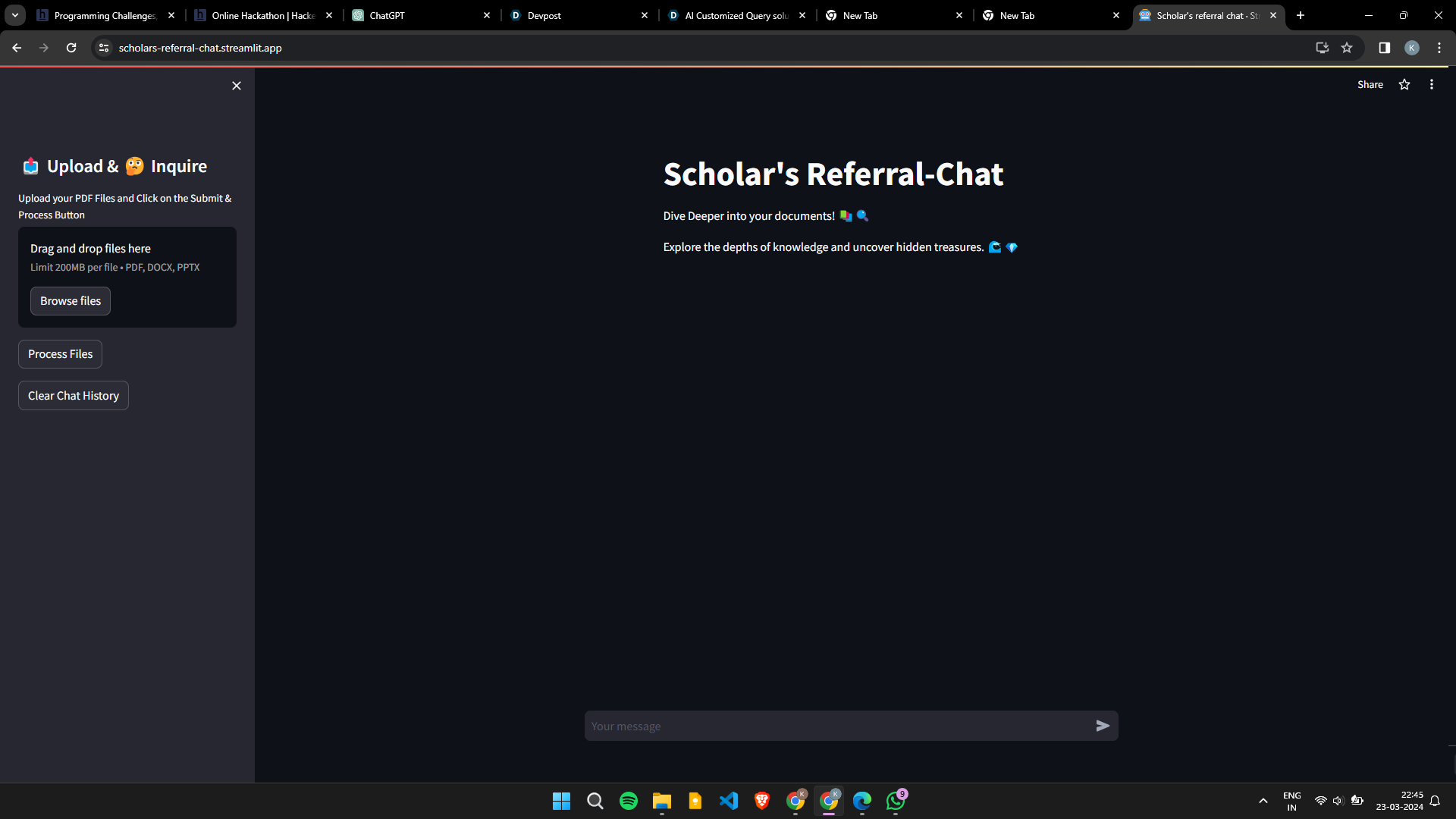
The AI Customized Scholar's Referral Chat is a sophisticated AI-powered tool designed to process natural language queries and provide tailored responses from a diverse range of scholarly documents. Users can input their questions or topics of interest, and the referral chat leverages advanced algorithms to sift through academic papers, research articles, and educational materials, extracting relevant information, and presenting it in a coherent manner. Whether it's finding specific research papers, exploring scholarly literature, or discovering related work, this tool aims to streamline the information retrieval process for academics.
How we built it
Building the AI Customized Scholar's Referral Chat was a multidimensional endeavor that involved harnessing cutting-edge technologies in natural language processing (NLP) and machine learning. We utilized libraries such as spaCy, Transformers, and TensorFlow to develop the core functionality of the referral chat.
The first step was to curate a diverse dataset of academic papers, research texts, and scholarly articles spanning various domains. This dataset served as the foundation for training our AI model to understand and interpret natural language queries accurately in the scholarly context.
Next, we implemented a robust pipeline that involved text preprocessing, feature extraction, and fine-tuning of the NLP model. We optimized the system for both precision and recall to ensure that users receive accurate and comprehensive results for their scholarly queries.
The front-end interface was designed to be user-friendly, allowing researchers and scholars from different disciplines to easily interact with the referral chat. We integrated the back-end AI engine with the front-end interface to create a seamless user experience tailored for academia.
Challenges we ran into
Throughout the development process, we encountered several challenges that tested our problem-solving skills and perseverance. One of the main hurdles was training the AI model to handle a wide variety of scholarly query types effectively. Achieving a balance between precision and recall required extensive experimentation and fine-tuning of hyperparameters specifically for academic literature.
Another challenge was optimizing the referral chat for real-time performance, especially when dealing with large volumes of scholarly text. We had to implement efficient algorithms and parallel processing techniques to ensure timely responses to user queries.
Additionally, ensuring the system's scalability and reliability posed significant challenges. We had to architect the referral chat in a way that it could handle increasing user demands from the academic community without compromising on speed or accuracy.
Accomplishments that we're proud of
Despite the challenges, we're proud to have developed a functional AI Customized Scholar's Referral Chat that has the potential to make a significant impact in the academic research sector. Our referral chat can efficiently retrieve tailored information from vast repositories of scholarly documents, saving researchers and scholars valuable time and effort.
We're also proud of the user-friendly interface we've created, which enables seamless interaction with the AI system specifically designed for academia. The positive feedback we've received from early testers within the scholarly community has been incredibly encouraging and validates our efforts.
What we learned
The journey of building the AI Customized Scholar's Referral Chat has been a tremendous learning experience for our team. We deepened our understanding of NLP techniques, machine learning algorithms, and model optimization strategies in the context of academic literature.
Moreover, we gained insights into the importance of user-centric design within the academic community and the significance of usability testing for scholars. Understanding the unique needs of researchers and scholars and incorporating their feedback has been instrumental in refining our referral chat for scholarly use.
What's next for AI Customized Scholar's Referral Chat
Looking ahead, we have ambitious plans to further enhance the capabilities of the AI Customized Scholar's Referral Chat to better serve the academic community. Some of our upcoming goals include:
- Improving Query Understanding: Continuously refining the AI model to better understand complex and nuanced scholarly queries.
- Expanding Document Sources: Integrating with additional scholarly databases and repositories to offer a wider range of academic information sources.
- Enhancing User Interactivity: Adding features such as citation suggestions, literature review assistance, and personalized research recommendations to make the referral chat even more valuable for researchers and scholars.
- Collaborating with Institutions: Partnering with universities, research institutions, and libraries to tailor the referral chat to their specific needs and integrate it into academic workflows.
- Ensuring Accessibility: Making the referral chat accessible to a global academic audience by supporting multiple languages and ensuring compliance with scholarly accessibility standards.
We're excited about the potential of the AI Customized Scholar's Referral Chat to revolutionize how researchers and scholars access and interact with scholarly information. Our team is committed to ongoing innovation and refinement to create a tool that empowers academics in their pursuit of knowledge and research.
Built With
- ai
- chromadb
- flask
- generativeai
- langchain
- natural-language-processing
- python
- streamlit


Log in or sign up for Devpost to join the conversation.